
By Andy Frombolton
Underpinning Project Darwin is the ECB’s belief that ownership and accountability is key to the future growth and success of women’s cricket.
But whether a regional or a county-based structure is better will be moot unless the standard of cricket is high enough to attract tv deals and spectators. And with considerable extra funding being put into the women’s game and an ever-increasing cohort of professionals, expectations are quite rightly growing against a rapidly-rising datum.
In many areas the results of increased funding are apparent; there’s an abundance of quality bowlers, both slow and fast; several keepers are making their case for higher honours; and the quality of fielding is so much higher than it was even a few years ago.
But for all the investment in regions and academies, and despite hundreds of talented youngsters passing through the academy system, the same trend is simply not evident in terms of batting.
To illustrate this point, consider the highest run scorers in the domestic T20 competitions since 2019 (NB there were no games in 2020).
For each year, the table below shows the total number of batters scoring more than a specified number of runs* and lists all ‘young’ batters (aged under 25) meeting the criterion for the first time (hence ‘emerging batters’) in that year plus the number of runs they scored. The table then tracks their run scoring in subsequent year to distinguish those who have become consistent run scorers and those for whom this was a ‘flash in the pan’.
(* The criterion is 75 runs for 2019-2023 and 150 for 2024 to reflect the higher number of games played.)
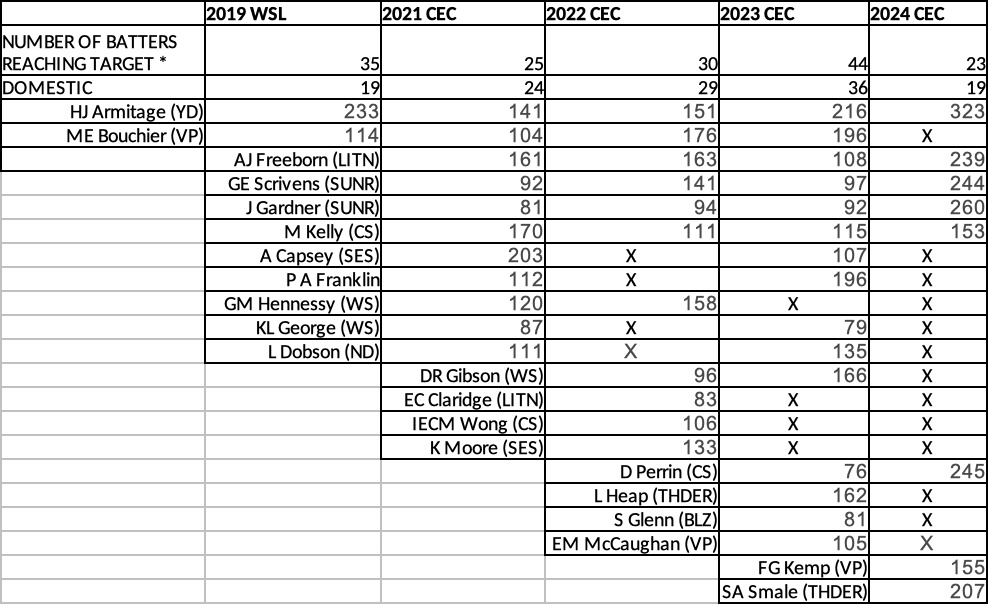
Armitage and Bouchier stand out for consistency; one deservedly achieving England honours and one seemingly destined not to. Of the 2020 cohort, Freeborn, Gardner and Kelly have all gone on to the epitome of a cricket professional: reliable and consistent. But all these players are primarily products of their county age group systems and pre-date the professional era. The one ‘new generation’ name is that of Scrivens.
Thereafter, emerging batting talent diminishes in inverse proportion to the increasing professionalisation of the game. From 2020 and 2021 only Gibson probably has the potential to be a genuine (bowling) all-rounder whilst Wong, Glenn and Heap should be more accurately categorised as bowlers who can bat a bit.
Only in the last 2 years do we see 3 names: Perrin, Smale and Kemp who appear to have the potential to become top class batters; plus of course Alice Capsey.
So after 5 years of academies and considerable investment, we end up with a list of just 5 possible long-term England batters.
This doesn’t seem like a good return. There are only 2 explanations: (1) The talent doesn’t exist, or (2) the academies and the regions have failed to develop that talent. The first is self-evidently not true – there’s a huge amount of talent on display in every CAG match.
So, what’s going wrong?
Players are selected far too early. Latent and slow-developing talent is squandered.
With increased prize money on offer, teams (understandably) prioritise winning over player development. And in most teams this means stuffing your batting top order with proven players who can ‘do a job’. The trouble with this approach is that the vast majority of these players have plateaued in terms of skills (as evidenced by their run scoring and strike rates) and consequently the game as a whole isn’t evolving. Younger players either get shoved down the batting order or don’t get picked at all.
What can be done about it?
The ECB’s plans to address this (Tier 2, etc.) remain vague whilst their ongoing refusal to discuss continuing to run an amateur women’s team in each Tier 1 county will see hundreds of talented girls and young women give up on the sport and huge amounts of talent will go undiscovered.
It’s a simple fact that you get better, faster by playing against people who are better than you. The great former players learnt their game playing “men’s” cricket (Lydia Greenway for instance captained a premier club and scored a century in premier league cricket) but now talented young players are ensconced in the academy set-up from an early age with their workload managed and often banned from playing club cricket. The best batters need to play against the best bowlers possible – which for the foreseeable future means Saturday club cricket.
The Academy players similarly need to be challenged. One easy way would be for them to enter a mid-week T20 league. (Southern Vipers did this some years ago – and the team went on to win that league.)
Playing for a team in e.g. New Zealand over the winter might be fun, but it’s essentially the same issues outlined above with a different accent. The over-dominance of slow bowling in the women’s game will remain a problem until players learn how to play it better. (An often-barely-spinning ball delivered at 45mph should be going to the boundary, not picking up wickets.) Similarly, going on a 10-day pre-season tour might be good PR but it’s a costly indulgence especially when all the team does is play their domestic rivals in a warmer climate. Instead, why not form a partnership with a school in Sri Lanka and send 5 batters to spend 4 months there – coaching during the day and then getting 2 hours in the nets against the best bowlers every afternoon. (This would also help with life skills and getting coaching qualifications for post-career.)
And finally put some youngsters up the order. If they fail, then the dependable experienced players can come in and restore order. But if they come off, we’ll see higher scores and – hopefully – if this analysis was repeated in a few years far more new names appearing.
 CRICKETher
This article is absolutely bang on with regards young batters, speaking as a father of one in the system I couldn’t have put it better myself.
Far too many bits and pieces cricketers, mainly bowlers that can bat a bit, with so little specialisation of coaching in developing those with batting a their primary skill and huge inconsistency in selection.
These young batters don’t fear failure, they fear the consequence of failure as they are always shifted out of teams/squads and down batting orders for the more experienced “senior” players.
The Sunrisers have got it right with Grewcock/Surenkuma, two youngsters that have been consistently backed in specific roles and are now performing.
Sent from my iPad
LikeLike
Nice idea for an article Andy and well written, but I have a few counter points for you.
*Basing these stats purely on runs and not strike rates (or some weighted combination of both) risks misplacing your conclusions.
As I’ve argued on here before, and to summarise my point, English cricket’s damaging obsession with the Ashes and “keeping up with Australia” at the expense of almost anything else, has led to our batters focussing more on strike rate and quick runs rather than aggregate of runs, sticking around at the crease or seeing a match home rather than getting out early. This issue filters down to domestic level, coaching and selection. Solid players are overlooked, as are the technical flaws of power hitters if it’s believed rightly or wrongly that the batter in question can still score quick runs.
*Most of the emerging players you mentioned aren’t even in the England side anyway. Which reinforces my point that who the England management are looking for, and who they maybe should be looking for aren’t necessarily aligned.
*There are loads of players in all the domestic sides with masses of potential for becoming one of these elusive emerging batters. To name at least 2 from each side (under 30):
Sparks: Perrin, George
Diamonds: Marlow, Armitage
Stars: Scholfield, Jones
Vipers: McCaughan, Norgrove
Storm: Corney, Wraith
Sunrisers: Scrivens, Grewcock
Blaze: Claridge, Kelly
Thunder: Smale, Threlkeld
*There are even batters emerging within the England team itself (Dean, Ecclestone) who miss a lot of the domestic game.
*Have you thought about performing the same analysis for other international sides, and how would they fare?
*I guess my overall conclusion is that the results we see have be viewed through the lens of the current environment. Some coaches would argue that they are getting exactly what they want from young players, but at what price? I think there is no long term consistent development strategy in place and until that changes we will see more players playing quick cameos rather than big innings.
LikeLike