OPINION: An ‘Alternative Universe’ England T20 Team

By Andy Frombolton

Following the announcement of the England T20 squad, my mind turns to a possible counterfactual universe.

Several members of the current England squad enjoyed a considerable run in the team before eventually repaying the selectors’ faith; whilst conversely, more recently, a significant number of players have been picked and subsequently jettisoned without being given a decent run to prove (or disprove) the wisdom of their selection.

As we approach the T20 World Cup, I thought therefore it might be fun to choose a team of uncapped players who – had they been picked several years ago and given similar opportunities – might now be mainstays of the England T20 squad. I mused with a ‘less than 10 caps’ cut-off point as I’d like to have been able to pick both the Smiths (Bryony and Linsey), but the final selection criterion is binary, i.e. a player cannot have played a single match for England to be considered.

In picking the team, I also sought to address some of the weaknesses evident in many national squads, such as the lack of top-order left hand batters and too many weak fielders. 

I’ve also chosen not to be bound by conventional team structures; meaning, for instance, that my team only has 1 opening quick bowler since there wasn’t an obvious second option with good enough stats to justify their inclusion. 

But the team does have an incredible 10 genuine bowling options including 2 leggies (Levick and Armitage), 2 offies (Morris and Adams), plus Kelly’s ambidextrous offerings; ideal considering that the vast majority of batters, even at international level, score far more slowly off slow bowling. The team bats down to 9 with the option to use Gibson and/or Norris as sacrificial opening pinch-hitters, meaning Adams may need to drop herself down the batting order if the innings gets off to a good start.

The XI:

  • Eve Jones
  • Bess Heath (wk)
  • Georgia Adams (capt)
  • Aylish Cranstone
  • Marie Kelly
  • Holly Armitage
  • Dani Gibson
  • Naomi Dattani
  • Fi Morris
  • Tara Norris
  • Katie Levick

“In counterfactual history, nothing is certain” (Robert Dallek).

Did I overlook any obvious candidates (and who then gets left out)? Conversely who should I have left out (and who gets their place instead)? Share your thoughts!

WBBL08: Lessons Learnt and Trends – Everything Else

Part 3 of 3 in a series reflecting on WBBL08 by guest writer Andy Frombolton

Who gives a (bat) flip?

Received wisdom is that batting second in T20s constitutes a considerable advantage. However this presumes that teams are good at chasing. And also that team strengths are broadly equivalent .

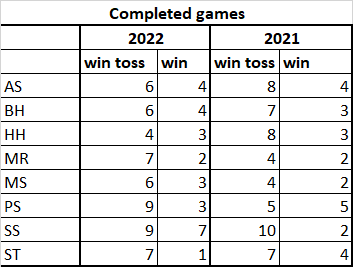
What’s the WBBL data when teams win the toss?

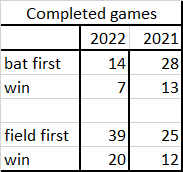
Thus on average teams win half the time whether they bat first or second but behind the headline figures are some big differences by team in terms of strategy and success. For example, in 2022, Renegades won the toss 7x, fielded 7x and lost 5x, whilst Stars won the toss 9x and fielded first every time (3 wins, 3 losses, 3 NR).

If any team displays a strong preference, it’s fairly obvious what the oppositon is going to do when they win the toss. Also, if a team’s whole strategy is built e.g. around chasing, how will they ever develop their ability to post a score?

Most interesting is Sixers’ transformation from the least-successful flippers to the best. In contrast, Scorchers went from winning every game when they won they toss last year to losing two-thirds in 2022!

The bat flip doesn’t really make much of a difference – the best teams tend to win whether they bat or bowl first and vice versa.

All-rounders

Professionalism will invariably decrease the viability of someone being an all-rounder since to be a world-class batter or bowler will require specialism for all but the most gifted.

Hence genuine all-rounders will be increasingly rare and conversely desirable in team selections.

How many players make it into the top 25 lists (most runs and most wickets), and who are they? Some of the answers may surprise …

Long term presence Devine had a poor season – a SR of less than 100 (compared to a usual 128+) and just 8 wickets. McGrath just missed out on batting honours (26th) but injury precluded her bowling as much as previous years.

Knight (2020), like Edwards and Root before her as England captains, has tended to underbowl herself. It’ll be interesting to see whether she bowls even less after her hip-surgery which would be a great shame since she’s an (undervalued) all-rounder.

Career resurrections – Perry and Healy

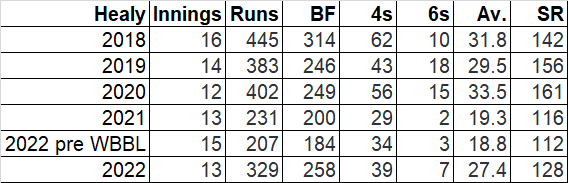
Going into this tournament the T20 careers of both these great players looked like they were in terminal decline when you looked at their WBBL performances. Perry didn’t make the CWG squad but found some form in The Hundred, whereas Healy’s miserable WBBL07 form continued right through until this tournament.

(2022 stats include all T20s for Australia and The Hundred)

Beyond the treat for all cricket fans of seeing these two on the world stage for a bit longer than they might have feared, the broader message is that older players can adapt their games for the modern game.

As discussed in Part 1 Perry, Jonassen and Kapp are great examples of how many older players could be much better deployed in the middle/late overs using their great game experience to pace and judge the innings and with the freedom to play which this new role could bring.

Wicket-keeping standards

In the women’s T20 game, keeping is as much about keeping batters in their crease as taking stumpings but far too few keepers appeared confident in going up to the stumps for the medium pacers. Healy (and previously Sarah Taylor) repeatedly showed how it limits many batters’ options.

Overall though too few of the keepers are athletes – tending to remain fairly static and waiting for a return over the top of the stumps. Keepers need to ‘own’ the area behind them 20 degrees either side of the stumps and whilst comparisons with the men’s game aren’t always relevant in this instance there’s no reason why the best women keeper can’t emulate the standards of the best male keepers who regularly beat fielders not wearing pads to snicks and tickles heading for the boundary.

Heaven help the opposition when Australia finally select the Harris siblings

Their stats say it all.

Is there any other country where Laura Harris wouldn’t be in the national team by now?

Pedestrian powerplays

The average figures were:

  • 23.9 for 1 wicket 1st innings
  • 23.6 for 1.1 wickets 2nd innings

In the first innings, 6 of the teams hovered around the average. Sixers were the only team with a materially better average PP (27) and Thunder the only team with a materially worse average PP (20).

In the second innings the stats were slightly more spread out, Hurricanes and Thunder both had materially better average PP (28). Heat had a materially worse average PP (19). But the surprising outlier in all the data was Sixers with an average PP of just 16!

Overall, these figures are far too low. The PP should be the launchpad for the innings but as discussed the batters either don’t have the skills (or feel they can take the risk) to take on the bowlers and take advantage of the fielding restrictions. The answer is simple – either the current batters need to change their mindset or teams need to deploy different openers.

And finally … the ultimate TFC

In the shorter format there will inevitably be squad members who don’t get the opportunity to do much with the bat or ball, but one player’s figures stood out above all others this year. Angelina Genford of the Sixers: 15 matches, 3 innings, 7 balls, 4 runs and 3 separate bowling spells totalling 4-0-36-1.


WBBL08: Lessons Learnt and Trends – Bowling

Part 2 of 3 in a series reflecting on WBBL08 by guest writer Andy Frombolton

Teams posting 140 or less lose 3/4 of their games. Hence any bowling attack which can regularly restrict the opposition to this figure will win the vast majority of games. Chasing down 140 requires a collective SR of just over 110 (well within the capability of even the most pedestrian batting line up) whereas restricting teams to such a low total is much harder.

Hence this article posits that when assembling a team the priority should be securing the best bowling unit.

This is the total opposite of what happens today, with teams competing for the best domestic and international batting talent and generally being far less interested in ‘pure’ bowlers (especially overseas bowlers). The other noticeable theme is how many uncapped players feature in each year’s Top 25 wicket takers list (or conversely how often ‘marquee’ names disappoint).

YEAR NUMBER OF FORMER AND CURRENT* INTERNATIONAL PLAYERS IN TOP 25 WICKET TAKERS
2022 AUSTRALIAN 8
OVERSEAS 4
2021 AUSTRALIAN 10
OVERSEAS 3
2020 AUSTRALIAN 7
OVERSEAS 7
2019 AUSTRALIAN 13
OVERSEAS 3
2018 AUSTRALIAN 7
OVERSEAS 5

* as of the relevant season

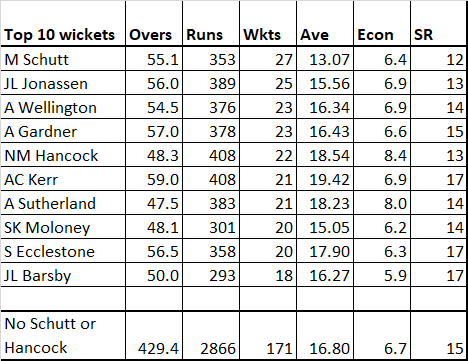
So, who were this year’s highest wicket takers?

What then constitutes a good bowling unit?

The first point is that, as noted above and unlike batting, international bowlers often don’t deliver the sort of performances expected. The stats are damning – in the past 5 seasons only 4 international bowlers (as opposed to all-rounders) have made it into the table of ‘Top 25 wicket takers’ (Tahuhu 2018, Glenn and Ismail 2020, Ecclestone 2022) (And Ecclestone should be an all-rounder!). So unless a team can secure the services of one of the top 3-4 overseas bowlers in the world the evidence suggests they’d be better off saving their money.

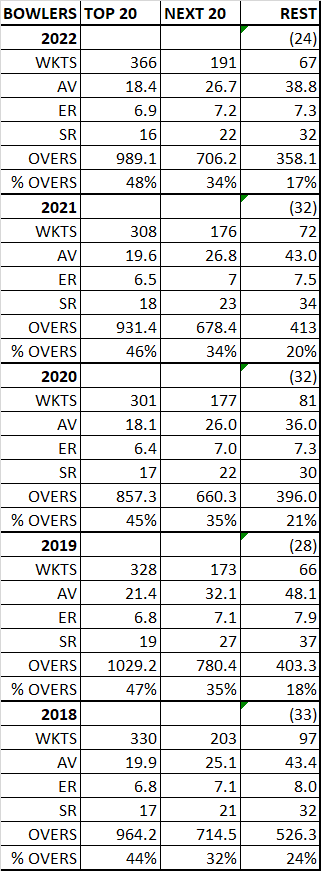
Equally interesting are the Economy Rates (ERs). Shouldn’t the ‘best’ bowlers have better ERs than the other bowlers? In fact, the ERs of the top 20 wicket takers, the next 20, and of all other bowlers are virtually the same and converging. In the past 3 years, the best bowlers are going for slightly more runs, the ‘change’ bowlers are holding steady and the bits’n’pieces bowlers are bowling less but becoming more economical.

Running counter to the men’s T20 game (where slow bowlers dominate the best ER tables and faster bowlers the best SR tables) the 2 best* (*rationale follows) bowling attacks in this year’s tournament (Adelaide Strikers and Brisbane Heat) employed very different approaches.

Adelaide Strikers: Schutt (fast), Wellington (slow), Barsby (slow), D Brown (fast) and Dottin (fast medium).

Of these, the hitherto-unspectacular Barsby was a revelation and is additionally interesting for being one of the new breed of ambidextrous slow bowlers (her occasional left arm accounting for Alice Capsey in one game).

Brisbane Heat: Jonassen (slow), Hancock (medium), A Kerr (slow) and Sippel (medium).

More important seemingly than the composition of the attack is that bowlers know their role and learn to bowl as a unit, which is what makes Adelaide Strikers truly unique – their 5 main bowlers bowled 92.6% of their overs i.e., the same 5 players bowled their full complement of overs in virtually every game. The closest analogy I can think of is the all-conquering Gloucestershire men’s side of the early 1990s. Similarly Heat had 4 bowlers who delivered 72.1% of their overs. Contrast this to Sixers whose core 3 bowlers always bowled their full allotment (59.4% of overs) but the bulk of the balance was shared between 4 bowlers. Sixers might counter that their approach demonstrated flexibility and greater depth in their bowling attack.

This is another area where performances in the women and men’s game diverge and hence so should tactics. In the men’s game, the best way to slow down the run rate is to get the top batters out (such is the difference in the SR of the top 4 batters compared to the next 4) which means teams need strike bowlers to perform this role (their ER being of less concern), but in women’s cricket (as discussed in the previous article) overall batting SRs are lower and hence dismissing a top batter has less impact (quantum) on a team’s eventual score.

Thus if bowling SR was the key determinant of an opposition’s score then Sixers might have a claim to have the most penetrative bowling unit. Sixers have 5 of the 23 bowlers (≥5 wickets) with a SR<20 with all the other teams having 3 (except Renegades which had 0, which perhaps explains why they conceded the 1st, 2nd and 4th highest scores in this year’s tournament).

But if instead keeping the run rate down is the priority, then a team needs a bowling attack able to do this consistently in all scenarios. Strikers’ top 4 bowlers had a combined ER of 6.4; far better than any other team and only once did a team batting first get on top of them (Stars’ 186, 3rd highest score of this season), otherwise they conceded 4 scores in the range 151-154 and 4 in the range (101-114). And when defending Strikers never got hit for more than 139.

Based on consistency and dependability, Strikers were the best bowling team and thus deserved champions.

The silver bowling award goes to Heat who bowled well in the first innings (only once conceding more than 140) but conceded more than 156 four times bowling second. It was their potential to wilt under pressure (not helped by some poor fielding at key moments) which cost them games.

Sixers also got hit for above par scores five times (three times bowling first and twice bowling second, although they went on to win 4 of these games so could contend this was ultimately irrelevant. The counter argument is that no team, however good their batting line-up, can afford to concede these sort of scores.) Equally telling was the three times they got taken apart in the death overs and only clinched victory each time courtesy of some equally-brutal hitting in their final overs. (Game 1, Heat hit the last 2 overs for 18. Sixers hit 19 off 11 balls; Game 42, Scorchers hit 22 off the last 2 overs, Sixers hit 23 off 12 balls; and Game 49, Heat hit 37 off the last 2 overs (and 47 off the last 3) and Sixers hit 28 (and 41). Hence their honourable bronze position in these bowling awards.

In concluding, what therefore would be the perfect bowling attack look like?

Look again at the list of top wicket takers. The stats say it all. Slow bowlers dominate the wicket-taking tables – 8 of the top 10 (with a collective ER of 6.7 and a SR of 15).

l

So team selection should start with a fielding set up capable of supporting your bowlers – a superb keeper and a minimum of three fielders who are great in the deep (trading a degree of run scoring ability for fielding prowess if necessary).

You need a fast bowler? Schutt, D Brown, Sippel or Strano. No other fast bowler has appeared in the Top 25 for 2 years in a row so you’re just taking a gamble on any other selection having a good year.

Add 1 all-rounder (more on that subject in the third article)

And finally 3 slow bowlers (or even 4 so you don’t even need to play your fast bowler when conditions don’t suit).

And then pick some batters!

WBBL08: Lessons Learnt and Trends – Batting

Part 1 of 3 in a series reflecting on WBBL08 by guest writer Andy Frombolton

The average 1st innings score in this year’s WBBL (in complete games) was 145, up slightly on 2021 (137).

Teams posting 144 or more in the first innings won 22/29 times whilst teams scoring 160 or more won 14/16. But the distribution of above-par 1st innings scores was highly skewed – only 3 teams managed it more than twice: Heat (7 wins from 8); Sixers (6 wins from 7); and, Hurricane (3 wins from 5). In contrast champions Adelade Strikers never posted more than 147 but defended 4 scores in the range 140-147 (twice against the Sixers) and their highest score in 6 successful chases was only 156.

The most obvious conclusion is that it’s bowling units which win games, not batters. Nevertheless batters are the focus of this first article.

There were 24 first innings scores of 150 or more (compared to 17 last season) but more interesting is who’s scoring the bulk of these runs. Intuitively you might imagine it would be the players with international experience – and this certainly used to be the case.

YEAR NUMBER OF FORMER AND CURRENT* INTERNATIONAL PLAYERS IN TOP 25 RUN SCORERS (*as of the relevant season)
2022 AUSTRALIAN 7
OVERSEAS 10
2021 AUSTRALIAN 8
OVERSEAS 10
2020 AUSTRALIAN 8
OVERSEAS 7
2019 AUSTRALIAN 10
OVERSEAS 13
2018 AUSTRALIAN 11
OVERSEAS 10

Slowly, uncapped players are being given, and are seizing, their opportunities. Disappointingly however this cohort (extensively coached in power hitting and 360 degree shot making) isn’t having the impact on run rates which might have been expected.

Top 25 run scorers WBBL 2022

(Orange – Australian former and current Internationals. Blue – former and current Overseas Internationals)

With the exception of Laura Harris, the uncapped batters are scoring their runs at about the same rate as the international players they’re incrementally displacing.

YEAR TOP 20 RUN SCORERS 20 NEXT MOST RUNS REST
2022 RUNS 6511 4274 3109
% RUNS 47% 31% 22%
SR 119 110 102
2021 RUNS 7301 3560 2231
% 56% 27% 17%
SR 116 103 95
2020 RUNS 6844 3383 2070
% 56% 28% 17%
SR 115 101 97
2019 RUNS 8457 4063 2497
% 56% 27% 17%
SR 121 108 101
2018 RUNS 7805 4452 2853
% 52% 29% 19%
SR 124 109 100

Most teams pack their top order with dependable batters who can be relied upon to get their team to the sort of total which will win most games (144 this year, as noted earlier).

But 144 only requires a collective SR of around 112 (assuming 10 extras per innings).

So, if you’re a former international or a fringe player seeking to secure a WBBL or Hundred contract why take risks trying to score more quickly – even against weaker bowling attacks – when a pedestrian 112 will be seen as a good innings? With this attitude team scores aren’t going to grow.

In their defence, the top order could cite some statistics which seemingly justify their cautious approach:

Bat Result % runs (off the bat) scored by batters 1-4
1st Win 75.00%
Lose 53.00%
2nd Win 77.00%
Lose 54.00%

This seems to suggest that the team won’t win unless the top order scores the bulk of the runs. But a lot of these victories batting second were in pursuit of low scores and hence inflate the average contribution of the top order. Watching teams slowly overhaul below-par scores was a scenario seen far too often this tournament.

More relevant then is to see how the top batters cope when presented with a more challenging target. If you take the average of a team’s 3 highest first innings scores as an indicator of what they’re capable of when they play well (‘batting potential’, ‘BP’) there were only 11 occasions (in full length games) when teams exceeded their BP batting second and only 4 times did this result in a victory.

The conclusion is that most teams simply don’t know how to chase anything above an average score – primarily because their top order is full of established players playing ‘old fashioned’ cricket. Powerplays are squandered and acceleration is too slow; leaving the middle/lower order batters too much to do if the top order fail.

Comparisons to men’s cricket aren’t usually helpful, but sometimes they can serve to shine a light on issues. Looking at 2021 Blast data, the average SR for the top 4 run scorers in each team was 141, 128 for the next 4 and 113 for the rest. This raises two questions: Firstly, why aren’t the best women batters able to achieve SRs more akin to the best men batters (Mandhana and Wyatt dispel any argument that physical size is the primary explanation) and, secondly, why are the tails so long? If batters 6 onwards can barely strike at 100, then it’s little wonder than the top order batters in most teams play so cautiously (knowing that if they fail, their teams have little chance of success).

Let’s look at this year’s (4 over) Powerplays. The average PP (both innings) was 24; equivalent to a SR100 (with only 2 fielders out). That’s not good enough.

Consider 6 hitting. There were 235 6s hit in this year’s competition but just 13 batters accounted for half of them. 46 batters didn’t hit a single 6 (including 4 of the top 25 run scorers) whilst a further 16 hit just 1 (including another 3 of the top 25 runs scorers). This means that 7 of the top 25 most prolific run scorers can’t clear the ropes. Perhaps they don’t take the aerial route? Well, 8 of the 25 (including 5 internationals) score less than 50% of their runs in boundaries – which is the average for the top 85 batters!

Why is this important? Because boundaries win games. In comparison the number of singles has barely any impact. (The same hold true in the men’s game.) The one exception was the Sixer’s (record) 66 singles to beat Hurricanes despite scoring 5 fewer boundaries. Next best (65) helped propel Stars to an truly-underwhelming 114 against the same opposition!

In this year’s WBBL, 42 of the 52 full length games were won by the team which equalled or hit more boundaries than the opposition. (Regarding the other 10 games, in 4 of these the winning team only hit 1 less boundary.)

The players who can hit boundaries are coming in too late, with too much to do.

Kudos then to the handful of players in the top 25 run scorers with a SR>120 and a boundary % greater than 55%.

PLAYER RUNS AV SR %4&6
L Harris 270 22.5 205 84.00%
A Gardner 339 28.25 151 63.00%
EA Burns 295 32.77 145 63.00%
DN Wyatt 263 20.23 129 64.00%
A Capsey 259 25.9 129 58.00%
AJ Healy 330 25.38 125 60.00%
BL Mooney 434 43.4 121 57.00%
EA Perry 408 40.8 120 56.00%

The stand out names? Harris, Gardner and Perry; because they bat down the order after the top order have chewed up lots of balls (scoring slowly).

Looking outside the top 25 runs scorers provides a vision of a different future. There were 6 other batters with more than 75 runs and a SR above 120:

PLAYER SR Boundary % Av BF per innings
Flintoff 166 60.00% 10
Brown 162 67.00% 11
Ecclestone 159 56.00% 9
Kapp 143 66.00% 16
Jonassen 135 49.00% 9
Johnston 123 68.00% 7

How then to hit bigger scores? The starting point has to be to differentiate between scoring rates which are capped by a player’s skill levels and those which derive from the position they bat (top 4 dependency).

The (few) international top order batters who can take advantage of the powerplay must open, but partnered by players with defined roles to take on the bowlers and the limit on out fielders. ‘Success’ has to be to be measured in terms of SR, not average. Imagine the team willing to open with batters like Laura Harris (batting for 4 overs with field restrictions instead of just 2 during the ‘Surge’), Flintoff or Ecclestone with complete freedom from ball 1. Some games it will come off and most it won’t. When it does the team score will surge above the 145 and the team will probably win. In those games a team’s experienced International players will come in later – but with a different role (akin to that which Kapp and Jonassen perform). And when your hard hitters fail, they won’t have wasted many balls and the more traditional players can rebuild and aim for a defendable 140.

OPINION: Central Contracts – Lessons Learnt and Possible Options

The next round of central contracts is to be shortly announced and will run from November 1st. Securing one of these contracts is primarily about recognition, but it would be naïve to ignore the associated financial rewards.

The current batch of 17 central contracts was awarded following what the ECB described as “a comprehensive and objective process” which saw all the existing contracts renewed (except Kirstie Gordon, replaced by Sophia Dunkley).

A positive spin on this would be that this demonstrated that, upon fair review, the existing squad members were adjudged to still be the best players in the country. A negative spin would be that, despite all the money and resource invested in the regional academies and the KSL, the system had produced only one cricketer capable of displacing any of the incumbents.

Less easy to justify was the usually-long duration of these contracts – 18 months; timed “to align with the professional contracts at the eight regional teams”. The first (obvious) observation is that 6-month contracts could also have achieved the same alignment. More crucially, by awarding 18-month contracts the ECB was perpetuating the ‘closed shop’ for two more seasons; committing to the same group of players regardless of their individual form or evolving team strategies whilst also ruling out the ability to award a central contract to anyone else for this entire period. Effectively nothing anyone did during 2021 (including the first season of The Hundred) could secure them a central contract whilst, conversely, holders of a central contract were guaranteed their status (and pay) regardless of performances or their level of involvement in England matches.

So, what happened?

Games During Contract Period

  Tests ODI T20
Tammy Beaumont 3 25 8
Katherine Brunt 2 16 15
Kate Cross 3 23 0
Freya Davies 0 5 10
Sophia Dunkley 3 25 19
Sophie Ecclestone 3 25 19
Georgia Elwiss 1 0 0
Sarah Glenn 0 3 19
Katie George 0 0 0
Heather Knight 3 23 7
Amy Jones 3 25 19
Nat Sciver 3 21 16
Anya Shrubsole 2 16 4
Mady Villiers 0 0 5
Fran Wilson 0 0 0
Lauren Winfield-Hill 2 12 0
Danni Wyatt 0 22 19

Obviously no one would expect teams to be chosen solely from the centrally-contracted cohort – but the right squad of 17 should contribute the vast majority of any team.

In fact, 9 players without central contracts were called up to the various teams; winning 93 caps (just under 20%).

Games During Contract Period

  Tests ODI T20
Lauren Bell 1 3 2
Maia Bouchier 0 0 14
Charlie Dean 1 19 1
Alice Capsey 0 3 10
Alice Davidson-Richards 1 2 0
Freya Kemp 0 2 9
Emma Lamb 1 8 1
Bryony Smith 0 0 5
Issy Wong 1 3 8

In addition, Emily Arlott would have made her Test debut if she hadn’t caught Covid and it’s reasonable to surmise that Tash Farrant would also have played if she hadn’t been injured.

Could anyone have predicted in May 2021 which of these 9 (or 11) would have played for England in the next 18 months? Perhaps Emma Lamb? But six months later, by October 2021, Dean had already played 5 ODIs and Bouchier 2 T20s and most observers could have confidently predicted the names of several other players who’d win their England caps in the next 12 months.

So, with the next round of central contracts due to be announced imminently, what could be done differently this time?

England’s selection process is unquestionably far more sophisticated than the days of Kirstie Gordon and Linsey Smith’s short careers (or Bryony Smith and Alice Davidson-Richard’s first incarnations), in which case all 11 of these players must be assumed to be genuine contenders for a central contract.

Yet, the only certainty is that there are 2 contracts available following the retirements of Anya Shrubsole and Fran Wilson. And 11 doesn’t go into 2!

Some of the associated conversations will therefore be difficult with significant consequences for those affected (whether positively or adversely), yet surely there is an argument that, however fair and objective the selection process, the current structure is unnecessarily binary, restrictive and incapable of accommodating the very different teams which England might want to field for e.g., the world cup compared to the Ashes.

One easy improvement would be to have 2 types of central contracts. Instead of funding 17 full contracts (i) with the risk that some players don’t / rarely play) and (ii) having no ability to accommodate emerging talent, why not fund e.g., 12 full contracts for those players envisaged to form the core of any team across the formats and 10 incremental contracts for fringe players / emerging players / restricted format players (reserving 1 or 2 of these to be awarded based on performances after the World Cup or even the County Championship or Charlotte Edwards Cup).

This would give greater financial security to more players, increase the talent pool of centrally-contracted players, facilitate improved format-specific squad selection and provide the flexibility to recognise players who press their case for selection mid-term.

REPORT: Cheshire Women’s League Finals Day 2022

Martin Saxon reports

—-

Senior Knockout Cup

Stockport Trinity Fire 95-6 (20; Carys White 25, Ellie Mason 21)

Nantwich Vipers 97-1 (17.5; Seren Smale 40ret, Grace Michell 20)

Nantwich secured their biggest prize to date in their short history with a commanding victory here. With Bethan Robinson – four overs for seven runs – and Beth Hughes – 11 from three overs – leading the way, the Vipers attack ensured Trinity never really built up any momentum.

Seren Smale’s 40 from 32 balls well and truly broke the back of this run chase, indeed 12 was scored from the opening over, 20 from the first two and 70 from the first ten. Although the scoring slowed down after that, with some tight overs from Lauren O’Reilly, the result was never in serious doubt.

Scorecard

Development Knockout Cup

Hayfield 83-3 (20; Ruth Lomas 25ret)

Greenfield 87-6 (19.5; Abigail Barlow 28*, Zoe Cuthill 22, Bethany Garforth 20, Rosie Bradshaw 2-13)

For the first time, the Development Knockout – the competition for division three and four clubs – occupied the prime middle slot on Finals Day and those watching were rewarded with the closest finish of the day. Hayfield might have won both of the crucial clashes between these teams in Division Three East this year, but Greenfield had the last laugh here, ensuring they have a trophy to mark their first year in the Cheshire League.

Both teams started their innings slowly and there were impressively economical figures for Gracie Wray, Hannah Stewart and Lily Bailey in the first innings and Molly Doody in the second. However, both sides also rallied strongly in the closing overs, and ultimately it would be Greenfield who prevailed, overcoming the loss of two wickets in Rosie Bradshaw’s opening over. Abigail Barlow’s 28 from 22 balls supplied the finishing touch, ensuring the trophy is bound for Tameside.

Scorecard

T20 Divisional Competition

Stockport Trinity Fire 122-7 (20; Ellie Mason 43ret, Lauren O’Reilly 20, Emily Page 2-7, Maddie Lawson 2-12, Abbey Gore 2-24)

Appleton Tigers 126-5 (17.4; Georgia Heath 39ret, Emma Barlow 33, Amy Seddon 23*, Emma Royle 2-11, Kate Harvey 2-16)

Appleton completed the highest successful run chase to date in a CWCL cup final to win this competition for the first time since 2018. It all meant that Stockport Trinity were unable to repeat their T20 double of 2019 and ultimately went home empty-handed.

However, this is one match that the Stockport side appeared to be bossing during the early stages. Ellie Mason had not quite been at her fluent best in the first final of the day, but here her unbeaten 43 set her side on the way to a good total. The total looked even better when Emma Royle struck two early blows in reply, and with Lauren O’Reilly contributing some tight overs at the other end, the Tigers were reduced to 15-2 from six overs. 

However, the next four overs would see the game turned on its head, as some big hitting from Georgia Heath led the way in adding 47 in four overs, firstly cashing in from the final overs bowled by the new ball pair, then dominating the opening overs from the change bowlers. 

Heath ultimately retired with 39 from 26 balls with five fours and two sixes. Trinity also dismissed Emma Barlow short of the retirement score, so had this wicket opened the door for Trinity? The answer proved to be an emphatic No, as Amy Seddon scored nine runs from the remaining balls in that over.

Although further wickets fell, Trinity could not halt Appleton’s momentum, and having been second favourites earlier, the Warrington club ran out winners with all of 16 balls in hand.

Scorecard

ANALYSIS: How to Win at Domestic T20 – A New Approach

By Andy Frombolton

The tactics and strategies deployed by many women’s teams are fairly standard and largely mirror those seen in the men’s game (possibly not surprising given how many of the coaches are men) with seemingly little questioning as to whether these really are actually the best ways to win T20 games.

This article argues that just 2 stats* could drive a number of different approaches in team composition, batting order and bowling attacks. (*Taken from the 2021 WBBL – the best T20 competition in the world and the one with the most match data.)

Stat #1: “15 runs”

What’s the significance of this number? The margin of victory in 40% of games (21/53 completed) was 15 runs or less i.e.,

  • Chasing teams fell short by ≤15 runs; or
  • Teams batting 1st would have successfully defended a score which was 15 runs higher. This second point is obviously simplistic since it assumes that the chasing team wouldn’t have scored more quickly if they were chasing a higher target.)

But the crux holds true that just a few more runs made (or saved) would change the results of a large number of games.

Stat #2: Over-reliance on the top 4 batters

Bat Win/Tie Runs* scored by Top 4 Lose Runs* scored by Top 4
1st 28x 83.00% 25x 55.00%
2nd 25x 87.00% 28x 60.00%

* Runs off the bat only

Basically, teams don’t win unless their top 4 batters deliver the vast majority of the runs.

So, how could these 2 facts influence the way that a team might bat, field and select players?

Batting

Some might opine that if batters were capable of scoring more runs then they would. But this assumes, firstly, that these batters are making good decisions regarding how to make runs and, secondly, ignores the fact that top batters understand, and hence are constrained by, the correlation between their personal success and team success.

So how could a team score 15 more runs? The average 2022 Blast score was approximately 171 whilst the average 2021 WBBL 1st innings score was 137; the difference (34) being primarily attributable to approximately 3.4 fewer 6s, 1.1 fewer 4s and 11 fewer singles.

Can 6 hitting be improved? The best women batters can clear any boundary but the vast majority can’t. In the WBBL 50% of 6s were hit by just 10 batters. So, this wouldn’t seem a viable approach.

Can teams score more singles (and twos)? Most objective observers would agree that many teams could take far more singles through ‘drop and run’ or targeting weaker fielders. Rapidly improving batter fitness levels will also help. And boundaries need to be pushed out to avoid what some commentators have dubbed “1s or 4s games”. The recent Cricket World Cup saw big boundaries so it’s disappointing that the organisers of the Commonwealth Games have decided to bring them in so far. Big boundaries open up gaps, reward those batters able to manipulate the ball and allow the best fielders to showcase their skills.

But who is to score these runs given the highlighted reliance of teams on their top batters? More aggressive batting comes with higher risks and there simply isn’t the depth of batting in most teams to recover if several wickets fall early. (This is in marked contrast to the Blast where the SRs of batters #1 through to #8 barely drops.) So how do you reconcile the need to take more risk with the fact that you can’t afford to lose your top batters too early?

The proposal here is the deployment of pinch hitters. Central Sparks alluded to such tactics by using Issy Wong at the top of the order in this year’s CEC but this isn’t about promoting a solitary batter to ‘give it a go’ before the ‘proper’ batters come in – this tactic would see a succession of lower order batters promoted to the top of the order with the clear role of taking advantage of fielding restrictions during the powerplay. Losing 3 wickets in the powerplay is rarely recoverable in men’s T20s, but 30-3 off 3 overs might be fantastic start for a women’s team utilising this strategy. (For comparison, in 2021, the average powerplay in the CEC was 38.4 for 1.6 wickets.) And, if the opposition didn’t change their bowling order, it would also mean your best batters faced fewer balls for the opposition’s best bowlers.

Fielding / Bowling

The strategic ramifications of these 2 stats are just as important for the fielding team (particularly if your opposition also adopt the above batting tactics).

The wicket-keeper becomes even more pivotal. All keepers should be able to stand up, even to the fastest bowlers, and thereby keep batters in their crease. This is not an unreasonable expectation as Amy Jones and Sarah Taylor have demonstrated. They should also look to how the best men keepers cover a wide area behind the stumps rather than, as many women keepers do, hovering by the stumps and expecting third and fine leg to field snicks and edges.

A keeper standing up combined with a ring of athletic fielders would put enormous pressure on batters – the tactic so brilliantly deployed by the men’s Gloucestershire team during their 90’s heyday or the current men’s Hampshire squad.

Teams then need a bowling attack capable of taking out the opposition’s top 4 batters. Economy rates shouldn’t matter and nor should overall Strike Rates (which can be flattered by cheap wickets at the back end of an innings) – just a bowler’s SR against the best batters. This also means teams shouldn’t necessarily copy the men’s tactics of using 4-5 different bowlers in the powerplay – teams need their best bowlers attacking the opposition’s best batters (because if the best bowlers can’t get the best batters out, what chance do the other bowlers have?)

Regarding the composition of the bowling attack, teams need to focus on what works versus what’s ostensibly exciting. The simple fact is that slow bowlers are hard to score off – in the 2022 Blast the 26 most economical bowlers were slow – so a team should have at least 3 spinners (ideally a wrist spinner, a left armer and a conventional off spinner). But why not 4?

Is this anti-fast bowler? No, but coaches should acknowledge the realities of what fast bowlers bring to a team versus the hype. It might sound exciting if someone is bowling at 70-75mph, but in itself that just means more speed off the bat and no decent batter should be fazed by such speeds since they’ll regularly face bowling machines set at this speed or, for the diminishing number who play men’s cricket, in club matches. Speed of this magnitude is only penetrative when it’s combined with something else. (The 27th most economical bowler in the Blast is the 6’7” Irfan.). So, your fast bowler needs to be tall (e.g., Bell, Arlott or Filer) or left arm (e.g., Kemp, Farrant or George) or someone who can take the ball away from the righthander (since the majority of women bowlers bowl inswing).

What therefore might a team look like built on these insights?

4 bowlers: selected for their SR against the best batters, not against the middle order and tail. (Once you’ve dismissed the top 4 opposition batters, further wickets become unimportant since the SRs of number 5 to 9 are pretty similar.) Hence a SR of 10 / ER of 9 is far more desirable a SR of 20 / ER of 6. But they need to be matched up against the best batters – your all-rounders and batters-who-bowl should be capable of getting the other batters out.

4 batters: capable of batting the bulk of 15 overs (although not the first few) with a SR of 120+. (A team could perhaps afford to have 1 ‘anchor’ but even then their SR should be at least 110.) Your keeper doesn’t have to be one of these 4 if they form part of the expendable opening batting line up, but their keeping and wider athleticism has to be exceptional. If any of these batters can offer the occasional over of bowling, all the better.

3 all-rounders: collectively capable of delivering 4-8 overs once the top 4 batters are out (or early in the innings if the opposition also cards their best batters lower) combined with role as pinch-hitters capable of scoring e.g., 10 off 4 balls and ‘gun’ fielding.

Fielding athleticism: the ability to squeeze teams in the field is core to this strategy. As we start to get better fielding stats, we can better assign value to this aspect of the game.

The most valuable player in such a squad might not be the batter with an average of 25/SR 120 or a bowler with an ER of 5, but instead someone who bats at 3 with an average of 12 / SR 150, often bowls 2 overs for 16 and typically saves 5 runs in the field compared to the ‘average’ fielder.
Einstein famously said that “Insanity is doing the same thing over and over and expecting different results”. It could similarly be contended that any team hoping to beat Southern Vipers by simply repeating the same tactics which haven’t worked to date is destined to the same fate. Is any team ready to re-think the way domestic T20 is played? If so, perhaps some of the answers lie herein?

NEWS: Carlton Win The Women’s Premier League

Jake Perry reports from Royal High School

Carlton are Women’s Premier League champions after a dramatic final day of the competition played out in Edinburgh. After being bowled out for 106 against Royal High Corstorphine, 5 for 5 from Saskia Aldridge and 3 for 12 from Zaara Dancu turned the tables in style as Annette Aitken-Drummond’s team closed out a 67-run win to take its second title in two years.

Annette Aitken-Drummond being presented with the WPL shield by Sue Strachan and Rosy Ryan

“I can’t believe that we’ve won that match,” said the Carlton skipper. “Obviously we were put in to bat first, and I don’t know what it is about this ground but we seem to get very nervous, it’s a bit of a bogey ground, and RHC always put up a good game against us. So I was a little bit panicky that we didn’t have enough runs on the board, but our bowlers have gone out there and done an incredible job: Zaara’s bowled incredibly well, Saskia has come in and bowled amazingly, and I’m a very, very happy captain today.

“It’s an amazing feeling,” Annette continued. “We were competing with a lot of good teams this season and we were missing quite a few players for various reasons, so it’s been a real full-squad effort. It’s just been fantastic to see, especially the youngsters stepping up and doing a job: a really, really great team performance [from] a great squad.”

Second-placed West of Scotland, the only team that could have overhauled Carlton at the top of the table, did all they could against Grange, openers Ellen Watson and Nayma Shaikh polishing off their target of 58 in just 4.5 overs, while Stewart’s Melville secured third with an eight-wicket win over fifth-placed Northern Lights. Dumfries & Galloway finished just behind Stew-Mel in fourth after centuries from Hannah Rainey and Roshini Prince-Navaratnam against Watsonians: D&G’s trip to Hamilton Crescent for the first round of the Beyond Boundaries Scottish Cup on 24 July is already looking a cracker.

And for Carlton, of course, there is now the chance of an unprecedented ‘double-double’. 

“We’ve got Watsonians first up, so that’ll be a great game,“ said Annette, “and you never know, we could do the double again. That would be incredible.”

Follow Jake Perry on Twitter

PREVIEW: RHC looking to build on an impressive first win in Scotland’s Women’s Premier League

By Jake Perry

Northern Lights are out on their own at the top of the Women’s Premier League after the fourth round of matches was completed last Sunday. Despite the abandonment of their game at Hamilton Crescent, Carlton’s victory over Stewart’s Melville leaves the league leaders as its only unbeaten side as they prepare for their meeting with the champions this coming weekend.

Elsewhere, though, there were celebrations at Barnton, where Royal High Corstorphine claimed their first win of the campaign with a 68-run triumph over Watsonians. It has been a difficult season for the Edinburgh side so far, but women’s rep Clara Sablitzky is encouraged by the positive signs it showed.

“I would obviously have liked to see us in a better position at this point in the season than we currently are, but there is so much potential within this squad,” she said. “We just need to find our rhythm, and I hope that this win over Watsonians will help us to do that.”

“I don’t think we expected to beat Northern Lights, but we didn’t expect to lose in the way we did against Dumfries & Galloway [by nine wickets] and then Stew-Mel [by seven]. We have worked on things since our defeat in Dumfries, but there is still a lot of room for us to improve.”

It is a time of transition for RHC. Ailsa Lister and Abbie Hogg were among those who turned out for the side last year, but with both now at Northern Lights and Ikra Farooq relocated down south, a lack of firepower with the bat left their innings average in double figures going into last Sunday’s game. A club record partnership of 233 between Bronwyn Sumption and Louise Nichols changed all that, however, with Pretoria-born Sumption hitting a 93-ball 142 and Nichols a run-a-ball 79: the form of the big-hitting South African is going to be particularly important in RHC’s bid to climb further up the table.

“It’s been great to have Bronwyn join us this year,” said Clara. “Since losing a couple of good batters we’ve had to reconfigure the top order and it’s been so good to have someone who has fitted into that so well.”

“In our first couple of games she struggled a little bit with the Scottish deck: I think she was expecting South African pace and she got Scottish green-tops, but as she’s got used to the conditions she has really come in to her own and is now playing how she feels she is supposed to be playing. I know she was disappointed after her first game down in Dumfries, but as we saw from last weekend at Barnton, she can really hit the ball.”

“Amongst our other players, one to keep an eye on is Emily Rose,” Clara continued. “She’ll be away down south for the rest of our season, but she played in our first few games. Emily had only ever played garden cricket with her family before she started to take the game more seriously during lockdown, and she’s come in and, wow, she can hit a ball. It’s been so impressive to see somebody who is basically self-taught make it on the indoor squad for the Uni, then the first eleven outdoor women’s team and then open the bowling for RHC with Phoebe [Beal].”

“She’s a seriously competitive player and has only just turned nineteen: she’s certainly one to watch and I hope we keep her through her time at Uni and hopefully beyond that as well.”

As far as the remainder of this season goes, though, RHC have their sights set on finding the consistency that has so far eluded them.

“I’m not going to put too much pressure on the girls, but as long as everyone plays to their potential we can be confident. Our strength is in our bowling, I would say, even though it hasn’t necessarily come across in some of our games so far because we’ve bowled against some pretty strong batters, but as long as we can find our stride again, recapture the confidence we showed last weekend, things are going to continue to move in the right direction.”

Women’s Premier League – 19 June 2022

Grange v RH Corstorphine (at Royal High School)
Dumfries CC/Galloway CC v Stewart’s Melville (at Nunholm)
Watsonians v McCrea FS West of Scotland (at Myreside)
Northern Lights v Carlton (at Mannofield)

Follow Jake Perry on Twitter

MATCH REPORT: CE Cup Finals Day – McCaughan & Dean Carry Vipers Home

Katya Witney at Northampton

The Southern Vipers were crowned the winners of the Charlotte Edwards Cup in Northampton on Saturday as they swept aside qualifiers the Central Sparks on their way to the trophy.

An exciting finals day got underway with the County Ground bathed in sunshine and the Sparks taking on the South East Stars in a thrilling low-scoring contest for a place in the final.

It was carnage from the first over as Issy Wong dismissed Bryony Smith with her third delivery. This started an almighty top-order collapse which saw Wong and Potts combine to leave the Stars reeling at 25 for 5 after the powerplay. There was some brilliant fast bowling from the pair, combined with some poor shot selection from the Stars’ top order.

Kalea Moore and Alice Davidson-Richards were tasked with rebuilding for the Stars in the middle overs and they managed to lift their side to 83 for 5 going into the final five.

Just as they may have been starting to think about a half-decent score, Sarah Glenn broke the partnership, dismissing Davidson-Richards in her final over for a well-batted 29.

The Stars managed to cobble their way to a total of 104 for 8 by the end of their innings, Wong finishing with impressive figures of 2 for 8 off her four overs. Despite the recovery, it looked to be a straightforward chase for the Sparks.

Indeed, Wong and Eve Jones made an explosive start, smashing boundaries to take their side to 34 for 0 off three overs. Sparks looked to be cruising towards their target when they suffered a rapid collapse. After losing Wong they lost three wickets for just one run to leave them 60 for 4 in the ninth over.

Tensions rapidly heightened as wickets continued to fall, Smith bowling beautifully taking 4 wickets for 14.

After Sarah Glenn was dismissed trying to smash a four square of the wicket, there looked to be another twist in the tale with the Sparks still needing seven and Grace Potts now at the crease.

It took the calm head of Emily Arlott to guide the Sparks to their target, farming the strike beautifully to knock the runs off. As Arlott smashed the first ball of the final over for four and leapt triumphantly in the air, the Sparks’ place in the final was secured. The Stars had put in an admirable defence of a small total, but their chance of back-to-back titles was always going to be tough after their first-innings collapse.

All eyes now turned to see whether the so-far unbeaten Southern Vipers could claim the trophy or whether the Sparks could spring a surprise on the favourites.

Fresh from their nervy early afternoon chase, the Sparks elected to bat again with an unchanged side.

After a tidy first over from Lauren Bell, Charlie Dean struck immediately, bowling Eve Jones as she looked to relieve the pressure with a big shot. Kemp replaced Dean from the Wantage Road End and produced another breakthrough as Wong mistimed a powerful drive and was brilliantly caught by Maia Bouchier at mid-on. Sparks were 15 for 2 in the fourth over.

Amy Jones looked in dangerous form and was finding the boundary with ease, an aerial shot from the right-hander flew straight through the hands of Georgia Adams at mid-off and down to the boundary. The drop didn’t prove too costly, however, as two overs later Jones mistimed another shot down the ground and Bouchier took a second excellent catch.

The Vipers bowled excellently and built the pressure well in the middle overs. It paid off as Abi Freeborn danced down the pitch to Elwiss, Rudd completing an easy stumping. With Campbell run out in the following over, Sparks were faltering at 62 for 5.

Glenn came in and looked to advance the scoring in the final five, picking up boundaries behind square to Dean. She was dismissed by Adams in her final over, the right-armer taking a smart catch off her own bowling. Adams took a second wicket in the same over, fielding off her own bowling again to run out Arlott at the non-striker’s end.

As the Sparks’ innings meandered to a close it was reminiscent of their earlier innings, a promising start stifled by the fall of quick wickets. Perrin was run-out in the last over pushing for a second and they finished on 109 for 8. Tight bowling from the Vipers had produced the rewards, forcing the errors from the Spark’s batters and derailing their innings.

The Sparks needed early wickets if they were to produce a repeat of this morning’s thriller. Wong delivered in the first over, taking the wicket of Adams for a duck, brilliantly caught by Eve Jones low to the ground.

A big opportunity was missed by Glenn to dismiss Danni Wyatt for just five in the second over, a simple catch put down at mid-on. Wyatt looked in the mood to capitalise as she raced to 20 off 10 but another opportunity to dismiss her at mid-on was taken in the fourth over, Potts safely snaffling the catch.

The damage looked done however and as the powerplay ended with Vipers 50 for 2, Elwiss and Bouchier looked content to knock around the singles and pick the boundaries off bad balls. Elwiss was given out LBW to Glenn in the seventh over but Bouchier was hitting her stride at 26 off 16 in the 7th over.

It was looking very easy for the Vipers and the Sparks were struggling to build any pressure before a full and straight delivery from Arlott shattered Bouchier’s middle stump. As Dean came to the crease it was very much the last throw of the dice for the Sparks.

However, they couldn’t stop Vipers marching on towards their target. McCaughan and Dean built a solid partnership to see their side home with 25 balls remaining.

As McCaughan heaved the winning runs through the leg side for a boundary, the Vipers had completed a dominant T20 campaign. McCaughan and Dean were swamped by their teammates running onto the field in celebration. Their near clinical performance had proved too much for the Sparks who couldn’t build on their victory earlier in the afternoon.

Speaking after her team had lifted the trophy, Southern Vipers head coach Charlotte Edwards said:

“I couldn’t be prouder this week to go unbeaten in seven and to win in that fashion and to improve every game like we have done at the moment.”

“They’ll enjoy tonight. They deserve it. It’s been a great, great few weeks. It’s been tiring, but topped off well here at Northampton today.”

“I said to the team before they went out there that they’ve played brilliantly, but six out of six won’t mean as much if we don’t get the seventh. But the message wasn’t to do anything different than what we’ve been doing and this is what’s so great about this group. They’re used to finals and they’re used to having pressure.”

“Going into this T20 competition, we didn’t play as well as we should have last year and that disappointed us. Our goal is to win the double. We’ve done one bit of that – now we’ve got a massive part of the season to come in the 50 over comp.”

“We want to win, and I think that’s the kind of culture we’ve created down at the Vipers and we don’t want to be second place. I couldn’t be more pleased today really and to do it here again with the Rachael Heyhoe Flint win here last year as well is brilliant.”

“We’ve got Rachael and Charlotte now, that’s what the girls keep saying. They’ve been so desperate to bring Charlotte back to the Ageas and to do that today, under the pressure they’ve been under coming in as favourites, I’m really chuffed.”

“I think what we’ve created here (at the Vipers) is competition for places. I’ve had some really tough selections over the last few weeks and I think that means so much for us today. We just keep producing players that will go on and play for the Vipers and for England, which is again another part of our job. We seem to be doing both at the moment and I’m really, really proud.”

Central Sparks captain Eve Jones said:

“Obviously disappointed today. We thought we’d learn things once scores were on the board in the final. Things didn’t quite go to plan in the first game but we managed to scrape through. Obviously we didn’t quite reach our potential today.”

“Amy (Jones) has been unbelievable for us this season, both with the bat and the gloves so it’s great to have her around. Hopefully we might have her around a bit longer with the Rachael Heyhoe Flint Trophy next up to give us a bit of confidence for that.”

“I think we’ve had a really good winter of training, and I think from that as time goes on, it’ll be good to see how we go in the longer format. Hopefully it gets us to the final and we can go one better.”

Follow @KatyaWitney on Twitter