NEWS: Bexley Bees Buzz Into Action

John Daniels reports from Bexley Cricket Club

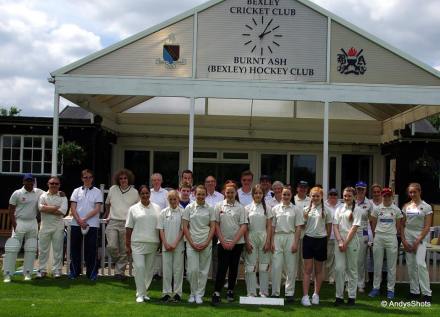
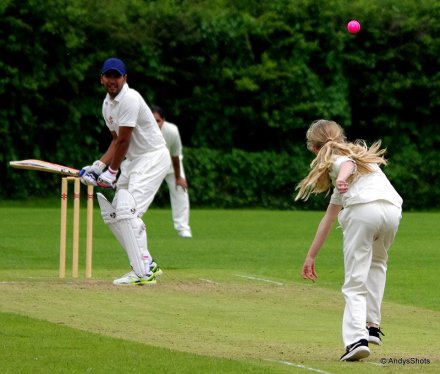
Sunday 19th June saw the launch of the Bexley Bees, the new women’s section of Bexley Cricket Club. The Bees – comprising of Bexley CC girls aged between 13 and 17, plus a couple of more experienced players from Catford Wanderers – took on the Bexley Churches XI, made up of male and female players from St John’s and St Mary’s Churches in Bexley Village, in a 24-overs-a side-game.

13466300_1107090919360862_5397240334900892685_n

(Photo credit: Andy Clay)

Batting first the Churches attained 158-7 and in reply The Bees made a fight of it but came up a little short to end up on 132-8. Both teams batted out their full allocation of overs.

Bexley CC supported the day well. A good crowd attended and the bar was open along with the BBQ and a tasty cake table. The fixture, organised by Andrew Hill (one of the Bexley CC girls managers) was a resounding success.

While Bexley has a thriving girls cricket set-up, a full adult section is a new venture for the club, and has been launched because it became apparent that some of the older girls were not able to get any girls colts club cricket once they reached the age of around 14. Bexley did not want to lose these girls from the game and decided they needed to do something to keep them playing and enable them to keep up their membership at the club.

13435544_1107091149360839_85123657007998873_n

(Photo credit: Andy Clay)

While the intention is for the Bees to eventually enter the Women’s Cricket Southern League, they will mainly play friendly matches for the time being until such time that the squad is big enough to take on a league commitment. It is hoped that the side will get a couple more fixtures in during the summer and perhaps some indoor games in the coming winter.

For Bexley women’s cricket, it seems, the future is bright.

REPORT: T20 Cup – Berkshire v Kent v Lancashire

Raf Nicholson & Syd Egan at Wokingham

On an increasingly drizzly Sunday at Wokingham Cricket Club, it was Berkshire who came out on top, to open up a big lead in Division 1 of the T20 Cup.

Berkshire v Kent [SE]

First up, a Berkshire side without Heather Knight, faced a Kent line-up which included Charlotte Edwards, Suzie Bates, Lydia Greenway and Tash Farrant. Berkshire were, however, bolstered by the debut of New Zealander Rachel Priest, who prior to the start of play received her cap from coach Aftab Habib.

Edwards and Bates opened the batting, and the gods initially appeared to be on Edwards’ side, as an edge off Daisy Gardner fell agonisingly short of Carla Rudd behind the stumps, and then a tame cut to point off the same bowler was put down by Alex Rogers.

The batsmen having been softened up by Gardner however,  the double-breakthrough came from Linsey Smith, who bowled Edwards for 2 off 9 balls and had Bates caught at slip by Priest for 18 off 17.

Alice Davidson-Richards (26) and Lydia Greenway (16) then took Kent to 52-2 at the half-way mark; but what looked like a good platform somehow crumbled away as Berkshire continued to bowl tightly. Nevertheless, Kent’s final total of 95-8, though disappointing, looked like it might just have been enough.

Indeed, it very nearly was enough. Although a 2nd wicket stand of 56 between Rachel Priest (38) and Alex Rogers (20) looked to have put Berkshire firmly in charge, Kent dragged themselves back into the game with 3 quick wickets; and then kept the partnership between Lissy Macleod and Amanda Potgieter sufficiently in-check that it came down to the final ball, with Berkshire needing 2 to win.

A scampered single brought the scores level, but it was a reckless shy at the stumps which proved Kent’s undoing, as Macleod and Potgieter ran the overthrow to record a thrilling win by the narrowest of margins.

Kent v Lancashire [RN]

The second game of the day saw one of the biggest upsets in the history of the Women’s County T20 competition, as Lancashire – who have not won a Division 1 county game since 2006 – triumphed over Kent by 6 runs.

Lancashire started on the back foot as they lost both Emma Lamb (caught by Greenway at cover) and Lauren Smith (lbw for a first-ball duck) in the first over of the day, though Tash Farrant failed to achieve the hat-trick. However, they proceeded to add 44 for the third wicket as some loose bowling by Kent offered up easy pickings for Ellie Threlkeld (19) and Natalie Brown (23). While both were eventually dismissed by Megan Belt, a fiery 13* down the order from Rachel Dickinson, coming in at 9, helped them post a target of 91.

This did look eminently gettable as, in the absence of Charlotte Edwards, Suzie Bates and Farrant walked out to open for Kent. Indeed, at 44-0 in the 11th over, Kent were were cruising towards victory, albeit at the pace of a tandem rather than a Porsche. Yet a clever piece of glove work by Threlkeld – who realised swiftly that Farrant’s foot was on rather than behind the line – saw her stumped for 17 off the bowling of Natalie Brown (2-10). In Brown’s next over Bates also fell foul of a great piece of fielding, as Dickinson took a fantastic catch over her shoulder, running backwards from midwicket.

From there the wickets continued to tumble – none of Alice Davidson-Richards, Lydia Greenway, Lauren Griffiths and Charlotte Pape made it into double figures – and Kent were left needing 14 off the last over, which proved too big an ask.

Berkshire v Lancashire [SE]

So the final match was (by coincidence) itself to be a sort-of “final” between the day’s earlier winners.

With drizzle already beginning to fall, Berkshire won the toss, and might have looked to the weather, and to the advantages of batting second when shortened matches are decided by simple run rate, not Duckworth Lewis; but with the pitch deteriorating, they opted to bat first instead.

Berkshire found it heavy-going, as Lancashire’s spinners pegged them back early-on, and all of their top 5 fell for single-figures, leaving it to Linsey Smith (29* off 25) and Amanda Potgieter (12) to try to claw things back at the end, taking then to 91-6; with Sophie Ecclestone and Aussie Lauren* Smith the pick of the Lancashire bowlers, both taking 2-11.

The drizzle continued as Ellie Threlkeld and Emma Lamb walked out to begin the reply, with Berkshire also opening with spin from both ends, as Linsey Smith and Fi Morris took the ball. Morris had a hand in all of the first 4 wickets to fall: Threlkeld LBW, Smith skying a catch to Macleod at mid off, Brown caught at slip by Rachel Priest, and finally running out Emma Lamb, who had played very positively for 26 off 21 balls.

As the ball became increasingly soggy, so did Berkshire’s fielding, with catches going down and run outs going begging; but fortunately for the home side, it mattered not, as Rachel Hardy came on to clean up the tail with 3-3, as Lancashire were bowled out for just 55 off 16.1 overs.

Afterwards, Berkshire’s new overseas signing, New Zealander Rachel Priest, praised the Berkshire bowling attack, though admitted that her side could have improved in the field against Lancashire:

“Our bowling was great today. There were a few dropped chances [and] against a better side we’ll need to tidy that up a little bit.”

Priest, who is one of Western Storm’s overseas players in the inaugural Kia Super League, also said that she was happy to have the chance to acclimatise to English conditions before the competition begins next month:

“It was good to be out in those conditions and not just sitting at home [in the rain].”

“As many games as I can be available for, I’ll be back to Berkshire for those.”

———

* Play Cricket says “Dave” Smith… but we are fairly sure this isn’t her name 😉

Random Thoughts: England v Pakistan 2nd ODI

Thoughts from Syd Egan & Raf Nicholson (And don’t forget to add yours below!)

Short Boundaries

Tomorrow’s back page story will of course be the fact that England smashed their highest ever score in one day internationals. And yet it’s hard not to feel a bit cheated by this, given that the boundaries – at 55 yards – were at the absolute minimum required by ICC regulations. At one point Tammy Beaumont, fielding at deep backward square leg, was actually starting off outside the boundary rope to give her space to “walk in” as the bowler ran in to bowl.

Officially the boundaries are at the groundsman’s discretion. However, it’s pretty obvious from what Mark Robinson has said in recent interviews that he is strongly pushing for shorter boundaries – he thinks it encourages attacking play. Maybe; but if it turns everything into bish-bash-bosh we’re going to see a LOT of records smashed in the next few years. Surely allowing players to start mishitting sixes not only devalues the skill of someone like Nat Sciver – who as she showed today is perfectly capable of hitting big without any artificial assistance – but the women’s game as a whole?

Pakistan’s Fielding

It might be hard for their bowlers to adjust to the English conditions; but Pakistan could help themselves massively if they upped their game in the field. Leaking boundaries through your legs, or sliding past the ball and turning round to watch it pass behind you over the rope, only makes life easy for the opposition. Something to work on before Monday?

Centurion Central

We can’t remember the last time we saw two English players hit centuries in an ODI (anyone know when it was?); and the fact that the boundaries were short shouldn’t take anything away from the fact that Tammy Beaumont and Lauren Winfield fully deserved their maiden hundreds. It’s interesting that Beaumont reflected in the post-match press conference that she felt Mark Robinson’s faith in her as a batsman during the World Twenty20 had provided her with the level of confidence which she needed to translate her ongoing excellent domestic form into England level cricket. Both Winfield and Beaumont seem to be thriving under the new regime, and that’s great to see. Having said that…

England’s Batting

Mark Robinson told the press a couple of weeks ago: “Lottie would have filled her boots against Pakistan but we would not have learnt anything.” But you have to ask: what have we actually learnt here? Lauren Winfield and Tammy Beaumont can fill their boots against innocuous bowling? Nope – we already knew that! Nat Sciver can bosh it when the pressure is off? I think we probably knew that too! Yes, England were very good with the bat, but it isn’t time to get carried away yet, if only because…

England’s Bowling

We tend to think of bowling as being England’s main strength… and with Shrubsole and Brunt – the most feared opening pair in the world – why wouldn’t you? Perhaps because (whisper it) they looked a mite toothless again today. They did the job – they bowled Pakistan out – and admittedly, it is difficult when a team play as defensively as Pakistan have done, but nevertheless it wasn’t the “bossing it” performance with the ball that we saw with the bat.

OPINION: Five Selection Dilemmas For England

Syd Egan & Raf Nicholson look at some of the selection dilemmas facing England coach Mark Robinson as he considers his side for the ODIs against Pakistan next week.

Dilemma 1: Lauren Winfield v Tammy Beaumont

In the post-dystopian wasteland that is English cricket without Charlotte Edwards, the first question Mark Robinson has to answer is: who will open with Heather Knight? Robinson obviously thinks highly of Beaumont – saying recently he was “excited” to see if she could build on her World T20 performances – and she is the highest run scorer in this season’s County Championship; but Winfield opened in the ODIs in South Africa, albeit not terribly successfully, scoring just 22 runs in the 3-match series. SE

Dilemma 2: Amy Jones v Fran Wilson

With Sarah Taylor currently out of the equation, another difficult call for Robinson is going to be: who should bat at number 3? While Jones will no doubt be an automatic selection as Taylor’s former under-glove butler, it remains to be seen whether she can step up and anchor an innings in the way that the no. 3 position requires. Wilson, on the other hand, is not only back to full fitness but appears to have made a good case for herself batting at 3 for the Academy, fresh from making 88 against Ireland A at Loughborough last week. RN

Dilemma 3: Georgia Elwiss v Jenny Gunn

It’s the Battle Of The All-Rounders. In the Blue Corner, we have Jenny Gunn: for so long England’s Heavyweight Champion. In the Red Corner, we have Georgia Elwiss: the young(ish!) upstart who alone of England’s batsmen came out of the Canterbury Test last summer with her head held high. Gunn may have played 232 internationals for England to date, but if the last month is anything to go by, Robinson seems quite prepared – indeed almost eager – to discard experience in favour of potential. Is Gunn’s time as England’s front-line all-rounder at a close? RN

Dilemma 4: Kate Cross v Tash Farrant

There is a good chance England will go into the series with just the two seamers (Shrubsole and Brunt) but if either of them gets injured, or they decided to try to take advantage of English conditions while they can, then it comes down to a shoot-out between Kent’s Farrant and Lancashire’s Cross. Farrant has impressed this year in domestic cricket – she is the leading wicket-taker in Division 1 of the County Championship – but Cross is the more likely candidate to eventually take over opening the bowling from Brunt when she retires, so if Robinson is building for the future, he might well be looking to give her a chance against Pakistan. SE

Dilemma 5: Becky Grundy v Alex Hartley

The battle of the left-armers is probably the most interesting of Robinson’s dilemmas, because the way it falls will be quite telling of the direction Robinson intends to take. Hartley is without a shadow of a doubt the better bowler, but she is also what they call a Genuine No. 11™ while Grundy had a good game with both bat and ball for the Academy last week against Ireland. Then again, Robinson could pass them both by and pick Lancashire’s Sophie Ecclestone, who at just 17 really is “the future”. SE

The Future of Women’s Club Cricket – Does it have one?

Simon Pearson writes…

This seems like an odd question given the constant mantra from the ECB and England players extolling the continued growth in the sport (1.3 million girls through Chance to Shine for example) but, in my experience at least, the competitive club side of the sport is dying, and that is before any impact from the KSL which, I fear, is likely to hit hard once the 50 over competition starts, presumably next year.

I say this because the number of teams is falling. A few seasons ago our County used to have nine teams in the leagues; they now have four. One of the local leagues has lost a substantial proportion of its members. Our team has only played one game so far this season due to other teams being unable to field a side, and we have just heard that another club has withdrawn from the league due to lack of availability of players. Ironically this is one of the clubs which has been featured on CRICKETher.

Lack of cricket at an appropriate level is a constant theme, and it’s interesting that the England coach has raised the same point because it is, of course, one of the aims behind the KSL. Generally women’s teams seem to play less than half the fixtures of the equivalent men’s teams, even before the concessions start. Recent surveys have confirmed the desire for more cricket but the changes brought in have resulted in even less.

It seems to me that the club scene has no role in the ECB/County pathway and so is largely ignored. Although there are very few clubs playing competitive league cricket in our County, our club has never been visited to see what players we have. It is also of note that the ECB have given up their role in the Premier Divisions and, I was told, will no longer protect club days.

The main emphasis seems to be on Chance to Shine. This was clearly demonstrated during a meeting called by my County several seasons ago to discuss Women’s and Girls’ Cricket. A question was asked about what the plan was for the girls as they got older, and there was no answer. We later heard that a club had lost all their older girls to another sport – not, as is often said, due to other interests but simply because there was nowhere for them to play. Most of our County girls who are at clubs at all are where there is no women’s team. When I was involved (some years back), very few played any cricket other than County and were not encouraged to do so.

One issue seems to be that Chance to Shine feeds few, if any, girls into the clubs – we have never seen one and, in fact, currently have no juniors at all.

The pathway seems to be Chance to Shine -> County Age Groups -> County -> KSL -> England.

My fear is that the game is on the edge and the KSL will push it over. Am I being overly pessimistic?

Some seasons ago I recall there was a rule that to field a County side you had to have a minimum number of league teams – maybe this should be brought back. Maybe to qualify to play at County at U15 and above you should be required to be playing in an approved competitive league.

Or maybe we should simply give up on women’s club cricket and feed the ladies into men’s teams at an appropriate level; at least they would get to play more. Unfortunately many do not want to do this, and many club facilities are not suitable.

Another issue is the verbal abuse they suffer. Contrary to what the ECB etc seem to think, a number of women I have spoken to have left clubs due to what they have been subjected to, often by their own teams.

The question of how we move forward is rather difficult to answer since there seems to be little reliable information as to where we are – the figures put forward by the ECB are regarded with considerable scepticism by those on the ground. But it is clear that the women’s game is very different from the men’s and we need to think outside the box.

While in a men’s club you can bring in new players who will find a place in whatever XI is appropriate for their standard, very few women’s clubs now have even a 2nd XI – further evidence of the decline. This means that it is very hard for players to join a club whose team is playing in an upper division. Maybe clubs should be more open to loaning players so they get the cricket they need, and it might help to keep struggling teams going. I raised this at a County area meeting a few years ago but it met with a hostile reception. Another possibility is a group of clubs getting together and co-operating.

Maybe I am exaggerating things, but I am more pessimistic than ever about the future. In my view the next couple of seasons are crucial if we are not to lose this level of cricket altogether.

REPORT: Oxford University v MCC Women

Andy Lynch reports on MCC’s recent match against Oxford University.

Lovely venue, perfect weather, idyllic scene – it is easy to imagine that Hugh de Selincourt had days like these in mind when he wrote his classic ‘The Cricket Match’. To complete the picture, all that was needed was a close finish – but MCC Women showed their experience in easing to a 69 run win over a spirited Oxford University side in the Parks.

This long standing fixture has been keenly contested over recent years, at a ground that practically breathes history – from the pavilion nestling within the beautiful Oxford Parks, to the engraved Blues teams on the walls for each season since Victorian times, to toilets that we strongly suspect date back to the Edwardian era.

Unlike some sporting institutions in the news of late, Oxford does welcome females, and this long standing fixture has been keenly contested over recent years. Results have ebbed and flowed – an Evelyn Jones-inspired victory by Oxford in 2013 prompted MCC to return ‘tooled up’ in 2014 via the inclusion of Claire Taylor and Charlotte Edwards. MCC proceeded to rattle up 360, win by 275 runs, photo-bomb Oxford’s team photo and doubtless pin the opposition to the wall and take their pocket money before allowing them home.

It was another strong MCC team who turned out again this year, with Mesdames Taylor and Edwards once again providing a more than solid look to the middle order. MCC won the toss and naturally batted first in perfect sunshine – a serene opening partnership between Genevieve Porter and Amanda Potgieter saw them move to 96-0 at the halfway stage of their 40 over innings.

MCC 2.png

Oxford’s bowling impressed throughout however, and when the opening partnership was finally broken at 109, wickets started to fall with increasing regularity. Potgieter departed for a belligerent 64 off 83 balls, and steady bowling supported by some impressive fielding (a stunning boundary catch by Laura Down to dismiss Clare Ross being a particular highlight) saw MCC eventually being restricted to 202-9. The dismissal of Charlotte Edwards for just 9 by Sam Moore whilst attempting an extravagant reverse sweep was something of a bonus, although it could have been even better had 43 extras not been conceded (including 27 wides). A special mention to the opening pair of Sam Moore (2-29) and Immy Brown (3-28), who proved a handful for everyone.

MCC 1

203 off 40 overs was not an outrageous ask, especially not after the fireworks of the Varsity T20 match the week before when Oxford achieved a total in excess of this in half the overs.

A lot seemed to depend on the star from the Varsity game, Sian Kelly, and early signs were good as Oxford took 23 off the first 3 overs (with MCC returning the compliment with a few wides of their own). Sian Kelly was unable to repeat her heroics from last week however – driving to mid-off for just 13 – and after 9 overs, Oxford were 42-3.

A collapse would not have been surprising, but to their credit, keeper Ellie Ingram and captain Immy Brown combined to add 68 in 15 overs. At 110-3, the game looked evenly poised, but having missed out with the bat, Charlotte Edwards made up for it with the ball, turning in the impressive figures of 2-6 off 6 overs. Nikhila Ravi also bowled with impressive loop to take 3-34 (or at least we think she did – given that we were convinced that she and her twin sister Neeraja were doing their upmost to be indistinguishable to the scorers). Ingram fell for an excellent 41 off 55 balls, and although Brown continued her lone hand thereafter, she was the last wicket to fall for 39 off 66 balls, to a smart catch by Claire Taylor off a full blooded pull.

So an eventually comfortable win by the MCC – but at a time when cricket participation is under scrutiny at all ages, levels and indeed sexes, the enthusiasm and skill shown by the Oxford team does them credit and provides optimism for the future. I suspect we’ll be hearing more of at least a couple today’s players.

MATCH REPORT: Varsity Twenty20 – Kelly’s Class Too Much For Cambridge

CRICKETher reporter Ben Gardner was at Friday’s Varsity match to see a memorable innings by Oxford’s Sian Kelly.

Oxford v Cambridge, T20, The Parks, Friday 20 May

Result: Oxford won by 162 runs.

Toss: Cambridge won and elected to field

Sian Kelly produced a sustained and controlled assault on the Cambridge bowlers, paving the way for a victory by 162 runs, the margin of which did not flatter Oxford in the slightest.

Kelly’s innings, of 102* from 61 balls, was so brutal and calculated, it seemed remarkable that it wasn’t her best; Kelly made 127* in the reverse fixture last year. From the moment she put away Holly Tasker’s first ball to the square leg boundary to when she walked off the field 61 balls and 102 runs later, she exuded control, rarely seeming troubled by the bowling.

Runs were plundered all around the ground, with the favouring of the leg side being more a result of the full tosses bowled by Cambridge, invariably pumped between square leg and midwicket, than any lack of ability through the off side, as demonstrated by perhaps her best shot, a drive behind point for four, which brought up fifty.

The pacing of Kelly’s innings too was something to behold. To begin with, she exploded. After 6 overs Kelly was 46 off 24, Oxford were 74/0, and Cambridge were chasing the game, four consecutive fours of one Holly Tasker over being a particular highlight. Then, with the Powerplay finished, she switched gears, content to push the ball around, while still picking up regular boundaries, before accelerating again, moving from 83 to 97 in just 5 balls.

This was a masterful innings, and Kelly simply was a class above the bowling. She looks ready for greater challenges, and perhaps more game time alongside her twin sister Marie, Warwickshire’s captain, awaits.

Wagon Wheel of Sian Kelly's innings

Wagon Wheel of Sian Kelly’s innings

Tina Gough, who turned over the strike well and played some excellent shots of her own, was an excellent foil for Kelly. When she was out, for 52 off 50, the scoreboard read 173/1 off 16.3 overs, and the match was almost over as a contest but Cambridge did well to keep their heads up and stick to the task.

It mattered little in the grand scheme of things, but Cambridge bounced back well to restrict Oxford to 33/2 off the last 4 overs, and on a different day, without two batters in such fine form, such a recovery could have been the difference. While the full toss and no ball counts show there is much improvement to be had, this was certainly an attack with potential.

Still, a target of 205 seemed a tall order, and Oxford put the result beyond any doubt with an immaculate bowling display, with perhaps the only disappointment being that Cambridge bettered their 36/8 against Oxford in a league match 2 weeks ago by 6 runs.

The first three bowlers used by Oxford all represent various counties, and their extra quality showed. Sam Moore moved the ball away at pace, while her Oxfordshire colleague Helen Baxendale was metronomic in her line and length. Captain and Berkshire opening bowler Immy Brown was even more impressive, picking up 3 of the top 4 batters with her skiddy pace, as well as running out the 4th.

Away from the county stars, Oxford showed impressive depth; Sarah Attrill’s loopy accurate bowling especially is so difficult to get power behind, and therefore ideal for a T20. In the field too Oxford were sharp, and though there were a couple of missed run outs, these were more a result of smart work to earn the opportunities in the first place.

However, while it would be difficult to overstate how well Oxford played, there were some simpler areas where Cambridge could have improved. Their fielding was one such, but perhaps more inexcusable was their running between the wickets. There were several occasions where they chose not to push the fielders, or to attempt to rotate the strike, which meant Oxford were under almost no pressure. The boundary balls weren’t there to be hit to be sure, but the fact that no batter had a strike rate over 50 tells its own story. This was in stark contrast to earlier in the day, when Oxford wasted no opportunity to score runs, turning the strike over regularly and always looking if the second was on.

Cambridge, it has to be said, were missing key players. Most notable was Frankie Barber, who made fifty in the Varsity match at Lords last year. She is the only full Blue currently at Cambridge. Oxford and Cambridge examinations do not take place at the same time so finding a date when one university is not unfairly disadvantaged is tricky. However, making Cambridge play away while it is their students more likely to be affected is unfair, and something you’d hope the organisers would look at for coming years.

Still, to focus on such small details would be to miss the greater joy of the day, which was of a well-trained and extremely talented team playing to their potential, and of one special batter playing an innings that will be remembered by all who witnessed it.

Laura MacLeod: A Pro At Last

On a wet Thursday evening at Bowdon Cricket Club a group of cricket loving children and adults descended on the ground to see the launch of the Lancashire County Cricket Club Thunder & Lightning Roadshow.

As part of the evening there was a question and answer session hosted by former Lancashire captain and wicket keeper Warren Hegg, himself a former international cricketer.

Hegg interviewed man-of-the-moment Liam Livingstone, a product of the Lancashire youth system who has made a sparkling start to his first class career this summer.

Seated next to Livingstone on the stage was another cricketer who, thanks to the Kia Super League, can now also be deemed to be a professional player.

Whilst all of the children present knew of Livingstone thanks to his early season exploits there were fewer that would readily have recognised his colleague on the panel despite the fact that she is a veteran of 73 One Day Internationals for England as well as 13 Test Matches.

This week in fact marks the first time that Laura MacLeod, previously Newton, has had sight of a contract that will mean that she is paid to play cricket despite the service that she has given to her country on cricket grounds all across the world.

Refreshing then that, following the questions with Hegg and during the autograph session that followed, MacLeod found herself signing as many, if not more, autographs than Livingstone.

A contemporary of recently departed England captain Charlotte Edwards, 38 year old MacLeod left international cricket in 2007 aged just 29 due to the pressures of being an amateur playing in an increasingly professional environment.

Earlier this week MacLeod found herself in the nets at Emirates Old Trafford batting alongside current England players Danni Wyatt and Kate Cross who will be two of her teammates in the Lancashire Thunder squad later this summer.

Incredibly it was the first time outside of an international fixture that the former Lancashire and England star had actually trained in the facilities at the ground.

Her teammates in the Thunder squad are, happily, growing up in a time when their presence at such venues and in the presence of coaches such as Gary Keedy is becoming normalised. MacLeod, an outstanding coach in her own right, probably appreciates the opportunity that is being presented more than most.

Her impact upon the Kia Super League is as yet unclear but whilst the competition presents an exciting road ahead for the young stars of tomorrow it is already presenting opportunities for players like MacLeod to finally get the recognition they have deserved.

Just ask those kids that were at Bowdon who their new hero is.

OPINION: James Piechowski’s Deep Cover Points – England Without Edwards:­ Analysing Robinson’s Eclipse Theory

The events of the last few days have taken many people by surprise. To say it has been an eventful week is an understatement. Whatever your own opinion on whether Edwards should have continued as captain, or at least continued playing in the England side, as by all accounts she so desperately wanted to, you have to admit that there was a growing pressure for big change. Although many had questioned her captaincy lately, the biggest criticisms seemed to emanate from the more casual observer, who are less familiar with the nuances of the team.

From that perspective, it seems unthinkable. Why would Robinson even for a minute consider forcing the person who has undoubtedly been England’s best player to exit from the side? In order to try and justify a decision which at first glance may appear ridiculous, it requires an attempt at diagnosis of the current state of affairs at the top level of England women’s cricket. Robinson has a theory, I think, and not to be too presumptive I shall call it the “eclipse theory” here, for want of a better name. Let’s start with what Edwards has said:

“Mark spoke to me quite honestly and told me how he saw the next series as an opportunity to develop players and take the team in a new direction…He said the girls are hiding behind me sometimes and that they needed to develop.”

“We have a number of younger batters who have not shown their potential at that level. Mark sees the next couple of series as an opportunity to give them a chance with a new captain as well. He thinks there is not a place for me in the team.”

George Dobell at ESPNCricinfo expressed a similar thought:

“Robinson, the coach for six months now, noted that nothing seemed to grow in (Edwards’) shade. While that is no reflection of Edwards, he knew he had to act and made what Connor, the head of women’s cricket at the ECB, called ‘a ballsy decision’.”

It’s clear that Robinson has subscribed to the theory that Edward’s excellence has prevented other players’ development. Can this theory explain the logic, if any, behind pushing Edwards out of her role?

Support for the“eclipse” theory

A good theory must at least be internally consistent and have some explanatory power. On the surface, this theory appears to be onto something. Some players have been allowed to continue playing despite not making much contribution to the side. This is my take on the theory. And please be aware, I am playing devil’s advocate for this section.

The theory goes that winning cricket matches due to many runs scored by one superb player allows other individual poor performances to be overlooked. A side without any outstanding individuals, on the other hand, relies heavily on consistency throughout the batting order for any success they achieve. The England team of recent years has benefited in the short term from a massive glut of runs from one source, and so has not needed to tap into other sources very often.

Hence, we see players with somewhat unenviable records, such as Beaumont and Wyatt, still appearing for England despite a long track record which on paper looks more akin to failure than success. The theory would say that they have only done as well as they have needed to, to stay in the squad. With England still winning most series over the past few years, there has been little opportunity for upcoming players to break into a side which has, on the surface, looked fine as it is. The introduction of professional contracts, which have seen little change since 2014, has only cemented an already static group of players. Robinson, it would appear, wants to be the irresistible force to give momentum to this immovable object.

Robinson’s theory plays heavily into a narrative that we have seen him expound from the inception of his tenure. He’s come into the training set-up and immediately noticed that there are quite a few players who should be much better than they have been. A prime example is Tammy Beaumont: a very gifted player who looks superb in the nets and yet has looked timid for England out in the middle. She has only managed averages of 17 in ODIs and 13 in T20s despite playing over 60 matches in a career stretching from 2009. The fact is, she hasn’t needed to do any better, according to this theory. Despite what’s gone before, she’s still around the team now, and with Edwards’ exit, she looks a certainty for the Pakistan series as one of very few experienced specialist batsmen left in the contracted Performance squad.

Indeed, Robinson has been nothing if not consistent. A comment on the Cricinfo web site article covering Edwards’ retirement reveals how it’s very easy to not understand Robinson’s thinking. User BRUSSELSLION asks: “Only a month ago, he (Robinson) was saying that England needed more players like Edwards, now she’s surplus to requirements. What’s changed?” But actually, I’m not so sure these ideas are in direct contradiction. Robinson clearly wants players of Edwards’ skill to evolve from the existing squad; however having just one Edwards, Lottie, who so dominated the run scoring, he viewed as more of a hindrance to the other players, a roadblock to their evolution.

If Robinson could show that the average runs gained from having Edwards in the side was likely to be less than we could have expected from other “fully developed” players, he has some justification at least. But can he show that? With Edwards struggling to take quick singles and twos these days, it’s clear that some runs are being lost, not only from her own score but from her batting partners too. Quantifying this can be difficult. I think the total runs lost to this effect is unlikely to be more than 10 or 15 per T20 innings, and that assumes that Edwards batted for most of it anyway, and probably scored 60+ in the process.

Robinson cannot expect to backfill places from the development set-up as quickly as he could in men’s cricket. On the other hand there are several Academy players long overdue for a full England debut. The definition of the phrase”ready for International cricket” may have to change, because frankly (in my opinion) those in charge of selection have become too sure about certain players not being able to rise to International play. In reality, it is very difficult to be sure how well a player may adapt to it, unless they are given a good chance to show off their talents. What Robinson has done should help shake this up. Other teams blood their promising players at much younger ages. England may need to start debuting more teenagers in the near future.

Even if this is all true, I don’t necessarily agree with Robinson’s decisions to date, or his pet theory. Let’s look at some of the problems with it.

Criticism of the “eclipse” theory

There are several areas where we could criticise Robinson’s actions. Some have already been identified in articles and comments on this site. Certainly, it is a huge risk for England to lose their best player at a time where we desperately need more runs, not less. Hopes for victory in the 2017 Women’s World Cup were real and serious whilst Edwards was in the team, particularly as it would be a home series. Now, with Edwards gone, there can be little hope of that achievement, and even a semi-final seems like it would be a good result rather than an average one.

I’m sure it wasn’t Robinson’s intention but he seems to have set himself up to be able to make excuses. If England perform poorly for the rest of the year, he can always point to the fact that Edwards is not around and he needs more time with the squad. The other side of the coin is that he must be accountable for this decision, and I’m sure there will be many looking to criticise if England start to lose overall series in the next year or two. I sure will.

Those supporting Robinson’s decision have drawn comparisons with Alastair Cook’s forced exit from the ODI captaincy of the England men’s side. He scored a lot of runs, and didn’t want to go either. And Cook’s departure was followed by a complete change in approach from the rest of the team, which has led to much more exciting play and the side enjoying renewed success, really challenging the world’s best teams and indeed coming within an over of winning the WT20 final.

This argument doesn’t really work, though. The men’s team needed a change in approach only; the side already contained experienced, confident players with strong records, and fifties and hundreds in the bank, who had to adjust their mental and technical approach, but not fundamentally raise their whole game. Many of the England Women batsmen will have to do things they have never done before, set new standards, and advance their games to entirely new levels to make up for the loss of Edwards. This is, needless to say, a huge ask, and some of them may not be able to do it as well as Robinson demands.

On the flipside of the theory, a small number of players have excelled in addition to Edwards’ excellence. So this is a big problem for the theory. For example, Sarah Taylor is a player who has generally succeeded with the bat in recent years. She and Edwards stand apart from the rest. And yet Taylor was obviously not part of Robinson’s plans for “refurbishment” of the squad. It is possible, of course, that his attempts to change the status quo could prove ironically futile this summer. Maybe Taylor will score most of England’s runs now (she’s certainly done it before), and big contributions from other players will still be few and far between. In which case, Robinson has only passed the whole problem along a step, and really achieved nothing of note, all the while forcing the exit of our finest player in far from ideal circumstances.

Perhaps the biggest issue I have with Robinson’s decision and explanation, though, is that he has already disproved it with his first few months in the job. The South Africa series saw a more attacking approach from the batting line-up, with the likes of Jones in ODIs, and Beaumont in the WWT20, coming to the fore. If anyone had been previously eclipsed by Edwards, it was Beaumont. Except, by hook or by crook, the situation seems to have been turned around for her, and quickly – with Edwards still there. If Beaumont had done as well for England since 2009 as she had in the last few months, her record would be quite impressive. If we could see the same effect for some of the other underachieving players, this whole problem suddenly evaporates and along with it, Robinson’s entire justification.

So is it possible that this whole debacle could turn out to be a complete folly after all, even stretching into the long term? Perhaps.

Let’s look at some specific details. One way to identify players who have not been subject to any eclipsing effect is by looking at who has performed well when Edwards did not. So I have checked the scores made by our main batsmen in T20Is and ODIs since the start of 2014 (to roughly coincide with “professionalism” and also because going back further starts to look pretty desperate). The scores are only counted when Edwards scored less than 20 in a T20, and less than 40 in an ODI, and the player in question scored more than 20. There are less entries than you may think. As a rule of thumb, the more a player features in these lists, the less sense the “eclipsing”argument makes for them specifically.

England T20I Cricket from 2014 onwards: Edwards scores 19 or less, batsman scores 20+

# 20+ scores Batsman Runs Strike Rate
6 Taylor 246 115
5 Knight 131 120
3 Greenway 71 79
2 Winfield 122 103
2 Sciver 75 97
2 Beaumont 41 121

Edwards scored 19 or less in 12 out of 26 matches since 2014. England’s record in these games: won 8, lost 4 (67% win ratio). England’s overall T20 win ratio is 73% (source WCB)

So this is not a particularly good start for the theory. England’s win ratio when Edwards gets a sub-20 score is not much worse than their overall win ratio. This shows that the other players, overall, are largely making up for this deficit. We see no Jones, Gunn or Wyatt in the list, however, which shows that these players have not done it for England in T20Is when needed the most.

England ODI Cricket from 2014 onwards: Edwards scores 39 or less, batsman scores 20+

# 20+ scores Batsman Runs Strike Rate
5 Taylor 295 97
5 Knight 243 69
5 Sciver 231 93
3 Greenway 148 65
2 Elwiss 86 99

(Brunt, Jones and Shrubsole also feature once each in this list, but I’ve not included them in the table.)

Edwards scored 39 or less in 8 out of 16 matches since 2014. England’s record in these games: won 4, lost 4 (50% win ratio). England’s overall ODI win ratio is 69% (source WCB)

The results from the ODI analysis support the theory better, which is strange as Robinson made his decision after a T20 competition. I had to increase the range of Edwards’ scores for ODI, as there were so few entries in the list if you go much lower! The team record is significantly poorer when Edwards did not score heavily, which shows how vital she was to England in ODIs. However, I think we can say that Sciver, Taylor and Knight have not been negatively affected, as all tended to contribute when Edwards didn’t, and all have decent overall ODI records. Indeed Sciver’s performances for England have often outmatched those for Surrey.

The effect is only slight for Greenway, and Elwiss hasn’t played enough games to make any conclusions – a problem in the selectors’ hands and not Edwards’. Jones is in the same situation. The only remaining players who could have been eclipsed by Edwards are Gunn, Winfield and Wyatt. (I have already discussed Beaumont.) Is the development of just these 3 players really worth getting rid of Edwards for?

The only justification left for Robinson would be the idea that the likes of Beaumont, Knight and Winfield would be getting hundreds every other week had they been developed correctly. They should be absolutely superb players. To prove that, you’d have to show that their batting trend lines (average, strike rate) have been decreasing since coming into the England team. That is a statistical minefield, though, as any decline is more likely to be due to improving opposition than anything else. I’m left with the distinct impression that Robinson’s decision, and the eclipse theory, has more to do with a vague feeling than any hard data. It is merely a smokescreen for bringing about the change he wants. He wants a fresh start, and is placing too much faith in the hope that players can develop far further than we have seen. Let’s hope he knows something we don’t.

The fact is, we don’t know how any of these players would have performed had Edwards not been part of the team. But that’s the problem Robinson has. We don’t know how they will do going forward either, and that is a huge risk to take when you know you could have had Edwards still playing, particularly in ODIs, for the next couple of years. The number of players potentially eclipsed by her excellence is too small, and the effect too slight, to base any big decisions on. The transition option, with Edwards still in the ODI team (and possibly the T20 team as well) but not as captain, still seems more favourable to me.

Catching Them Young: Girls Cricket in Toronto

Guest writer Aparna M tells of her experiences setting up a cricket academy in Toronto.

Cold, dark, long winters. Staying indoors for almost 7 to 8 months a year. Hardly an ideal setting for the game of cricket. But at the other end of spectrum you have a large, South Asian community. Mostly new immigrants. Trying to find a footing in a new country, environment and culture.

Throw economic hardships into the mix, and what do you get? Young families with children trying to find space to play sport, to stay engaged in some physical activity, where they do not have to spend a fortune. Organized sport is largely out of question for children of new immigrants struggling to make ends meet. In this setting was established a multisport academy which began its operations with cricket only, keeping in mind the largely South Asian population in the neighborhood in Toronto.

The first year of operation saw limited numbers both for boys and girls (there was just one girl). She too dropped out after a couple of weeks. The reason given by her father was that they tried to work out the timings but without success. This could have been discouraging both for the organizers as well as for other potential girl participants. However, the efforts to bring in girls to the program did not stop.

And these efforts did not go to waste. The second year of the academy saw more girls coming along. About six of them. No, it was not a lot. But it was the beginning. Most of them tagged along with their brothers. But that was okay. What mattered was that they were enjoying their time at cricket. That they wanted to learn the sport. They wanted to learn how to hold the bat, how to move their feet, how to bowl without bending their elbow and of course, they wanted to master the art of fielding, both catching and throwing.

Toronto Article 1

It was heartening to see these little girls all excited, and being part of the games after the practice session. They were developing game awareness. You could see it in their running between the wickets. Calling for a run. Or responding to their partner’s call. Throughout the summer, they would show up every day for five days a week, for seven weeks. And their numbers too went up.

Once summer was over, and the school year started, the program shifted to once a week in the evenings. Some from the summer dropped out, but other girls joined in. While almost all of them were still tagging along with their brothers, there were a few who were coming there on their own. Because they were enjoying the new sport. They were enjoying playing cricket!

It was heartwarming to see girls enjoying the sport at such an early age. It was important to keep the environment fun, with the aim for them to develop a liking for the game – hopefully a lifelong one. While of course it is too early to say whether they would ever be able to take up the sport professionally while they are in Canada, it certainly would do no harm if they could continue their association with the sport by playing it regularly.

The program saw success in the younger age group of 5-10 year olds, but it was difficult to attract the slightly older girls in the program. Separate sessions were set up for the 12-and-up age group after initial interest was shown by some of the older girls. However, once the schedule was set the response was extremely poor.

The reason was the pressure of studies. Of assignments and exams. Of coping with domestic chores. There was the peer influence aspect as well. The girls wanted to be part of the program as a group, but once a couple of them dropped out, the group’s participation fell apart. This for sure was a setback, but hopefully things could still be turned around in future. For example, some programs could be offered during school time, or even as part of after-school programs.

However, the participation of the younger girls is a definite positive. Hopefully by the time they are 12-13 they will have a few years of cricket under their belts, and will have developed a love for the game and a desire to continue playing it, even at recreational level. With women’s T20 leagues being set up across the globe, there might even be the chance to take up the sport professionally, if these girls continue to seriously develop their skills.