On the CRICKETher Weekly:
- Northern Superchargers triumph in The Hundred
- Davina Perrin’s once-in-a-lifetime century
- CSA make a mess of bringing Dane van Niekerk back into the fold
- NSB bites back after being blamed for the Kate Cross non-selection

On the CRICKETher Weekly:
Southern Brave have been involved in a few low-scoring games this season – chasing 106 against Rockets with two balls to spare; chasing 111 versus Fire with just one ball remaining; and perhaps more significantly in the context of this match, defending 106 against Fire in their final group match. They won them all – the first time any team has gone through the group stages undefeated.
Now, in the final at Lord’s, they needed to do it all over again, after posting a slightly disappointing 115-6 against Superchargers. Lord’s isn’t The Oval, of course – anyone hoping for a repeat of yesterday’s run-fest in the Eliminator doesn’t know their North London from their South; but nonetheless Brave would have been hoping for more.
Ultimately, they probably needed a lot more – Superchargers chased it with 12 balls to spare, and with very little urgency required. There were a couple of moments in Superchargers’ chase that the Brave might rue. First they failed to go upstairs for a DRS review on Nic Carey, which would have been out. It would have been a golden duck – it was Carey’s first ball – but she went on to top score with 35 and be named the Meerkat Match Hero. Then later a delivery from Lauren Bell nicked the bails, which lit up but didn’t fall. Annabel Sutherland survived, and went on to hit the winning runs with a 6 over mid on.
The Sutherland wicket might not have mattered – Superchargers needed a straightforward 16 from 20 balls by that point, with two proper batters (Hollie Armitage and Bess Heath) plus the highly experienced and pretty unflappable Kate Cross still to come. But the Carey one definitely did; and would have made up somewhat for a disappointing season from the bowler in question – Chloe Tryon, who will go home with £20,000 in her pocket having taken 4 wickets and scored 31 runs in 9 games for Brave this summer.
None of Brave’s overseas stars really fired today. Laura Wolvaardt at least can legitimately claim that she got an unplayable delivery from Kate Cross, who will have perhaps enjoyed a moment of ‘Look What You Could Have Won?’ on the day Isa Guha let-slip live on the BBC that she has lost her central contract. (We understand that she was told this well before the World Cup squad was announced, which… shall we say… certainly adds an additional dimension to those discussions.)
But Sophie Devine chewing up 28 balls – over a quarter of the innings – for just 23 runs made it very difficult for everyone around her; and Tryon “chipping in” by stuttering to 5 off 10 balls at the death was pretty inexcusable – you have to hit out or get out in this shortest of short formats, especially at that stage!
Prior to the game, all the talk in the press box was of Davina Perrin, after her incredible performance in the Eliminator. Men’s cricket journalists who would have struggled to spell her name 24 hours before were sidling up to media managers trying to wrangle an exclusive interview with the girl who now looks set to be cricket’s next global superstar.
And why not? That unbelievable innings will turn her into a millionaire within a year or two, and deservedly so. But expecting her to do it twice in one weekend was probably a bit much; and personally I was simply keeping my fingers crossed that she didn’t let the pressure get to her and dry-up like a mountain stream in a heatwave. And she didn’t – 17 off 16 balls wasn’t a match-winning knock but it was no disgrace either. It got them all-but through the powerplay and gave them the foundation they needed to go on and win the game by playing (mainly!) sensible disciplined cricket.
Phoebe Litchfield was named Player of the Tournament, after a cameo today where she dragged out all the classics like an old music hall performer – the sweep, the reverse sweep, the switch sweep – we saw ’em all! No doubt she has been great entertainment, and she did finish as the leading run-scorer; but if I was Lauren Bell I’d feel slightly aggrieved I think. No one has taken 19 wickets in a Hundred season before, whilst both the last two top run-scorers (Nat Sciver-Brunt in 2024 (303) and Danni Wyatt-Hodge in 2023 (295)) scored more than Litchfield’s 292 runs. If Bell’s team had won the final, might that have made the difference? Should it have? I’m not sure.
So ends the era of The Hundred… at least in its current form. The format itself may drag on for another season or two; but it is certainly doomed after that, and I’d just bite the bullet and change it now, mainly because so much else will change in 2026.
As I look out from the Lord’s press box with the men’s final being played, I see thousands of kids in Invincibles’ bucket hats and sea-green shirts. They’ll be chip-paper next year, with the team from south of the river likely renamed MI London and playing in blue; as will all those Superchargers shirts being worn by the boys and girls who cheered their women’s team’s win earlier. The full house for both games proves that the public has taken this competition to their hearts. The challenge now will be to keep it there for The Hundred 2.0.
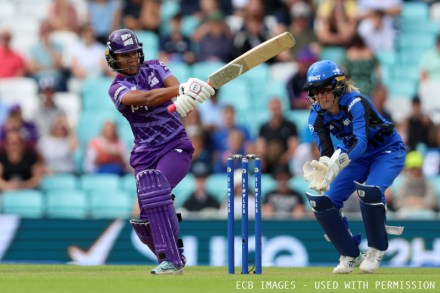
Every autumn, The Cricket Society hand out the Charlotte Edwards Schoolgirl Cricketer of the Year award to the most promising young player in England and Wales. So let’s flashback to October 2022. Alice Capsey – a former winner of the award – has just made her international debut; and this year’s winner is a young lady from Birmingham – Davina Perrin.
Attending the awards ceremony at The Oval with her proud parents, Perrin herself is shy – almost demure – as she receives her plaque and mingles with guests.
Three years later, Perrin, now a professional cricketer with Warwickshire and the Northern Superchargers, and her parents are back at The Oval; and Perrin is receiving another award – the Meerkat Match Hero – following her performance in the Eliminator (AKA semi-final) for this year’s Hundred.
But this was a very different woman to the one who had received that award 3 years previously – all confidence and swagger, having become just the second woman to score a century in The Hundred, and doing it with all the pressure of a knockout game in front of over 10,000 fans.
For 5 seasons, Alice Capsey has been the poster-girl of The Hundred after making a half-century at Lord’s in only her second game. That innings ultimately catapulted Capsey into the England team, perhaps in retrospect a little too rapidly as her development seemed to stall. Capsey hasn’t had a bad Hundred in 2025 – 191 runs and two half-centuries isn’t a bad return – but today Davina Perrin dominated a match in a way Capsey never quite has.
This wasn’t just the best innings of the day, or even of 2025 – it was the best we’ve seen in 5 seasons of this competition. The Hundred now has a new poster-girl. Jon Lewis take note: this is how you inspire and entertain.
Coming into this match, there were still a few question marks over Perrin. We’d seen good performances from her in her county and regional shirts; but a series of poor returns for England A and in big games hinted that there might be a problem – could she cope in those pressure situations that are the real test of a cricketer’s worth?
I think it is fair to say, we have our answer now.
Having been put in to bat, with a forecast of rain likely to affect the second innings, Superchargers needed to get runs on the board; and with Perrin and Alice Davidson-Richards at the crease, they went off at a decent clip, reaching 41-0 at the end of the powerplay. Well… I say Perrin and Davidson-Richards; but ADR had very little to do with it. When Perrin brought up a 25-ball 50 off the 31st ball, ADR was on 3, having faced just 6 deliveries.
By the time ADR was dismissed for 18, Perrin had reached 85, as Superchargers plundered an incredible 68 runs from 25 balls in the Early Middle phase. Perrin’s hundred, off 42 balls, was greeted with a standing ovation from the Oval crowd. Some had come to see the Superchargers; some the Spirit; some the two men’s teams who were scheduled to meet later. Every one of them will go home today with just one memory though, having witnessed something truly remarkable from Perrin, as ball after ball was dispatched to the boundary.
It is fair to say that it wasn’t a great bowling performance from Spirit, though probably one that was in keeping with what they’ve done in this competition, where they have been decidedly average with the ball, ranking 6th across the 8 teams.
But you’ve still got to hit your shots; you’ve still got to find your gaps; you’ve still got to generate your power. Phoebe Litchfield, whose numbers across the whole competition have been better than Perrin’s, didn’t find it easy out there initially; but Perrin was a cut above even Australia’s most promising young player today, hitting sixes that didn’t just cross the rope, but soared over the Oval’s white picket-fence and into the crowd. The Spirit fielders had no chance.
With Nic Carey coming in at the end and sweeping Grace Harris for 22 runs in the biggest set of the match, Superchargers finished on 214 – an absolute mountain, which it would have taken a miracle for Spirit to climb.
Spirit gave it their best shot – they were slightly ahead after the powerplay, but they lost 3 wickets in the process, including Grace Harris, promoted to open the batting in the knowledge that Spirit needed something extraordinary from her, for a two-ball duck. Charli Knott went hard (harder than Perrin had) but couldn’t keep it going and once she was lost, the only question was whether the weather would finish the game before the players on the pitch could.
A succession of blustery showers threatened to end things early, but the umpires were able to keep things going for the full game to be completed with Spirit on 172-9 – a total that would have won all bar two games in this season’s competition. But not this one. Davina Perrin had already long seen to that.
This week:
Laura Wolvaardt was made for days like these. With Southern Brave chasing a low-ish total, she scored one of the coolest, calmest 50s of her career to get her side home. The scorecard says Brave won with just 6 balls to spare, but it was possibly the longest 6 balls in history – as WinHer reflects, the result was absolutely never in doubt.
Having been put into bat, London Spirit didn’t get off to a great start – Kira Chathli, who veers from the sublime to the sordid like a character in one of the 19th Century Russian novels she likes to read, holed out in the first set to one of the worst shots I’ve ever seen. Spirit then limped to 24-1 at the end of the powerplay, with neither Cordelia Griffith nor Georgia Redmayne playing with much… well… “spirit”.
When Redmayne – such a critical cog in the Spirit machine that won this competition 12 months ago – was dismissed to a stunning low catch from Mady Villiers off her own bowling, things quickly went from bad to worse as Grace Harris delivered a classic “Six and Out” – slogging just (just!) over Maia Bouchier at long on for a maximum, and then sending the very next ball in exactly the same direction but a foot or two shorter, allowing Bouchier to make the catch at the second time of asking.
Griffith continued to stutter, with her Strike Rate falling back into the low 70s at one stage; but crucially she hung in there long enough to remind Mady Villiers that fielding might be easy but sometimes bowling isn’t – Griffith taking her for 19 runs in a set, including two sixes. This one set threatened to turn the tide in favour of the Spirit, giving them a platform to push on towards 150; but they blew it big-time. Dani Gibson first ran out Charli Knott; then after (just) failing to run out Issy Wong, ran herself out for 9.
This exposed the lack of power in Spirit’s tail, as they scored just 22 runs in the final 25-ball phase, with the only boundary coming by sheer luck, after a fortunate deflection off non-striker Sarah Glenn wrong-footed Maia Bouchier on the long on boundary.
Needing 126, Brave lost Danni Wyatt-Hodge early after Issy Wong somehow persuaded Charlie Dean to review an LBW that everybody in the stadium except Wong (including, crucially, the umpire) thought was going down leg, but proved to be just straightening enough to get the decision – a millimeter of difference would have been umpire’s call, and Wyatt would have survived.
Wyatt-Hodge was Brave’s top run-scorer in the tournament coming into this match; but today they didn’t need her. Wolvaardt and Bouchier took control of the game, pushing just hard enough to stay ahead of the rate whilst keeping their wickets in hand. Bouchier did eventually lose her concentration, possibly demonstrating why Emma Lamb is going to the World Cup and she isn’t, as she was caught on the ring.
But Wolvaardt stayed cool, even as Brave’s run-rate dropped unnervingly towards the end, with 4 consecutive sets between balls 70 and 90 going for 3 or less. Others would have been panicked into going for the big hit, but Wolvaardt just rotated the strike in the knowledge that was all she needed to do; before Sophie Devine finished things off to maintain Brave’s unbeaten season and catapult them straight into the final back here at Lord’s next weekend.
Who they will meet there remains of course to be decided. London Spirit could yet defend their title – they finished third in the group stages last year and went on to win it – but they will need to be much more convincing in their final match against Invincibles, as well as hoping other results go their way, if they are to repeat the trick.
Southern Brave crushed Oval Invincibles by 89 runs – the biggest margin in the history of The Hundred – via the ultimate team performance: no 50s or 100s; no 4fers or 5fers; just contributions up and down the XI, as the Brave made it 5-from-5 to leave themselves one win away from qualification for the knockout stages. Regardless of what else happens, a win in their next match versus Welsh Fire will guarantee Brave at least 3rd place in the table.
Maia Bouchier and Danni Wyatt-Hodge got Brave’s innings off to a solid enough start, reaching 33-0 after 25 balls, with Bouchier having had the bulk of the strike through that period, facing 17 of those 25 balls and making 21 runs. But it was definitely a platform rather than a big start, little hinting at what was to come.
Brave began to accelerate immediately following the powerplay, with Bouchier hitting a 6 and a 4 off Amanda-Jade Wellington’s first set which went for 13. But her dismissal – holing-out on the midwicket boundary – saw a dip in the trend of their innings which could easily have become a fatal slump, especially after Wyatt-Hodge, who has been Brave’s leading run-scorer this season, decided to charge Phoebe Franklin, presumably guessing that Franklin wouldn’t bowl two slower balls in a row. (She did; Wyatt-Hodge was way too early on her charge down the pitch, and was comprehensively bowled!)
Although neither Laura Wolvaardt (36 – Brave’s top score) nor Sophie Devine (19) really got into 5th gear, they kept pressing as they put on a partnership of 42; before they were dismissed in quick succession – Wolvaardt caught on the ring; and Devine run out after a bit of the “Yes; No; Yes; Nos” with Freya Kemp. Kemp, however, more than made up for it with a rapid 24 off 11 balls as Brave timed their innings perfectly – losing 4 wickets in the final phase, but getting 46 more runs on the board, moving from 115-2 to 161-6 in the final 25 balls.
Interestingly, if this had been a “normal” T20 game, Brave might well have struggled to score many runs off the extra 20 balls – certainly not at the rate they had been going. But for a 100-ball match, it was perfectly timed; and left Invincibles needing a record chase for the win.
To be fair, it was a record chase.. just not the record they’d have had in mind!
We’ve seen a few times already in The Hundred this season that you have to get ahead of the rate if you’re to have any chance in these big chases; but after Sophie Devine removed both Invincibles openers in the space of 4 balls, they could only cough and splutter their way to 17 off the powerplay.
If Invincibles chances were slim after 25 balls, by 50 they were non-existent, after Lauren Bell and Rhianna Southby (who continues to show the value of a specialist wicket-keeper in this competition) combined to have Alice Capsey and Paige Scholfield caught behind off consecutive deliveries; and Invincibles eventually succumbed to the inevitable as their longish tail collapsed to 72 all out.
The result puts Brave back on top of the table, with an enormous Net Run Rate advantage over their rivals; but on the evidence of tonight they won’t need it to qualify directly for the final – they might not have had a stand-out star today, but as a team they look unstoppable.
This week:
This week we discuss The Hundred:
On the CRICKETher Weekly:
This week:
 CRICKETher