KSL Storm v Stars: Talking Points

Lizelle Lee

Once again Lizelle Lee (with 77 off 44 balls, including six 6s) formed the mainstay of the Stars innings – Surrey can certainly thank their lucky… er… Stars (!!) that her delayed visa did, eventually, come through. You’d have to say, though, that Storm’s bowlers only made it worse for themselves: of the 64 runs Lee hit in boundaries, at least 60% were hit in the region between square leg and long leg. Give her enough room on the leg side and she will punish you.

Marizanne Kapp

Lee may have been Player of the Match today, but after close of play she was full of praise for one person: fellow countrywoman Marizanne Kapp. “In the beginning when Kappie batted with me I struggled a little bit… She knows sometimes I can get a little bit frustrated with myself and she helped me stay calm. That helped me a lot.” The pair’s 103-run partnership was the second highest in KSL history.

It might be an exaggeration to claim, as Lee did, that Kapp is “one of the best batters in the world”, but she is quickly proving her worth as a crucial anchor for her side, today coming in at 0-1 and remaining at the crease right until the first ball of the 20th over. Combined with her wicket-taking abilities – she was just a smidgeon away from a hat-trick today – she has certainly been a key factor in the Stars’ solid journey to qualification for Finals Day.

Storm’s Batting

Heather Knight aptly summed up her team’s performances with the bat in this year’s KSL after close of play: “We seem to all have a bad day as a batting unit or all have a good day. We’ve been really inconsistent.” Whether they are being bowled out for 70 or thumping Diamonds by 10 wickets, Storm are very much an all-or-nothing side with the bat. Today, with 4 wickets falling in the powerplay overs, it was a reasonably foregone conclusion that Stars had the match sewn up early on, however much Georgia Hennessy and Lissy Macleod railed valiantly against that conclusion.

Fran Wilson

Conceding 169 today was far from ideal for the Storm, but it could have been far worse without the efforts of Fran Wilson in the field. She’s the best backward point in the business, and though she couldn’t quite pull off what would have been a spectacular catch at midwicket to dismiss Lee off the bowling of Stafanie Taylor, nobody else would have even got close.

KSL Vipers v Stars: Talking Points

A Close Game?

With Stars eventually winning by a mere 4 runs (via the D/L Method), on the surface of it this match ended in a close result. In actual fact the only reason Vipers got so close to the required total were the 16 runs Tash Farrant and Suzie Bates hit off the 16th over – largely a result of Stars’ misfielding an incredibly slippy ball, thanks to several previous overs of constant rain. While no one likes the weather intervening, justice therefore probably was done this time around.

Lizelle Lee

You could tell that Lizelle Lee was furious with herself when she hit the ball straight to Bates at cover in the 5th over, but she’s a risk-taking player, and sometimes when you take risks you get out! With 40 off 20 balls, you’d have to say that she did a good job in laying a foundation for her side to launch from – and though the runs dried up once she departed, that was hardly her fault.

Vipers Vanquished

Prior to this game we’ve had plenty of people asking if (when) we were intending to revise our prediction that Vipers wouldn’t retain their KSL crown. But, while Vipers absolutely annihilated their opponents in the first two matches of the tournament, today was always going to be the big one as far as we were concerned, with Stars our favourites to take home this year’s KSL title. And so it proved. Vipers are still a good team – but they aren’t invincible this time around. On that note…

Vipers Batting

In some ways it was a familiar story today, with Suzie Bates once again ploughing her way to 50 not out. Unfortunately for the Vipers, she can’t bat at both ends. Indeed in some ways they were victims of their own success – before today, they had never lost more than 4 wickets in a KSL game, and as such their middle / lower order were always going to find it difficult coming out to bat in the middle of a tricky run chase.

Ultimately it was losing the cluster of wickets in the 13th-15th overs that really made the difference and ensured that the Vipers ended up having to play D/L catch-up. Something to work on, perhaps, as a still-likely spot in Finals Day looms on the horizon.

Opening Gambit

Both Stars and Vipers have shipped in international openers this year, acquiring Lizelle Lee and Hayley Matthews. In turn, that’s meant that last year’s KSL openers Bryony Smith and Georgia Adams have been booted down the order – today coming in at 5 and 6, and scoring 5 and 0, respectively. It’s unfamiliar territory for players who both regularly open for their counties, and it shows in their unease walking out to bat. Might an experienced international player like Lee be better able to cope with coming in further down the order? Or should you always play your “best” openers up top? It’s a dilemma not easily resolved, but a dilemma nonetheless.

Domestic Cricket Matters

The best preparation for KSL is of course high-quality domestic cricket in the lead-up; for non-international players that’s a particular concern. On that note, it’s interesting to look at the contrasting fortunes of two of today’s Vipers’ players: Charlotte Edwards and Arran Brindle.

Exhibit A: Edwards, who now plays her domestic cricket for Bishop’s Stortford CC’s women’s team, and Hampshire (who sit in Div 2 of the Women’s County Championship). Exhibit B: Brindle, who (with two young children) is no longer able to play women’s county cricket, but still regularly plays 1st XI men’s cricket for Louth CC in Lincolnshire. Edwards today was out for a 5-ball duck. Brindle, meanwhile, took 1-19 in her 4 overs, and hit 19 off 17 balls to boot. It seems pretty clear who was the better prepared of the two.

So could it be that there are issues with the quality of domestic women’s cricket in this country, below the elite level? We’ll leave you to ponder that one…

KSL Diamonds v Thunder: Talking Points

Diamonds bt. Thunder by 28 runs

Some Internationals You Win… 

She might have been a last minute KSL selection, but Chamari Atapattu proved today that she should never be anyone’s second choice, hitting the ball just as hard as she did during the World Cup. With 41 runs, 4 overs and a catch to her name, it was a pretty solid start from the first Sri Lankan to play in an overseas women’s league.

… And Some You Luus

Presumably KSL captains have at least some say over the international players who are selected to play under them. It seems baffling, then, that Lauren Winfield not only chose to bowl home-grown talents Katie Thompson and Katie Levick ahead of her international leg-spinner Sune Luus, but that she chose not to use Luus at all. It seems we weren’t the only ones questioning her choice!

https://twitter.com/danevn81/status/896035151330856961

Alice Davidson-Richards

We’ve seen enough of ADR at Kent over the past couple of years to know that she’s a much improved player of late, and she certainly proved it today. 22 off 13 balls and 3-20 – at 23, maybe she won’t ever go on to play for England, but she still stacks up pretty well against the top internationals in this competition.

Helmet Help?

When Sophie Devine comes out to bat without a helmet, one is brought out for her pretty pronto because it’s against the regulations. But when Anna Nicholls decides she is going to keep wicket against Katherine Brunt – one of the fastest bowlers in world cricket – without any head protection, there’s nothing in the rules to stop her. Time for a rethink?!

KSL Vipers v Storm: Talking Points

Vipers bt. Storm by 9 wickets, with 66 balls remaining

Nobody Puts Lottie In The Corner

Down to bat at 7, before this game started it seemed likely Charlotte Edwards might well not get a look in. Not so. Not only did she take the catch to dismiss last year’s Player of the Tournament Stafanie Taylor, she followed that up the very next over by running out Sophie Luff with a direct hit from mid on. This might be her (probable) swan song but nobody puts England’s greatest in the corner.

Linsey Smith: Not Just A One KSL Wonder?

Was Linsey Smith’s performance in last year’s KSL just a one-off, based on the fact that she was a last-minute addition to the squad and nobody had quite yet got the measure of her? Not on the evidence of today. Just 9 runs conceded off her 4 overs – and the wicket of the England captain to boot. Knight was totally deceived: Smith, totally chuffed.

Famine vs Feast

Sometimes sides are bowled out for 70 because the other team bowl beautifully. It’s probably fair to say that Storm didn’t quite fall into that category today. If they’d left the wide ones alone and punished the mediocre balls, life would have been a lot rosier. As it was, Georgia Hennessy was the only player in the entire Storm line-up to hit a boundary.

Meanwhile Vipers knew they only needed to plod along at 4 an over but went for it hammer and tongs to finish things off with 11 overs still in the bank. “I wanted to be really aggressive,” Suzie Bates told us after close of play. “I’ve got the power and I’ve got to back myself to clear the boundary. When you see the men’s rope and then your rope, sometimes it is a little bit of a kick up the bum to prove that you can clear the men’s one.” The fact that she finished things off with a six really did epitomise the difference between the sides.

Storm Blown Over

Before the tournament Heather Knight explained Storm’s rationale for swapping Lizelle Lee with Holly Huddleston this time around: “We had too much batting – Sophie Luff and Fran Wilson both coming in too far down the order. With the overseas allocation we felt like we wanted an extra seam bowler.” After being bowled out for 70 in 18.5 overs today, with Huddleston’s second over of the day going for 34 runs, you sense they might yet come to rue that decision.

NEWS: Statistician Marion Collin Honoured At Lord’s

On Sunday at Lord’s, women’s cricket statistician Marion Collin was honoured with a special presentation by ECB Director of Women’s Cricket, Clare Connor.

Screen Shot 2017-07-24 at 12.00.15

Clare Connor with Marion Collin at Lord’s

Marion has chosen this summer to end a 44-year career devoted to the collation of statistics in women’s cricket. The day that England won a World Cup was not a bad one to go out on, as it happens.

Her involvement in cricket began at school, and she went on to play for the Redoubtables Women’s Cricket Club in Surrey. Fellow club member Margaret Dickens, then official keeper of the England Women statistics, passed over the baton to Marion in 1973.

In 1995 she took early retirement from her job as local government finance officer to begin collating statistics for the International Women’s Cricket Council (then the international governing body of women’s cricket) full-time.

When the ICC took over in 2005, she retained her position as Honorary Women’s Cricket Statistician.

It has not been an easy job, involving many hours of communications with those in countries all around the world to ensure a complete record now exists of all international women’s cricket since the first Test match was played in December 1934.

Marion has also overseen the transition from pen and paper to computer scoring: it took four years of work to ensure that all the paper scorecards which she had collected were slowly and painstakingly made available online.

Since we at CRICKETher have been covering women’s cricket, Marion has been a constant presence in the press box, always ready with the latest stat to enhance our writing. We’d like to say congratulations, and thank her for her long service to our sport.

#WWC17 WORLD CUP FINAL: Talking Points

Pace bowling

Before today only Marizanne Kapp could really claim a rightful place as a pace bowler in any team of the tournament: it’s been not just a batsman’s tournament, but one dominated by spin as well. What a time for that all to change.

Two of the greats of the game today showed exactly why they are considered such: firstly Jhulan Goswami, whose spell of 3 wickets for 2 runs in 10 balls changed the course of England’s innings. Then Anya Shrubsole wreaked utter havoc, finishing with the best ever figures in a World Cup final and proving precisely why the inswinging yorker is her trademark delivery. It wasn’t even a particularly seam friendly pitch. It just proves that when you need them to, your best bowlers will come good, every time.

DRS

As the first women’s tournament where DRS has been in use, today was again a mixed bag for both sides – for England, Lauren Winfield overturned an incorrect LBW decision, but Nat Sciver later proved that it isn’t only male cricketers who will use DRS out of hope rather than good judgement. India, too, struggled: Punam Raut asking for a review but being turned down because the umpire said she had taken too long to reach her decision.

It’s been a big ask for female players to become accustomed to DRS in such a short space of time, especially when it’s only available at certain matches – it’s not like you can have a “DRS net session” – but that didn’t stop Heather Knight being pretty unequivocal about her views on its use post-match: “I think it’s a brilliant addition to the game… it’s important that it continues [being used].” I agree. Let’s hope the ICC do as well.

Bottom order contributions

“Batting is something everybody needs to do”, Mithali Raj said in the post-match press conference. She couldn’t have hit the nail on the head more if she tried. The key difference between the sides today was the fact that India’s last 7 wickets fell for 28 runs – whereas Jenny Gunn and Laura Marsh were able to put on 32 runs between Katherine Brunt being run out in the 46th over and the end of England’s innings. “The last 4 or 5 [Indian] batters couldn’t handle the pressure,” admitted Mithali.

In fact, since their loss to India in game one, England haven’t been bowled out in this tournament, and that’s been crucial to their success. In the Australia match it was Gunn and Katherine Brunt putting on 85 for the 7th wicket which dragged them up to a competitive total – in the semi-final against South Africa Gunn and Fran Wilson put on 40 for the same. Most teams say they bat deep. England actually do.

New England

New England still get things wrong: Sarah Taylor does, occasionally, miss stumpings; Heather Knight does drop catches (and so does Jenny Gunn). But they also never give up. They looked absolutely dead in the water today, and then the miracle happened. One minute I’m eating scones at the back of the press box, the next Anya Shrubsole is on fire and the game is turning on its head. Amazing to watch. Frankly, all the tributes in the world aren’t enough for Mark Robinson, who has somehow transformed this side into world-beaters.

And finally…

What a day! What a match! The atmosphere. The roar from the crowd that went up as Goswami bowled her first ball. The ticket touts lining the streets from the tube station to the ground. The queues at the gate to get in. The flags, the drummers, the kids wrapped in Indian and English flags. Whether you’re an England fan or not – what a magical, magical day for women’s cricket.

WORLD CUP FINAL: How Big A Deal Is The Sell-Out At Lords?

Yesterday, during one of the most nail-biting games of cricket I have ever seen, it was announced that this World Cup will culminate in a sell-out final at Lord’s.

It’s being proclaimed as a “record-breaking finale” for the tournament. But just how big a deal is it for the women’s game?

Here’s some statistics to put it into perspective:

1. Attendance at previous World Cup finals held in England:

  • 1973 at Edgbaston: 1500 spectators
  • 1993 at Lords: 5000 spectators

2. Previous women’s internationals held in England which have sold out:

  • 2013 and 2015 England v Australia T20s at Chelmsford: 6500 spectators
  • 2015 England v Australia T20 at Hove: 7000 spectators

3. Previous highest attendance at a women’s international match in England:

  • 1951 England v Australia Test match at The Oval: 15,000 spectators

4. The record attendance at a Women’s World Cup match:

  • 1997 World Cup final: 80,000 spectators*
  • (*But it should be noted that these were not all paying spectators. Most of them had been bussed in by the Sports Minister of West Bengal in a specially commandeered fleet of 1600 buses.)

5. Lords 2017:

  • Overall, more than 26,500 spectators are expected to be in attendance on Sunday. England will be playing either Australia or India in front of a sell-out crowd – the majority of whom have purchased tickets in order to be able to attend.

Just take a minute to digest that.

It’s a very, very big deal.

T20 CUP: Berkshire v Middlesex v Surrey

On a warm day that threatened showers at North Maidenhead Cricket Club, Surrey fought hard to remain out of the T20 Cup relegation zone, coming away with two wins, while home team Berkshire struggled to stay in contention.

Berkshire v Middlesex

In the first game of the day Middlesex beat Berkshire easily by 56 runs after Beth Morgan starred with the bat, scoring 53.

Berkshire, having won the toss and chosen to field, had made early inroads thanks to some excellent fielding – a great low catch by Ashley Muttitt at midwicket sending Tash Miles packing in the third over of the day, with fellow opener Naomi Dattani falling two overs later for 14, run out by a direct hit from Emily Cunningham at mid on.

But that brought Morgan to the crease, and she was not slow to get going, hitting Berkshire captain Lissy Macleod’s two overs for 10 and 11 runs respectively. By the time she was dismissed in the 20th over, driving a ball of Emma Walker’s straight to Macleod at mid on, she had hit 53 off 41 balls – the only player to finish with a strike rate of over 100. Her partnership of 42 with Amara Carr for the 5th wicket formed the backbone of the Middlesex innings, and ensured they finished on 140-7.

It was always going to be a tough ask for Berkshire to chase down the runs, and they did not help themselves, with two suicidal run outs in the first three overs. Carla Rudd (25) was the only Berkshire batsman to really look comfortable at the crease, but the runs were slow to come – Berkshire not reaching 50 until the 14th over – and, with Middlesex’s Sophia Dunkley (3-7) mopping up the tail, the home side ultimately fell way short of their target.

Middlesex v Surrey

An all-round performance from Hannah Jones carried Surrey to victory against Middlesex in the second match of the day.

Having been put in to bat, Middlesex’s Tash Miles made a solid start on her way to top-scoring with 29, but Naomi Dattani struggled to get bat on ball, eventually dismissed for 2 off 10 balls. Hannah Jones then entered the fray to take the crucial wickets of Sophia Dunkley and Beth Morgan, the latter to a brilliant one-handed catch by Cecily Scutt. A quick 20 off 16 balls from Maia Boucher took Middlesex past 100… just… as they finished on 102-6.

Surrey were soon in trouble as birthday-girl Sophia Dunkley reduced them to 5-2 in the very first over; but a brief interruption for rain handed Surrey a crucial advantage as, with no Duckworth Lewis, the target was reduced by 5 without having to account for wickets. The fight-back was on, led by Jones who finished 26*, supported by Amy Gordon (16 off 17 balls), as Surrey reached the revised target with 1 ball to spare.

Speaking after the game, Morgan praised the “sensible approach” of Hannah Jones, and said that her side had mixed feelings about the day overall:

“We’re very happy with how we played in the first game, but we know we under-performed against Surrey, despite the rain helping us – it made the ball skid on a little bit.”

“We’re disappointed – we probably should have gone away with two wins, but Hannah Jones batted very sensibly.”

— Syd Egan

Berkshire v Surrey

In the final game of the day, a dominant Surrey strode to victory by 10 wickets within the space of 10 overs despite the best efforts of Carla Rudd (41).

Rudd, opening in place of Sherisa Gumbs – who had retired hurt after diving to try to make her ground in the first game – once again carried the team’s batting, with none of her teammates making it into double figures. It meant that Berkshire struggled to post a competitive total, finishing on 83-6 in their 20 overs.

For Surrey, victory was always well within their sights, and so it proved. While Bryony Smith experienced some good fortune – dropped at midwicket while still on 0*, and caught off a Lauren Bell no-ball – the efforts of the Berkshire bowlers were ultimately fruitless, with both Smith (34*) and opening partner Kirstie White (27*) seeing Surrey safely home.

Afterwards Surrey captain Cecily Scutt said that she had been pleased with her team’s performance:

“We stuck to our plans today and with the bowling especially, executed them. Batting, we had talked a bit about partnerships, and we’re starting to see some of the younger girls coming in and doing a bit.

Hannah [Jones] has been bowling really well, and taking lots of wickets. She’s tight, she sticks to her line and plays really positively with the bat – she’s starting to enjoy it a lot, which is really good to see.”

The final round of T20s takes place on July 30th.

OPINION: Australia Have An Ellyse Perry Problem

I never thought I’d say this, but… Australia have an Ellyse Perry Problem.

Perry with the bat: superb, glorious, a run-machine. Batting at number 4 for Australia she averages 83.83.

Perry with the ball: nothing special. She has 5 wickets so far in this World Cup, all of which came against West Indies and Sri Lanka. Against New Zealand, Pakistan and England her figures were 0-58, 0-24 and 0-31 respectively.

Four years ago, at the 2013 World Cup, Perry was Australia’s star bowler. Her 3 wickets for 19 runs in the final, as she limped in to give everything for her side, were crucial. As recently as the 2015 women’s Ashes series, she was their leading wicket taker.

She is no longer the same bowler.

This Ellyse Perry can only bowl in 3-over spells. This Ellyse Perry has to bat at 4, sometimes (like yesterday) even at 3, and she is tired. Too often since she was promoted up the order the weight has been entirely on her shoulders: opening the bowling, and then coming in when the openers have both been dismissed cheaply, and doing the hard graft.

Meg Lanning – the consummate professional in press conferences – denies there is a problem. “She can bowl long spells definitely,” she says. “[Bowling her in short spells] is more about the game situation really… It’s just the way that it’s panned out so far.”

Wrong. There is a problem, and Lanning knows it.

Yesterday, bowling in the nets before the England match, Perry couldn’t even muster a run up – she just stepped in off two paces to deliver the ball.

Yesterday, Perry went for 31 runs. She only bowled 7 overs – the last one the 34th, when she was tonked for six by Tammy Beaumont.

Does it matter? It hadn’t before yesterday. Australia had 4 wins from 4 games at this World Cup. But it is starting to.

Australia’s weakness coming into this World Cup was always going to be their pace bowling. Lanning may deny it, but the retirement of Rene Farrell in April and the injury to 18-year-old Lauren Cheatle means they are not exactly overrun with pace options right now. Effectively, with Perry struggling, they are one pace bowler short – quite a burden for Megan Schutt, who wasn’t even selected against Pakistan.

Who are Australia left with? Elyse Villani, apparently, who in the match against England yesterday leaked 42 runs from her 5 overs. Out of options, Lanning even brought her on to bowl the 50th. It went for 13 runs (including 2 wides).

Elyse Villani is a part-time, couple-of-overs-in-the-middle if you want a bit of a change bowler. She is not, and never will be in a million years, a death bowler. Using her as one frankly suggests that all is not rosy in the Australian camp.

So what’s the answer?

Of course you don’t drop Ellyse Perry. If there was one rule of thumb in women’s cricket, it would be: you never drop Ellyse Perry. But why not play her as a batsman only? As Lanning herself acknowledges: “She’d hold her own in the side as a batter.”

It may mean bringing in Sarah Aley, who is probably good enough to enjoy a late-onset international career. It may mean bringing in Belinda Vakarewa. Maybe it means focusing on spin, at the expense of pace. It does mean that you stop tasking Perry with something which she isn’t doing very well anymore. Something which just seems to be making her tired.

The loss to England should tell Australia something important: if they’re going to go on and win this World Cup, they need to sort out their Ellyse Perry problem.

And they need to do it soon.

OPINION: Hollow Headlines In The Mainstream Media

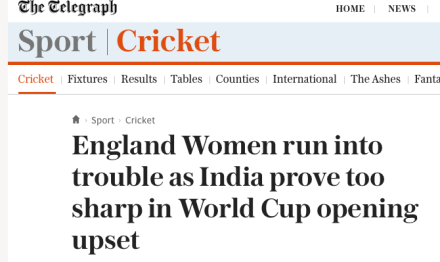
It’s been a rather eventful World Cup thus far (Wednesday’s washout at Derby not withstanding). We’ve even seen two “upsets” – India beating England in the first match on Saturday, and yesterday, India beating West Indies by 7 wickets.

Both times the media have swooped down upon the result and devoured it like hungry ravens. England’s loss to India, in particular, created some stark headlines in the mainstream press (headlines are not, it’s worth remembering, written by the journalists actually reporting on the game):

Screen Shot 2017-06-30 at 13.22.53

Screen Shot 2017-06-30 at 13.23.33

Similarly West Indies have now lost 2 games by very wide margins, and it looks increasingly unlikely that they will make the semi-finals.

But is any of this really so surprising?

England are a young side. They have many weaknesses: one of which is that they are NOT good at chasing. India, meanwhile, have enjoyed an incredibly successful few months – including 10 wins out of 11 ODIs that they had played in 2017 prior to the start of this tournament.

It was always likely, therefore, that England’s game against India would be a potential banana skin for them in this tournament – just read Syd’s piece here.

Unfortunately, given England’s thumping of Pakistan last summer, expectations tended to ignore the reality of the situation.

What of West Indies? Here is another case study of where media hype around a team comes into its own. Because if you take performances by West Indies in isolation – their victory against Australia in last year’s WWT20 final, their status as finalists in the 2013 World Cup – then of course they look like a good bet to do well in this tournament.

If, however, you dig a little deeper, it becomes apparent that West Indies are the most inconsistent side in global women’s cricket. They were about a gnat’s whisker away from being knocked out before the semi-finals of last year’s WWT20. And their ODI performances have been all over the place in the last 4 years, as I pointed out in my preview piece here.

Actually you don’t even have to dig that far. Just listen to what captain Stafanie Taylor said on the eve of this tournament:

“If I don’t play in a game, the team seems to struggle. I have to remind them that you guys do have the belief and you’re talented, and you can do it. A lot of us lack that belief, so it’s [my job] to remind them of that.”

When you take England’s loss to India and West Indies’ poor start to this tournament in context, then, neither are really “upsets” at all (hence my use of inverted commas).

In fact, to label them as such is actually rather lazy journalism. The trouble is that a lot of those covering cricket only bother to watch the finals of women’s tournaments, and / or the few games a year that happen to be televised. Very little attention is paid to what happens in between.

We want more media coverage of the women’s game, of course we do – and this World Cup is doing a brilliant job of that. But what we also need is well-informed journalism, based on a more than surface-level knowledge and understanding of the global women’s game. Unfortunately, as we’ve already seen in this World Cup, we haven’t quite got to that stage yet.

Let’s keep pushing for it all the same.