Thoughts On The Batter / Batsman Debate

The first time my PhD supervisor read a draft of my thesis she highlighted the following quote, from Women’s Cricket magazine’s article on ‘Courtesies’ in 1954:

“If the backing-up batsman leaves his crease before you bowl, it is quite legal to run him out, but it is only sporting to warn him the first time.”

“Interesting choice of language,” she noted. “Why batsman?”

The debate over the choice of language in cricket has recently raised its head again on Twitter, after the commentators at the Women’s World Cup Qualifiers in Colombo queried use of the term “batsman” in the women’s game:

Snehal Pradhan’s view, eloquently expressed in this piece for Wisden India, is that use of the term “batsman” might send a message to young girls that cricket is really a man’s sport, and ensure their continued exclusion.

I’m not convinced – and I’m as feminist as they come.

I, too, was initially surprised to find – when I started researching the history of the women’s game almost a decade ago – that the language used by the English Women’s Cricket Association, from its foundation in 1926, was riddled with references to “batsmen” (not to mention “third man”, “twelfth man” and “man of the match”). This was particularly interesting given that in so many other ways the WCA were the epitome of conservative femininity. They were obsessed with their appearance on the cricket field: there were rules about skirt length and sock colour, and caps were strictly forbidden. When there was a push for players to be able to wear trousers, as recently as the 1990s, there was enormous resistance to a move which would mean that female cricketers “no longer looked like women”.

And yet use of the word “batsman” did not bother them in the least.

Why? Because – just as with the terms “third man” and “twelfth man” – it was seen as part of the terminology of the game. Former international Megan Lear summed it up pretty well in Pete Davies’ book on the 1997 World Cup:

“You don’t call third man third woman, do you? It’s a fielding position, and it’s called third man, and a person with a bat in her hand’s a batsman.”

This was the approach adopted by the WCA in the 1920s; and since then female players have in almost all cases referred to themselves as “batsmen”, indiscriminately using words that – to the casual observer – might look rather gender-specific.

So where has this move towards using “batter” come from? The minutes of the International Women’s Cricket Council tell an interesting story. The issue was first tabled for discussion at the 1985 IWCC meeting, held in Melbourne, and was debated as follows:

“As the media is concerned with altering the cricketing terms for women’s cricket to ‘batters’ etc, a determination by IWCC was requested. After discussion it was agreed that the conventional cricketing terms be retained (eg batsman, manager, 12th man).”

This is extremely telling. The point is that it was the media who insisted on trying to alter the terminology of the women’s game from that of “batsman” to “batter”. It was the media (and still apparently is the media!) who seem determined to pigeon-hole female cricketers into the “batter” box, somehow uncomfortable with the idea of labelling them as “batsmen”. “The press,” the IWCC reported at their subsequent 1987 meeting in London, “still finds difficulty in coming to terms with the present terminology.”

And yet the players themselves rejected this pigeon-holing by the media. To them, “batsman” was the conventional cricketing term – so why should they not use it to describe themselves?

None of this is to deny that language matters. But, by taking up the term “batsman”, the WCA were attempting to ensure that the word (just like actor, waiter and author) would become gender-neutral. In fact the WCA rather anticipated the issues that we seem to be dogged with at the moment: they recognised that trying to insert a word like “batter” into the cricketing lexicon would simply mark the women’s game out as different and strange. Why overcomplicate things? Do we really want those commentating on the women’s game to have to stumble over odd and intrusive new terminology?

I’d rather just take my cue from the WCA founders and continue with the term we’ve got.

In any case, given that we’ve now been using the term “batsman” to describe female cricketers for nearly a hundred years, as far as I’m concerned the WCA have been successful: “batsman” doesn’t suggest a man to me, but any cricketer of either gender holding a bat. Perhaps what we really need to do is to educate the people who don’t know any better about the fact that our sport has its own long and interesting history – and that throughout that history, none of women’s cricket’s pioneers ever felt the need to call themselves “batters”. That’s what I always try and do, anyway, when asked – which I often am – whether it’s okay to use “batsman”.

I guess if people want to use “batter”, then I’m not going to try and stop them (although you will find short shrift with me if you try to use “batswoman” or “batsperson”, I’m afraid). But the people who seem determined to use it – often journalists who pay little attention to the women’s game generally – aren’t those who it really affects.

If the players are okay with it… if the founders of our sport were okay with it… then “batsman” is good enough for me.

Women’s Cricket Survey – Cricket Deal Direct

Cricket Deal Direct are running a survey to ascertain views about women’s cricket in the UK. Please read on if you are interested in participating.

——————-

You can help shape the future of women’s cricket.

With the support of England women’s captain, Heather Knight – and CDD’s other SM Ambassadors – Cricket Deal Direct are spending the next few months finding out as much as they can about the women’s game in the UK, as well as the hopes and fears of current and potential players, with a view to informing debate at all levels about the future of the game.

With input from Heather, as well as a steering group of top women’s cricket stakeholders, CDD designed and introduced The Heather Knight Collection of cricket kit three years ago. But there is much more to think about over and above the availability of specialist women’s equipment.

They would like to hear your views about the women’s game and invite you to complete a short online questionnaire at http://bit.ly/2j4YDPE

To thank you for completing this questionnaire, you will receive a £10 Gift Voucher which you can redeem against any purchase of women’s cricket kit from CDD, and what you say will be added – anonymously – to the voices of other women who share our view that the women’s game will go from strength to strength in the years ahead. Your email details will not be shared with anyone else, and will be securely stored subject to CDD’s internal security policies in line with Data Protection legislation.

179 Not Out: A Tribute To Rachael Heyhoe-Flint

It got so that I knew what was coming when I told someone I was researching the history of women’s cricket. “Aha! Rachael Heyhoe-Flint,” they would say. She was always – without fail – the name on people’s lips.

Sometimes they would ask, “Does she come into your research at all?” I scarcely knew how to answer. Did she come into my research? Of course she did.

When I tried to find other histories of women’s cricket, the closest I came was her wonderful 1976 volume Fair Play, co-authored with Netta Rheinberg. I was surprised, at first, to discover that there were two forewords, penned by Brian Johnston and Colin Cowdrey; I realised later that Rachael’s force of personality was such that they could hardly have resisted when she approached them.

Her autobiography, published in 1978, was endlessly informative but also, in keeping with the great lady herself, filled with humour. Feminism was one of the central themes of my thesis; RHF, in the preface to her autobiography, was pretty open about her own feelings on that topic:

“Challenging male supremacy…doesn’t mean I’m Women’s Lib. Far from it, because I value that bit of underwear they rush out and burn each week with a matinee on Wednesdays. I, too, believe in good support.”

In one memorable meeting with my thesis supervisor, in which I quoted from the Eric Morecambe-penned foreword to RHF’s book – “she rarely eats at home. In fact, her lonely husband has eaten so many frozen dinners that he’s been treated for a chilblained stomach and has had a gas heater fitted in his igloo” – my supervisor struggled to believe that it could have been written by THE Eric Morecambe. It was, of course.

When I went through the Women’s Cricket Association archive, there was an entire folder devoted to the euphemistically-termed “RHF Affair” – the occasion in 1977 when she was sacked from the captaincy and omitted from the World Cup squad.

When I looked for newspaper coverage of women’s cricket, she would inevitably crop up at some point. If the story wasn’t about her, it was written by her – like all those match reports in the Daily Telegraph in 1968/9. Looking for stories about women’s cricket was often like looking for a needle in a haystack; occasionally they would be there, but they were usually very hard to spot. Interviews with RHF, on the other hand, would be whole-page spreads. “Our busts don’t get in the way,” she told one Guardian reporter in 1973, when he asked. “We don’t have to cut them off.” Somehow she still managed to charm him.

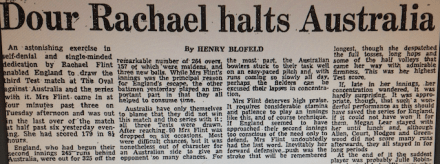
Most recently – just last Monday in fact – I spent the afternoon in the library reading about her incredible innings of 179 not out at The Oval in 1976.

screen-shot-2017-01-19-at-17-17-57

Did she come into my research? Always.

She was such an ever-present theme, in fact, always there in the background, that when she agreed to meet me to be interviewed for the thesis I was rather nervous. They say, after all, that you should never meet your heroes. Thankfully in this instance that adage proved far from the truth. She was interested in my PhD. She was warm, funny, and charming. It was one of the best afternoons of the entire research process. All I can say is that I feel privileged, now, that I got the opportunity to talk to her about her incredible, eventful life before it was too late.

“Let’s rest on 179 for now,” her last email to me, sent just after Christmas, ended. Not a bad final note to strike.

Three Cheers To 2016… Here’s To 2017

Three Cheers To 2016… 

… For giving us the first Kia Super League. This time last year, we didn’t even know who the hosts were going to be. This time last year, with each of the teams starting out from scratch, it could easily have been a flop. It wasn’t.

… For giving us Tammy Beaumont Mark Two. Whatever Mark Robinson said to her, it worked. Back in January her England career looked dead in the water; now she’s being named in ESPNCricinfo’s Women’s Team of the Year and the future looks bright. Incredible, really.

… For giving us a new captain of England who already looks a natural in the role. When her appointment was announced in June, we wondered: was she ready? How would she handle the difficult few months ahead, with the media ready to pounce should England fail to shine against Pakistan, West Indies and Sri Lanka? Three series wins later, and, well, you do the maths.

… For giving us Alex Hartley in an England shirt. ‘Nuff said.

Here’s To 2017… 

… The year of KSL 02 – hopefully even bigger and better than before, especially now we know that Finals Day will be broadcast live on Sky.

… The year of the biggest world tournament women’s cricket has ever seen. Bring on the final at Lord’s on 23 July!

… The year when we find out just how far Mark Robinson’s team are capable of going towards winning a world title at home. Fingers (and toes!) crossed…

NEWS: ECB Introduces New Two-Year Contracts

In another revolutionary move for women’s cricket, the ECB have today announced that the next wave of England Women’s contracts, which come into effect on 1st February 2017, will last for two years.

There will also be a new level of “rookie” contract for “players who sit just above the England Women’s Senior Academy squad, but who have not quite hit the level required to win a full central contract.”

Alex Hartley, having made her international debut against Pakistan this summer and followed it up with an incredible performance in the West Indies, has been awarded a full central contract, while Beth Langston has been awarded a “rookie” contract.

Unsurprisingly, Charlotte Edwards and Lydia Greenway (who both retired from international cricket earlier this year), alongside Becky Grundy, who was not selected for England’s series’ against Pakistan, West Indies or Sri Lanka, have all been removed from the list of centrally contracted players.

The contracts have also increased in value, although the ECB have given no indication of the scale of the pay rise (the top contracts were previously thought to be worth c.£50,000).

The two-year contracts will help to answer recent criticism that the short-term nature of women’s contracts makes it difficult for contracted players to feel any kind of job security.

The full list of contracted players is below:

Tammy Beaumont (Kent)

Katherine Brunt (Yorkshire)

Kate Cross (Lancashire)

Georgia Elwiss (Sussex)

Tash Farrant (Kent)

Jenny Gunn (Warwickshire)

Alex Hartley (Middlesex)

Danielle Hazell (Yorkshire)

Amy Jones (Warwickshire)

Heather Knight (Berkshire)

Beth Langston (rookie contract) (Yorkshire)

Laura Marsh (Kent)

Natalie Sciver (Surrey)

Anya Shrubsole (Somerset)

Sarah Taylor (Sussex)

Fran Wilson (Middlesex)

Lauren Winfield (Yorkshire)

Danielle Wyatt (Sussex)


NEWS: Charlotte Edwards Signs For Hampshire

Following on from the news of Charlotte Edwards’ retirement from Kent after 16 seasons, Hampshire Cricket have today announced that Edwards will, as of the 2017 season, be representing Hampshire Women.

Having captained Southern Vipers – who are based at Hampshire’s Ageas Bowl – to victory in the inaugural KSL earlier this year, as well as being recently appointed a management board director of Hampshire CCC, a move to Hampshire makes logistical sense for Edwards. It will enable her to continue to play county cricket while also committing large portions of her time to KSL.

Bob Parks, Hampshire Women’s Head of Performance and the Southern Vipers Manager, said that he was “delighted  to welcome Charlotte to Hampshire ahead of the 2017 season. She has been exceptional during her time at the Ageas Bowl so far as part of the Southern Vipers and the immense value, experience and knowledge she adds will be key in driving the improvement of women’s and girls’ cricket in Hampshire and across the Southern Vipers region.”

While Vipers triumphed in the KSL, Hampshire currently linger in Division 2 of the County Championship, and will no doubt be hoping that Edwards can spur them on to promotion next season.

OPINION: England’s Year – Win Percentage Doesn’t Tell The Whole Story

Having completed a 4-0 series whitewash against Sri Lanka last week, England have reached the end of their busiest year ever, and the time seems to have come to reflect on the preceding 12 months. The latest press release from the ECB tells us that during 2016, England have played 26 matches across all formats of the game, and won 21 of them – giving them a win percentage of 81%.

Now of course that is pretty impressive. (For the record, in 2015 their win percentage was 50% – 6 games won, 6 games lost across all formats.) But it’s also pretty obvious that a team’s win percentage doesn’t tell the whole story of their year.

For England, given that nearly half of their victories (10 games in total – about 48%) have come against teams we would have expected them to easily beat anyway (Sri Lanka and Pakistan), it’s perhaps more pertinent to look at the lost games – and particularly at the manner in which they were lost.

Of the 5 games in which England were defeated in 2016, 3 of them were lost when chasing. More significantly, all 3 of these losses were matches which, at the half-way stage in their chase, England looked on course to win easily:

1. The WWT20 semi-final. England chasing 132, and at the 10-over mark were 67-1, coasting along. They subsequently collapsed to finish on 127-7, missing out on a spot in the final by 5 runs.

2. The second ODI in the Caribbean at the Trelawny Stadium. England were chasing 148, were 56-3 after 24 overs – and collapsed to 110 all out.

3. The fourth ODI at Sabina Park. Target 224. England reached 95 before losing their first wicket. They were all out for 181.

I’ll mention one other match here which England did ultimately win: the final ODI in Sri Lanka. Nonetheless, it’s pertinent that at one point England were 58-6 in this game, following a rather embarrassing middle-order collapse. They ended up reliant on Nat Sciver and Dani Hazell to bat out of their skins in order to take them to respectable total. Against almost any other team in world cricket, being 58-6 at any point would have been fatal.

When Mark Robinson sacked his best batsman, back in May, his justification was that the rest of the team were “hiding behind” Charlotte Edwards. The argument seemed to go as follows: when Edwards gets out, the rest of the team no longer believe that they have the capacity to win the game. That’s when the collapse happens. Get rid of her, and other players will step up; get rid of her, and the problem disappears.

I never quite bought this argument. And the evidence above seems to suggest that I was right. Old weaknesses die hard, and the tendency for England to collapse in a heap doesn’t seem to have vanished quite yet.

I don’t want to put a downer on what has been a pretty positive 6 months for England – with the rise of Alex Hartley; the exciting debut of Sophie Ecclestone; the return of Fran Wilson from the wilderness; and a new captain in Heather Knight who seems to be relishing the responsibility. But ignoring a problem, pretending it no longer exists, isn’t going to make it go away. It certainly isn’t going to win you a World Cup.

The last time the Women’s World Cup was played in England, back in 1993, England had a coach – Ruth Prideaux – who knew that so much of cricket is mental. She had her players chanting “we will win”, at a time when sports psychology wasn’t even a thing. It paid off. England beat Australia, got to the final, and won it. Afterwards, most of the players recognised that believing they could do it was one of the most crucial factors in that victory.

Do England have the players at their disposal who can win a World Cup? Yes, I’d say they do. But whether they’ve got it in them mentally is another question entirely. So many of their losses in recent years haven’t been to do with talent, but with not being able to withstand the mental pressure that comes when you know you should be able to make the runs, but you just aren’t quite sure if you can do it. That’s when the collapse happens.

Unfortunately for England fans, you won’t get much greater psychological pressure over the course of a career than playing in a home World Cup. It’s going to be a stern test. If I was Mark Robinson, I know what I’d be focusing on this winter – and let’s just say it wouldn’t be cardio training.

CLUB OF THE MONTH: Woolpit Ladies Cricket Club

Here at CRICKETher, we’re passionate about women’s cricket at all levels, including club cricket. It’s our mission to offer coverage of women’s (and girls’) club cricket wherever we can! Our ‘Club of the Month’ feature will focus on one women’s or girls’ club every month (or so!), giving you the lowdown on their highs, lows, and everything in between.

If you’d like to see your club featured here, get in touch – we’d love to hear from you!

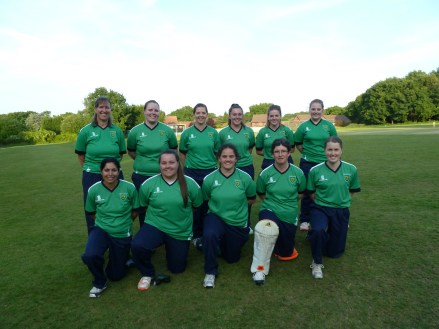
The Woolpit Ladies Cricket team was formed in 2005, led by the future Suffolk captain Alice Parker, who went on to captain the Woolpit team for a decade, winning the Two Counties League in 2013. The junior girls section was created in 2014 and currently has over 35 girls aged between 8 and 15.

Woolpit currently play on a Sunday, in the Two Counties Ladies Challenge (a 35 over league). They are lucky enough to have two pitches at home in Woolpit, allowing them to play matches alongside any one of the 3 Sunday men’s teams, resulting in a good level of support on match days.

Screen Shot 2016-10-15 at 10.39.58.png

Woolpit Ladies Cricket Club team photo – League Winners 2013. Photo Credit: Laura Moss.

The junior girls currently take part in the U13 Girls Suffolk Junior Cricket League and the U11 Boys Suffolk Junior Cricket League Division C. The girls won all bar one of their matches in the latter league and so took the title for 2016.

screen-shot-2016-10-15-at-10-37-16


Screen Shot 2016-10-15 at 10.37.55.png

Woolpit U13 and U11 girls teams after competing in the Woolpit CC Girls Tournament 2016, with the U13’s coming runners-up on the day. Photo Credit: Steve Unwin at DE Photos.

Many of Woolpit’s players have played county cricket, with 10 having represented Suffolk or Cambridgeshire, and are now being ably followed by the juniors, 8 of whom have been called up to play age-group county cricket.

Their current junior county representatives are as follows: Elizabeth ‘Wizz’ Firman, Sophie Utteridge, Millie Gale, Sophie Kubitzek, Lily Tillbrook, Florence West, Isobel Melville-Ross and Cara Swinburn.

The current ladies captain is Natalie Samuels, who has been at the club since 2013 and took over from Alice after her retirement from playing in 2015. She also coaches at the club and will be taking on the challenge of the U15 and U14 girls teams in the upcoming season.

The ladies train on a Wednesday evening during the summer, in Woolpit’s 5 lane net facility located at the club. During the winter, the ladies train at the net facilities at the Victory Ground in Bury St Edmunds, on a Friday night. The junior girls train on a Friday evening during the summer and they alternate between training on the outfield and using the nets as this is also when the junior boys train.

As a club, Woolpit have a good social scene with special nights organised by the committee, such as quiz nights, race nights and the annual awards dinner. They also have ‘girls only’ evenings, whether it is a night in the curry house, a BBQ at the club or a trip to see England play at Chelmsford.

Screen Shot 2016-10-15 at 10.46.16.png

Dressed up watching a T20 at Chelmsford – Ladies Night Out 2014

The ladies team are very fortunate to have an array of helpers, putting the teas out at every home game and then coming to support at away games. There should also be a big thank you to Kathy Parker, for scoring for the ladies and always being the background with organising events, on top of her role as treasurer of the club and as the main sponsor for the ladies team via her business Grange Farm Bed and Breakfast.

The support for the ladies team at the club is continually improving and Woolpit are very proud of their ladies section, as they have been extremely successful over the years. Despite needing some new recruits for this season nearly all the fixtures were played, and that was down to the hard work of current ladies captain Natalie finding people to play. Their junior girls section is also going from strength to strength, and including friendly games they competed in 18 fixtures from April to August.

By the start of the 2017 season, the extension the club are having built to improve changing and kitchen facilities at Woolpit will be completed and the ladies will benefit from this. Woolpit’s aims for next season include enhancing their numbers through a mutually beneficial arrangement with Bury T20 ladies side, developing the U15 girls into a standalone team and challenging for the League title. The men’s section is setting up a 4th team on a Saturday, and this will allow ladies to play in a mixed team, giving them a greater opportunity for participation and improving their own performance through experience.

Woolpit’s annual U13 girl’s cricket tournament will run again on Friday 25th August 2017.

If you are an adult and interested in playing, please email nataliesamuels13@gmail.com. If you want to find out more about junior cricket, for girls aged 13 and under, then please contact Jo Ticehurst: jo_ticehurst@hotmail.com or 07956051992.

NEWS: Emma Lamb Called Up To England Squad

Lancashire’s Emma Lamb has been added to the England squad which will tour Sri Lanka this month, following a successful training camp in Abu Dhabi.

Coach Mark Robinson said that Lamb had impressed in the two internal warm-up games played in Abu Dhabi, as well as during the Kia Super League, when she was the only non-international player to feature among the top ten group-stage run scorers.

Though she opens for Lancashire and Lancashire Thunder, it is likely that if she makes her debut during this series – which begins with the first ODI tomorrow – Lamb will come in down the order, having batted at number 6 in the Abu Dhabi matches.

Her international call-up follows a successful Academy tour earlier this year to Sri Lanka, when she made 85 off 80 balls in a one-day game versus Sri Lanka A and 45 off 29 balls in a T20 against Australia’s Shooting Stars.

NEWS: Alex Hartley Wins Cricket Society’s Most Promising Young Cricketer Award

Four months after making her international debut, 23-year-old left-arm spinner Alex Hartley has won the Cricket Society’s Most Promising Young Female Cricketer Award.

2016 has been an exciting year for Hartley, after she fought her way back into England contention having been dropped from the Academy 7 years ago. Having impressed new coach Mark Robinson, she was called into the squad for the summer series’ against Pakistan, and took her first international wicket in the final T20 at Chelmsford, finishing with figures of 2-19.

She performed brilliantly in the inaugural Super League for Surrey Stars, ending the competition with 8 wickets, including 3-11 against Lancashire Thunder.

Most recently in England’s ODI series in the Caribbean she took 13 wickets at an economy rate of 3.4 – a record total for England in a bilateral series.

Hartley said: “I’m so excited to have won this award – thank you to everyone at the Cricket Society.”

“Looking through the names of previous recipients, it is incredible to think that my name has now been added to that list.”

“The past 12 months have flown by in a bit of a blur, but I have loved every second of it. I’m still learning so much with every match I play, and I now can’t wait to see what 2017 and the possibility of playing in a home World Cup has to bring.”

The award has run since 2002, with previous winners including Nat Sciver (2013), Heather Knight (2010) and Katherine Brunt (2004). It will be formally presented at the Cricket Society’s annual autumn dinner this evening.