Jimmy Hill – Friend of Women’s Cricket

The sad death of Jimmy Hill, described by the BBC as “one of English football’s most influential figures”, was announced today.

Hill will no doubt be remembered for his football punditry, especially on Match of the Day, as well as his reign as chairman of the Professional Footballers’ Association.

Not many will remember him for his relationship with women’s cricket. But I will.

Hill was born in 1928 in Balham. In one interview in 1985, he recalled his days growing up in the 1930s in south London:

“We were a cricketing family. My father often took me to see Fulham. My stepbrother, Wally, played football and cricket… My step-sister, Irene, played cricket for England. They were quite a bit older than me and they dragged me around to watch them.

The first time I went on a train was when Wally took me to see the Redoubtables play cricket at Beddington. It was only three stops down the line but to me going on a train was as exciting as today’s kids would feel about travelling on Concorde.”

Irene Panton never actually played a Test for England, but she certainly played at the highest level in the early organised years of the sport – the Women’s Cricket Association was set up in 1926, five years after Irene’s club, Redoubtables, formed. Sadly she was killed in a motorcycle accident in the late 1930s.

When I heard the news of Hill’s death, it took me back to the time several years ago when, going through the archives of the Surrey-based women’s club Redoubtables WCC as part of my PhD – the club still exists, and now play at Purley CC – I stumbled upon the most amazing series of correspondence between Molly Gilbert, then club secretary, and Hill himself:

October, 1985:

“Dear Mr Hill,

I was so delighted and surprised to read your ‘potted’ autobiography in the ‘Roots’ article in the Sunday Express Magazine. It was great to think that you remembered our Club name and were kind enough to mention it. We are still a club of keen players…When you came with Irene I was Match Secretary. I remember her so well, she was a lovely girl and a great player. Her early death was such a tragedy…

I also remember her friend Joyce Wawman… ‘Panton’ and ‘Wawman’ used to bring a small boy to our matches who may have been the brother of either of them, ie you.

I have a small snapshot of some of our members at that time accompanied by a small boy (Irene Panton is in the picture). We would be most interested to find out if we have a famous portrait or not. I think Irene and Joyce joined us in 1932 and we have five ‘old girls’ still interested in the Club, one as President (Miss S Swinburne OBE for Services to Women’s Cricket), two as vice-presidents, myself as Secretary (since 1935!!) and one other and we all remember Irene well.”

December, 1985:

“Dear Molly,

Thank you for your letter following ‘Roots’. Forgive my late reply… I’m certain I was the young boy in the photograph. Joyce Wawman was a kind of cousin who lived with us and who continued to take me around even after Irene’s death.

I remember your name well and Sylvia Swinburne too… Thank you for writing and do have a very happy new year.

Your sincerely, Jimmy (Hill).”

January, 1986:

“Dear Mr Hill,

Thank you so much for your letter… the Women’s Cricket Association is 60 years old this year and they are arranging a celebration match between two teams made up of first class players from all over the country. The match to take place at Bramley Cricket Club on Sunday 8th June, afternoon… We are hoping to have several famous people at the match (to draw the crowds) and I do hope you still have enough love of the game to come along and meet present day players. If you can possibly spare the time, we should all be delighted to meet you.”
Screen Shot 2015-12-19 at 14.54.25

February, 1986:

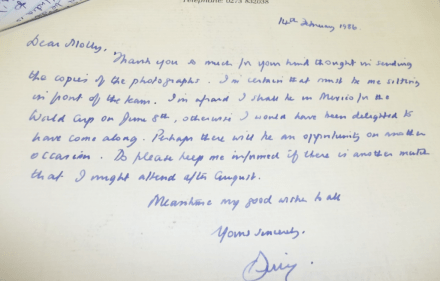
“Molly,

I’m afraid I shall be in Mexico in the World Cup on June 8th, otherwise I would have been delighted to have come along. Perhaps there will be an opportunity on another occasion. Do please keep me informed if there is another match that I might attend after August.”

Sadly the correspondence ended there. I like to think that perhaps Hill did, though, attend another Redoubtables match or two after his trip down memory lane.

So there you have it. Jimmy Hill, 1928-2015: football pundit, player, chairman, manager and analyser…and friend of women’s cricket.

OPINION: Question Marks Over Super League As Sussex Fail To Bid

It will be 2016 by the time that we find out who has been selected to host the six inaugural Women’s Cricket Super League sides. Yet even as we speak the bids are being mulled over and potential hosts interviewed by a panel consisting of ECB Chief Executive Tom Harrison, Director of England Women’s Cricket Clare Connor, and a mysterious third “independent” panel member.

Currently, CRICKETher are aware of the following bids:

  • Middlesex and MCC
  • Lancashire
  • Hampshire (supported by Sussex, Berkshire, Oxfordshire, Wiltshire, Dorset and the Isle of Wight)
  • South West (Somerset CCC, Gloucestershire CCC and the University of Exeter)
  • Surrey

Yet there is one significant omission from the list: Sussex.

For the past 15 years, since the inauguration of the women’s county championship in its current form, Sussex have been one of the leading counties in women’s cricket, with six Championship titles to their name, and most recently finishing the 2015 season as county T20 Champions.

Sussex’s success has been founded at least in part on the support that Sussex Women’s Cricket Association has received from the Board – including access to the top facilities available at Hove.

This summer, Hove staged the second Women’s Ashes Twenty20 match under lights, with a record crowd of 5,750 turning up (let’s not remind ourselves of what the crowd actually witnessed, please!)

Yet while Sussex had earlier submitted an Expression of Interest, they did not subsequently follow this through with a bid to host their own Super League side.

(While Sussex officially “support” Hampshire’s bid, as far as CRICKETher can tell their involvement should Hampshire’s bid be successful will be minimal.)

Sussex refused to comment on their reasons for deciding not to place an independent bid when approached by CRICKETher. Reading between the lines, though, it does seem to indicate a certain level of scepticism about the potential success of the Super League, not to mention the financial implications of agreeing to host a team.

Surely a county which has experienced so much success with regards to the women’s game would otherwise have been biting the ECB’s hand off?

Whether or not this scepticism is shared by other counties is difficult to say, but the fact that the ECB have refused to say exactly how many bids were eventually submitted – despite previously having been open about the number of Expressions of Interest (28) – is presumably some indication that fewer bids were received than might have been hoped for.

Clare Connor has recently said that the Super League is causing her “sleepless nights” – and this might be one of the reasons why!

CLUB OF THE MONTH: Wanstead CC

Here at CRICKETher, we’re passionate about women’s cricket at all levels, including club cricket. It’s our mission to offer coverage of women’s (and girls’) club cricket wherever we can! Our ‘Club of the Month’ feature will focus on one women’s or girls’ club every month, giving you the lowdown on their highs, lows, and everything in between.

If you’d like to see your club featured here, get in touch – we’d love to hear from you!

The ladies section at Wanstead CC has its roots back in 2002, a time when the club’s current Head of Women’s and Girls’ Cricket Pauline Osborn had sons who were members of the club’s colts section. Several girls, whose brothers were club members, decided that they wanted to play themselves. “We agreed that there was no reason why girls should be excluded,” Pauline recalls. “Wanstead always strives to do things properly and with girls playing it was decided that there should be female coaches to support them – which is how I quickly found myself on an ECB Level 1 coaching course!”

Once it became known that girls were welcome, numbers swelled, and it was decided to form a women’s section too – initially made up of the mums and aunties of the girls who were playing, as well as Pauline herself. They named themselves the Wanstead Heronettes.

pik

In 2007, after a few seasons of struggling to find local clubs to play “friendlies” against, Pauline was instrumental in the Wanstead Heronettes applying to join the recently-formed North London Women’s Cricket League. Since then, Wanstead have won the league on several occasions – doing so in 2011 and 2012 without losing a game!

They currently play every Sunday at the club’s second ground at Nutter Lane, as well as occasionally at the club’s main ground at Overton Drive. Current captain and coach Saba Nasim says that their facilities are very good, with the Overton Drive square recently having been redone, and new nets installed a few years ago.

About 40-50 girls are registered players at the club and the club offers both softball and hardball cricket. Saba says that the upcoming girls section has really boosted players for the ladies side and that they regularly use their youth talent to play in league fixtures. Many of the Wanstead girls currently play for Essex age-group sides.

pik 2.jpg

Unusually for a women’s club, Wanstead have both female coaches and female umpires. Pauline herself is now a level 2 ECB coach and a qualified scorer and umpire (as well as being manager of the side and chairman of the North London League). And team coach Saba – an inspirational role-model for many of the girls she coaches – recently won the ECB’s Coach of the Year Award at the Asian Cricket Awards.

The club are looking forward to their annual pre-season 2016 cricket tour to La Manga, Spain and aim to get more of the younger girls playing in competitive league cricket for the ladies team on a regular basis.

Wanstead are a friendly club and welcome players of any ability young or old. If anyone is interested in joining then please do contact captain Saba Nasim on sabanasim@hotmail.com.

OPINION: Robinson Talks The Right Talk

Two weeks on from the announcement that Sussex’s Mark Robinson has been appointed Head Coach of England Women, the dust is beginning to settle.

Robinson will now have met with captain Charlotte Edwards, and will be gearing up for his first encounter with the England squad at Loughborough before Christmas, as he meets the women whose development he will be responsible for over the coming months (well, most of them – some are already in Australia or will soon be heading that way, bound for the inaugural WBBL).

How will he fare? The worry with airlifting in a coach who has worked almost exclusively in the men’s game is always going to be that they fail to understand the unique needs and challenges of women’s cricket. But CRICKETher – as we tweeted at the time – were uniformly impressed with Robinson and are optimistic about the future with him at the helm.

Why? Because, for someone who openly admits that he knows very little about women’s cricket, Robinson’s intuitive sense about the game is spot on.

This was clear in the press conference a fortnight ago, at which some journalists – perhaps inevitably, given that Robinson has recently interviewed for the position – seemed to see his appointment as a mere stepping-stone to the “real job”, coach of the England men’s team. Robinson, though, was unequivocal in his response:

“The women’s game stands by itself now, it shouldn’t be compared. It has its own identity, its own stage of development, and I want to play my part in continuing the fantastic work that’s gone on before, the momentum.”

CRICKETher’s mission statement, from the lips of the man of the moment himself!

And Robinson’s commitment to all levels of the game is also very evident. On the day of his appointment he told CRICKETher: “Instinctively I want to help as much as I can where I can…We’ve got to make sure that [the hundreds of coaches round the country] feel joined up to the top as well. I’ve got to do my bit to make sure that the women’s game keeps moving in the right direction.”

He had already spent time working with Sussex girls alongside coach Charlotte Burton – whose commitment to the game he praised effusively in his first press conference – and will no doubt be looking to her for some advice about his new role.

While much of the critique of the ECB from those involved in the women’s game has come from those at grassroots level, it seems they can be reassured by Robinson’s attitude. CRICKETher certainly is.

If Robinson has not yet had to walk the walk –  that will have to wait until England’s arrival in South Africa in February, and beyond that the World Twenty20 in India – he certainly talks the right talk…and that is a pretty good start!

NEWS: England’s Enid Bakewell Wins Lifetime Achievement Award

Former England international Enid Bakewell was last night honoured with the Lifetime Achievement Award at the 2015 Sunday Times and Sky Sports Sportswomen of the Year Awards.

The award “recognises a lifetime of sporting success”, and Bakewell, who averaged nearly 60 with the bat and took 75 wickets over her 14 years as an England all-rounder, is a worthy recipient.

Born Enid Turton in Newstead, Nottinghamshire in 1940, she first played cricket aged 9 in a field in the village with some of the local boys. Several years later, while attending the local grammar school – where they were not permitted to play cricket – a teacher recommended that she join a nearby club in Nottingham, advice she duly accepted.

She went on to study at Dartford College of Physical Education (now part of the University of Greenwich), which was a hotbed of women’s cricket, producing many future stars of the game including Rachael Heyhoe-Flint. This enabled Bakewell to continue with her sport of choice, and she toured Holland with a Young England side in 1959 while still at Dartford.

Her full England debut came in December 1968 at Adelaide on England’s tour of Australia and New Zealand. She hit 113 in that match, and went on to score over 1000 runs and take more than 100 wickets on the tour – the first woman to ever achieve the feat. It earned her a full page feature in the 1970 edition of Wisden – the first time ever that a woman had been awarded such exposure.

It was a remarkable achievement partly because by this time Bakewell was married and the mother of a two-year-old daughter. In order to tour, she had to leave her daughter behind in the care of her husband and parents, at a time when it was exceptionally difficult to combine motherhood and playing international-level sport.

She went on to represent England in the first ever Cricket World Cup in 1973, and played a large part in their victory against Australia in the final at Edgbaston, hitting a century and taking 2-28 as England triumphed by 92 runs.

Six years later, in her last Test against West Indies, she became the first England player, male or female, to score a century and take ten wickets in the same match. By this time she was a mother of three young children, but she continued to play international cricket until the 1982 World Cup in New Zealand.

After retiring from international cricket, she remained involved with the Nottinghamshire and England set-ups, eventually going on to coach a Junior England team which included future stars Arran Brindle (then Thompson) and Charlotte Edwards.

Now aged 74, she can still be found shouting encouragement from the boundary at most England matches, both at home and abroad. Even more remarkably – as CRICKETher reported earlier this year – she is still playing regularly, both for her club Redoubtables and for MCC.

She was named one of Wisden‘s 5 greatest ever female cricketers in 2014, and this latest honour is undoubtedly thoroughly deserved. Congratulations Enid!

CLUB OF THE MONTH: Orpington Nomads

Here at CRICKETher, we’re passionate about women’s cricket at all levels, including club cricket. It’s our mission to offer coverage of women’s (and girls’) club cricket wherever we can! Our ‘Club of the Month’ feature will focus on one women’s or girls’ club every month, giving you the lowdown on their highs, lows, and everything in between.

If you’d like to see your club featured here, get in touch – we’d love to hear from you!

Kent Nomads WCC were formed way back in 1948, by a group of women who wanted to play organised cricket matches. They were originally a wandering side, before finding a home at Orpington Cricket Club over 40 years ago. In the 1990s they merged fully with Orpington CC, and changed their name to Orpington Nomads WCC. One of their founding members was Cecilia Robinson, former captain of Kent and England.

Orpington Nomads 2

One of the oldest women’s cricket clubs still in existence, Orpington Nomads have a whole host of former members who were leading lights of the game in the Women’s Cricket Association days. The list includes Norma Izard (England Manager and last ever Chairman of the WCA, who oversaw the merger of the WCA and the ECB in 1998), Sheila Hill (Member of the MCC Laws Committee until very recently, who oversaw the last rewriting of the MCC Laws of Cricket), former England captains Sue Goatman and Mary Pilling, and too many other internationals and county stalwarts to mention in a short article.

At their home ground they have two squares, with the likelihood of a third being added soon, meaning that they are always able to get a pitch on a Sunday. They have a fantastic 4-lane enclosed outdoor net facility, replacing two decrepit nets destroyed by the snow a few winters ago. They have sole use of the facility on Tuesday nights from 7pm until dark, when they can also use the practice wicket on the square and the roll-on cage. They also have a great bar lady who will open up whenever they ask her to!

Orpington Nomads 1

Though they do not have a girls section, they welcome all ages and all experience to the club, with members ranging in age from 17 to 50+.

They currently play in the Women’s Cricket Southern League, and have played in all leagues since women’s cricket introduced them. As current secretary Caroline Barrs puts it, “We play competitive cricket but always for fun. We like to win, but it is not the end of the world if we do not!” They always try to give everybody a go at either batting or bowling in their games.

The club also enjoys club outings and socials; Caroline tells CRICKETher that “the last social was to Greyhound racing, suggested by one of our members who said ‘shall we go dogging – it’s great fun’!”

Caroline herself has been involved in women’s cricket since the 1970s and represented England between 1988 and 1990. She says that women’s club cricket has changed immensely in the time since Orpington Nomads was formed: “We used to play friendly cricket both days of the weekend, most of the season – up to 30 games in a season! Now with league cricket we are lucky to get 14 games. The demographic of those playing has massively changed too: there used to be many adults in their 20s and 30s playing, but teams often mostly consist of 15 – 18 year olds now.” However, “in the early days there were very few clubs,” she says. “There are a lot more now.”

Orpington Nomads 3

Back in the days when women’s club cricket was played in skirts…

Sadly Orpington Nomads are currently struggling for players, so if there is anybody out there looking to play cricket with a friendly group of women who enjoy a good laugh, of any age of experience, get in touch with Caroline Barrs (cjbarrs@yahoo.co.uk). They’d love to hear from you!

EXCLUSIVE: Tennis Star Ashleigh Barty Set For Junior Coaching Role With Cricket Australia

CRICKETher can exclusively reveal that former Junior Wimbledon champion Ashleigh Barty will be acting as joint coach for the Cricket Australia XI team at the U15 Female National Championships, to take place at Hobart next month.

Barty will be working alongside Hobart Hurricanes coach Julia Price, who last season took the Tasmanian Roar side to a 4th placed position in the state T20 competition.

It had already been announced that Barty would be participating in the inaugural WBBL for Brisbane Heat, after attending a Southern Stars training camp earlier this year and, more recently, undergoing training with Queensland’s WNCL team, Queensland Fire.

Barty has been quoted as saying that she was attracted to the idea of team sport because: “There’s never a lonesome moment on the field if you’re struggling.”

Now it seems that Cricket Australia are looking to utilise her experience in junior tennis coaching to help talented cricketing youngsters too. As an international athlete who has trained at the highest level, it is also the case that Barty will be able to provide guidance for a new generation of girls coming through into a cricket set-up which is now increasingly professional, with ever-higher expectations of its players.

Cricket Australia’s National Coaching Manager Matthew Betsey told CRICKETher:

“Ash is an experienced athlete with a tennis coaching background and we want to use these skills alongside a ‘cricket’ coach in Julia Price.  It will also help Ash understand the game more deeply before she plays in the WBBL for the Brisbane Heat.”

The WBBL kicks off on Saturday 5th December, with Barty likely to feature in Brisbane Heat’s double-header against Melbourne Stars at the Junction Oval.

Keightley Aiming To “WACA” New Talent Into Shape

It was announced last month that England Academy Head Coach Lisa Keightley would be leaving the role she had done since early 2011 in order to return to coach in her native Australia.

What exactly will Keightley be doing Down Under? Her main role will be with the Western Australia Cricket Association (WACA), heading up their Female Talent Development programme. While she will have work to do – the Western Fury have underperformed in previous seasons – she also has a great deal of talent at her disposal, with the squad having been strengthened this year by the addition of Australian openers Nicole Bolton and Elyse Villani.

But CRICKETher have learned that Cricket Australia will be harnessing Keightley’s talents at national level, too. Next month at the U15 Female National Championships in Hobart, she will be acting as a coach mentor for all State coaches involved in the set-up. Following on from that, she will be coaching the Cricket Australia XI in the U18 Female National Championships, to be held at Canberra in January: effectively the equivalent to her recently-vacated Loughborough role.

While England are therefore left seeking both a head coach and an Academy coach – with Keightley’s replacement not to be selected until the New Year at the earliest – it seems that England’s loss is, for the moment, Cricket Australia’s gain!

OPINION: Are the new ICC rankings totally meaningless?

Earlier this month the ICC announced their new rankings system for women’s cricket, which combines results from all three formats of the game into one table, to produce the Definitive List of where each team sits in relation to the others.

As we pointed out on CRICKETher at the time, the fact that Australia lead the way is no surprise, but below that there are some quite interesting placings!

The new ranking system has been devised by David Kendix, the same statistician who calculates the men’s rankings. While his exact methodology has not been revealed, we are told that equal weighting has been given to the Test, ODI and T20 formats.

There has been a lot of scepticism about the merits of a system which combines all three formats, especially given the dearth of Test match cricket currently played in the women’s game.

In some ways, therefore, the new ranking system is not hugely meaningful. In fact, CRICKETher would strongly advise that you follow Martin Davies’ new ODI and T20 rankings available over on Women’s Cricket Blog – England are currently at the top of the T20 rankings, and Australia are heading up the ODI rankings. These will be updated after every game and are an excellent reflection of the true state of affairs in depth.

Having said that… the ICC should be given some credit here for what they are trying to do: promote the women’s game. Having a single rankings system simplifies this process. It gives meaning to matches like the recent Pakistan-West Indies ODI, whereby seventh-ranked Pakistan pulled off an unexpected and exciting win against fifth-ranked West Indies. And it gives some context to bilateral series’ which, unlike the women’s Ashes, often still go under the radar.

Giving the media something to latch onto, and helping them create coherent stories and narratives about the women’s game, can surely only help women’s cricket in the long-run. So, even if it is via an oversimplified methodology, CRICKETher think that there’s room for both the ICC rankings and the more sophisticated WCB ones.

NEWS: ICC Announces Details of 2017 World Cup

The ICC have today announced details of the prize money and new format for the next World Cup, to be hosted by England in 2017.

Prize money for the 2017 tournament will now stand at $1 million, a huge rise from previous tournaments. While prize money for the men’s event (currently £2.5 million) is still significantly more, the ICC Board has also agreed that the 2021 event, in New Zealand, will be worth $1.2 million overall, and this therefore does appear to be a step in the direction of equal prize money for both sports.

Additionally, it has been announced that the 2017 World Cup will be an eight team round-robin competition, with the top four sides progressing to the semi-finals, followed by the final. This guarantees each team at least seven matches, and is a change from the 2013 tournament format, whereby the 8 participating teams were split into two groups and played 3 games each, before the top sides progressed to the “Super Sixes”.

Lastly, the ICC has confirmed that the Women’s Championship, which sees all of the top 8 teams in the world play each other in order to determine who automatically qualifies for the next World Cup, will continue after 2017 into a second cycle. The Championship has effectively acted as a Future Tours Programme for the women’s game since it was introduced in 2014, and its continuation is welcome news for the sport.