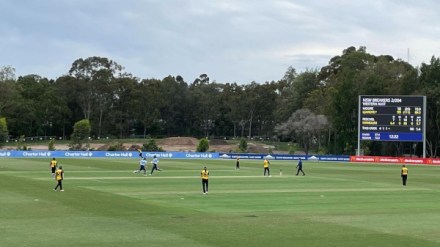
NSW v WA

WNCL: NSW v WA – Jailbreak for NSW in Thriller at Cricket Central

By Helen Maynard-Casely

A bleary cloudy day greeted spectators at Cricket Central, probably matching the weary badgers who had watched Australia’s wobble and recover against Pakistan late the night before. But this game was game much brighter than the dull clouds skirting the sky: NSW won the toss, elected to bat, and so started a proper WNCL classic.

The NSW team was unchanged from the side that won twice against Victoria in round one, while WA made one change from their travails against Queensland. This was due to Heather Graham’s call-up to the national side, meaning Rebecca McGrath gained her first WA cap.

WA started well, pinning down openers Mack and Wilson with the new ball, the culmination of which was an easy catch by Hinkley at mid-on of Wilson off Peschels’s bowling. This brought Anika Learoyd to the middle, who with Mack set in to build a sizable partnership. Overs of worker-like rotation of the strike kept the scoreboard ticking over, and by drinks after the 17th over, the WA bowlers didn’t quite know what to do.

Spinner Manolini came on, but Mack and Learoyd continued to match each other both in runs scored and balls faced – bringing up their fifties in overs 23 and 24 respectively. Following a mini-drinks break after the 25th over it was clear the batters wanted to move things on, with both Mack and Learoyd advancing down the wicket – intimidating and pushing up the run rate. The conclusion came in the 29th over with Mack being caught at mid-off by a reaching Piparo off McGrath’s bowling. She returned to the pavilion with 69 runs off 85 balls.

Learoyd and Claire Moore picked up where Mack had left off, running singles and giving WA fielders quite the run around. Learoyd pushed into the 90’s courtesy of a square leg boundary, looking relatively untroubled by the bowling attack throughout, even after catching an earlier delivery on the glove. She powered to her century with consecutive boundaries. However, soon after Learoyd was run out at the non-strikers end, bowler Ebony Hoskin tapping the return from Moore onto the wicket – a whimper of an end to an excellent batting innings. Moore continued in a similar vein, lofting a massive 6 that had the WA fielder vaulting the advertising hoarding to retrieve. She fell just after reaching 50, caught at deep mid-on. An entertaining cameo partnership between Georgia Adams and Maitlan Brown at the end, saw the total inflate to 298 after 50 overs.

Pescel was the pick of the WA bowlers, her nippy skiddy balls returned an excellent economy of 2.62 from her 8 overs, leaving spectators slightly perplexed why Hoskin (economy rate 5.2) and Mills (6.60) were bowled out in her stead. New cap McGrath picked up two wickets, but NSW were largely able to bat as planned with WA unable to put them under enough pressure. 299 was the target.

After the innings break WA’s openers got off to a flying start, making the most of the powerplay, and getting to 56 runs by the end of the 9th over. Maddy Darke in particular drove several boundaries off the opening seam bowling. The wily spin of Samatha Bates in the 9th over brought about the change, with Chloe Piparo caught at mid-off by Lauren Kua executing an excellent running catch. This brought Mikayla Hinkley to the crease. Piparo’s wicket at the end of the powerplay began a swing of momentum back to NSW, as Caoimhe Bray and Bates teamed up with some tight bowling to slow WA’s run rate down. By the 16th over the strain showed on the WA batters with Hinkley hampered by some serious cramping. She batted for two more overs before retiring hurt on 21.

Hinkley was replaced by Mathilda Carmichael, who formed a steady partnership with Darke, working similarly to Mack and Learoyd and keeping the required run rate in check. At 25 overs, WA were neck-and-neck with the NSW score (each being 126/1 at this point), and again at 30 overs (157/1 vs 157/2 for NSW at the same point). This matching continued to over 40 – WA were 213/2 after losing Darke for 73 to a sharp direct hit run-out from Kua, and nothing separated them from NSW who were 214/2 at the same point.

Tension built though the last 10 overs, the school holiday vibe of the first innings into the second (kids running everywhere, liberal shouts of ‘great shot’) waned, and finger nails started to be bitten. The 40th over was a flashpoint with the dangerous Bhavisha Devchand run out on 33 by some brilliant work by Tahlia Wilson behind the stumps, despite a slightly wayward throw from fielder Kua. Any relief that NSW may have felt at this point disappeared as Hinkely marched back to the crease – cramp or no cramp she was there to get her team over the line. Teaming with Carmichael, they wrestled the momentum back to WA for the next few overs. The grit particularly from Carmichael batting was evident, but she fell to a full toss from Brown, chipping over her shoulder to a waiting Bates.

McGrath joined Hinkey, who was limping again by this stage, and each took on Brown’s bowling, with McGrath getting a 6 into the trees. Hinkley brought up her 50, and by the start of the 49th over, with 19 needed off 12, it looked like WA were going to make it. But with one shot too many, Hinkley was caught at square leg by Sarah Coyte, one of two wickets during an excellent penultimate over from captain Cheatle. This was the final stumble for WA, and after a tidy final over from Bates, they finished just short on 291.

It was a match for the ages – the closest WNCL match so far this season – WA’s heroic efforts meaning that Saturday’s second match-up could be a classic again.

Helen (Crystallised Cricket) is a writer based in Dharug and Gundagarra country, and here is writing about a game played on Dharug country. She acknowledges the traditional owners of the lands that she writes from.

WORLD CUP: England v Bangladesh – Charmed Knight Invokes the “Power of Three”

England might have recorded one of the largest margins of victory in their history against South Africa in their opening match last week, but against Bangladesh it was so nearly a different story – a charmed innings of 79 from former captain Heather Knight being the only difference between the teams.

Knight was forced to invoke the “Power of 3 (Reviews)” – dismissed thrice by the on-field officials, she survived each time by appealing to the third umpire.

In the third over of their chase, with England already one down having lost Amy Jones, Knight was given out after the ball squeezed between bat and pad and was taken by the keeper. It was unclear whether the on-field dismissal was for caught behind or LBW – Knight indicating that the ball had hit her pad, suggesting she thought she’d been given out caught, but the TV umpire appeared to think the on-field decision was LBW. Regardless, the TV umpire concluded that there was no LBW case to answer, but also that there was insufficient evidence that she’d hit it to give her out caught, with the Ultra-Edge spike clear but not clearly attributable to the ball hitting the bat. (And if you are confused… welcome to the club!)

Then in the 7th over, with England Tammy Beaumont have joined Jones back in the pavillion, Knight was given out LBW on 8; but was reprieved once more by the third umpire – this time uncontroversially, with the ball clearly missing the stumps according to the ball tracking system.

The third review was perhaps the most disputable. In the fifteenth over, Knight drove towards extra cover and appeared to be spectacularly caught by a low-diving Shorna Akter. Knight (who probably had the best view in the ground) was walking off when the on-field officials asked for the catch to be double-checked, with the third umpire re-adjudicating the decision apparently on the grounds that it wasn’t clear the ball hadn’t touched the turf, even though all the available angles seemed to suggest Shorna’s fingers were underneath it.

Whilst the middle decision was obviously correct, the other two were much less obviously so, and if they’d gone the other way, England could have had few complaints. But Knight survived, and dug in for one of the slowest half-centuries of her career; and although England’s other batters fell one-by-one, a partnership of 79 with Charlie Dean got England the win they needed to go top of the table… albeit partly because Australia dropped a point to the rain on Saturday; because (as I warned on last week’s vodcast) England’s Net Run Rate was only ever going to go down from where it was following the South Africa result, and it is now already lower than Australia’s.

Bangladesh will be pleased to have pushed England so close in a match they definitely didn’t expect to win, but they will also doubtless be disappointed that they got so close to what would have been a famous demon-killing but couldn’t strike the final death-blow.

So often the smaller teams go into these matches with a survival mentality, but Sharmin Akhter got Bangladesh off to a bright start, striking at a run-a-ball early in the powerplay. However, with the loss of a couple of wickets Bangladesh shut up shop and had crawled to 121-5 after 40 overs.

Bangladesh 178 v England #CWC25 🏏

CRICKETher (@crickether.com) 2025-10-07T12:41:38.301Z

But a strong death phase added 57 runs, 43 of them from the impressive bat of Rabeya Khan, to get them to a total which proved enough to make it tricky for England.

It was a result which told us far more about where England are than the South Africa match, which was very much a self-inflicted implosion on the part of the South Africans. Against Bangladesh, England wobbled badly, got lucky with some DRS calls, but ultimately came through. They now sit atop the table thanks some marginal umpiring calls against a team who expected to win two games in this tournament at best. Of course, the fates always have a part to play in these things; but if England are going to stay on top, they need to find a more convincing way of winning than drawing magic circles in the sand.

WORLD CUP: England v South Africa: Oftentimes it doesn’t feel so glamorous to be South Africa

I woke up at 5am this morning full of excitement for a day I’d been looking forward to for months – I refer, of course, to the release of the new Taylor Swift album Life of a Showgirl on which the American singer reflects that “oftentimes it doesn’t feel so glamorous to be me”.

I know how you feel Tay! Like… one time back in 2017, I was one of a handful of people schlepping up to oh-so-not-very-glamorous Leicester to watch a Women’s World Cup match between South Africa and West Indies. And let’s put it this way – it wasn’t one of the fixtures everyone was clamouring to cover!

Nonetheless, it turned out to be one of the most memorable matches of the tournament – South Africa bowling West Indies out for 48 on their way to one of the fastest victories in World Cup history, winning with 262 balls to spare.

Manifesting 2017 today! 🏏 #ENGvSA

CRICKETher (@crickether.com) 2025-10-03T09:18:08.952Z

Appropriately, I was wearing my official 2017 World Cup press polo today, to watch from the sofa as South Africa were again involved in a low-scoring mugging; but this time the boot was on England’s foot, and South Africa were the victims.

England will have been mightily relieved to win the toss and have the opportunity to insert South Africa – there has been big pressure on the team batting first in the opening matches of this World Cup, and we’ve seen wobbles from both India (124-6 at one stage) and Australia (128-5) already this week, whilst Pakistan were skittled for 129.

With Nat Sciver-Brunt having admitted in the pre-match press conference that she wasn’t going to be able to bowl 10 overs, somewhat contradicting what coach Charlotte Edwards had said the day before, England’s selections were driven partly by the need to find some extra overs from somewhere, meaning Alice Capsey and Emma Lamb getting the nod over Danni Wyatt-Hodge, who to be fair has some decent experience running drinks in India, having spent an entire WPL doing it for UP Warriorz in 2024!

But neither Capsey nor Lamb were required, with either bat or ball, as South Africa imploded in the 30° heat of Guwahati.

After a bit of a loosener of an opening over from Lauren Bell, Linsey Smith picked up the ball at the other end, and within two deliveries she had South Africa in trouble. Natalie Germanos on comms called it “the big wicket”, because… that’s what she always says! But on this occasion she was right, with captain Laura Wolvaardt being the first dismissal – a classic Linsey Smith Caught & Bowled.

In her following over, Smith took another – Tazmin Brits, bowled by a drifting quicker delivery that ended up somewhere between an arm-ball and an inswinger.

By the time the 3rd wicket fell, leaving South Africa in what looked like real trouble at 17-3, Charlie Dean was not so much celebrating in the England huddle as shaking her head in disbelief, whilst I texted a friend that South Africa must have been wishing they had selected Tumi Sekhukhune so they could just send her in to block out the next 45 overs.

The wobble was well and truly happening, as it had for both India and Australia; but unlike those two, South Africa could not pull out of the skid they were in. One by one, they fell, mostly to pretty basic bowling – simply bringing the stumps into play, and letting the ever-increasing pressure do the hard work.

Only Sinalo Jafta (22) made it to double-figures, and she should have been stumped by Amy Jones on 8 – a relatively straightforward chance, of the sort which you’d generally expect Jones to be taking in her sleep.

It was one of two or three mistakes from the England keeper, who for the first time since she took the gloves following the retirement of Sarah Taylor, might be starting to feel some selection pressure, at least in terms of her keeping, with the brilliant form of Rhianna Southby. Southby was always capable of moments of brilliance, but is now backing them up with the more bread-and-butter sustained spells of competence which you need from a keeper in 50 over cricket – hence her “selection” as a non-travelling reserve for this tournament.

In the end, South Africa were bowled out for 73. It was 25 more than West Indies had made in Leicester that day in 2017, but I don’t suppose that even if it occurred to any of them (and several of them were there that day, including Wolvaardt and Marizanne Kapp) it was much consolation. Oftentimes it doesn’t feel so glamorous to be South Africa, and this time was one of those times.

South Africa 69 v England 73-0 #ENGvSA 🏏

CRICKETher (@crickether.com) 2025-10-03T12:25:49.729Z

Having got themselves into the position they did, it was important for England to go out and back up the bowling with a 10-wicket win, as South Africa had done in 2017. There were obviously a few nerves, and Marizanne Kapp threatened to  make it interesting with her usual fire. England didn’t go particularly hard, and in terms of runs scored, the teams were even-stevens at the end of the powerplay – England on 39 where South Africa had been 38; although of course the difference was that South Africa had lost 5 wickets!

In what could turn out to be a critical moment in England’s progress through this tournament, Amy Jones was dropped by Masabata Klaas off her own bowling, just as she was looking to accelerate. Jones is a Confidence Player™ and if she’d gone then, there could have been ramifications well beyond this match; but she went on to finish strongly on 40* hitting back-to-back 4s off Ayabonga Khaka as England reached for the… well, it is hard to call 73 “the stars”, but you can only chase the total you are chasing, and England will be heading now into a run of (theoretically!) easier games against Bangladesh, Sri Lanka and Pakistan with some momentum behind them.