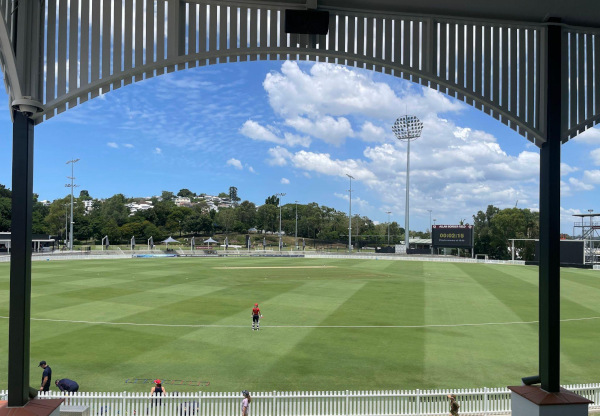
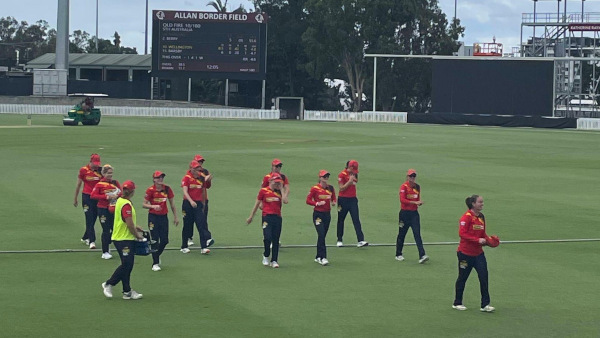
One of the interesting things to note about the WNCL as a competition, is the pairing of matches with the same opponents facing each other twice during a round, with only one day in between. The second rubber of each match-up can be an interesting study of who has taken on the lessons from the first game, studied the opponent and found the chink of armour to exploit in the second. After a close first game on Thursday, it was the battle of the analysts during the rest day to find what to target when Saturday rolled around.
A stonker of a day greeted the players – Sydney’s weather had cleared, the pitch bathed in bright sunshine. Was this also going to bring about a change? NSW won the toss, and decided to keep with the plan that had (narrowly) won the first game – putting out an unchanged side. WA swapped Shay Manolini for Charis Bekker, a right-hand bat but left-hand spin allrounder into their side.
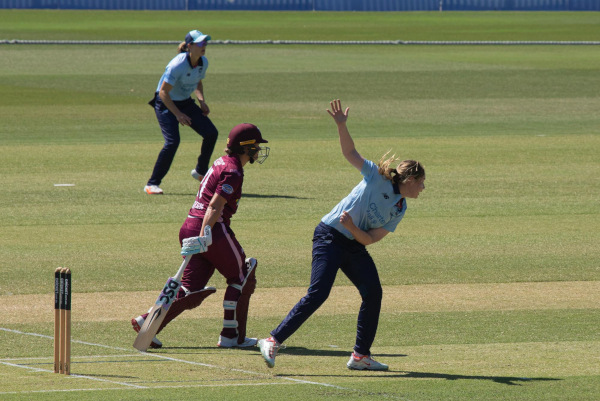
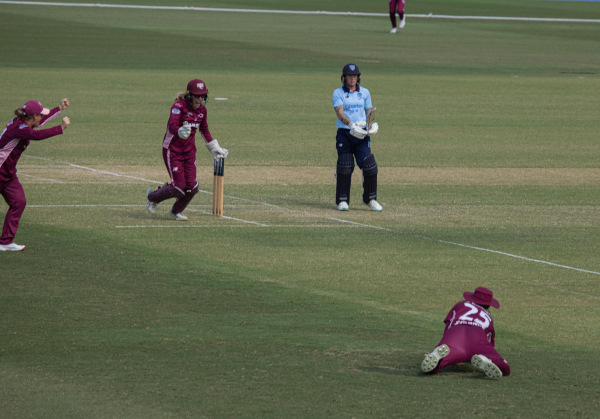
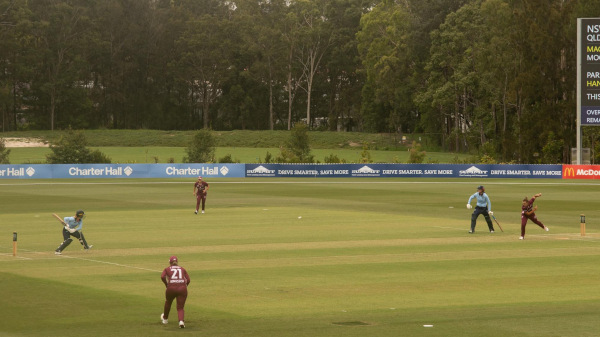
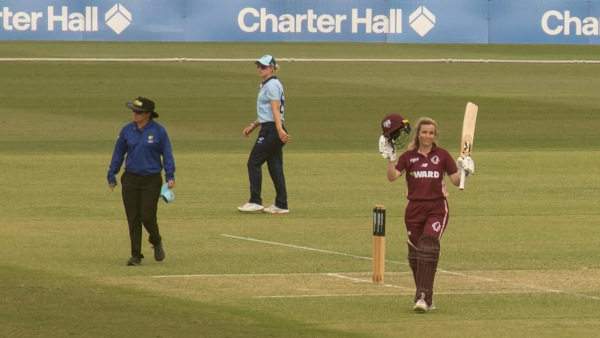
NSW openers Katie Mack and Tahlia Wilson put on a show for the few spectators (was everyone else at the beach?) putting on 157 runs before Wilson fell for 60 to an excellent diving forward catch from Bhavisha Devchand of Bekker’s bowling. This proved an excellent backbone to the NSW batting total, and gave the rest of the batters freedom to play at run-a-ball with the knowledge that there were ample wickets yet to come. So though wickets fell (notably Mack for 96 lbw by Peschel) the runs kept going up, with the majority of the batters contributing well. By 50 overs NSW had 301 runs on the board – just passing their total of 298 from Thursday’s game.
The eight wickets taken had included 2 from Amy Edgar, who had also put the most pressure on NSW, bowling 30 dot balls in her 10 overs. It would seem that though WA had found a way to take wickets they hadn’t taken them quickly enough, was NSW going to take advantage of this?
The short answer: yes they were! NSW proceeded to execute a masterclass in working out the WA batters’ weak spots. Lauren Cheatle’s captaincy and bowling were en point, not only taking early wickets and being on a hat trick in the 6th over, but also setting attacking fields with a tailored gameplan for each weary WA batter as they came to the crease, and soon marched back. This was especially the case when Sam Bates came on to bowl – she proceeded to work her way steadily taking the wickets of WA’s middle order – disrupting partnerships in turn with her four wickets in her 10 over spell, only conceding 26 runs. WA opening batter Maddy Darke fought valiantly, but had to watch from the other end as each of her batting partners were dismissed, she finished not out on 75, with WA reaching 158 all up.
NSW will be happy with the big win, which also landed them a bonus point in the chase for top of the table. Bates was awarded player of the match, and NSW breakers march forward undefeated into the big break before they next appear in round 4 of the WNCL. They are looking hard to beat.
Helen (Crystallised Cricket) is a writer based in Dharug and Gundagarra country, and here is writing about a game played on Dharug country. She acknowledges the traditional owners of the lands that she writes from.
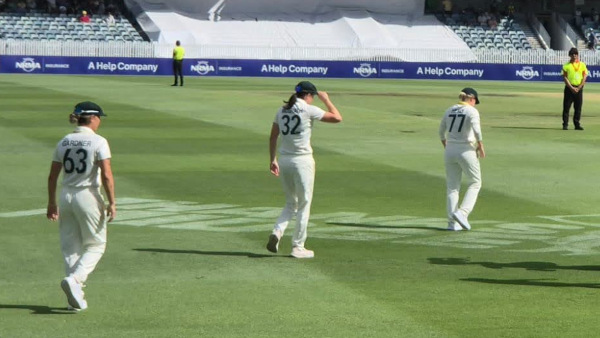
A bleary cloudy day greeted spectators at Cricket Central, probably matching the weary badgers who had watched Australia’s wobble and recover against Pakistan late the night before. But this game was game much brighter than the dull clouds skirting the sky: NSW won the toss, elected to bat, and so started a proper WNCL classic.
The NSW team was unchanged from the side that won twice against Victoria in round one, while WA made one change from their travails against Queensland. This was due to Heather Graham’s call-up to the national side, meaning Rebecca McGrath gained her first WA cap.
WA started well, pinning down openers Mack and Wilson with the new ball, the culmination of which was an easy catch by Hinkley at mid-on of Wilson off Peschels’s bowling. This brought Anika Learoyd to the middle, who with Mack set in to build a sizable partnership. Overs of worker-like rotation of the strike kept the scoreboard ticking over, and by drinks after the 17th over, the WA bowlers didn’t quite know what to do.
Spinner Manolini came on, but Mack and Learoyd continued to match each other both in runs scored and balls faced – bringing up their fifties in overs 23 and 24 respectively. Following a mini-drinks break after the 25th over it was clear the batters wanted to move things on, with both Mack and Learoyd advancing down the wicket – intimidating and pushing up the run rate. The conclusion came in the 29th over with Mack being caught at mid-off by a reaching Piparo off McGrath’s bowling. She returned to the pavilion with 69 runs off 85 balls.
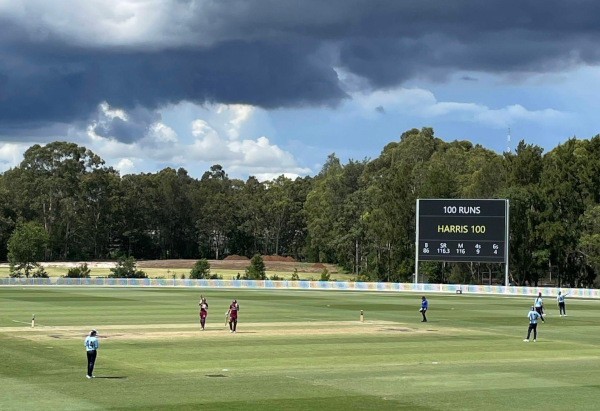
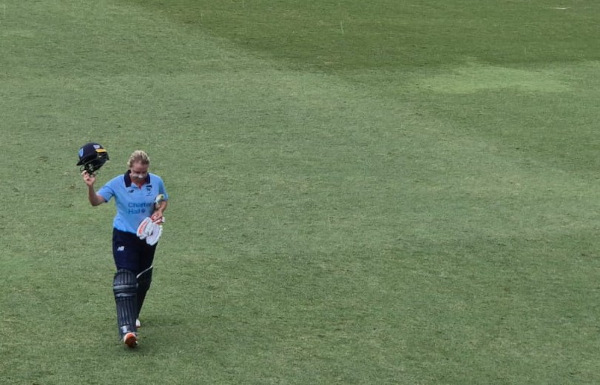
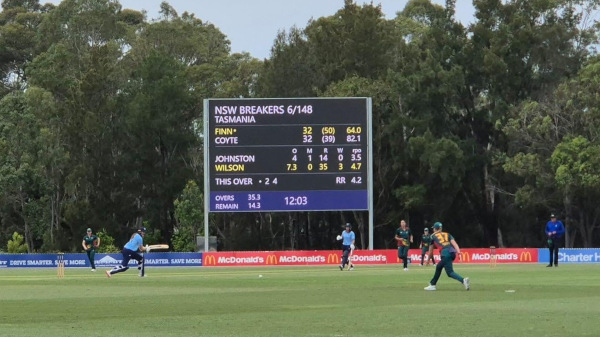
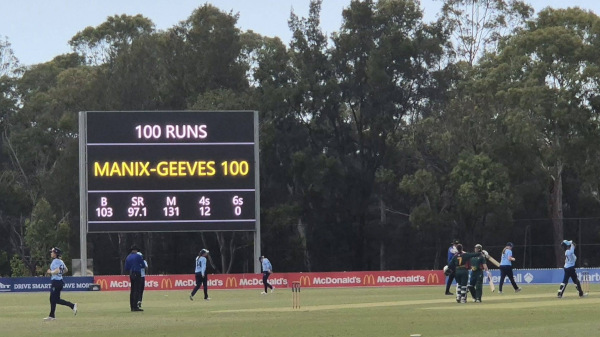
Learoyd and Claire Moore picked up where Mack had left off, running singles and giving WA fielders quite the run around. Learoyd pushed into the 90’s courtesy of a square leg boundary, looking relatively untroubled by the bowling attack throughout, even after catching an earlier delivery on the glove. She powered to her century with consecutive boundaries. However, soon after Learoyd was run out at the non-strikers end, bowler Ebony Hoskin tapping the return from Moore onto the wicket – a whimper of an end to an excellent batting innings. Moore continued in a similar vein, lofting a massive 6 that had the WA fielder vaulting the advertising hoarding to retrieve. She fell just after reaching 50, caught at deep mid-on. An entertaining cameo partnership between Georgia Adams and Maitlan Brown at the end, saw the total inflate to 298 after 50 overs.
Pescel was the pick of the WA bowlers, her nippy skiddy balls returned an excellent economy of 2.62 from her 8 overs, leaving spectators slightly perplexed why Hoskin (economy rate 5.2) and Mills (6.60) were bowled out in her stead. New cap McGrath picked up two wickets, but NSW were largely able to bat as planned with WA unable to put them under enough pressure. 299 was the target.
After the innings break WA’s openers got off to a flying start, making the most of the powerplay, and getting to 56 runs by the end of the 9th over. Maddy Darke in particular drove several boundaries off the opening seam bowling. The wily spin of Samatha Bates in the 9th over brought about the change, with Chloe Piparo caught at mid-off by Lauren Kua executing an excellent running catch. This brought Mikayla Hinkley to the crease. Piparo’s wicket at the end of the powerplay began a swing of momentum back to NSW, as Caoimhe Bray and Bates teamed up with some tight bowling to slow WA’s run rate down. By the 16th over the strain showed on the WA batters with Hinkley hampered by some serious cramping. She batted for two more overs before retiring hurt on 21.
Hinkley was replaced by Mathilda Carmichael, who formed a steady partnership with Darke, working similarly to Mack and Learoyd and keeping the required run rate in check. At 25 overs, WA were neck-and-neck with the NSW score (each being 126/1 at this point), and again at 30 overs (157/1 vs 157/2 for NSW at the same point). This matching continued to over 40 – WA were 213/2 after losing Darke for 73 to a sharp direct hit run-out from Kua, and nothing separated them from NSW who were 214/2 at the same point.
Tension built though the last 10 overs, the school holiday vibe of the first innings into the second (kids running everywhere, liberal shouts of ‘great shot’) waned, and finger nails started to be bitten. The 40th over was a flashpoint with the dangerous Bhavisha Devchand run out on 33 by some brilliant work by Tahlia Wilson behind the stumps, despite a slightly wayward throw from fielder Kua. Any relief that NSW may have felt at this point disappeared as Hinkely marched back to the crease – cramp or no cramp she was there to get her team over the line. Teaming with Carmichael, they wrestled the momentum back to WA for the next few overs. The grit particularly from Carmichael batting was evident, but she fell to a full toss from Brown, chipping over her shoulder to a waiting Bates.
McGrath joined Hinkey, who was limping again by this stage, and each took on Brown’s bowling, with McGrath getting a 6 into the trees. Hinkley brought up her 50, and by the start of the 49th over, with 19 needed off 12, it looked like WA were going to make it. But with one shot too many, Hinkley was caught at square leg by Sarah Coyte, one of two wickets during an excellent penultimate over from captain Cheatle. This was the final stumble for WA, and after a tidy final over from Bates, they finished just short on 291.
It was a match for the ages – the closest WNCL match so far this season – WA’s heroic efforts meaning that Saturday’s second match-up could be a classic again.
Helen (Crystallised Cricket) is a writer based in Dharug and Gundagarra country, and here is writing about a game played on Dharug country. She acknowledges the traditional owners of the lands that she writes from.
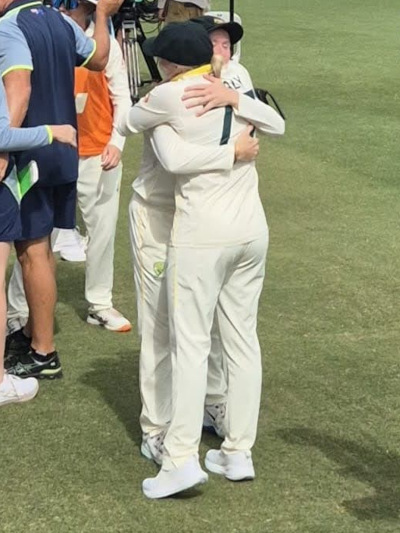
And so we returned to Karen Rolton Oval for the second WCNL game between South Australia and Tasmania, where conditions could not have been more different to those of Friday. Bright warm sunshine gave way to overcast grey mizzle, classic early season cricket weather. Play was delayed by half an hour while umpires, ground staff and players alike waited for conditions to brighten. South Australian captain Jemma Barsby again won the toss and decided to bat first, with both sides fielding unchanged sides from Friday’s game.
The contrast in the weather also reflected the contrast in SA’s batting innings from Friday – with the side struggling from the very first ball. Nic Carey’s glorious in-swinger took the bails off Emma de Broughe’s wicket leaving the batter stunned as she walked right back to the pavilion. Then, by the fourth over fellow opener Bridget Patterson had been tempted into lofting a shot to Gibson fielding at mid on. Any hopes that Penna and Webb would fill the run void at this point were dashed by the next over, with Penna falling into a trap set by Carey again for her second wicket.
Carey’s bowling continued to be crafty all through the innings, and also claimed the wicket of Friday’s player of the match Courtney Webb for 14 with a shorter delivery. By this point SA were still in the powerplay, but severely struggling on 36/4. Excellent captaincy by Tasmania’s Elyse Villani kept the South Australian batters under wraps, with the next wicket brought about by a change of the bowling, Larosa caught at mid-off off Gibson’s ball.
South Australia continued to grind out some runs with the highlight being Ellie Johnston’s 63 off 82 balls. She and Barsby weathered a long section of tight bowling from Tasmania, and chipped away, only being able to pick the field for the odd precious boundary. Johnston brought up her 50 with a stylish 6 over covers off Kathryn Bryce’s bowling just before second drinks. She looked to be finding her stride, but as is often the way was bowled by Carey the next ball after successfully threading through to the boundary.
Carey now sat on 4 wickets, but was denied her 5-fer by a belligerent Amanda-Jade Wellington who hit her for 6 and 4 in Carey’s tenth over. Wellington’s aggressive cameo of 20 runs came to an end with her run out at the non-strikers end, after chasing runs in the back of the innings. The tail fell cheaply, leaving South Australia on 196. Carey was the pick of the bowlers with 4-48 after 10 overs, but an honourable mention to Bryce’s 1-35 off her 10 overs, an economy rate that definitely helped keep the total limited.
By the time Tasmania’s inning’s commenced, Karen Rolton Oval was bathed in warm afternoon sunshine. With the outfield drying out it seemed that boundaries would come easier – but that proved not to be the case. Openers Lizelle Lee and Rachel Trenaman, unhurried by the chasable total, kept the scoreboard ticking over – but boundaries were hard won in the very early stages. By the seventh over, however, the outfield was nipping and both Trenaman and Lee had the measure of the new ball and SA’s opening bowlers Courtney Neale and Ella Wilson.
But never count SA out, especially with a bowling attack that includes Amanda-Jade Wellington, now ably assisted by Isabella Malgioglio. Between them the run rate was brought down, and in the 15th over Wellington affected a breakthrough with Lee succumbing for 60 off a great running catch by Penna, followed by Carey being bowled for a duck. Villani worked to support Trenaman as Adelaide life literally flew past (a helicopter swooping over the Oval on its way to the next door hospital). But the temptation to knock the runs off at a fast rate saw Villani go for a boundary in the air, but find opposing captain Jemma Barsby instead. A few overs later Kathryn Bryce was at the crease, and together with Trenaman weathered the tight mid-innings spin, keeping the score ticking along. It was all they needed to do, and by the 36th over a cover drive by Trenaman found the boundary to both make the total and see her carry her bat for 75 not out.
So brought to a close a fascinating weekend of cricket. Tasmania had done their homework over the rest day, and came up with successful plans to combat the SA batting attack. They capitalised on the momentum of a first ball wicket to keep SA to 196, quite a feat on a famously batter-friendly Oval.
Helen (Crystallised Cricket) is a writer based in Dharug and Gundagarra country, and here is writing about a game played on Kaurna country. She acknowledges the traditional owners of the lands that she writes from.
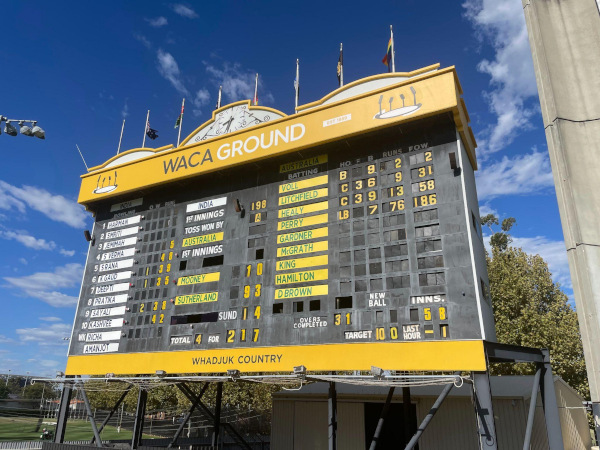
A stunning Wirltuti (Spring day) marked the start of the WNCL for South Australia and Tasmania. It was held at Karen Rolton Oval, which sits very much in the thick of Adelaide life – traffic bustling around the ground, commuters able to glimpse pitchside as they scurry about their lives in Australia’s cathedral city. Those who paused and took in the match were treated to batting masterclasses followed by a remarkable stint of fielding captaincy.
The teams could be forgiven for first-game nerves, but neither of them showed it – instead the trepidation was only shown by the ground’s scoreboard which took until the 19th over of the game to be tamed to show updates from the pitch. South Australia had won the toss, and elected to bat – preferring to start the season on their own terms it would seem. What followed was a perfect attritional innings – with the teamsheet batters building a skyscraper of a total for the SA women to defend.
South Australian openers Emma de Broughe and Bridget Patterson played it perfectly, with a new-ball soaking 50 run partnership – including a lofty six from B Pat in the 6th over. With both falling within a couple of overs, Courtney Webb and Madeline Penna found themselves together at the crease by the end of the 14th over. And there they dug in, in spectacular style – building a match-winning 197-run partnership which saw both players reach centuries, textbook middle order batting. Webb remained to the end of the innings, and saw SA put a total of 330 on the board.
Though Tasmania didn’t seem to show too many nerves, the players who took their honours in the field were those on debut for the team – Scotswoman Kathryn Bryce took three wickets for 60 runs. Queenslander-in-search-of-cooler-climate Courtney Sippel took most of the high-impact catches, as well as the bonus wicket of Eleanor Larosa late in the innings. In fact, Sippel was highly visible on the field, and was in amongst most of the big fielding moments. Bowling changes seemed a little haphazard, with Tasmanian captain Villani choosing to bowl Lauren Smith out with the finish of the innings, rather than turning to end-of-innings specialist Nicola Carey.
With 330 to defend, a relaxed South Australia took to the field after the innings break. Opening bowling from Courtney Neale and Ella Wilson squeezed the Tasmanian openers and had the run rate starting to climb. Tasmanian opener Lizelle Lee brought a level of restraint to her shots not often seen, suggesting the ball around the field rather than her more usual slog/insistence way of playing shots. Along with Rachel Trenaman, Lee built a good partnership weathering the aggressive spell of bowling, particularly from Neale. Here, though, was where the genius of Jemma Barsby’s captaincy became clear – preventing the batting side from finding stride to shoot for the total. Four of the seven wickets taken from Tasmania were straight after bowling changes, coupled with fielding set and bowling executed in a way that prevented the batters from getting into the rhythm they needed. This was exemplified in the 18th over, which saw Barsby both bowling and commanding the fielders with the authority that only bowling captains show.
Then the openers were gone. Trenaman skied a ball which was caught by Busby off debutant Isa Malgioglio’s bowling and Lee was caught by Penna off the bowling of stalwart Amanda-Jade Wellington. Nicola Carey and Ellyse Villani were now in batting for Tasmania and fought valiantly to keep the required run rate under control. At times it seemed like they were grappling with a slippery fish, it writhed and wriggled, but by over 29 it looked like they might be starting to wrestle it under control. Then Carey got a metaphorical fin-slap – she tonked a ball towards mid-on, only to see bowler Barsby snatch it from the air, leaving Carey to depart the crease for 24.
From there the maths started to hurt, and the required run rate steadily climbed, while wickets ticked over. A seventh wicket stand from Hayley Silver-Holmes and Sippel was entertaining at the back of the innings, but ultimately Tasmania reached 294/7, 36 runs short.
A win on the table for South Australia, and on Sunday they return to face Tasmania again. Conditions for Sunday’s game are starkly different – cloudy with a slight chance of rain. Will this aid the Tasmanian spinners, perhaps preventing SA from getting the two-fer at their home ground? Or will SA brazen it out – Sunday’s match awaits.
Helen (Crystallised Cricket) is a writer based in Dharug and Gundagarra country, and here is writing about a game played on Kaurna country. She acknowledges the traditional owners of the lands that she writes from.
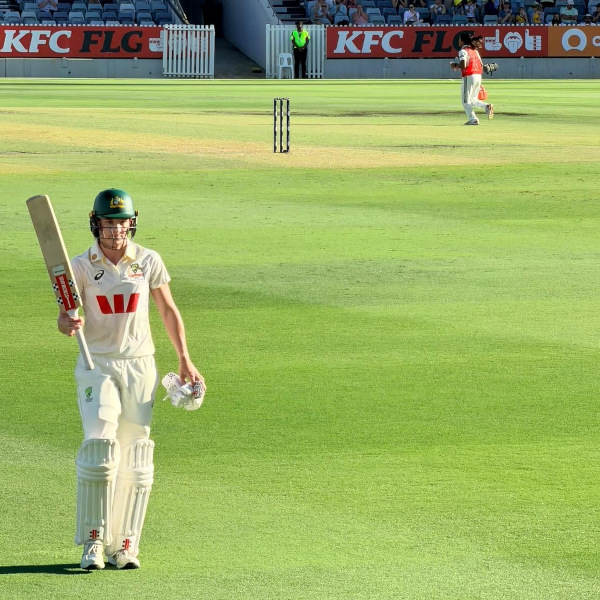
As has been so often the case in recent years, there was a new name on the Cheshire Women’s League trophy this year. There has only been one instance of a team retaining the title in the last 13 years, and in this time, as many as eight different clubs have topped the table.
For the first time, the Championship was won by Wilmslow club Lindow, completing their remarkable rise through the league structure, with their women’s first team having been champions of division 4 as recently as 2019. Heidi Cheadle grabbed many of the headlines throughout the season, scoring a league record 777 runs, including four centuries. Lindow’s varied and exciting young bowling attack also played a significant role though.
Lindow didn’t have it all their own way, losing two league matches along the way, and you now must go back as far as 2013 to find the last time that a Division 1 team went through a season unbeaten. Chester Boughton Hall finished second and Leigh third.
In the highly competitive top division, it was always going to be a good team who were relegated, and here Stockport Georgians well and truly pulled off a great escape, winning all of their last three matches when their position had looked more than precarious prior to this. It was Nantwich who eventually ended up with the wooden spoon, and they will be replaced in next year’s top flight by Northop Hall.
The joint highest wicket takers in Division 1 were Chester Boughton Hall’s Carys Lambe and Oakmere’s Sarah Worsdale, with 18 each.
Lindow’s successes continued as their second team won Division 3 East, while the only teams in the hardball leagues to finish with an unbeaten record were Runcorn in Division 4 West and Whalley Range in Division 4 East. The feat was also repeated by three of the six winners of the Division 5 softball competitions: Widnes, Sale and Macclesfield. Didsbury were unbeaten champions of the senior T20 competition.
There were also significant achievements for league clubs in external competitions. Leyland became the first Cheshire League team to win a national competition by landing the Plate prize in the ECB’s National Knockout.
Five of the league’s Division 1 teams were chosen – alongside three from the Lancashire League – to play in the Thunder Cup, a new competition for the north-west of England, organised by Lancashire CCC. Significantly, the final of this competition was played at Old Trafford, surely the first time that a women’s club match has been played at the Test ground? It was Stockport Georgians who emerged triumphant here, beating Leigh by eight wickets in the final.
A timelapse of the milky way making its way across the sky of the Southern hemisphere.
One thing you will notice is that in the cacophony of stars, those celestial bodies you would normally recognise fade a bit, as the great mass of others become brighter – it is not that anything has dimmed, you just get to see all the stars a bit more. A good metaphor for the coming Australian domestic cricket summer.
The crossover of the seasons is upon us, as Autumn’s grasp and muddy fields take hold, finals have reached their dramatic conclusions in the UK. Down in the Southern half of the globe training camps are reaching their fruition and first game nerves are taking hold. With that, the curtain will rise on the 2025/26 season of the Women’s National Cricket League (WNCL) on Wednesday.
Those unfamiliar to Australian domestic women’s cricket may not be so aware of the league, which like the Sheffield Shield weaves around other adventures in the domestic and international cricketing calendar. Though mainly state based, the WNCL includes a seventh team in the Australian Capital Territory (ACT) Meteors. In deference to the geography of Australia, there are not ‘home and away’ fixtures – but each team does play each other twice within each round, so seven rounds in total will play out with each team given a bye over the course of the season.
Why cacophony of stars metaphor? Well the established Australian internationals will struggle to make it out for their state teams teams (despite the fanfare of Ellyse Perry’s return to the NSW Breakers), with neat overlaps of the WNCL rounds occurring between every major international calendar date in their season. Hence, the chances for others to find their luminance.
Rounds one and two are squeezed in before the pomp and circuses of the domestic 20/20 season, and will be missing the Australian internationals as they warm up and compete in India for the 50 over World Cup. There’s then a long break in proceedings as the Spring challenge and Big Bash roll into town, so that the WNCL doesn’t recommence until 2026. The two January rounds will overlap with the Women’s Premier League in India, where Australian International stars are in high demand, keeping them from State duties. February’s two rounds will then overlap with the Australia v India multi-format tour. The last round (and the final, between the two teams that finish at the top of the table) will be in mid-March, when the Aussie team will have jetted to the Caribbean for the next multi-format international adventure. So without the ‘big’ players – who will rise to prominence?
Who to watch in 25/26? (you’ll note that in the team pages, despite now in the 8th year of full professionalism of the WNCL, not all the women even have a picture on their state page… sigh)
QLD Fire – It is only perhaps a matter of time before Charli Knott becomes a fixture in the international side, but until then we can marvel at her domestic outings. Jess Jonassen will lead a side that has kept together pretty well from last season, stats demonstrate that their success last year derived from an all-round team performance.
NSW Breakers – The success of the breakers last year can be traced to batting powerhouses Tahlia Wilson and Annika Learoyd, who both had terrific seasons and topped the number of runs in the competition respectively in 24/25. They will be back for more – and will be ably assisted by Katie Mack who has moved from the ACT Meteors into the side. The young sensation of WBBL10, Caoimhe Bray has also scored a contract with the side. NSW breakers look formidable and up for keeping their mitts on the trophy.
TAS Tigers – After a run of titles, Tasmania will be hungry to get back to the top, and with the most experienced captain in the competition, Elyse Villani, they no doubt have the leadership to get back there. They have recruited Scotswoman Kathryn Bryce, along with Courtney Sippel who will only add to their team strengths.
SA Women – Amanda-Jade Wellington topped the table of wickets over last season’s WNCL by a margin of 6, she also bowled A LOT – 117 overs (only topped by NSW’s Sam Bates). Bridget Patterson, the quiet achiever (and nonchalant celebrator) of Australia domestic cricket takes the gloves and along with Courtney Webb will lead the batting. SA are always a challenging team to beat, and were the ones to arguably keep Tasmania out of the final last season. They will continue to be a thorn in the side of the others.
VIC Women – With six of their contracted players due to be away from the WNCL on national duties, Victoria will probably struggle to make headway. But Molly Strano is back at her home state, and as ever it will be hard not to see a certain M Lanning make an impact in her 50 over element.
ACT Meteors – Georgia Elwiss returns to play for the Meteors this season, and steps neatly into the senior play position left vacant by Katie Mack. She will be supported in building runs by Olivia Porter and Zoe Cooke, along with newly contracted locals Stella Wilde and Rachel Carroll.
WA Women – WA will be looking to improve their table spot this season, and of the table last year, and bringing Heather Graham over from Tasmania would have seen the most excellent way to start this. But with Grace Harris’ injury Graham has now been drafted into the national side, which will be a blow for WA for rounds one and two at least. The team though has much young talent, an exciting trio in Innes McKeon, Rebbecca McGrath and Maddie White will be fun to see develop over the season.
Round 1 fixtures – ACT Meteors with a bye
Date
Home
Away
Ground
Start (AEST)
Start (UT)
24/09
WA
QLD
WACA – Perth
15:30
5:30
26/09
VIC
NSW
Junction Oval – Melbourne
10:00
0:00
26/09
SA
TAS
Karen Rolten Oval – Adelaide
10:30
0:30
26/09
WA
QLD
WACA – Perth
16:00
6:00
28/09
VIC
NSW
Junction Oval – Melbourne
10:00
0:00
28/09
SA
TAS
Karen Rolten Oval – Adelaide
10:30
0:30
That’s the preview. Think of it like lying back on a grassy bank, taking in a deep breath and filling your lungs with the damp grassy scent. Open your eyes, see the stars above you. Enjoy.
Helen (Crystallised Cricket) is a writer based in Dharug and Gundagarra country and acknowledges the traditional owners of the lands that she writes from.
It’s often said that winning a title is one thing, but keeping hold of it is actually the truest test of a champion’s status.
Having won the Home Counties Women’s Cricket Premier League in 2024, that was precisely the challenge facing Moreton Mavericks this year. Based in the tiny village of North Moreton, known mainly for The Bear pub (a Maverick sponsor, along with local estate agent Singleton & Daughter) and its 167-year-old cricket club, the giant killers have returned with another premiership title, defeating their much bigger cousins from Beaconsfield, Binfield, Charlbury, Newbury, Oxford, Stony Stratford and Thame.
The Mavericks recruited a 21 year New Zealander as their first ever overseas player to prepare for the inevitably fierce challenge that awaits reigning champs. Competition in the league this year was indeed noticeably strong, with no soft contests, and in fact every team lost at least 3 times in the 14-match programme.
Maverick’s skipper, Georgia Haworth cited squad depth as a significant factor in their achievement: “Huge thanks & congratulations to the 35 girls who representedthe club in the Premier League this season and with several injuries to keyplayers, we were very grateful to have that extra capacity at our disposal,making it very much a squad success this summer.”
Moreton Cricket Club President Mike Howat was also fulsome in his praise: “Wewere all delighted at Moreton to see the Mavericks retain their Home CountiesWomen’s Premier League title. As a small village club we continue to punch above our weight in this competition and great credit goes to captain GeorgiaHaworth and her squad.”
With Thame Town taking some notable scalps in the Premier League and near-neighbours Steventon also winning a Division 2 title, confirmation that female cricket in South Oxfordshire is certainly thriving. The Mavs also picked up the GU18 county title this year, indicating that their talent pathway is in rude health; preparations for 2026 are already well underway!
If you would like to join or help the Mavericks, where all ages & abilities are catered for, please visit https://moretoncc.org/ or contact Tim Haworth (Coach/ Manager) directly on tim@busbar.biz.
Many commentators have described the north-west regional team – whether they have been known as Lancashire Thunder, Thunder or Manchester Originals – as the perennial underachievers of the regional era that began in 2016 with the launch of the Super League.
The match against Diamonds where Thunder made just 90 was supposedly from the regional era, yet almost all of that day’s eleven hailed from Lancashire, even with most of that year’s home matches being played at grounds in Cheshire.
The ironic thing is that, with the team free to call themselves Lancashire this year, and with the regional era supposedly consigned to history, last Monday’s win in the final of the Vitality County Cup owed a great debt to the north-west region as a whole.
Of the eleven Lancashire players in the final, four are products of Cheshire’s county system: Sophie Ecclestone, Sophie Morris, Tilly Kesteven and Seren Smale. Grace Potts has played in the Cheshire Women’s League, while a sixth member of the team, Emma Lamb, has played a great deal of cricket in the Cheshire men’s leagues.
Morris is perhaps the breakthrough player of the year at Old Trafford, while Kesteven chose the perfect moment to make her first significant score of her professional career, making 77 from 60 deliveries in the final.
Of the Lancashire squad not involved in the final, Hannah Jones, Eve Jones, Danielle Collins and Olivia Bell are all no strangers to anyone who has followed women’s club cricket in Cheshire in recent years.
From a personal point of view, the question is, how much can I celebrate Lancashire Women’s newfound success? I was born and bred ten miles from Old Trafford and was introduced to supporting the Red Rose men’s team by my father at an early age. The fact that I’ve always lived ‘south of the river’ in Cheshire is not really an issue here, with Cheshire forever destined to be a minor county in the men’s game.
I was, however, heavily involved in the administration of the Cheshire women’s team between 2007 and 2013. In these heady times, Cheshire and Lancashire were actually rivals, indeed Cheshire won both of their 2009 matches against Lancashire by a significant margin. In 2011, Lancashire were back on the rise, but still only beat Cheshire by one run, and there was another closely fought match between the counties in 2012.
So, after all those years of seeing Lancashire as a deadly rival, can I now reconcile myself to supporting the county’s women’s team and celebrating their successes? I think I’ve decided that the answer is most definitely Yes. The number of players in the team with Cheshire connections makes my decision much easier for sure. Many observers have voiced the opinion that Cheshire still does women’s club cricket much better than Lancashire, and I have no doubt that the strength of the club game in Cheshire will continue to provide Lancashire with a steady supply of talented players for many years to come.
One also has to accept the fact that the women’s cricket scene continues to evolve rapidly. Lancashire are destined to be a Tier 1 county in perpetuity, while current indications are that Cheshire, and all of the other traditional ‘minor’ counties, cannot aspire to anything other than Tier 3. (Although it will be interesting to see if Tier 2 really does operate with just six teams once Tier 1 has expanded to 12 counties in 2029.)
While the smaller counties may no longer be able to aspire to reach the highest level, it must be considered that no one ever suggests that the Cheshire men’s team is not a viable proposition simply because it can’t be promoted to the main County Championship. Likewise, few cricket followers in the county see any issue at all with supporting both the Cheshire and Lancashire men’s teams.
In summary, the new era of county women’s cricket is something we have to accept as a necessary evil, so I see no conflict between celebrating what Lancashire Women have achieved, while also wishing the newly relaunched Cheshire Women every success.
A sponsorship snafu could mean that England A coach Jon Lewis is promoted to the main England role as soon as next week, after it emerged that department store John Lewis had already spent hundreds of thousands of pounds on a new advertising campaign centred around the name of the former head coach Jon Lewis.
Lewis has been flown home from Australia, where England A are currently playing Australia A, for emergency talks as the ECB scramble to save their sponsorship deal with the department store.
The advertising campaign centres around a new line of Bondi-2-Coogee budgie smugglers modelled by the England Men’s cricket team, but hit a snag last week when it emerged that the OG Jon Lewis had been fired from his role following the 16-0 Ashes whitewash.
Clare Connor said: “In England, we pride ourselves on our excellent talent pipeline of coaches with the name Jon Lewis, so we feel confident this is just a temporary hitch.“
“Our synergies with the John Lewis brand couldn’t be stronger – after all, here at the ECB we never knowingly undersell ourselves.”
Please note that the opinions of guest contributors to CRICKETher do not necessarily reflect the views of the Editor.
By Andy Frombolton
The clamour for Jon Lewis to be sacked as England coach continues – without anyone explaining what he’s done so wrong or, more pertinently, what anyone else could realistically have done differently or better.
Heavily shackled by having to primarily select from a centrally-contracted group whose limits are well evidenced, and additionally limited by the paucity of credible ‘ready-to-go’ alternatives, Lewis has done as well as could be expected with the hand he was dealt.
Meanwhile, Charlotte Edwards is widely heralded as The Answer to the Problem. Whilst there’s no denying that she’s enjoyed significant achievements as a coach, recent results suggest that success doesn’t invariably follow wherever she goes: Vipers finished third in last year’s RHF Trophy and the CEC; Sydney Sixers finished fifth and sixth in the last 2 WBBLs; and MI were third in last years WPL (and hold the same position currently). In her early coaching days she also undoubtedly benefitted from the ‘Lottie Effect’ – attracting good players who wanted to be in her orbit with the resultantly-strong teams routinely crushing their opponents.
And what would her conditions be for taking the role? The right to ditch established players (however embarrassing for the ECB – and financially wasteful – this might be if they hold long contracts)? To prioritise trialling players during the upcoming summer series over results? For the ECB to publicly acknowledge that re-building will take a few years and may entail some low ‘lows’ en route? If those freedoms are what’s needed, why not just give Lewis the same?
It’s my strong view that Lewis is a good coach and that he should remain, perhaps with Edwards appointed as an advisor or deputy.
My earlier use of the term ‘rebuilding’ was deliberate because, for all the investment in the England team and for all the record-breaking crowds, the simple fact is that the current England squad’s collective zenith isn’t high enough to beat Australia or India in 50 over cricket.
Defenders of individual incumbents might seek to cite ICC rankings or statistics to justify their continued selection – but this ignores the fact that the majority of their performances are against international teams which are weaker than the better Tier 1 counties. The true test of an international cricketer is how they perform against the strongest opponents and, as illustrated in my last article, the performances of most of the current England squad crumble when playing Australia.
In which case, what possible purpose is served by continuing to pick this same group of players? Sometimes you need to accept that no amount of coaching or training or additional match experience is going to transform a player into a world beater. Business people refer to the ‘sunk cost fallacy’ to describe a cognitive bias that causes people to keep investing in something even when it’s no longer beneficial. It doesn’t necessarily mean that the original decision was wrong – just that it didn’t work out as hoped.
With the freedoms referred to earlier, whoever’s head coach this summer should therefore announce a series of England vs England A games to be played across the summer pitching incumbents (desperate to prove they still warrant their place) against challengers (eager to show that they don’t).
These games shouldn’t be hidden away, played behind closed gates as if they’re some sort of shameful talent slugfest, but promoted to encourage crowds and media scrutiny; with the best performers selected for the summer international series. (If some centrally-contracted players subsequently lose their places, the message can be all about the opening-up of the selection process to hitherto-overlooked talent rather than the ousted. That’s what PR people are for!)
The best performers should then play in a series of England A games versus the touring teams. (No touring team should turn down the chance for more match practice.)
The sooner the rebuilding starts, the sooner we’ll have an international team capable of matching Australia and India.
Here’s the 3 steps needed:
1. The ECB clarifies the head coach situation and announces a series of England vs England A matches; explaining that the purpose is to identify the group of players capable of (A) winning the 2026 World Cup (to be held in England), or (B) the Ashes in 2027.
Players should be given a proper ‘run’ to prove themselves at the highest level. Remember, Knight didn’t score a 50 until her 10th ODI innings and her second in her 33rd whilst Wyatt took 48 innings to score her maiden ODI 50. We cannot go back to the days of e.g. Gordon, Lamb and the two Smiths being discarded after a few games.
2. To commence the reset, start with the only truly world-class player we have – Nat Sciver-Brunt – who needs to be asked to take the ODI captaincy until after the October World Cup. A separate T20 captain should be appointed.
2. There needs to be a volte face in selection criteria. Chris Guest, head coach of the Under-19s, recently observed in a Cricketer article that “if you’ve got someone who is outstanding within their skill and can’t field as well as someone who is less good within their skill but can field brilliantly, the skill still takes precedent at the moment.”
Numerous games turn on moments of fielding brilliance but England have only one exceptional fielder – Wyatt-Hodge – whilst most of the other centrally-contracted players are not international-standard fielders; several to the point where it could be posited that their mistakes and lapses in the field outweigh any ‘delta’ skill in their principal discipline over their nearest rival.
A stunning catch or a sharp run-out is more likely to impact a result than having a fractionally-worse ER or a slightly-lower batting average/ Strike Rate. Hence this prevailing attitude needs to be reversed.
Going forward players need to know that they won’t be selected unless they are (or have the potential to rapidly become) world-class fielders.
In the last article, I proposed a new-look T20 squad and promised my ODI squad would follow. Given the short timeframe I’ve proposed a transitional squad to participate in the October World Cup plus possible contenders for each slot. For ease of reference, I’ve also included my (slightly modified) T20 squad for next summer’s World Cup.
Transitional Squad World Cup October 25
Contenders To be tested during the 2025 summer in A matches
T20 World Cup June 26
Bouchier
Lamb
Bouchier (cpt)
Armitage
Smale / ADR
Wyatt
Scrivens
Capsey
Knight
NSB (cpt)
NSB
Wyatt
Perrin
Perrin / Capsey
Scholfield
Marlow
Bryce / Heath (wk)
Jones (wk)
Bryce / Heath (wk)
Gibson / Kemp
Gibson / Glenn
Kemp / George
Dean
Dean
Skelton / Smith / Baker
Smith / Baker / Gregory
Filer
Gaur
Filer
Bell
MacDonald-Gay / Ballinger
MacDonald-Gay
Note: Ecclestone’s omission was explained in my previous article.
Amy Jones’ recent ODI batting form has been good. However, a keeper’s role goes beyond catching and stumping; a great keeper additionally covers a huge area behind the stumps, intercepts all incoming throws to make them look good, manages fielding angles for their captain and acts as the vocal drumbeat of the team. Jones doesn’t do any of these things well and hence October’s World Cup should be her swansong.
I’m assuming that Bryce, like Gordon before her, can be persuaded to swap allegiances if adequately incentivised. If not, Heath has just a few months to seize her chance. (If she doesn’t, Smale is breathing down her neck.)
In the last 18 months, Knight has turned herself into a versatile and creative T20 batter. (In the last 2 years her T20 average is 33.6 SR 129, before that her figures were average 28.3 SR 116.) This evolution warrants her inclusion as a specialist batter notwithstanding her decreasing agility in the field.
Capsey might need to replace Scrivens to provide a sixth bowling option. (N.B. Wyatt could extend her career if she returned to bowling. Admittedly, she hasn’t bowled in internationals since 2020 but her stats are decent and even a couple of overs per game would give a captain more options.) Regardless of when she enters the senior team, Perrin’s bowling needs to be encouraged. Australia’s men’s and women’s teams demonstrate the advantages of having lots of batters who can bowl a few overs.