NEWS: Stockport Georgians Are Champions For The First Time

Martin Saxon reports

No team has retained the Cheshire Women’s League first division title for eight years now, and it has only happened once in the last 14 years. 2026 duly saw another new name on the trophy with Stockport Georgians claiming a first title.

There were some eye-catching batting contributions from Cheshire captain Ellie Mason and new Lancashire and England Under-19 breakthrough star Skye Thomas during the season, but Georgians couldn’t call on their services for every match, so they needed some consistent performances from young players who were available regularly, with Neve Boon and Gracie Whittle standing out in this respect.

2025 champions Lindow had to settle for second place, despite losing just one match in the main league competition all year and having the leading top-flight run scorer in Heidi Cheadle and the leading wicket taker in Faye Smith. In what was of course mostly a very dry season, two cancelled matches in late August cost the Wilmslow club dearly.

That’s to take nothing away from Georgians, who played some superb cricket in reeling off ten wins on the bounce, after they had lost their opening day fixture. The Stockport club also completed a double by winning the Senior Knockout Cup.

It completed a dramatic turnaround for Georgians, as both they and third-placed Leyland were in danger of relegation on the final day of the 2025 season.

The Division 1 record for best individual score fell four times during the season. Leigh’s Danielle Collins made 174, which was followed by 187* and then 190* from Cheadle. Collins then broke the overall league record with 204* and also became the first double centurion in league history.

Nantwich were champions of the second division and will be back in the top flight for 2027, and they also recorded a statement win in the T20 Championship, where they topped the table, ahead of five first division clubs. Sarah Nettleton’s tally of 28 Division 2 wickets breaks the all-time record for the most wickets taken in any division of the league.

Most divisions were closely fought affairs, but unbeaten seasons were recorded by a few teams in winning their divisions: Whalley Range in Division 3 East, Lindow’s third team in Division 4 South East, the Brooklands softball team in Division 6 East, Bredbury St Mark’s in Division 7 East III, Kingsley’s softball team in Division 7 West I and Christleton in Division 7 West II.

There were also significant achievements for league clubs in external competitions. For the second year in succession, Leyland bagged the Plate prize in the ECB’s National Knockout. Lindow came within a hair’s breadth of becoming the first Cheshire League team to make the final of the National Cup.

Five of the league’s Division 1 teams again played alongside three from the Lancashire League in the Thunder Cup, a competition for the north-west of England, organised by Lancashire CCC. Again, the Cheshire League supplied three of the semi-finalists and both finalists, with Lindow emerging triumphant against Leyland.

TEAM HONOURS

WinnersRunners up
Elite Hardball
Division 1Stockport GeorgiansLindow
Division 2NantwichHayfield
T20 ChampionshipNantwichChester Boughton Hall
Senior Knockout CupStockport GeorgiansDidsbury
Development Hardball – Standard Scoring
Division 3 WestChester Boughton Hall 2ndRuncorn
Division 3 EastWhalley RangeMacclesfield
Division 4 WestCreweOxton
Division 4 EastDidsbury 3rdBrooklands
Division 4 South EastLindow 3rdRomiley
Development Knockout CupChester Boughton Hall 2ndWhalley Range
Development Hardball – Pairs Scoring
Division 5 WestElworth 2ndGrappenhall
Division 5 EastHeaton Mersey 2ndMacclesfield 2nd
Softball – Standard Scoring
Division 6 West & SouthChristletonHolmes Chapel
Division 6 EastBrooklands SoftballSale
Division 6 WirralOld ParkoniansIrby
Softball – Pairs Scoring
Division 7 West IKingsley SoftballOver Peover
Division 7 West IIChristletonWidnes
Division 7 East ISaleBrooklands Softball 2nd
Division 7 East IIBowdon ValeHolmes Chapel 2nd
Division 7 East IIIBredbury St Mark’sStockport 2nd
Division 7 SouthAlsagerRode Park & Lawton
Division 7 WirralOld ParkoniansUpton Softball
Softball Knockout CupCrewe SoftballHolmes Chapel

INDIVIDUAL AWARD WINNERS

 Batting Award (Most Runs)Bowling Award (Most Wickets)Fielding Award (Most Catches & Run Outs as Fielder)Wicketkeeping Award (Most Catches & Stumpings as Wicketkeeper)
Division 1Heidi Cheadle (Lindow) 776Faye Smith (Lindow) 20Hollie Sigsworth (Northop Hall) 8Heidi Cheadle (Lindow) 16
Division 2Alice Dyson (Hayfield) 539Sarah Nettleton (Nantwich) 28Sarah Nettleton (Nantwich) 9Bethan Hughes (Nantwich) 6
Division 3 WestBella Williams (Chester BH 2nd) 289Nicola Heaton (Runcorn) 14Ffion Jones (Chester BH 2nd) 5No qualifier
Division 3 EastRachel Monteath (New Mills & High Peak North) 456Hannah Price (Whalley Range) 20Rebecca Scholes (North East Cheshire) 9Nida Bano (Whalley Range) 5
Division 4 WestMolly Price (Oxton) 247Amy Bourne (Crewe) 17Tarryn-Lee Warman (Kingsley) 10Ailsa Meakin (Crewe) 8
Division 4 EastCharlotte Howard (Didsbury 3rd) 129Tasnim Akram (Didsbury 3rd) 18Anjali Santhakumar (Didsbury 3rd) 6No qualifier
Division 4 South EastCheryl Reville (Romiley) 123Poppy Hague (Langley) 11No qualifierNo qualifier
T20 ChampionshipRoshini Prince-Navaratnam (Didsbury) 200Roshini Prince-Navaratnam (Didsbury) 9No qualifierKatie Bennett (Chester BH) 4
Batting Award (best average)Bowling Award (best average)
Division 5Claire Higgs (Elworth 2nd) not dismissed (122 runs, 5 innings)Jess Isaacs (Heaton Mersey 2nd) 3.43
Division 6Helen Jones (Old Parkonians) 108Leeann Hilton (Alsager) 7.14
Division 7Julie Harris (Rode Park & Lawton) 220Aimee Scragg (Haslington) 4.33

WNCL: No Team Dominated Despite Stars and Debutants Shining

By Helen Maynard-Casely

The opening round of Australia’s WNCL saw six teams kick off their campaigns for the Ruth Preddey Cup. Each of the competitors had both highs and lows in what proved to be a rather exceptional round. Victoria took the honours of the top of the table, a great turnaround from their 25/26 season that had left them bottom with negative points overall.

The ticker tape from Kylie’s AFL grand final triumph had barely settled before, without much pomp and ceremony, the Australian cricket season opened. From a professional standpoint, the kick off on Tuesday was the first round of the Women’s National Cricket League – the states (and one territory) 50-over tournament. This is the comp that threads through the season, with sides facing each other twice in each round in deference to the size of the Australian continent.

This outliner round had additional challenges for team selection, as it coincided with the Australia A tour of India, removing a whole squad of WNCL stalwarts from each team’s pool. But help was at hand, with the fact that the contracted Australian players were available, and itching for match practice with New Zealand arriving soon. So each team was a bit of a motley mix of superstars and rookies – which made for some entertaining performances and results.

TeamMatchesWonLossTiedNo resultNRRDeductionsBat bonusPoints
Victoria210010.119006
Western Australia211000.655015
NSW Breakers211000.04015
Queensland Fire21100-0.04015
Tasmanian Tigers21100-0.655004
South Australia20101-0.119002
ACT Meteors000000000

The 26/27 WNCL standings after Round 1

The WNCL kicked off with a re-run of last year’s final, NSW breakers hosting Queensland Fire at NSW Cricket Central. This first match saw Queensland struggle to get runs on the board, only posting 167 (with 83 of these scored by opener Georgia Voll) before they were bowled out in the 38th over – with five of the wickets taken by NSW veteran Sam Bates. NSW tied the first game up by the 25th over – roaring to most of the total courtesy of openers Phoebe Litchfield and Emma Mannix-Geeves (in her NSW debut after moving North from Tasmania). The one highlight for Queensland in that first game was the (only) four wickets taken by rookie Ayaka Kato-Stafford in her first match.

However the tables were turned spectacularly in the second NSW v Queensland tie, probably in part down to the return of Queensland captain Georgia Redmayne from injury. She opened and scored 139, the backbone of the Queensland score of 285. NSW could only manage 174 in reply, an innings that saw Kato-Stafford in the wickets again. Both Queensland and NSW end the round with a win and a bonus point on the board.

Over at the WACA, the two games similarly resulted in honours even as Western Australia hosted Tasmania. The WA team were particularly bolstered for the first game with Beth Mooney and Alana King being available to play, with the two of them putting on an unlikely 98-run partnership for the 7th wicket. In reply, Tasmania fell short of the runs required, with Ruby Strange (newly transferred from Queensland) taking a fifer on her WA debut.

Like the action over east, the results switched for the second match with Nicola Carey providing runs for Tassie’s total of 299, which then it was the turn of WA to fall short of.

The pick of the games for the round was the match-up between Victoria and South Australia, under lights for the first time at Melbourne’s Junction Oval. South Australia posted a daunting target of 290, again with the bulk of the runs coming from a moonlighting international in Tahlia McGrath – scoring 154. Victoria had the bit between their teeth and their reply was spearheaded by two more Aussie stars returning to state duty, Annabel Sutherland and Georgia Wareham who posted a 164-run partnership for the 4th wicket. The game had a tense ending, when with four overs to go, with Victoria still needing 37 runs Sutherland was caught at fine leg in search of a boundary. Victoria managed to grind out the rest of the runs to break the losing spell that had lasted the whole of last season. With the second game between the sides getting washed out, Victoria takes 2 points for the null results on top of their win and finish round one at the top of the table.

ACT had a bye for round one, so will not start their WNCL campaign until mid December. And so after that curtain raiser, the (very) early interval is now called – with the WNCL paused for the pandemonium of the 20/20 season that kicks off with the Spring Challenge on the 11 October.

Helen (Crystallised Cricket) is a writer based in Dharug and Gundagarra country, and here is writing about a game played on Dharug country. She acknowledges the traditional owners of the lands that she writes from.

OPINION: The Blaze Is Dead. Long Live The Blaze

There was a certain irony in the result of Saturday’s One-Day Cup final. After beating Hampshire by 3 wickets, The Blaze now have their name carved on all three of the English domestic trophies – the Blast, the County Cup and the One-Day Cup. And yet, very shortly, The Blaze will no longer exist.

Two and a half years ago, after The Blaze won the final Charlotte Edwards Cup, I wrote in The Guardian:

The women’s domestic teams will morph from regions into counties at the end of this season, but Gordon has nonetheless confirmed that The Blaze (who are “becoming” Nottinghamshire) will retain their team moniker. Some have questioned that decision – wasn’t the whole point of the restructure supposed to be alignment with the men’s team? – but the evidence of Saturday suggests that it is, undoubtedly, the right call. Who wants to change a winning brand?

I could have written the exact same thing yesterday. Which sports organisation would want to erase a team who have just swept the board in terms of trophies?

And yet this, it seems, is the world we currently live in.

Exhibit A: when I turned up to the Utilita Bowl on Saturday, I discovered that the Southern Vipers mural has been replaced by a Hundred mural.

This has made me a bit sad. The Southern Vipers mural at the Utilita Bowl has been replaced by a Hundred mural.

— Raf Nicholson (@rafnicholson.bsky.social) 2026-09-19T15:19:50.453Z

Southern Vipers are one of the most successful teams in the history of cricket, if you take the ratio of trophies won to years in existence. It’s baffling to me that you would want to wipe them out of the tangible heritage of your club – but this appears to be what has happened.

Two years on from the “official” end of the regional era, it feels like that era has now finally concluded. Was it the right thing to do? Probably. But let’s not forget about those nine years of regional cricket. They happened. They mattered. 

The Blaze Is Dead. Long Live The Blaze.

THE HUNDRED: Southern Brave v Birmingham Phoenix – Brave Victorious But Perrin Welcomes “Small Wins”

On Wednesday, Birmingham Phoenix released a new poem to celebrate the team, written by the Birmingham Poet Laureate Ayan Aden: “This is Birmingham, where it’s your turf, your team. This is Birmingham, where we rise.”

Presumably rising from the bottom of the table wasn’t quite what they had in mind. Nevertheless, that is the position Phoenix now find themselves in, having lost Thursday’s match to Southern Brave by 24 runs.

This was a match which Phoenix really should have won – or more accurately, one which Brave should have lost. Brave’s batters went for 30 balls without scoring a boundary. They dropped three catches. They failed to take a single Phoenix wicket for 55 balls.

But Brave’s bowling depth once again proved the key factor, preventing Phoenix from accelerating across the final 30 balls, despite having 9 wickets in hand. “I think they were trying [to go harder]”, Sarah Glenn said. “The intent was there for sure. But we shut it off really with our bowling.”

Put in to bat, Southern Brave had earlier reached 140 for 3, though it should really have been more after a rollicking start from Lizelle Lee. Lee might not be the most adept at moving her feet these days, but she has enough heft in her arms to make up for it, smashing 43 from 28 balls.

In the end the pace-off approach from Alice Capsey worked – there wasn’t quite enough velocity on the ball for Lee to clear the rope at deep midwicket and Linsey Smith took the catch.

Brave’s run-rate had actually fallen off a cliff prior to Lee getting out – they had a poor early-middle phase. Slow spin was most effective on this wicket, which meant that Capsey was particularly useful, bowling her full allocation of 20 balls (she only bowled 10 in Phoenix’s first match of the comp).

Brave 140-3 v Phoenix #The100 🏏

— CRICKETher (@crickether.com) 2026-07-30T15:23:00.488Z

As an aside, I still think making Capsey back-up keeper for England’s World Cup campaign was a bit silly. But it was always pretty obvious it was a temporary move, while Lottie tries to figure out who is Amy Jones’s long-term replacement, and that Capsey remains committed to her off-spin. In fact, she told me so when I interviewed her at the start of the tournament: “I really enjoy bowling. It’s still a massive priority of mine. It just means my training days are slightly longer than they used to be. Instead of doing bat, bowl, field I’m doing bat, bowl, field, keep.”

Maia Bouchier looked dangerous until she got out in unnecessary but sadly typical fashion, trying to reverse-ramp Lauren Filer five runs short of a half-century. Enter Laura Wolvaardt, who limped to 11 off 15 balls before being dismissed in two different ways off the same ball, simultaneously caught behind and stumped (yes I know this isn’t technically possible in the Laws).

Wolvaardt has just come off the purplest patch of her career, but for some odd reason looks a shadow of her former self since she arrived in England for the start of the World Cup, with a highest score of 45 against Netherlands. From the peakiest of peaks to the troughiest of troughs – it’s not clear quite what’s gone wrong or why?

Thanks to some punches from Jemi Rodrigues in the final set, Brave did eventually get up to a total which was towards the high end of a “typical score” in this competition according to the Ghost:

Brave 140-3 v Phoenix #The100 🏏

— CRICKETher (@crickether.com) 2026-07-30T15:17:10.493Z

In reply, Davina Perrin played an innings dominated by wild hacks, offering up three chances – on 30, 32 and 34. Each time, Rodrigues dashed 100 yards across the field to comfort the culprit – Bouchier, Wolvaardt and Bell – before finally getting so fed up / exhausted that she decided to take a catch herself, running in from deep midwicket; although the batter out was Tammy Beaumont, not Perrin.

Heading into the last 35 balls, WIN-her had both teams neck-and-neck:

Brave 140-3 v Phoenix 92-2 #The100 🏏

— CRICKETher (@crickether.com) 2026-07-30T16:24:17.314Z

But then Alice Capsey chewed up nine balls for eight runs, and chipped a catch straight to Sophie Molineux at cover. It was the death knell for Phoenix, and Capsey knew it – she was so annoyed at herself that she threw her bat in the air, tried to catch it with the other hand, dropped it, and suffered the added indignity of having to bend down and pick it up before walking off.

Perrin did go on to get fifty, but was reluctant after the match to take any credit for an innings which was ultimately in a losing cause and perhaps wasn’t quite quick enough to make up for slow-ish scoring at the other end. “Missing the Blast and being injured, and having a lot of the season out, obviously means that when you come back to play, you’re just sort of finding your feet,” she said.

She admitted, too, that it feels like these days she is trying to live up to her magical Eliminator innings every time she is at the crease. “I’d be lying if I said it doesn’t cross my mind. But I think I’m also reminding myself, it’s the small things at the minute. Being back out on the pitch, having a healthy body, they’re the small wins for me at the minute.”

For now, the bigger wins will have to wait.

THE HUNDRED: MI London v SunRisers Leeds – Money Makes The World Go Round

Just three weeks ago (it feels like an eternity), Hayley Matthews was here at The Oval, playing in a World Cup semi-final and unleashing a brilliant, heartfelt critique of cricket’s financial inequities.

On Tuesday she was back at the same ground (well, sort of: apparently we have to refer to it as The My London Stadium for the next four weeks… or do we?). This time, she was opening the batting for MI London in shiny new blue kit. She will earn £120,000 for four weeks work: a small cog in a big tournament which has itself become part of the problem.

Money from overseas investors (£520 million to be more specific) can buy you a lot of things. Judging by Tuesday’s opening match in The Hundred, that includes very big, very noisy fireworks. At least some of that money also trickles down to (some of) the players. Take a moment to compare the 2026 Hundred with the first franchise cricket in England, the Kia Super League, which got underway almost exactly a decade ago up in Headingley – incidentally now home to SunRisers Leeds. Matthews played in that, too, representing Lancashire Thunder. Her take-home pay was about £600.

Interesting, then, that when she decided to call out cricket’s haves and have-nots, Matthews was actually nostalgic for that period. “The reason we were so successful back in 2012 and 2013 and 2015 and 2016 is because women’s cricket was based off pure talent at that time,” she said. “The minute that investment comes into the picture, we’ve seen the gap widen a lot because of that.”

Perhaps without even realising it, Matthews was expressing a certain wistfulness for times gone by when women’s cricket didn’t revolve around making a bunch of Indian (and American) businessmen richer. And as I watched the match on Tuesday at The Oval The My London Stadium on Tuesday, I was wistful too.

Matthews herself finished as top-scorer for MI London, with 33 from 22 balls, looking good until she popped up a return catch to Deepti Sharma. The music which the powers-that-be insist “makes the Hundred experience” was still blaring when Deepti delivered the ball, which didn’t seem ideal if you were the batter trying to to focus on the actual cricket. MI head coach Lisa Keightley put it best after the match: “That’s just The Hundred, isn’t it? You’ve just got to roll with it.”

From there, though, MI got stuck, and the runs stopped coming, as they limped along to finish on 107-8.

MI London 107-8 v SunRisers Leeds 109-3 #The100 🏏

— CRICKETher (@crickether.com) 2026-07-21T16:45:58.181Z

SunRisers Leeds (don’t forget that all-important capital R) then strolled to a 7-wicket victory with 31 balls (almost a third of the innings) remaining, led by their two star Aussies Phoebe Litchfield and Annabel Sutherland, who were both part of the previous iteration of the Popchips who won The Hundred in 2025.

That did, though, leave time for John Newman to perform a longer gig between matches – either a bad thing or a good thing, depending on if you have heard of him like his music or not.

One fascinating aspect of this opening encounter was the number of spectators who turned out for the women’s game – 8,532. Of course, in the days of the Kia Super League, we would have given our right arm for a crowd like that. But, for comparison, that’s almost 2,000 less than the 10,249 people who attended the opening match of the 2024 Women’s Hundred at The Oval, which was also on a Tuesday, against Birmingham Phoenix.

It’s early days, but does this maybe reflect a slight wariness on behalf of the British public, who don’t quite trust that this iteration of fake plastic teams will stay around long enough for them to bother caring about?

A final word on Dani Gibson, she of the £190,000 price tag, who hit the winning runs on Tuesday. I’m told that we aren’t supposed to talk about money – let alone compare salaries – because it makes the players uncomfortable. Certainly, SunRisers head coach Adrian Birrell refused to admit that it might have been on Gibson’s mind as she led her team out onto The Oval on Tuesday: “I don’t think she’s thinking about it for one second. She’s trying to win matches. I don’t think it’ll be a factor at all.”

“No one’s mentioned anything about who earns what. It’s just purely cricket, and everyone’s getting down to playing cricket and doing what they do,” he added.

Given that SunRisers’ Lauren Winfield-Hill, whose salary dropped from £50,000 in 2025 to £27,500 in 2026, has previously described the auction process as “awful” and an “ego bruise”, I find that hard to believe.

Either way, the honest truth is that we don’t talk about money anything like enough in women’s cricket – who has it, who doesn’t, and what are the problems when a whole load of it suddenly gets concentrated in a few places.

That press conference by Hayley Matthews was memorable precisely because she DID talk about money. And maybe in the age of The Hundred 2.0, we need to start talking about it a little more.

INTERVIEW: Scotland Coach Craig Wallace Relishing Kirstie Gordon’s Return

Kirstie Gordon
Image: © Cricket Scotland

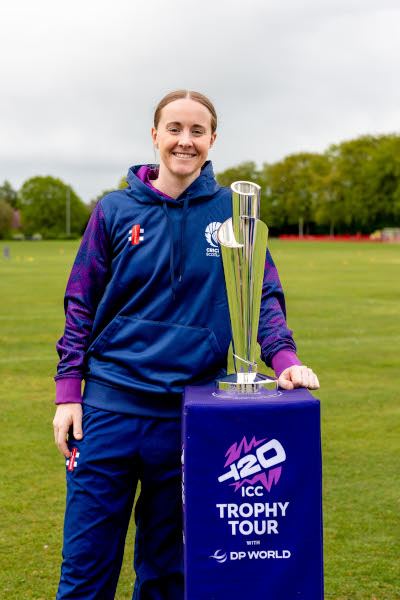
On the day Scotland announced their squad for the forthcoming T20 World Cup, Scotland head coach Craig Wallace spoke to CRICKETher about the long-awaited return of a certain Kirstie Gordon – who is available for selection for Scotland for the first time since 2017.

Back in February, Raf interviewed Kirstie for The Observer (paywalled link); the Blaze captain explained that a conversation with Craig had been instrumental in her decision to return to her home nation. So we got his side of the story!

He recalled: “The last time I was in Nottingham, seeing Kathryn and Sarah [Bryce], I messaged Kirstie saying, ‘shall we have a little catch-up?’ 

“I tried not to be too intense. We had a drink. I literally said, ‘what is your plan?’ And I managed to outline the next year and a half to her.

“And I could see in her eyes, she was like, ‘wow, I want to do that’. I left that meeting quite happy!”

We asked exactly what he said to persuade Kirstie that the time was right to return. “It’s the team,” he said. “It’s how well we’re playing, how well we’re acting as human beings and as people. For me that was the easiest sell – we are going to this World Cup, we are going hopefully to many more World Cups, and we will keep improving and playing a brand of cricket that I can be proud of, that she wants to be part of.

“It’s not the team it was when she made her debut – it’s so much bigger and better than that,” he added.

He apparently messaged Kirstie when the England squad was released to check in, concerned that there might be doubt or regret bubbling up. “But there was literally nothing. She just said, ‘I cannot wait to get started’.”

As for how Kirstie is feeling about facing her old team, England, at Headingley on 20 June?

“She’ll be excited to take them on. That day will be me trying to calm her down, more than anything! And try and make sure that we get the best out of her.”

A fired-up Kirstie Gordon? It should be a cracker of a match!

The full Scotland World Cup squad is below:

  • Kathryn Bryce (captain) – Blaze
  • Chloe Abel – Gunnersbury / New Town
  • Olivia Bell – Lancashire
  • Sarah Bryce – Blaze
  • Darcey Carter – Lancashire
  • Priyanaz Chatterji – Surrey
  • Gabriella Fontenla – Yorkshire Academy
  • Katherine Fraser – Durham
  • Kirstie Gordon – Blaze
  • Ailsa Lister – Lancashire
  • Maisie Maceira – Carlton
  • Abtaha Maqsood – Essex
  • Megan McColl – Glamorgan
  • Rachel Slater – Yorkshire
  • Pippa Sproul – Hampshire

NEWS: Last Ball Drama in Delayed 2025 Cheshire Knockout Final

By Martin Saxon

2025 Senior Knockout Final: Didsbury 87-8, Lindow 88-8

2025 Development Knockout Final: Alvanley 70-9, Lindow 71-1

Early May isn’t usually the time for cricket cup finals, but at Grappenhall today, four teams were engaged in a third attempt to play the 2025 hardball T20 knockout finals, after two unsuccessful attempts last year.

It turned out to be a double celebration for Lindow as their first team won the Senior Knockout final and their seconds triumphed in the Development Knockout final. This also completed a season double for both teams at the Wilmslow club, as their 1st XI were champions of Cheshire Women’s League Division 1 in 2025, and their 2nd XI won Division 3 East.

There may have been some close finishes to Cheshire cup finals over the years, but surely nothing to match the drama of today’s encounter. Lindow’s Katie Farmer hit a single from the final ball to take the Wilmslow club past the target. In truth, Didsbury needed a wicket from that last delivery to pull off victory, as a simple dot ball would have left the teams tied on both runs and wickets. With the 19 over scores also the same, the decisive factor would have been the 18 over countback, when Lindow were one run ahead.

Didsbury’s Emily Wilkins opened the match by hitting the first delivery for four, but the runs quickly dried up. Emily Page took two early wickets, Libby Ackerley bowled her four overs straight through for just 10 runs and at the halfway stage, Didsbury had still scored only 35 and had not hit any more boundaries.

Things improved a little with 52 in the second half, but Roshini Prince-Navaratnam’s 35 from 45 balls was the only double figure score in the South Manchester club’s innings. Libby Taylor took 3-5 in two overs at the death just as Didsbury would have been hoping to accelerate.

Lindow began their reply by losing regular wickets, but at 37-3 after six overs and 51-4 after nine, they were staying well ahead of the required rate. The next seven overs would produce just 15 further runs and see three wickets fall, including that of Lindow top scorer Heidi Cheadle for 29. It really did seem like the bowling efforts of Prince-Navaratnam and Isabelle Hevican had turned the game in Didsbury’s favour.

The next twist came in the 17th over as 10 were added to the score. This kicked off a stand between Farmer and Page which took Lindow within 12 of victory. Three more overs of four runs each – including a couple of wides as the pressure mounted, and some scampered byes and leg byes – then took Lindow to the magic score of 88.

Earlier in the day, Lindow’s second team enjoyed a more comfortable victory. Last August, in the first attempt to play the match, Alvanley’s bowlers reduced their opposition to 39-9, but the tables were turned here by Lindow’s new ball pair of Claire Ashworth and Bethany Seddon.

Put into bat, Alvanley slumped to 19-6. After surviving the first eight deliveries without mishap, two wickets fell before the end of the second over, and further wickets fell in the third, fourth, fifth and six overs as Seddon claimed a 4-14 return and Ashworth bowled her three overs for just four runs, taking two wickets.

Agatha Simmons and Lucy Powell led a recovery of sorts, adding 33 for the seventh wicket, with Simmons the eighth to fall, for the innings top score of 70.

Despite the partial recovery, a target of 71 never looked a daunting one. Lindow’s reply began at a rate of five per over and the scoring rate never dropped too far below this, as a nine-wicket win was wrapped up in 15.2 overs – Nikki Hill’s 25 not out being the top score.

The League thanks Grappenhall CC for hosting the event, and umpires Derek Barnett and Tony Sayle.

WNCL: Queensland Prevail In Charged WNCL Final

By Helen Maynard-Casely

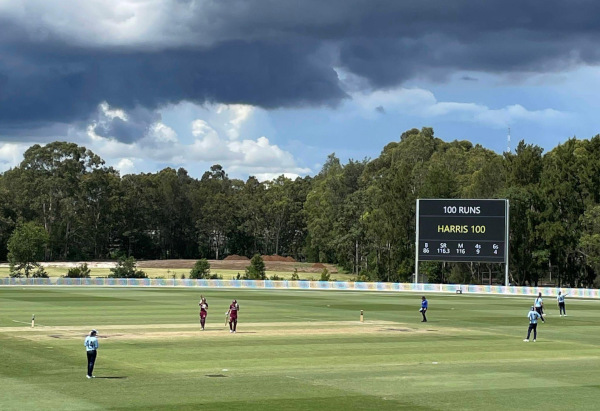
Grace Harris celebrates her century with batting partner Georgia Redmayne who also reached the milestone later in the innings.

Queensland Fire were propelled by centuries from Grace Harris and Georgia Redmayne to victory in the 2025/26 Women’s National Cricket League today at Cricket Central in Sydney. Having featured in the last three finals, this was third time lucky for the Queensland team, also enacting revenge on NSW Breakers who had swiped the Ruth Preddey Cup from their grasp last season. In a close match, made more dramatic by weather interruptions and a revised DLS-affected target, the day’s theatre was directed by the batters out in the field.

After winning the toss and deciding to bat, Queensland knew they would need a good total to defend. But the Breakers were first to strike, with captain Lauren Cheatle continuing her habit of taking early wickets by beating the inside edge of Jess Jonassen to dislodge the bails. A few overs later Matilan Brown struck when Charli Knott edged her delivery to the keeper’s gloves, sending Knott back to the sheds for a duck. However, the Breakers’ commanding early position was effectively dismantled by a huge third wicket partnership of 192 runs built by Redmayne and Harris. Harris was in particularly devastating form, probably smarting from little time at crease during recent international stints, she expanded into her innings from early hard drives down the ground, to later pull shots for 6. In true Harris tradition her batting caused one ball to be abandoned on a roof, and nearly had another lost in the scrub around the oval. Her disciplined batting gave little chances for the NSW fielders, with one notable exception when Cheatle dropped a sitter off Sarah Coyte’s bowling. After completing her century Grace Harris looked set to continue, but fell soon to some wily bowling from veteran Georgia Adams – Harris departing for 111 off of 94 balls. The relief of breaking the Harris-Redmayne partnership was short-lived as Lauren Winfield-Hill set about her batting at pace, reaching 50 runs from only 30 deliveries. By the time Redmayne and Winfield-Hill were both caught off Coyte’s bowling in the 46th over, 296 runs were on the board. An end of innings push by the lower order Queensland batters took the innings total to 332: the biggest WNCL innings total at Cricket Central so far, beating the 309 the Breakers scored against Queensland a month ago.

NSW openers Tahlia Wilson and Alyssa Healy got to the business of the chase in fine style, unruffled by the magnitude of the task. With ominous clouds building, there were probably back-room instructions to keep ahead of the DLS par should the game be ended prematurely. Healy, in her last ever professional match, brought her experience to the task and kept a measured pace such that the score was always just neatly ahead of the DLS par. Wilson followed suit, and between them they put on a 121 run partnership before Healy placed her final short in professional cricket into the hands of Ruby Strange, just as the rain started to fall. Katie Mack joined Wilson at the crease, but only two overs later play was suspended as lightning crackled around the ground – NSW at this stage were 1/129 and ahead of the DLS par score.

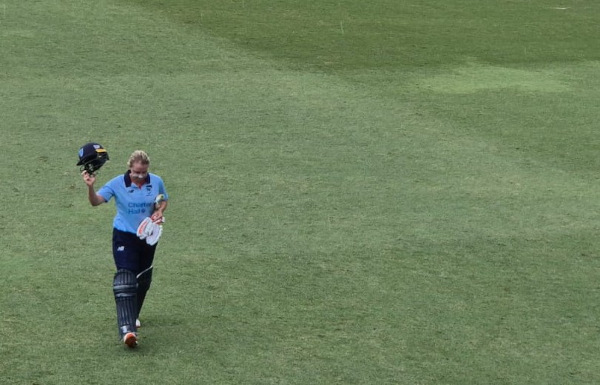
Alyssa Healy, departing from the crease in her last professional game.

A long break ensued, and while the ground was spared the dramatic storms that drove over Sydney that afternoon, the proximity of the lightning kept players from returning to the ground until 5:35pm, much to the increasing frustration of the Queensland players. With the NSW innings shortened to 32 overs and a revised DLS target of 220 runs – the wet outfield and looming darkness were to provide additional challenges to the run rate for the NSW batters.

But Wilson and Mack charged in an electric atmosphere created by the crowd, setting the tone with aggressive running between the wickets to not only put pressure on the Queensland field but also to keep up to the run rate. Needing 91 runs from 9 overs at the resumption of play, four overs later Wilson and Mack had put on 44 runs and were beginning to look in control of this challenging chase. But Jess Jonassen changing ends seemed to be the magic twist that the Queensland team needed, and in the 28th over they forced the run out of Wilson, a few balls before Katie Mack was caught in the deep by Grace Harris. New batters Anika Learoyd and Georgia Adams arrived at the crease and the next stage of this all-or-nothing chase began. Learoyd and Adams battled valiantly and continued to pressure the Queensland field, such that even when a running mix-up occurred, the Fire were not able to execute the run out. But the pressure of the run rate was also showing on the batting, and Learoyd fell making a valiant push for boundaries, Charli Knott taking a catch just inside the rope in the penultimate over. With 15 needed off the last over, Jonassen took the ball and bowled tightly enough that Adams and Maitlan Brown were unable to get more than 2 runs from any delivery. Brown was run out, and then Adams was caught off the last ball, sealing Queensland’s victory by just 7 runs.

Helen (Crystallised Cricket) is a writer based in Dharug and Gundagarra country, and here is writing about a game played on Dharug country. She acknowledges the traditional owners of the lands that she writes from.

INDIA v AUSTRALIA – TEST DAY 3: India Crushed as Healy Goes Out on a High

Helen Maynard-Casely at the WACA

Australian captain Alyssa Healy contemplates the pitch decoration as she walks out to shake hands with the Indian team. Image credit Andy Casely

It took less than 100 minutes today for Australia to wrap up the Test with a bow. Even as they strode out to the middle the Indian batters knew that this was a tough day at the office. That said, returning batters Pratika Rawal and Sneh Rana set to business in the first 30 minutes, and Rawal turned her 43 overnight into a half century. The batters worked past the 125 run deficit from the first innings and began to build a lead. But they faced the spin of Ashleigh Gardner and Alana King, and with a WACA pitch starting to crack in after the high heat that was never going to end well.

Just as we were thinking of looking up the records for India 7th wicket partnerships, Gardner’s bowling beat Rana’s outside edge and she was wandering back to the sidelines. The nameless* Kashvee Gautam came and went for a duck – not able to replicate her heroic 34 runs from the first innings when Alyssa Healy plucked a ball in the slips from Alana King’s delivery. Soon after Sayali Satghare fell similarly to close fielding off King’s bowling. The Indian innings was dealt its final blow when Annabelle Sutherland made an insane amount of ground to take a diving catch sent sky high by Rawal off of Garner’s delivery. India were only 24 runs ahead.

The change of innings was rapid, and Australian openers Phoebe Litchfield and Georgia Voll were perhaps impatient to get into their ice baths. A small wobble of a LBW challenge on Voll hardly seemed to phase the pair, and in the 4th over the innings it was the Queenslander who swept a classy shot through the close field to the boundary to bring up the total, the match and the series.

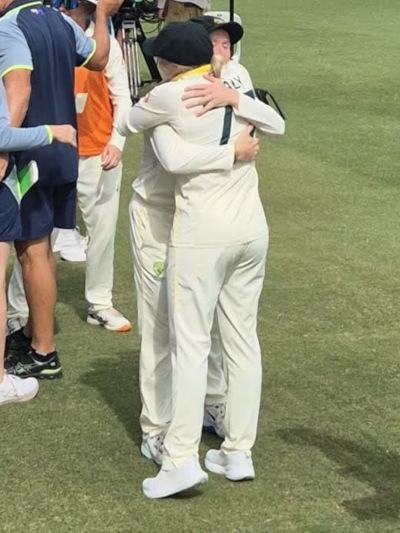
Beth Mooney hugs Alyssa Healy, and we can only interpret quite how much went into that hug. From shared experiences, to the passing of the gloves, a tender moment to witness. Image credit Andy Casely

And so ended the 152nd Women’s Test, not perhaps a classic of the genre, but notable for Australia as they have now won three test matches in a row, well and truly reversing the spate of drawn Tests. Despite the team only playing on average one Test a year, they have found the tactics to force a win, and with this exerted dominance on the multi-format series that they have played.

One can use this juncture to wax lyrical on the departure of Alyssa Healy from both captaincy and the international game. On reflection it is not so much that she was an innovator of the women’s game, but she was the most stalwart of ambassadors. Having worked in the game through the advent of professionalism and overseeing the transition, she was the ultimate advocate in nudging space and visibility for the women’s game. This was of course coupled by her fierce determination to never be anyone’s niece, or wife, but very much a cricketer to excel in her very own right. We are glad we got to watch her play, and because of her impact many more will grace a similar stage.

*OK, this should be explained, the author is still rather fuming that ON INTERNATIONAL WOMEN’S DAY (of all occasions) the Indian cricket team can send a player into the TEST field without the dignity of including her name on her shirt (she literally had duct tape covering over another’s name on her shirt). Though such actions should never detract from the players themselves it is a reflection of how the administration that oversees them views them.

Helen (Crystallised Cricket) is a writer based in Dharug and Gundagarra country, and here is writing about a game played on Whadjuk country. She acknowledges the traditional owners of the lands that she writes from.

INDIA v AUSTRALIA – TEST DAY 2: Australian Heroes Journey Continues as Milestones Pass

Helen Maynard-Casely at the WACA

Australia conducted the second day of the Test to near perfection, keeping India in the field through the heat of the day and batting at an aggressive rate – resulting in the tourists finding themselves batting in the dreaded twilight session. The loss of the top order without finding a lead has India needing something extremely special on the third day to remain competitive in this Test and the series.

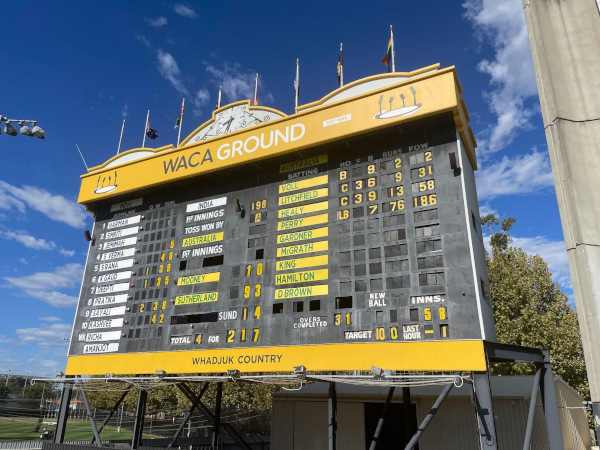
The WACA scoreboard during the tea break.

It is probably returning on the second day where it really sinks in that you are playing Test cricket. Muscles are sore from the day previous, and you find yourself again in the field wearing whites (hopefully with your name on) and battling on. The game becomes more of a journey, and instead of one destination, there are virtual (and real) milestones to mark the progress.

As Ellyse Perry returned to the crease, after sitting on 43 overnight, she would have known that only 30 runs separated her from two auspicious markers. The first was to be only the second Australian Woman to reach 1000 test runs, and the second would be that she would only need three further runs to pass Karen Rolton’s career total of 1002 runs. Perry was not to allow the Indian bowlers to deprive her of this feat, and working with her overnight batting partner Annabelle Sutherland looked unruffled as the session progressed. Not only did they both seem unfazed by the 39 degree heat (running three effortlessly) they each used boundaries to glide past their half centuries. As a result of the momentum, Perry broke both 1000 runs and then became the highest test run scorer for Australia in a matter of balls.

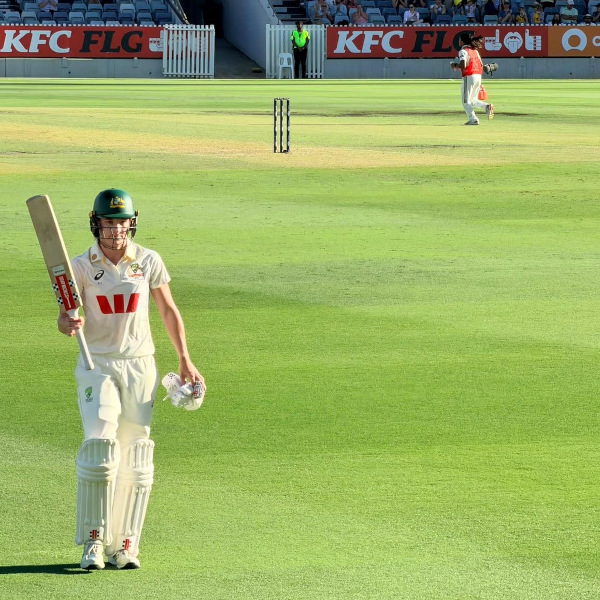
But even as Perry reached this lofty position, there would have been mutterings in the crowd that it was unlikely that she would hold this record for the 16 years that Rolton did. As she stagnated just past the total, Sutherland accelerated to meet her score – and when Perry was dismissed LBW by Deepti Sharma it was perhaps a nuanced passing of the guard. Sutherland continued in her own hero’s journey, and by just after the tea break brought up her century with a whippy pull shot to backward point, reaching the milestone of the first Australian woman to score four test centuries at just 24 years old, and with many years ahead to pass Perry’s new Test runs mark. She batted on through the heat, with her Test average climbing with her live score, peaking at over 100 before she fell also to Sharma’s bowling – punching a ball too high and into the hands of Harmapreet Kaur.

Annabelle Sutherland returns to the dugout after scoring 129, an innings that cemented herself into the Australian Test records. Image Credit Mike Edelstein.

The Indian spinners worked through the heat of the day, and though giving Sutherland leeway, they had otherwise restricted the Australian middle order. Ashleigh Gardner only scored 1 run, Talia McGrath 13 runs and Beth Mooney just 19. But Australia had built a lead, and by the time India’s pace attack – headlined by debutant Sayali Satghare – finished the tail, late afternoon shadows had consumed the ground. Satghare finished the innings 4 wickets for 50 runs, when she forced Lucy Hamilton to push a ball into Sneh Rana’s hands (the latter redeeming herself after an awkward drop off Mooney’s second ball).

You have to wonder though, if this was the trap Australia had set. Throughout their batting innings each of the players had batted relatively aggressively (considering the few Test innings these players get) to the point that you had to wonder if this was the game plan. To get 100 or so ahead, and to put India back into bat in the twilight session. If so, it worked perfectly, Australia’s reply of 323 to the Indians’ first inning totals of 198 – meant that they had a 125 run cushion, with tricky pink ball batting conditions facing India.

Bowling pace under the lights, Australia had a dream start when Darcie Brown sent Smriti Mandhana’s leg stump tumbling, with the India opener only on 2 runs. Verma fell in short order, nicking Lucy Hamilton’s delivery to Beth Mooney. India’s batters struggled on, with only Pratika Rawal proving resilient. She had to watch helpless as four more of her batting partners fell to the Australian pace attack, Hamilton picking up the wickets of Deepti Sharma and Richa Ghosh in the 24th over. Sneh Rana joined Rawal and survived at the crease up to stumps, and India finished the day still 20 runs behind the Australian total with 4 wickets remaining.

An odyssey of a day in Test cricket at the WACA, but hard to go past the controlling tactics of the Australia team. They will return tomorrow likely to clinch the 4 points from the Test victory and the series win.

Helen (Crystallised Cricket) is a writer based in Dharug and Gundagarra country, and here is writing about a game played on Whadjuk country. She acknowledges the traditional owners of the lands that she writes from.