A sponsorship snafu could mean that England A coach Jon Lewis is promoted to the main England role as soon as next week, after it emerged that department store John Lewis had already spent hundreds of thousands of pounds on a new advertising campaign centred around the name of the former head coach Jon Lewis.
Lewis has been flown home from Australia, where England A are currently playing Australia A, for emergency talks as the ECB scramble to save their sponsorship deal with the department store.
The advertising campaign centres around a new line of Bondi-2-Coogee budgie smugglers modelled by the England Men’s cricket team, but hit a snag last week when it emerged that the OG Jon Lewis had been fired from his role following the 16-0 Ashes whitewash.
Clare Connor said: “In England, we pride ourselves on our excellent talent pipeline of coaches with the name Jon Lewis, so we feel confident this is just a temporary hitch.“
“Our synergies with the John Lewis brand couldn’t be stronger – after all, here at the ECB we never knowingly undersell ourselves.”
Please note that the opinions of guest contributors to CRICKETher do not necessarily reflect the views of the Editor.
By Andy Frombolton
The clamour for Jon Lewis to be sacked as England coach continues – without anyone explaining what he’s done so wrong or, more pertinently, what anyone else could realistically have done differently or better.
Heavily shackled by having to primarily select from a centrally-contracted group whose limits are well evidenced, and additionally limited by the paucity of credible ‘ready-to-go’ alternatives, Lewis has done as well as could be expected with the hand he was dealt.
Meanwhile, Charlotte Edwards is widely heralded as The Answer to the Problem. Whilst there’s no denying that she’s enjoyed significant achievements as a coach, recent results suggest that success doesn’t invariably follow wherever she goes: Vipers finished third in last year’s RHF Trophy and the CEC; Sydney Sixers finished fifth and sixth in the last 2 WBBLs; and MI were third in last years WPL (and hold the same position currently). In her early coaching days she also undoubtedly benefitted from the ‘Lottie Effect’ – attracting good players who wanted to be in her orbit with the resultantly-strong teams routinely crushing their opponents.
And what would her conditions be for taking the role? The right to ditch established players (however embarrassing for the ECB – and financially wasteful – this might be if they hold long contracts)? To prioritise trialling players during the upcoming summer series over results? For the ECB to publicly acknowledge that re-building will take a few years and may entail some low ‘lows’ en route? If those freedoms are what’s needed, why not just give Lewis the same?
It’s my strong view that Lewis is a good coach and that he should remain, perhaps with Edwards appointed as an advisor or deputy.
My earlier use of the term ‘rebuilding’ was deliberate because, for all the investment in the England team and for all the record-breaking crowds, the simple fact is that the current England squad’s collective zenith isn’t high enough to beat Australia or India in 50 over cricket.
Defenders of individual incumbents might seek to cite ICC rankings or statistics to justify their continued selection – but this ignores the fact that the majority of their performances are against international teams which are weaker than the better Tier 1 counties. The true test of an international cricketer is how they perform against the strongest opponents and, as illustrated in my last article, the performances of most of the current England squad crumble when playing Australia.
In which case, what possible purpose is served by continuing to pick this same group of players? Sometimes you need to accept that no amount of coaching or training or additional match experience is going to transform a player into a world beater. Business people refer to the ‘sunk cost fallacy’ to describe a cognitive bias that causes people to keep investing in something even when it’s no longer beneficial. It doesn’t necessarily mean that the original decision was wrong – just that it didn’t work out as hoped.
With the freedoms referred to earlier, whoever’s head coach this summer should therefore announce a series of England vs England A games to be played across the summer pitching incumbents (desperate to prove they still warrant their place) against challengers (eager to show that they don’t).
These games shouldn’t be hidden away, played behind closed gates as if they’re some sort of shameful talent slugfest, but promoted to encourage crowds and media scrutiny; with the best performers selected for the summer international series. (If some centrally-contracted players subsequently lose their places, the message can be all about the opening-up of the selection process to hitherto-overlooked talent rather than the ousted. That’s what PR people are for!)
The best performers should then play in a series of England A games versus the touring teams. (No touring team should turn down the chance for more match practice.)
The sooner the rebuilding starts, the sooner we’ll have an international team capable of matching Australia and India.
Here’s the 3 steps needed:
1. The ECB clarifies the head coach situation and announces a series of England vs England A matches; explaining that the purpose is to identify the group of players capable of (A) winning the 2026 World Cup (to be held in England), or (B) the Ashes in 2027.
Players should be given a proper ‘run’ to prove themselves at the highest level. Remember, Knight didn’t score a 50 until her 10th ODI innings and her second in her 33rd whilst Wyatt took 48 innings to score her maiden ODI 50. We cannot go back to the days of e.g. Gordon, Lamb and the two Smiths being discarded after a few games.
2. To commence the reset, start with the only truly world-class player we have – Nat Sciver-Brunt – who needs to be asked to take the ODI captaincy until after the October World Cup. A separate T20 captain should be appointed.
2. There needs to be a volte face in selection criteria. Chris Guest, head coach of the Under-19s, recently observed in a Cricketer article that “if you’ve got someone who is outstanding within their skill and can’t field as well as someone who is less good within their skill but can field brilliantly, the skill still takes precedent at the moment.”
Numerous games turn on moments of fielding brilliance but England have only one exceptional fielder – Wyatt-Hodge – whilst most of the other centrally-contracted players are not international-standard fielders; several to the point where it could be posited that their mistakes and lapses in the field outweigh any ‘delta’ skill in their principal discipline over their nearest rival.
A stunning catch or a sharp run-out is more likely to impact a result than having a fractionally-worse ER or a slightly-lower batting average/ Strike Rate. Hence this prevailing attitude needs to be reversed.
Going forward players need to know that they won’t be selected unless they are (or have the potential to rapidly become) world-class fielders.
In the last article, I proposed a new-look T20 squad and promised my ODI squad would follow. Given the short timeframe I’ve proposed a transitional squad to participate in the October World Cup plus possible contenders for each slot. For ease of reference, I’ve also included my (slightly modified) T20 squad for next summer’s World Cup.
Transitional Squad World Cup October 25
Contenders To be tested during the 2025 summer in A matches
T20 World Cup June 26
Bouchier
Lamb
Bouchier (cpt)
Armitage
Smale / ADR
Wyatt
Scrivens
Capsey
Knight
NSB (cpt)
NSB
Wyatt
Perrin
Perrin / Capsey
Scholfield
Marlow
Bryce / Heath (wk)
Jones (wk)
Bryce / Heath (wk)
Gibson / Kemp
Gibson / Glenn
Kemp / George
Dean
Dean
Skelton / Smith / Baker
Smith / Baker / Gregory
Filer
Gaur
Filer
Bell
MacDonald-Gay / Ballinger
MacDonald-Gay
Note: Ecclestone’s omission was explained in my previous article.
Amy Jones’ recent ODI batting form has been good. However, a keeper’s role goes beyond catching and stumping; a great keeper additionally covers a huge area behind the stumps, intercepts all incoming throws to make them look good, manages fielding angles for their captain and acts as the vocal drumbeat of the team. Jones doesn’t do any of these things well and hence October’s World Cup should be her swansong.
I’m assuming that Bryce, like Gordon before her, can be persuaded to swap allegiances if adequately incentivised. If not, Heath has just a few months to seize her chance. (If she doesn’t, Smale is breathing down her neck.)
In the last 18 months, Knight has turned herself into a versatile and creative T20 batter. (In the last 2 years her T20 average is 33.6 SR 129, before that her figures were average 28.3 SR 116.) This evolution warrants her inclusion as a specialist batter notwithstanding her decreasing agility in the field.
Capsey might need to replace Scrivens to provide a sixth bowling option. (N.B. Wyatt could extend her career if she returned to bowling. Admittedly, she hasn’t bowled in internationals since 2020 but her stats are decent and even a couple of overs per game would give a captain more options.) Regardless of when she enters the senior team, Perrin’s bowling needs to be encouraged. Australia’s men’s and women’s teams demonstrate the advantages of having lots of batters who can bowl a few overs.
Dedicated Eurovision fans will, of course, recognise the opening lines of the UK’s second-placed 1977 entry which perfectly sum up England’s current WAshes predicament.
But should anyone really be surprised at how badly the team has performed? Prompted by an observation by Melissa Story on the Storylines podcast regarding the difference between most England players’ performances against Australia and their performances against all other teams, I decided to delve into the data.
The results make for grim reading.
There are just 2 instances where a player’s batting performance against Australia is superior to their performances against all other teams: Dunkley in T20s and NS-B in ODIs. At the other end of the scale, Jones’s averages are 50% worse in both short formats. (Bouchier has obviously had a very tough first WAshes tour, but I don’t think these figures reflect her potential.)
Age
Format
Mat
Inns
NO
Runs
HS
Ave
% DIFF
SR
% DIFF
Knight
34
T20
All ex Aus
97
86
25
1787
108*
29.30
122
vs Aus
32
29
4
435
78
17.40
59%
113
93%
ODI
All ex Aus
116
109
24
3090
106
36.35
73
vs Aus
33
33
3
947
88*
31.56
87%
69
94%
Dunkley
26
T20
All ex Aus
55
44
8
792
61
22.00
117
vs Aus
9
8
1
194
59
27.71
126%
138
118%
ODI
All ex Aus
27
25
2
709
107
30.83
85
vs Aus
7
7
0
80
28
11.42
37%
62
72%
NS-B
33
T20
All ex Aus
101
97
24
2232
82
30.58
121
vs Aus
31
29
4
557
68*
22.28
73%
107
89%
ODI
All ex Aus
89
77
13
2698
42.16
98
vs Aus
26
25
6
1113
148*
58.57
139%
87
89%
Jones
31
T20
All ex Aus
98
78
16
1431
89
23.08
128
vs Aus
19
17
3
161
40*
11.50
50%
88
68%
ODI
All ex Aus
80
65
9
1892
94
33.79
86
vs Aus
17
16
1
245
47*
16.33
48%
66
76%
Wyatt
33
T20
All ex Aus
131
113
11
2446
124
23.98
130
vs Aus
39
36
3
744
100
22.54
94%
127
98%
ODI
All ex Aus
96
80
14
1729
129
26.20
91
vs Aus
22
21
0
309
43
14.71
56%
76
83%
Beaumont
33
T20
All ex Aus
88
73
9
1630
116
25.47
111
vs Aus
16
15
2
229
58*
17.61
69%
96
86%
ODI
All ex Aus
108
98
12
3635
168*
42.27
76
vs Aus
19
19
0
639
114
33.63
80%
75
99%
Bouchier
26
T20
All ex Aus
41
35
6
709
91
24.45
123
vs Aus
3
2
0
13
13
6.50
27%
81
66%
ODI
All ex Aus
14
12
2
456
45.60
110
vs Aus
3
3
0
26
17
8.66
19%
70
64%
Ecclestone
T20
All ex Aus
76
30
22
209
33*
26.13
133
vs Aus
20
10
1
76
22
8.44
32%
112
84%
ODI
All ex Aus
56
33
10
267
33
11.61
76
vs Aus
16
16
3
110
32*
8.46
73%
57
76%
Capsey
T20
All ex Aus
34
32
3
647
67*
22.31
117
vs Aus
4
4
0
60
46
15.00
67%
146
125%
ODI
All ex Aus
17
11
2
218
44
24.22
79
vs Aus
6
6
0
65
40
10.83
45%
59
75%
Dean
20
T20
All ex Aus
33
11
3
133
34
16.63
112
vs Aus
6
3
1
5
2*
2.50
15%
56
50%
ODI
All ex Aus
33
18
6
302
47*
25.17
69
vs Aus
7
7
1
57
21
9.50
38%
62
90%
Kemp
19
T20
All ex Aus
22
13
6
129
51*
18.43
129
vs Aus
3
2
1
16
11*
16.00
87%
133
103%
On the bowling front, only Capsey (in ODIs, and based on a small data set) improves her stats against Australia. But the absolute stand-out figures are Ecclestone’s. If Ecclestone is the #1 bowler in both T20 and ODI formats according to the ICC (and similarly Glenn is the #6 T20 bowler) this neatly illustrates Mark Twain’s observation that there are three types of lie: lies, damn lies and statistics.
Age
Mat
Bwld
Overs
Mdns
Runs
Wkts
Ave
% DIFF
Econ
% DIFF
SR
% DIFF
NSB
33
t20
All ex Aus
101
90
249.5
3
1569
70
22.41
6.3
21
vs Aus
31
27
67.1
0
527
20
26.35
118%
7.8
125%
20
94%
ODI
All ex Aus
89
76
409
34
1646
59
27.90
4.0
42
vs Aus
26
24
149.2
2
825
20
41.25
148%
5.5
137%
45
108%
Bell
24
t20
All ex Aus
24
24
82.2
0
558
31
18.00
6.8
16
vs Aus
5
5
19
0
178
6
29.66
165%
9.4
138%
19
119%
ODI
All ex Aus
13
13
101.2
2
520
22
23.64
5.1
28
vs Aus
6
6
53.3
1
316
12
26.33
111%
5.9
115%
27
97%
Ecclestone
25
t20
All ex Aus
76
76
281.4
9
1569
112
14.01
5.6
15
vs Aus
20
19
73.4
1
520
25
20.80
148%
7.1
127%
18
117%
ODI
All ex Aus
56
55
494.4
67
1678
99
16.95
3.4
30
vs Aus
16
16
151.2
7
707
21
33.66
199%
4.7
138%
43
144%
Filer
24
t20
All ex Aus
7
7
25
0
166
5
33.20
6.6
30
vs Aus
1
1
2
0
21
0
–
10.5
158%
–
ODI
All ex Aus
12
12
73.5
4
353
20
17.65
4.8
22
vs Aus
3
3
24
0
141
4
35.25
200%
5.9
123%
36
163%
Dean
24
t20
All ex Aus
33
33
114
1
774
44
17.59
6.8
16
vs Aus
6
5
19
0
150
6
25.00
142%
7.9
116%
19
122%
ODI
All ex Aus
33
32
275.3
14
1238
66
18.76
4.5
25
vs Aus
7
7
41.5
1
240
5
48.00
256%
5.7
128%
50
200%
Glenn
25
t20
All ex Aus
63
61
210.2
3
1187
80
14.84
5.6
16
vs Aus
9
8
28
0
247
9
27.44
185%
8.8
156%
19
118%
ODI
All ex Aus
15
15
106.1
6
440
18
24.44
4.1
35
vs Aus
2
2
16
1
86
2
43.00
176%
5.4
130%
48
136%
Capsey
20
t20
All ex Aus
34
10
17
0
108
5
21.60
6.4
20
vs Aus
4
2
5
0
39
1
39.00
181%
7.8
123%
30
147%
ODI
All ex Aus
17
6
25
2
119
4
29.75
4.8
38
vs Aus
6
5
22
2
96
4
24.00
81%
4.4
92%
33
88%
Kemp
19
t20
All ex Aus
22
18
46
0
362
18
20.11
7.9
15
vs Aus
3
3
8
0
65
3
21.66
108%
8.1
103%
16
104%
Jon Lewis is copping a lot of flak for the team’s performance – although his hands are constrained, firstly, because he’s obliged to pick any team primarily from the centrally-contracted squad (otherwise why have they got contracts?) and, secondly, there aren’t many oven-ready replacements available.
We need to be honest. This cohort has repeatedly demonstrated the zenith of its capabilities i.e. it can beat most opposition (but, to honest, so could the top 3 regional/Tier 1 teams), but against Australia and in T20 and ODI World Cups (and the Commonwealth Games) they have repeatedly fallen short.
No one calling for Lewis to lose his job has explained how anyone else could extract better performances in these circumstances.
At some point soon, therefore, we need to move on from many of the current squad. But timing will always be an issue. Should it be now after the WAshes – with the (potentially-increased) risk of an early exit from this October’s World Cup? Or before the 2026 T20 World Cup (being held here in England). Because we haven’t prepared adequately for the next generation, what should have been a phased transition might need to be a cull.
So, what’s the answer? For that, I’ll turn to the next two lines of the referenced Eurovision song: “Remedy? Why don’t we rub it out and start it again?”
In the business world when answers and solutions are hard to identify, a proven technique is to define the desired end state and then work backwards to the status quo. Applying this methodology…
1. The ECB announce the goal is to win the 2026 T20 World Cup in England. (Or Olympic Gold in 2028?)
Fans will accept hiccups along the way if they know what the goal is and understand why changes are being made.
2. The ECB should confirm its confidence in Jon Lewis as coach. Much fun has been made of one poorly-phrased comment, but he’s a great coach, inspires loyalty and, frankly, has done well with the situation he inherited.
3. Identify the players to deliver this goal – and back them.
Not picking centrally-contracted players would obviously attract criticism, and the ECB should learn from this and reduce the number of central contracts awarded for the next few years. It would be better to award a small number of central contracts to a core of players with proven credentials, plus development contracts to a larger group.
We simply won’t win a World Cup until our fielding improves, and consequently (unless an individual is truly world class in one other discipline) they shouldn’t be picked unless their fielding meets international standards. (In domestic cricket, Katie George and Alice Monaghan routinely demonstrate what’s possible.)
Here’s my T20 team:
K Bryce (I’m assuming cash triumphs over loyalty to country) or Seren Smale (if not)
M Bouchier (captain)
D Perrin
B Heath (wk)
NS-B
A Capsey (but only if she bowls more – if not, Wyatt-Hodge)
F Kemp
D Gibson / C Dean (depends if wicket is turning)
R MacDonald-Gay
H Baker / D Gregory (whoever develops best in next season)
M Gaur / L Filer
Yes, I know I’ve omitted S Ecclestone. Firstly, I refer you back to her stats. In addition, her batting simply hasn’t developed and her fielding is poor (although she openly remonstrates with fielders who drop catches off her bowling). In the long term, there are other options who would have a more positive impact on team morale.
(I’ll propose my ODI team in my next article. But as a taster, it will feature several different personnel and a split captaincy.)
4. An A squad comprising these players needs to be established within the next few weeks, thereby these players know they are potentially seen as part of England’s future plans.
5. Until we play slow/spin better we will never win consistently. This A squad therefore needs to go on a long tour to the Indian subcontinent / Sri Lanka this Spring (and next spring), and play tens of games against (men’s) teams. I know not everyone likes this idea, but realistically it is the only way to ensure high quality opposition. (You don’t improve by playing weaker teams.)
6. The A team should also play several games against visiting international opponents (also giving visitors the opportunity to test their fringe players).
7. AND finally, there needs to be a series of England vs England A games in the early season allowing the challengers to demonstrate why they should be picked for England and the incumbents to prove they deserve their places.
How often have you gone back to a restaurant where you had a bad meal? Or watched the second episode of a TV series if you didn’t enjoy the first one? The brutal fact is that you only get one chance to make a first impression and the key to attracting (and thereafter retaining) new customers is to prioritise quality control over everything else.
Hence the biggest threat to the growth of women’s cricket is if the initial experiences of potential fans are underwhelming.
This is not to ignore nor belittle the huge positives of the past 5 years: significant investment; greatly improved media coverage; and rapidly-rising standards. All helped by a tailwind of goodwill and a collective desire to address historic and systemic inequities.
But at some point, all products must be able to stand on their own two feet. No sport has an innate right to exist, or to be supported, or for its participants to be remunerated. Reward ultimately must be linked to popularity and the willingness of followers and advertisers to pay for access.
However, shielded from the commercial realities of having to ensure earned revenue exceeds costs, this simple truth is ignored by those running English women’s cricket whose preference is for catchy headlines and good optics. In the short term, it’s easy to proclaim every new initiative as Success or Progress. But that’s not the same as developing a sustainable, high-quality product.
1. Let’s start at the top – the national team. They’re a good team – but not nearly as good as they should be for all the money and resource spent in the last few years.
Looking first at the batting, the only new talent to have emerged in the past 5 years who has consistently delivered is Bouchier. Dunkley is reminiscent of Hick in the men’s game – too good for county cricket but possessed of a flawed technique and whose fielding and (abandoned) bowling aren’t good enough at international level. Capsey appears to have been similarly exposed. In the keeping department, next-off-the-rank Heath has been given virtually no chances to demonstrate that she could step up to the role and hence we remain one broken finger away from having to deploy a ‘stopper’ who can bat or a keeper who can’t bat. With respect to bowling talent England have good first-choice reserves but there’s still something wrong with the set-up when the selectors deem four 18-year-olds (Kemp, Gaur, Baker and MacDonald-Gay) to be better than anyone produced by the regional system in the past 6 years.
There is however a much bigger problem than how good the England team is – and that’s how bad most of the international opposition is. With the exception of Australia and India, the rest are no better than a typical regional/Tier 1 team and consequently many international games are terrible mismatches. That England additionally so often choose to bowl first against weak opponents (thereby denying fans the chance of at least seeing a good batting display before our bowling attack invariably works its way through the opposition) shows a complete disregard for the spectator experience. Which brings us back to ‘quality control’.
If we want better opposition (and hence a better showpiece product), it’s clear that England (and Australia) need to think far more holistically. The ECB should run (and pay for) a scheme under which 10-15 players from each of the West Indies, South Africa, New Zealand, Pakistan and Sri Lanka play a full season of cricket in England. The top talent should be assigned to Tier 1 counties with the rest spread across Tier 2 and 3 counties and also matched with a local club which is suitably incentivised to provide them with regular mid-week and weekend matches in (“men’s”) leagues and ideally women’s premier league games too.
The cost? With vision and creativity, this shouldn’t cost more than £20,000 per player – or £1.5m (or, put another way, roughly the ECB’s payment for one Tier 1 team). Ideally, the benefitting countries would be required to provide a reciprocal scheme for the best English players (providing a far better skills and life experience than a cosy few months in New Zealand which seems to be the preferred route for so many).
2. England squad size. (N.B. I’d be the first to agree that there’s an excess of England men central contracts – but (i) that doesn’t make it right, and (ii) they might argue that they generate the funds thus wasted.)
Central contracts are partly designed to ensure that players don’t play too much cricket. And in the men’s game, they are also essential to bind top players to England which is integral to maintaining the value of tv broadcasting rights and high ticket prices.
But female contracted players play far fewer days of international cricket* and also far fewer non-international matches. Nor is an alternative career playing in various T20 and T10 leagues around the world viable.
[*Between Nov 1 2023 and Oct 31 2024 (the period covering the last women’s central contracts), the England men’s and women’s team played roughly the same number of T20s (17 men, 20 women) and ODIs (10, 9), but the men played 14 Tests compared to 1 for the women.]
Consider the total number of games played by 3 representative non-Test players from each squad during this period:
ODI
T20i
FC/List A
T20/100
Bouchier
9
17
3
22
Capsey
7
16
0
29
Glenn
3
16
2
14
Salt
9
17
0
35
Livingstone
10
17
0
31
Ali
3
14
0
50
(As another comparator, James Vince played 13 county matches and 52 T20 matches in this period.)
So, neither the argument that you need to protect (most) female players from playing too much cricket nor that it’s essential that they are contractually bound to England holds for the women’s game.
This is not – before anyone gets too agitated – an argument for a smaller total pay pot for the women. My proposal is that there should be very few central contracts and that the money saved should be re-allocated to pay higher match fees.
3. Women cricketers need to play far more games.
This may sound curmudgeonly, but we shouldn’t be celebrating when an 18-year-old gets an international cap. The fact that someone who’s probably played less than 100 games in her life can seamlessly segue onto the international stage is ridiculous (genuine teenage sensations excepted). Not only does it reiterate the argument at point (1), but it’s a terrible indictment on the domestic set-up that after 5 years of professionalism there’s such a dearth of competition from players in their mid-20s.
There seems to be a belief that natural talent + youthful exuberance is enough. But even a brief study of the stats tables (particularly the batting tables) shows the domination of older players. Why? Because skill and training can only take you so far. To dominate you also need match experience i.e. exposure to, and dealing with, numerous game situations.
Adam Gilchrist, the Australian men’s keeper, came to England as a teenager and played 90 games in a season, returning home having vastly accelerated his development. Instead of every appearance being controlled by coaches and their game time limited (caps on overs for fast bowlers excepted), all female players, especially young players, need to play far more cricket.
And if you really want to get better you need to play against tough opponents. Most of the greats (Bates, Devine, Edwards, Greenway, Lanning) learnt their cricket playing “men’s” cricket. Fast bowlers bowl quicker, batters hit the ball harder, fielders stop more balls and throw faster. Modern Pathway players have far too little exposure to “men’s” cricket compared to their predecessors. This trend needs to be urgently reversed and participation encouraged.
4. Number of Tier 1 counties. As posited in a previous article most regional teams comprised too many ‘journeymen’ (the pool of pre-professional-era cricketers who were ‘known entities’) and academy graduates whose principal role was to make up the numbers. (Addressing one comment on that article – this is not to say those young players lack talent but TFCs are the inevitable consequence of playing in a team where paid professionals will expect to get the best opportunities.)
And if there wasn’t enough talent to justify 80 professional contracts, then expanding the number of contracted players to 120 (or 130+ given Yorkshire’s advance recruitment) was obviously going to exasperate the gap between the teams with the best recruiting strategies and those with the worst. The trickle-feed squad announcements from the Tier 1 counties has confirmed this fear – from what we know (and, equally importantly, from the lack of announcements from some counties) it’s fairly clear that at least 3 of the Tier 1 teams are going to struggle to win many games. Quality control, anyone?
An honest assessment of the talent pool should have seen the ECB launch this new era with just 6 Tier 1 counties to ensure a more even spread of available talent which could still have been sold as a ‘positive’ (90 full-time professionals).
But it’s obviously too late to reverse this decision, so the main lesson should be to not expand until it’s proven there’s enough talent to sustain more Tier 1 teams. “You can’t do that!” Why not? The ECB has repeatedly demonstrated that it doesn’t consider itself bound by the original Darwin tender document and hence should therefore be bold enough to reverse the pre-determined accession of Yorkshire and Glamorgan.
The ECB should then specify the conditions which would need to exist to warrant expanding the number of Tier 1 teams (in terms of spectator and tv numbers, sponsorship, advertising revenue, etc.) without predetermining the timescale. The number of Tier 1 teams should be dictated by demand, not by diktat.
Will real-life match the enthusiastic projections about the growth of women’s sport? Will the women’s game nurture its own fans? Will most of the audience (as now) comprise fans of the men’s game (and, if so, what will happen when there are far more women’s games which thus compete for the limited time of these fans?) Can fans be converted to switch their primary allegiance to the woman’s game by different marketing, scheduling or pricing strategies?
It is surely far more sensible to expand in line with growing demand than grow too fast and risk having to cut the number of teams in the future if the predicted support doesn’t materialise?
And, regarding any future expansion of Tier 1, access must be on the basis of performance on the field, not a desire for geographic spread. If e.g. the south-east produces the next 2 teams to be elevated, the issue should be to understand how this success was achieved and seek to replicate it elsewhere, not to penalise best practice.
All Tier 1 teams should also run A teams comprising any professionals not playing Tier 1 cricket plus the best academy players. These teams should play against each other during the week but – see point 3 – also play in a “men’s” league at weekends. If they did, I’d predict most of the A team players would usurp the 1st XI incumbents within 2 years.
5. Sub-Tier 1. Credit where it’s due. Here the ECB has basically got it right. There obviously has to be a pathway providing a smooth journey (both ‘up’ and ‘down’) from teenage county talent to professional. And the structure, together with the money going into – and the commensurate expectations of – the Tier 2 and Tier 3 counties appears well thought out.
Having only 6 Tier 1 counties would have permitted more money to go into this level where every pound spent benefits more players (Which is more likely to grow the talent pool and unearth the next England star? Betting on one full time professional or several semi-professionals?). Tier 1 expansion should not involve any decrease in Tier 2 or Tier 3 funding.
6. Finally, it’s not enough to create a pathway to professionalism. As more talent fights for a finite number of contracts there will be a commensurate increase in the number of players who either seek, but don’t reach, Tier 1 or whose tenure is short. Currently most of that talent, enthusiasm and investment is squandered (Challenge: Could any of the former Regional teams say what happened to all the players who passed through their academy but who didn’t win a regional contract in the past 5 years?)
Alongside a professional contract, all players should be encouraged to gain coaching or umpiring qualifications or offered further education opportunities which could take them into management, administration or data analysis. Better representation in these roles means that decisions about women’s cricket would increasingly be made by people who best understand it.
Leigh, who last won the title in 2022, won their second Cheshire League title in three years, seeing off a challenge from last year’s winners Didsbury, who finished 12 points behind; and Nantwich, who were a further eight adrift. Both of the challenger clubs at least had the consolation of winning a senior T20 trophy during the year.
We’ll never know what might have happened had there not been three washed out matches between the top three during the year. This included a cancellation of the potential winner takes all final match between Leigh and Didsbury.
There has now only been one occasion in the last 14 years where a club has retained the league championship.
Leigh’s star players included Kirsten Smith with the bat and Sophie Heaton with the ball, but it’s highly likely that they wouldn’t have claimed top spot without the close season acquisition of Ellie Mason, who hit 672 runs at an average of 112 and added 18 wickets at 17 apiece for good measure.
Didsbury’s Pooja Singh was the leading wicket taker with 22.
In the early weeks of the season, it seemed that newly promoted Lindow might be strong challengers, but they eventually faded to finish fourth. Their opener Heidi Cheadle finished as the top run scorer in Division 1 with 674, two more than Mason’s final total.
Four times title winners Appleton drop out of the top flight for the first time after a difficult season, and will be replaced by Leyland. After two third placed finishes in 2022 and 2023, Leyland stormed to the Division 2 title, ending with a 100 percent record, while all of their potential challengers lost at least three matches.The only other divisional winners with an unblemished record were Elworth in Division 5 South and Romiley in Division 5 East.
This is the final list of winners and runners-up across the CWCL competitions.
While England men seem to pick their teams primarily on height and vibes, the increased use of data in cricket means that we do have a lot more information that we can rely on to assess players. Of course there are lies, damned lies and statistics and you need to watch games not just scorecards and spreadsheets to judge players, but over time I’d rather have the batters with the best strike rates not the best looking cover drives.
I have combined all performances from the Women’s Hundred, WBBL, WPL and CWPL as well as international matches played by England, Australia, India, West Indies, South Africa and New Zealand in the last 12 months (from August 2023 to August 2024). I’ve not included Pakistan, Bangladesh or any other country with no representation in those leagues as we only have their international averages which are easily available. I’ve not done Sri Lanka either, but I have done Chamari Athapaththu given the amount of cricket around the world she has played.
I’ve not included the Charlotte Edwards Cup, WNCL, SuperSmash or any other leagues which are overwhelmingly competed for without high quality overseas players. There are some issues with comparing between leagues – the WPL was considerably faster scoring than the CPL, but broadly speaking the standards are similar – the CPL might have had the weakest overseas player contingent, but the international players who did compete there didn’t do substantially better there than they did in the other leagues – because it was lower scoring the bowlers tended to improve their figures while the batters saw theirs deteriorate. It’s less useful for analysing players who haven’t played international cricket and only played in one franchise league – especially those who did very well in that league like Lauren Smith or Amy Edgar in the WBBL or Freya Davies in the Hundred.
For the international data I’ve included all players who have batted or bowled at least 12 times or though I’ve included a few players in the national discussions with slightly less appearances.
England
Squad
Innings
Runs
Balls
Avg
SR
S Ecclestone
19
153
106
13.91
144.34
D Gibson
26
353
251
20.76
140.64
A Jones
36
585
425
20.17
137.65
D Wyatt
22
577
425
27.48
135.76
N Sciver-Brunt
20
967
731
53.72
132.28
H Knight
40
1005
803
38.65
125.16
M Bouchier
38
722
592
19.51
121.96
S Dunkley
31
491
421
16.93
116.63
A Capsey
46
1046
924
23.24
113.20
B Heath
23
225
201
11.25
111.94
F Kemp
18
131
120
8.73
109.17
C Dean
13
130
126
14.44
103.17
Contenders
P Scholfield
8
190
138
27.14
137.68
C Griffith
10
100
77
10.00
129.87
T Beaumont
25
531
449
22.13
118.26
G Scrivens
8
157
139
19.63
112.95
G Adams
13
101
112
11.22
90.18
H Armitage
8
62
69
7.75
89.86
B Smith
20
192
220
9.60
87.27
Squad
Innings
Balls
Runs
Wickets
Avg
ER
S Glenn
29
577
565
41
13.78
5.88
S Ecclestone
28
612
668
40
16.70
6.55
L Smith
22
470
516
28
18.43
6.59
A Capsey
21
296
343
16
21.44
6.95
C Dean
27
516
604
26
23.23
7.02
H Knight
13
150
180
5
36.00
7.20
L Bell
21
416
500
26
19.23
7.21
N Sciver-Brunt
28
491
609
25
24.36
7.44
D Gibson
35
588
760
25
30.40
7.76
F Kemp
12
173
271
9
30.11
9.40
Contenders
F Davies
8
140
132
11
12.00
5.66
R Slater
8
105
114
5
22.80
6.51
L Filer
13
247
276
10
27.60
6.70
M Villiers
9
132
149
6
24.83
6.77
K Levick
7
129
154
10
15.40
7.16
So. Smale
9
151
181
9
20.11
7.19
C Pavely
7
135
162
9
18.00
7.20
G Adams
15
188
227
9
25.22
7.24
E Gray
10
135
164
9
18.22
7.29
R MacDonald-Gay
9
140
175
8
21.88
7.50
H Baker
7
110
141
4
35.25
7.69
G Davis
8
140
180
10
18.00
7.71
E Arlott
7
135
185
11
16.82
8.22
M Corteen-Coleman
8
135
186
6
31.00
8.27
K Cross
10
170
235
8
29.38
8.29
K Gordon
8
140
194
3
64.67
8.31
England’s batting problems are fairly obviously at the top of the order. Wyatt’s figures are fine, but neither Bouchier or Dunkley have great figures – you’d probably be tempted to go with Bouchier as the marginally faster scorer. Tammy Beaumont has very similar figures to them both, I guess England have gone for Dunkley’s room to improve over Beaumont’s experience. Winfield-Hill had a poor 12 months, and doesn’t look like she’s in line for a comeback. Then Alice Capsey at 3 where a player renowned for fast scoring has spent a year with the lowest SR of any front line batter. England really need her to rediscover some of that uninhibited hitting as they don’t need solidity from number 3, they need dynamism.
Sciver-Brunt’s brilliance goes without saying at number 4. Knight’s had the best 12 months of her T20 career in my opinion, able to score fast as well as heavily. Previously you’d be reassured by her coming in at a crisis but not excited by her coming in with the run rate needing boosting, but she’s fulfilled both roles this year. From those who haven’t been selected, Paige Scholfield has much the best record and probably should be next in line for a batting place.
Amy Jones has done really well and has exactly the sort of figures you’d hope for from your number 6. For the all rounder slot, Danni Gibson outperforms Freya Kemp by a mile in batting terms (we’ll come to bowling shortly).
Also worth noting is that Ecclestone’s SR is one of the best in the world. Stats can be deceiving, and we’ve seen occasions when she’s been promoted and she’s looked a bit hapless, but her boundary striking ability shouldn’t be underestimated – she clearly doesn’t herself judging by when she’s come in to bat for Originals this summer.
Looking at the bowling, it’s clear why England have gone spin heavy, and it’s not just anticipating spin friendly pitches in Bangladesh then UAE. With the exception of Davies and Filer (neither of whom made the squad), basically every spinner that England might choose from (including Georgia Adams and Katie Levick who aren’t really part of the conversation as well as Capsey’s part-time spin) is more economical than the seamers. This isn’t something inherent to T20, brought about by fast bowlers bowling more in powerplays and at the death or something, it’s not the case for India or Australia. For whatever reasons, England’s spinners are better than their seamers at T20 currently.
Ecclestone and Glenn have world class figures – especially Glenn who is in the top 5 in the world for both average and economy. I don’t think Glenn gets enough recognition for the quality of her performances, hopefully she can demonstrate it on a global stage at the World Cup. Linsey Smith clearly outperforms Charlie Dean for the third spinner. Dean being an off spinner may count ahead of playing a second left armer, but Capsey actually has better figures than Dean if England just need an offspin option for particular matchups.
As for the faster bowlers, Davies was very economical for the Fire in the Hundred, it’s a shame she didn’t play any international cricket or other franchise leagues to give us more data to judge her current level, and she didn’t have a great Charlotte Edwards Cup. Otherwise, in the choice between Lauren’s for the new ball, Bell has a much better average than Filer, and although Filer has the better economy rate you can see why England would value Bell’s ability to get wickets early on. Filer would clearly be a useful option to have and I’d be very surprised if she hadn’t been picked if a 16 player squad had been chosen. Kate Cross can’t have any complaints at her exclusion on her T20 form this year. Sciver-Brunt is a bit more expensive than you’d want as a second seamer, assuming she’s fit to take on that role. England had better hope she is, as neither Gibson or Kemp have figures that inspire confidence, both averaging over 30 this year and with high economy rates, (stratospheric in Kemp’s case) as well as their own fitness issues. Spin to win for England then.
Australia
Squad
Innings
Runs
Balls
Avg
SR
G Harris
30
795
511
31.80
155.58
G Wareham
31
575
409
26.14
140.59
A Healy
20
543
398
28.58
136.43
B Mooney
42
1397
1048
43.66
133.30
A Sutherland
28
573
433
23.88
132.33
P Litchfield
37
768
588
24.77
130.61
E Perry
40
1297
1007
41.84
128.80
T McGrath
30
624
525
24.96
118.86
A Gardner
39
666
577
18.50
115.42
A King
16
132
123
14.67
107.32
Contenders
L Harris
12
122
60
10.17
203.33
J Jonassen
33
462
352
14.00
131.25
M Lanning
30
785
641
27.07
122.46
K Mack
15
452
381
30.13
118.64
G Redmayne
27
589
560
23.56
105.18
Squad
Innings
Balls
Runs
Wickets
Avg
ER
K Garth
24
507
548
17
32.24
6.49
M Schutt
26
564
612
30
20.40
6.51
A Sutherland
37
717
780
40
19.50
6.53
S Molineux
13
300
328
18
18.22
6.56
A King
23
464
529
26
20.35
6.84
E Perry
26
365
419
31
13.52
6.89
G Wareham
43
841
1009
39
25.87
7.20
A Gardner
42
866
1081
51
21.20
7.49
T McGrath
22
291
377
17
22.18
7.77
G Harris
17
191
252
7
36.00
7.92
Contenders
L Smith
8
150
146
11
13.27
5.84
A Wellington
24
449
458
33
13.88
6.12
L Cheatle
21
443
473
28
16.89
6.41
A Edgar
15
286
322
20
16.10
6.76
H Graham
21
396
503
25
20.12
7.62
J Jonassen
38
780
970
52
18.65
7.46
For Australia, the two main talking points have been the inclusion of Brown and Vlaeminck despite practically no top-level cricket in the last year and the exclusion of Jess Jonassen. As this article is primarily a statistical analysis of top-level cricket in the last year, I can’t assess Brown and Vlaeminck’s inclusion except to note that at their best they are very dangerous bowlers and the do allow Australia that fabled point of difference. More crucially, the fact Australia have 6 other bowlers who conceded less than 7 runs an over in the last year, plus Wareham, Gardner and McGrath means that they have plenty of alternatives if the gamble doesn’t pay off.
On statistical grounds, Jonassen can’t really complain about her omission. Her economy rate is 23rd among all the Aussie bowlers in the sample, below 7 bowlers in the squad, and only above Gardner and McGrath. Her average is much better – only worse than Perry and Molineux in the squad, but only marginally better than her rivals for a place in the squad. Wellington has a much better claim to be in the squad/team for her bowling and although her batting isn’t as good, it’s perfectly fine for a number 8 or 9.
For the batting, Healy and Mooney are certain of their places and both had good seasons. Perry has had a really strong season too, speeding up her scoring while maintaining a high average. Depending on how many all-rounders Australia play, they may only choose one of Grace Harris or Litchfield. If that is the case then I suspect they might go for the younger player, though Harris probably has been the outstanding T20 batter of the year, one of only two batters to have a SR of over a run and a half per ball, while maintaining a decent average of 31. The only batter with a higher SR was her sister, Laura managing over 2 runs a ball which basically puts her on a different level to the rest of the women’s game at the moment. However, Laura Harris only just averaged over 10 and that’s not enough runs to get picked however fast they are scored, especially for Australia. There’s no-one else from out of the squad who has produced the sort of elite performances that would warrant inclusion as a batter – even Meg Lanning.
What I would question is whether either Tahlia McGrath or Ashleigh Gardner is worth their places in the team. Both are top all rounders of course, but in the past year they have been substantially out- performed by Perry, Sutherland and Wareham in both batting and bowling. McGrath is vice-captain and Gardner obviously has masses of credit in the bank so I’d be surprised if they don’t play, but on form I think Australia’s team should have looked something like this (assuming they include one of Brown or Vlaeminck). Cheatle and Schutt basically have identical economy rates over the year, but Cheatle has a better average.
Healy Mooney G Harris Perry Litchfield Sutherland Wareham Wellington Molineux Cheatle/Schutt Brown/Vlaeminck
India
Squad
Innings
Runs
Balls
Avg
SR
R Ghosh
27
616
435
32.42
141.61
Sh Verma
30
894
649
34.38
137.75
S Sajana
10
117
86
19.50
136.05
J Rodrigues
28
663
512
36.83
129.49
D Sharma
21
572
449
71.50
127.39
D Hemalatha
15
301
240
25.08
125.42
S Mandhana
35
999
808
31.22
123.64
Y Bhatia
9
240
197
26.67
121.83
H Kaur
35
863
738
31.96
116.94
P Vastrakar
16
100
117
9.09
85.47
Contenders
K Navgire
8
110
75
13.75
146.67
A Kaur
11
89
66
17.80
134.85
S Meghana
6
168
149
33.6
112.75
S Sehrawat
7
108
106
15.43
101.89
Squad
Innings
Balls
Runs
Wickets
Avg
ER
D Sharma
37
797
820
44
18.64
6.17
R Yadav
22
438
488
32
15.25
6.68
R Singh
25
522
600
21
28.57
6.90
P Vastrakar
29
542
630
31
20.32
6.97
S Patil
20
381
457
29
15.76
7.20
A Sobhana
13
222
267
16
16.69
7.22
A Reddy
12
243
304
11
27.64
7.51
H Kaur
11
107
136
9
15.11
7.63
Contenders
T Sadhu
9
162
147
9
16.33
5.44
T Kanwar
12
270
283
11
25.73
6.29
S Pandey
14
309
363
13
27.92
7.05
S Ishaque
12
210
270
14
19.29
7.71
R Gayakwad
10
203
265
9
29.44
7.83
M Singh
8
144
242
5
48.40
10.08
For India, Ghosh and Verma are their fastest batters and both average over 30 so they are obvious selections. Deepti has had an astonishingly good year in franchise cricket averaging over 100 and scoring at 134. International form has not been nearly as good, dragging her down to a mere average of 71 and SR of 127, but that’s still elite figures – it is bemusing that no-one picked her up in the WBBL draft. The rest of their batting is all very similar with SRs in the 120s (compared to the Aussies who are mainly in the 130s). Harmanpreet has only managed 116.94 so it’s less surprising she was passed over in the WBBL, though Mandhana is only slightly quicker. There’s not many alternatives out of the squad who have performed better. Kiran Navgire might have been worth a place as she scored at 146 even with a low average.
Among the bowlers, Sadhu is one of a handful of bowlers to have conceded less than a run a ball in T20 this year, and probably deserves a place. Tanuja Kanwar also put up some very good figures, but the competition for places among Indian bowlers is fierce. Deepti is world class again. Radha Yadav, Renuka Singh and Pooja Vastrakar all went at under 7 rpo, with Yadav having the best average. Patil and Sobhana were more expensive but still have very good averages. Probably the luckiest bowler to get in is Reddy but there’s not a huge queue of Indian seamers behind her – indeed Meghna Singh who might have been in the running in the past had a very poor tournament for Gujarat. Shihka Pandey could have come in for her though. India’s main issue is that (Deepti apart) they lack allrounders. Harmanpreet is the only batter who has bowled much this year, and only Vastrakar of the bowlers has had much batting. Vastrakar has traditionally been called upon when a bit of tail end hitting is required but she’s had a very bad season with the bat, averaging below 10 and scoring at below a run a ball.
West Indies
Squad
Innings
Runs
Balls
Avg
SR
H Matthews
27
1403
1149
34.22
122.11
D Dottin
5
119
109
23.80
109.17
S Taylor
9
216
211
27.00
102.37
A Alleyne
30
114
121
10.36
94.21
Q Joseph
10
151
161
15.10
93.79
S Campbelle
28
243
260
22.09
93.46
C Henry
21
49
62
9.80
79.03
C Nation
15
94
124
9.40
75.81
Squad
Innings
Balls
Runs
Wickets
Avg
ER
Q Joseph
10
192
173
9
19.22
5.41
A Fletcher
11
214
235
16
14.69
6.59
A Alleyne
15
268
296
15
19.73
6.63
C Henry
11
144
159
7
22.71
6.63
H Matthews
47
949
1124
56
20.07
7.11
K Ramharack
13
246
295
10
29.5
7.2
S Connell
11
162
221
10
22.10
8.19
Z James
9
96
151
2
75.5
9.44
You don’t need recourse to statistics to know the West Indies have problems with batting – but they do lay bare how deep the problems are. Taking Matthews out of the equation (and while her figures are fine they are a bit short of the best batters globally), none of their batters who have played enough qualifying innings manage to score at over a run a ball, and Campbelle is the only batter among them to average over 20. No surprise then that they are hoping Taylor and Dottin can roll back the years. The bowling looks much better, Fletcher and Joseph have fine figures, and Alleyne, Henry, Matthews and Ramharack are reasonably economical. The only qualifier is that a lot of those figures come from the low scoring CPL plus a middling international calendar (5 matches vs Pakistan, 3 apiece against Australia and Sri Lanka), only Matthews has been playing in the other leagues.
New Zealand
Squad
Innings
Runs
Balls
Avg
SR
S Devine
43
990
771
26.05
128.40
J Kerr
13
88
70
9.78
125.71
A Kerr
35
940
768
32.41
122.40
I Gaze
10
111
102
13.88
108.82
S Bates
31
580
579
20.00
100.17
M Green
15
190
199
19.00
95.48
B Halliday
11
162
174
16.20
93.10
Squad
Innings
Balls
Runs
Wickets
Avg
ER
F Jonas
14
294
339
11
30.82
6.92
E Carson
7
132
162
7
23.14
7.36
J Kerr
11
230
292
4
73.00
7.62
A Kerr
34
699
896
30
29.87
7.69
L Tahuhu
11
180
258
10
25.80
8.60
S Devine
34
536
773
27
28.63
8.65
H Rowe
9
114
181
5
36.20
9.53
New Zealand have obviously slipped in recent years with their great players retiring or declining and not being adequately replaced. Devine and Amelie Kerr both have respectable figures, but neither can manage the 130 SR that seems to be the elite level for women’s T20 at the moment. Bates sadly has dropped to mediocrity with a SR of just a run a ball and would surely be in line for being replaced was anyone else doing better, but the three other qualifying NZ batters (Gaze, Green and Halliday) all average sub-20 and only Gaze scores at (marginally) above a run a ball. Only Jonas averages under 7 rpo among the bowlers and Tahuhu, Devine and Rowe all average above 8.5. Carson and the Kerr sisters return respectable economy rates in the 7po range but nothing that would frighten the opposition. Jess Kerr may want to claim bragging rights for being above her sister for both SR and ER.
South Africa
Squad
Innings
Runs
Balls
Avg
SR
N De Klerk
13
154
113
25.67
136.28
C Tryon
33
592
465
21.93
127.31
M Kapp
36
720
568
24.83
126.76
L Wolvaardt
42
1378
1126
37.24
122.38
A Bosch
12
326
267
27.17
122.10
T Brits
16
527
443
35.13
118.96
S Luus
13
176
159
19.56
110.69
Unavailable
L Lee
13
409
280
37.18
146.07
M Du Preez
17
382
309
23.88
123.62
Squad
Innings
Balls
Runs
Wickets
Avg
ER
M Kapp
39
825
803
36
22.31
5.84
C Tryon
34
571
634
28
22.64
6.66
N Mlaba
17
300
353
9
39.22
7.06
M Klaas
14
248
305
10
30.50
7.38
N De Klerk
14
269
357
13
27.46
7.96
T Sekhukhune
7
132
186
7
26.57
8.45
A Khaka
10
212
309
3
103.00
8.75
Unavailable
S Ismail
29
640
619
35
17.69
5.80
South Africa with all their players available would be a very dangerous side. Kapp is probably the best T20 quick bowler in the world right now, averaging 22 and conceding less than a run a ball, but there’s not much penetration elsewhere. Mlaba, Tryon and Klaas are economical enough, but don’t take enough wickets (Tryon’s figures got a big boost by taking 8 wickets for 66 runs in the WCPL) while de Klerk, Sekhukhune and Khaka are all pretty expensive. Add Ismail’s 17.69 average and 5.8 ER and things suddenly would look much better.
In batting, Wolvaardt averages 37 and has shown improvements in scoring quicker but a strike rate of 122 makes her a good anchor, but needing runs to come fast at the other end. However, only de Klerk scored at faster than 130 with Tryon, Kapp and Bosch all in the 120s. Luus struggling with a SR of 110 and a sub 20 average doesn’t help. Getting Lizelle Lee back who averaged 37 with a SR of 146 in the WBBL surely would.
Conclusion
Now putting all the data together to find the most effective players in world T20 over the last year. Players in bold are in the World Cup squads.
Best Strike Rate
Batter
Nat
Inns
Runs
BF
Avg
SR
1
L Harris
Aus
12
122
60
10.17
203.33
2
G Harris
Aus
30
795
511
31.80
155.58
3
L Lee
SA
13
409
280
37.18
146.07
4
S Ecclestone
Eng
19
153
106
13.91
144.34
5
R Ghosh
Ind
27
616
435
32.42
141.61
6
D Gibson
Eng
26
353
251
20.76
140.64
7
G Wareham
Aus
31
575
409
26.14
140.59
8
Sh Verma
Ind
30
894
649
34.38
137.75
9
A Jones
Eng
36
585
425
20.17
137.65
10
A Healy
Aus
20
543
398
28.58
136.43
11
N De Klerk
SA
13
154
113
25.67
136.28
12
D Wyatt
Eng
22
577
425
27.48
135.76
13
H Graham
Aus
19
276
204
21.23
135.29
14
C Knott
Aus
20
315
233
19.69
135.19
15
B Mooney
Aus
42
1397
1048
43.66
133.30
16
A Sutherland
Aus
28
573
433
23.88
132.33
17
N Sciver-Brunt
Eng
20
967
731
53.72
132.28
18
J Jonassen
Aus
33
462
352
14.00
131.25
19
P Litchfield
Aus
37
768
588
24.77
130.61
20
J Rodrigues
Ind
28
663
512
36.83
129.49
Dominated by Australians who fill half the top 20, England have 5 representatives, India 3.
Best Average
Batter
Nat
Inns
Runs
BF
Avg
SR
1
D Sharma
Ind
21
572
449
71.50
127.39
2
N Sciver-Brunt
Eng
20
967
731
53.72
132.28
3
B Mooney
Aus
42
1397
1048
43.66
133.30
4
E Perry
Aus
40
1297
1007
41.84
128.80
5
H Knight
Eng
40
1005
803
38.65
125.16
6
L Wolvaardt
SA
42
1378
1126
37.24
122.38
7
L Lee
SA
13
409
280
37.18
146.07
8
J Rodrigues
Ind
28
663
512
36.83
129.49
9
E Villani
Aus
12
324
279
36.00
116.13
10
T Brits
SA
16
527
443
35.13
118.96
11
A Athapaththu
SL
51
1615
1317
35.11
122.63
12
S Verma
Ind
30
894
649
34.38
137.75
13
H Matthews
WI
47
1403
1149
34.22
122.11
14
R Ghosh
Ind
27
616
435
32.42
141.61
15
A Kerr
NZ
35
940
768
32.41
122.40
16
H Kaur
Ind
35
863
738
31.96
116.94
17
G Harris
Aus
30
795
511
31.80
155.58
18
S Mandhana
Ind
35
999
808
31.22
123.64
19
K Mack
Aus
15
452
381
30.13
118.64
20
T Wilson
Aus
13
323
273
29.36
118.32
This is much more widely spread around geographically and is probably closer to what most people would say are the best batters in women’s cricket, but it is debatable how useful it is to a T20 team to average over 30 if you are scoring at under 120. The best batters at the moment, appearing on both lists are Grace Harris, Richa Ghosh, Shafali Verma, Beth Mooney, Nat Sciver-Brunt and Jemima Rodrigues.
Best Economy Rate
Nat
Inns
Balls
Runs
Wkts
AVG
ER
1
S Ismail
SA
29
640
619
35
17.69
5.80
2
A Wellington
Aus
29
563
546
38
14.37
5.82
3
M Kapp
SA
39
825
803
36
22.31
5.84
4
S Glenn
Eng
29
577
565
41
13.78
5.88
5
D Sharma
Ind
37
797
820
44
18.64
6.17
6
A Athapaththu
SL
43
745
778
37
21.03
6.27
7
T Kanwar
Ind
12
270
283
11
25.73
6.29
8
S Bates
Aus
14
312
330
5
66.00
6.35
9
L Cheatle
Aus
21
443
473
28
16.89
6.41
10
K Garth
Aus
24
507
548
17
32.24
6.49
11
M Schutt
Aus
26
564
612
30
20.40
6.51
12
A Sutherland
Aus
37
717
780
40
19.50
6.53
13
S Ecclestone
Eng
28
612
668
40
16.70
6.55
14
S Molineux
Aus
13
300
328
18
18.22
6.56
15
L Smith
Eng
22
470
516
28
18.43
6.59
16
J Barsby
Aus
12
168
186
7
26.57
6.64
17
C Tryon
SA
34
571
634
28
22.64
6.66
18
R Yadav
Ind
22
438
488
32
15.25
6.68
19
L Filer
Eng
13
247
276
10
27.60
6.70
20
A Edgar
Aus
15
286
322
20
16.10
6.76
The depth of Australian cricket illustrated here, with 5 bowlers here who didn’t make the squad, in addition to 4 who did. Again England come in second with 4 bowlers.
Best Average
Nat
Inns
Balls
Runs
Wkts
AVG
ER
1
S Day
Aus
14
294
337
27
12.48
6.88
2
E Perry
Aus
26
365
419
31
13.52
6.89
3
S Glenn
Eng
29
577
565
41
13.78
5.88
4
A Wellington
Aus
29
563
546
38
14.37
5.82
5
R Yadav
Ind
22
438
488
32
15.25
6.68
6
S Patil
Ind
20
381
457
29
15.76
7.20
7
A Edgar
Aus
15
286
322
20
16.10
6.76
8
H Darlington
Aus
13
264
365
22
16.59
8.30
9
A Sobhana
Ind
13
222
267
16
16.69
7.22
10
S Ecclestone
Eng
28
612
668
40
16.70
6.55
11
L Cheatle
Aus
21
443
473
28
16.89
6.41
12
S Ismail
SA
29
640
619
35
17.69
5.80
13
S Molineux
Aus
13
300
328
18
18.22
6.56
14
L Smith
Eng
22
470
516
28
18.43
6.59
15
D Sharma
Ind
37
797
820
44
18.64
6.17
16
J Jonassen
Aus
38
780
970
52
18.65
7.46
17
L Bell
Eng
21
416
500
26
19.23
7.21
18
S Ishaque
Ind
12
210
270
14
19.29
7.71
19
N Hancock
Aus
17
373
446
23
19.39
7.17
20
A Sutherland
Aus
37
717
780
40
19.50
6.53
A bit of a theme developing as Australia dominate once more with 10 representatives, 7 of whom don’t make the squad. Averaging under 20 makes you a very useful bowler whatever your economy rate, but only Darlington and Ishaque went at over 7.5 an over.
The elite performers, appearing in both lists, Shabnim Ismail, Amanda Wellington, Sarah Glenn, Deepti Sharma, Lauren Cheatle, Annabel Sutherland, Sophie Ecclestone, Sophie Molineux, Linsey Smith, Radha Yadav and Amy Edgar.
Imagine you ran a small restaurant business and planned to expand. You might have a vision to have twenty or fifty restaurants across the UK in 5 years and a strategy for how to achieve your goal. But you’d also recognise that things won’t always go as planned and consequently you’d need to review progress and revise along the way.
Two factors: the public’s appetite for your product, and your ability to maintain standards as your business grows, will primarily determine how things turn out – hopefully better, possibly worse.
However, provided you’ve not expanded ahead of demand and you’ve maintained the quality (to keep existing customers happy), the end state will be a viable business. Conversely, if supply exceeds demand or if quality is compromised by being spread too thin then you risk the whole chain going bust, taking with it any viable sites and any loyal customer base.
In this example, for the entrepreneur to ordain exactly how many restaurants they’ll have in 2 years and where they’ll be – based on speculative future demand and requiring expansion beyond their hitherto-proven ability to maintain quality – would clearly be madness.
The ECB has mandated that there will be eight Tier 1 counties in 2025. Each will employ 15 full-time professionals. There will be 9 Tier 1 counties in 2026 and 10 in 2027. Can you see the problem?
In fact, the only thing which could make this scenario worse would be not to know (or to deliberately obfuscate) the current state of your business.
In my example, the aspiring restaurant owner will know how successful their business is. Beyond overall sales and profit figures, they will also understand how loyal their customers are, the impact and effectiveness of promotions, pricing flex points, etc.
Unfortunately, women’s cricket has very little equivalent data – and the ECB has prioritised positive optics and narratives over every opportunity to collect it. Marketing spin prevails to the exclusion of anything which challenges their messaging, notwithstanding that to plan effectively for growth obviously requires an honest and objective assessment regarding the current popularity of the women’s game.
Attendance at international matches? There were good crowds at many of the international matches, particularly at those venues with a tradition of strong support for women’s cricket. But, let’s be honest, ticket prices were much lower than for a Blast match (with thousands of free tickets also given away). The result may have been a great atmosphere and good optics – but the ECB has no idea as to what value these spectators place on attending these games.
Viewing figures? The ECB and Sky were eager to publicise record viewing figures for last year’s WAshes, but similar press releases haven’t been forthcoming for this year’s Pakistan and New Zealand series and it’s reasonable to assume they did less well.
Broadcast rights? Historically, the broadcasters haven’t had to pay for women’s cricket separately. This is beginning to change and ICC and several boards plan to run separate auctions for men’s and women’s cricket going forward. Having to pay for something which was previously ‘free’ (or almost free) will force broadcasters to put a price on the product – and these figures won’t be determined by good intentions but by a hard-nosed assessment of how much a broadcaster’s advertisers and subscribers will pay. Looking for positives, Viacom paid $112m for 5 years of the WIPL (although any read-across from the Indian market might be limited?) whilst, less encouragingly, FIFA hoped to get over $300m for the recent Women’s World Cup but in the end narrowly avoided broadcast blackouts when it settled for a figure around $50m.
The Hundred? This is the ECB’s principal platform for promoting women’s cricket. Virtually every game this year seemed to be accompanied by announcements for new record attendances at a women’s game. But viewing figures for the Hundred were down across both men’s and women’s games (except for the men’s final) – a dramatic 41% for the women’s matches on Sky (and 2% overall for the women’s games shown by the BBC but with the women’s final down 20%). A widely-touted explanation was the lure of the Olympics, but the Olympics were on throughout the day and evening and so this doesn’t explain the relatively-sharper decline in viewers for the women’s matches. Moreover, if this argument is true, it shows a worrying lack of loyalty amongst cricket spectators when presented with other options.
And, how accurately does the number of people in the ground halfway through the women’s game reflect an interest in the women’s game which could be monetised? A cynic might posit that you wouldn’t use a similar metric to determine the popularity of a men’s game. Surely a true fan wants to see every ball?
So, whilst there were unquestionably good numbers from the first ball of the women’s game at many grounds this year, many spectators arrived later. Why was this?
Were they genuine fans of women’s cricket unable to make the start time?
Were these people who enjoyed watching some of the women’s game and appreciated the skills on display, but watching the men’s game was the primary reason for attending?
Compared to The Blast many fans have to travel further to Hundred host grounds and a single match (completed in under three hours) might be too short to justify the journey, whilst a double-header constitutes a ‘good day out’?
Some might have no interest in the women’s game, other than as a backdrop to eating, drinking or meeting friends? Or they wanted to ensure they got to the ground in good time?
I obviously have no idea what the respective percentage for each category is, but more importantly nor does the ECB – nor seemingly does it want to. Because if they did, it would be easy to design a series of matchday scheduling / pricing permutations [combined with spectator surveys] to better establish “Where We Are Today” in terms of the fanbase for women’s cricket, their loyalty and their willingness to pay. The downside is that establishing these data points could be expensive, could result in some negative optics and would probably be opposed by both Sky and the host clubs who risk losing viewers and footfall respectively.
Some of the considerations could be:
Ticket prices for Hundred matches during the Commonwealth Games weren’t reduced – even though spectators only got to watch a men’s game. This created a cognitive anchor that the women’s game is a ‘free’ bonus.
Hundred tickets could be sold providing access to either both games or just the second game. (Obviously, a stadium couldn’t be cleared of people who only wanted to watch the first match.) This would thus allow a separate value to be assigned to the first match.
Grounds could host 2 men’s games or 2 women’s games (rather than the current double headers).
The women’s game could be played second more often. (Although past evidence suggests this impacts attendance and viewing figures especially for weekday games; reducing ticket revenue and impacting on-site food and drink sales, in addition to not looking good.)
Whilst these different permutations still wouldn’t generate a comprehensive data set, it would be far better than what we have today. And it would be real-life data, not PR nor the projections of a marketing consultancy, with no consequences for whether they’re right or wrong as to the popularity of the women’s game and the value which viewers and spectators assign to it.
Now, there’s talk of hosting double headers for the T20 Blast next year. (NB Whilst it would be possible to align the home teams, the women’s opposition would often be a different team.) Why do this? This would simply replicate the issues seen in The Hundred. At some stage, the women’s game needs to become financially sustainable – and core to this is growing a loyal fan base which is attractive to sponsors, advertisers and broadcasters. This is a chance for everyone who complains how the women’s game is currently marketed to come forward with their proposals. Women’s double headers? Weekend festivals (4 games over a weekend)? Selling the broadcast rights to a different company with a compelling vision for women’s sport? Focussing on the digital aspects and engaging with younger, new customers in a different way?
To end, let’s return to our example of the ambitious restauranteur.
It’s good to have dreams. And to aim to be better and bigger.
But it’s stupid to pre-ordain outcomes. Be flexible. Be good at what you do. Leave customers wanting more. Never lose control of quality control. Understand what differentiates you from your competitors. Don’t just copy another chain which offers a similar product. And (eventually) revenue must always exceed costs.
If you do all those things, the outcome will be the best it can be. A sustainable product with customers who love it.
Let’s start by looking at some data from The Hundred and the Charlotte Edwards Cup.
First, The Hundred …
PLACE
PLAYERS USED
PLAYERS PLAYING ALL GAMES
ALL ROUNDERS
LOW IMPACT PLAYERS
Spirit
1
13
9
3
3
Fire
2
12
9
3
4
Invincibles
3
12
10
1
3
Superchargers
4
12
10
1
5
Rockets
5
12
10
3
5
Originals
6
13
8
2
7
Phoenix
7
13
7
2
4
Brave
8
13
9
0
3
All-rounders: 100+ runs plus 5+ wickets or wicket-keepers scoring 100+ runs. A ‘low-impact’ player took <5 wickets (i.e. wasn’t primarily a bowler) and scored <50 runs (i.e. did not contribute significantly with the bat.
Sticking with the same team is obviously fine if you’re winning, but 3 teams (Originals, Superchargers and Phoenix) won only 3 games and SB won just 1. It’s thus extremely telling about the deemed quality of the possible replacements that the coaches stuck with so many under-performing players in these circumstances.
The Hundred is promoted as the premier short-form competition and one might expect international players to dominate the batting and bowling tables. As this article will show, this was certainly true of the women’s competition, but far less so in the men’s Hundred (16 of the top 20 run scorers were English, 6 of whom were ‘uncapped’ [at international level] and 11 of the top 20 wicket-takers were English, 2 of whom were uncapped).
The Aussies are rightly renowned for their endless stable of all-rounders; producing 7 of the 15 all-rounders – compared to just 3 English players (Gibson, Sciver-Brunt and A. Jones).
Similarly, of the 12 bowlers taking 10+ wickets only 5 were English and just 3 (Davis, Arlott and Levick) were uncapped. Moving down the wicket-taking table, 19 bowlers took between 5-9 wickets with slightly better representation at this level from domestic uncapaped players (Gray, Pavely, McDonald-Gay and Corteen-Coleman).
Only 4 keepers scored more than 100 runs (3 non-English players: Redmayne; Mooney; and Bryce; plus Jones). (More on keepers who can’t bat in the next section.)
Finally, 34 out of 100 players were ‘low impact’. A good argument can be made that for some younger players mere participation is a valuable learning experience and it’s true that when teams are packed with International players and an innings lasts just 100 balls many players will have limited opportunities to make an impression. Nevertheless, this still seems a very high proportion.
In summary, the tournament was dominated by international players (with non-English international players very much in the ascendancy) and very few uncapped players made a credible case for higher honours. Most worryingly, squad depth – as illustrated by squad deployment – is extremely thin.
Turning to the CEC …
PLACE
PLAYERS
PLAYERS PLAYING 9+ GAMES
ALL ROUNDERS
LOW IMPACT
Blaze
1
14
9
2
2
Stars
2
16
7
1
3
Vipers
3
17
7
3
3
Sparks
4
15
10
1
2
Thunder
5
19
5
1
8
Diamonds
6
15
9
3
2
Storm
7
16
5
1
4
Sunrisers
8
14
8
1
5
All-rounders: 100+ runs and 7+ wickets or keepers with 100+ runs. The criteria for low impact players is far less onerous than for The Hundred: 0-1 wickets and <60 runs.
With only a sprinkling of overseas players and limited appearances by England players, the CEC provides a platform for domestic players to shine.
Most of the small number of international players participating did well; the Aussies providing 4 of the 11 all-rounders. A further 3 of the all-rounders were keepers, starkly highlighting the domestic system’s failure to produce batting/bowling all-rounders.
Another phenomenon is the continuing existence of keepers who can’t bat. Even allowing for the higher prevalence of slow bowling in the women’s game (which arguably means superior keeping skills can compensate for weaker batting) it seems an untenable anachronism that there were 4 keepers who averaged less than 8.5 with the bat. (NB Any good upcoming young batters with ‘good hands’ would be well advised to consider becoming a batter-keeper to maximise their prospects.)
But what’s been apparent for several years is the uneven spread of talent across the 8 teams. Take the bottom 4 teams …
Thunder’s team composition was very volatile which partly explains the high number of low impact players (more players playing a small number of games). But they had just 1(!) bowler with more than 7 wickets (F. Morris with 9). And whilst they do have several players capable of chipping in with wickets – unfortunately none displayed much batting prowess. With only 3 players scoring more than 100 runs (plus one other scoring 75 runs), Thunder’s tail effectively starts at 5. By any metric this is a weak team – but, notwithstanding this lack of batting and bowling strength, there were 3 teams beneath them!
Northern Diamonds tends to do better in the longer game – although they were CEC runners up in 2021. The younger generation has been brought up on T20, but only 2 domestic batters with 60+ runs (Heath and Armitage) had a SR of 100+. Heath was denied the gloves on occasions and unless she improves rapidly, I predict she risks being usurped as England keeper-in-waiting by Bryce switching her allegiance post the world cup. The bowling attack is skilled, but shallow, and Slater stands out as the best emerging talent.
Western Storm have long struggled to develop or attract talent to the south-west (which may not bode well for Somerset’s Tier 1 recruitment prospects). Knight scored most runs (155) in just 3 games which tells its own story (all other teams had at least 2 batters with more runs than this – and Sparks had 5) although one bright spot was Corney. However, of batters scoring 60+ runs, only Knight and Wellington had a SR of 100+. Only 3 bowlers took 7+ wickets; Smale being the domestic success. And Storm’s decision to play Wong and Anderson (neither of whom could get a game for their employer, Sparks) over their local talent reflects a lack of viable options.
And finally, Sunrisers. Sunrisers utilised the smallest number of players and surprisingly had 5 batters with 100+ runs; although their top 2 run scorers (Gardner and Scrivens) had SRs of 108 making it hard to post imposing targets. The resurgent Villiers, Gray and Munro were the only bowlers to take more than 7 wickets, although only Munro’s SR suggested a degree of penetration.
But here’s the most worrying statistic: 30 of the 126 players who made an appearance met the (unchallenging) criteria for low impact players. Whilst injuries and limited appearances partly explain this number 18 of this 30 are currently-contracted players.
Quite simply, the current talent pool isn’t deep enough to meet the current requirement for professional players, yet Project Darwin will see each of the 8 Tier 1 teams recruit 15 players (in addition to which Yorkshire is apparently assembling a team in preparation for becoming Tier 1 in 2026).
Put another way, that’s over 50 more contracted professionals.
For women’s cricket to grow standards in Tier 1 need to be uniformly high – both to prove the sceptics wrong but, more importantly, to ensure that the first impressions of those coming to the game will be positive (since a few disappointing experiences would be hard to subsequently change). A rational ECB realising this and looking at the data should have decided to start with 6 Tier 1 counties and specified the conditions (spectator/viewer numbers, broadcast/sponsorship revenues, etc.) which would need to be met before Tier 1 was expanded without pre-determining what the end state (timescales and number of Tier 1 teams) must be.
A successor article will illustrate why prioritising optics and selective narratives and mandating how many and which clubs will ascend to Tier 1 (and by when) is both sub-optimal and risks doing significant harm to the women’s game.
Didsbury landed their third Senior Knockout title, with their bowlers taking control and restricting Lindow to a below par score, before completing a fairly comfortable run chase.
Heidi Cheadle and Carys White added 47 for the first wicket in the opening seven overs, but any hopes that this would lay the platform for a significant total were swiftly dispelled. Hannah Marshall took the first two wickets inside four balls, swiftly followed by two more for Rosie Ackerley.
Besides Cheadle’s 43 retired from 33 balls, scores of 19 from White and Claire Ashworth were the only double figure scores, and most observers felt that the final total of 106 would not be enough. Several wickets fell to impressive catches in an eye-catching all-round fielding display from Didsbury.
In contrast, Didsbury not only started the innings at six runs per over, but largely maintained it throughout. Zoe Conway’s cameo played an important role in getting them off to a fast start. Grace Hemsted caused some difficulties for a time, and the door was briefly open for Lindow when their opponents were 66-4.
Kashmira Shinde responded by completing her innings of 42 retired with a flourish, and the South Manchester team got home with all of 13 balls in hand.
A superb day for the Didsbury club was completed here with a dominant performance in the final of the competition for division three and four teams. In doing so, they made a strong case for having one of the best second strings ever seen in the league, with this 2nd XI also riding high in Division 3 East.
After being restricted to 14 in the first five overs, Didsbury responded with 100 more in the remaining 15. Romilee Cabral tops cored with 30 retired at the top of the order, and despite the loss of regular wickets, the scoring rate continued to be rapid, with Amy Walkman and Noreen Latif amongst those playing their part.
Abbey Mayers contributed three wickets and Shree Dayama bowled her four overs for 10, but the overall impression was that Didsbury had posted a formidable total.
What was already a difficult start for Chester got worse when Amy Walkman struck twice in successive deliveries, and they eventually fell more than 30 runs short.
After winning the Senior Knockout in 2022 and 2023, Nantwich won the league’s other prestigious T20 trophy this time. The feat of landing one or both of the senior trophies in three successive years has certainly not been accomplished since Chester Boughton Hall’s dominance of the late 2000s and early 2010s.
It was therefore double heartbreak for Lindow, with the crucial period coming in the last 10 overs of the first innings, when 77 runs were added. After some impressive opening overs from Emilia Rossi and Libby Ackerley, Nantwich hit the accelerator pedal from the halfway point, with vital contributions from Grace Michell and Charlotte Neal. It all left Lindow needing to chase a total that was 17 runs larger than the team total they made in the morning’s final.
When three wickets went down in the first five overs of the reply, with Eleanor Sinker and Charlotte Kirk causing significant problems, the Wilmslow club’s task looked even harder. Having held a number of these triple-header Finals Days over the years though, the League knows all too well that it’s practically an unwritten rule that at least one match will go down to the wire.
From the start of their fourth wicket partnership, Grace Hemsted and Emily Murray looked in good form, and they gradually rebuilt the innings, adding another 79 runs to take their team to 93.
Hemsted departed after reaching the retirement score of 40 from 35 deliveries, but Lindow really needed Murray to reach this milestone as well. One of the most crucial deliveries of the match came when Sinker returned for her second spell and dismissed Murray for 35.
Although the likes of Katie Farmer kept swinging to the end, it always seemed that Nantwich were slight favourites, and a composed final over from Emily Clamp put the seal on a five-run victory.
The League extends its thanks to host club Hale Barns and to umpires Duane Jones, Keith Wells, Chris Moore and John Bone.
Underpinning Project Darwin is the ECB’s belief that ownership and accountability is key to the future growth and success of women’s cricket.
But whether a regional or a county-based structure is better will be moot unless the standard of cricket is high enough to attract tv deals and spectators. And with considerable extra funding being put into the women’s game and an ever-increasing cohort of professionals, expectations are quite rightly growing against a rapidly-rising datum.
In many areas the results of increased funding are apparent; there’s an abundance of quality bowlers, both slow and fast; several keepers are making their case for higher honours; and the quality of fielding is so much higher than it was even a few years ago.
But for all the investment in regions and academies, and despite hundreds of talented youngsters passing through the academy system, the same trend is simply not evident in terms of batting.
To illustrate this point, consider the highest run scorers in the domestic T20 competitions since 2019 (NB there were no games in 2020).
For each year, the table below shows the total number of batters scoring more than a specified number of runs* and lists all ‘young’ batters (aged under 25) meeting the criterion for the first time (hence ‘emerging batters’) in that year plus the number of runs they scored. The table then tracks their run scoring in subsequent year to distinguish those who have become consistent run scorers and those for whom this was a ‘flash in the pan’.
(* The criterion is 75 runs for 2019-2023 and 150 for 2024 to reflect the higher number of games played.)
Armitage and Bouchier stand out for consistency; one deservedly achieving England honours and one seemingly destined not to. Of the 2020 cohort, Freeborn, Gardner and Kelly have all gone on to the epitome of a cricket professional: reliable and consistent. But all these players are primarily products of their county age group systems and pre-date the professional era. The one ‘new generation’ name is that of Scrivens.
Thereafter, emerging batting talent diminishes in inverse proportion to the increasing professionalisation of the game. From 2020 and 2021 only Gibson probably has the potential to be a genuine (bowling) all-rounder whilst Wong, Glenn and Heap should be more accurately categorised as bowlers who can bat a bit.
Only in the last 2 years do we see 3 names: Perrin, Smale and Kemp who appear to have the potential to become top class batters; plus of course Alice Capsey.
So after 5 years of academies and considerable investment, we end up with a list of just 5 possible long-term England batters.
This doesn’t seem like a good return. There are only 2 explanations: (1) The talent doesn’t exist, or (2) the academies and the regions have failed to develop that talent. The first is self-evidently not true – there’s a huge amount of talent on display in every CAG match.
So, what’s going wrong?
Players are selected far too early. Latent and slow-developing talent is squandered.
With increased prize money on offer, teams (understandably) prioritise winning over player development. And in most teams this means stuffing your batting top order with proven players who can ‘do a job’. The trouble with this approach is that the vast majority of these players have plateaued in terms of skills (as evidenced by their run scoring and strike rates) and consequently the game as a whole isn’t evolving. Younger players either get shoved down the batting order or don’t get picked at all.
What can be done about it?
The ECB’s plans to address this (Tier 2, etc.) remain vague whilst their ongoing refusal to discuss continuing to run an amateur women’s team in each Tier 1 county will see hundreds of talented girls and young women give up on the sport and huge amounts of talent will go undiscovered.
It’s a simple fact that you get better, faster by playing against people who are better than you. The great former players learnt their game playing “men’s” cricket (Lydia Greenway for instance captained a premier club and scored a century in premier league cricket) but now talented young players are ensconced in the academy set-up from an early age with their workload managed and often banned from playing club cricket. The best batters need to play against the best bowlers possible – which for the foreseeable future means Saturday club cricket.
The Academy players similarly need to be challenged. One easy way would be for them to enter a mid-week T20 league. (Southern Vipers did this some years ago – and the team went on to win that league.)
Playing for a team in e.g. New Zealand over the winter might be fun, but it’s essentially the same issues outlined above with a different accent. The over-dominance of slow bowling in the women’s game will remain a problem until players learn how to play it better. (An often-barely-spinning ball delivered at 45mph should be going to the boundary, not picking up wickets.) Similarly, going on a 10-day pre-season tour might be good PR but it’s a costly indulgence especially when all the team does is play their domestic rivals in a warmer climate. Instead, why not form a partnership with a school in Sri Lanka and send 5 batters to spend 4 months there – coaching during the day and then getting 2 hours in the nets against the best bowlers every afternoon. (This would also help with life skills and getting coaching qualifications for post-career.)
And finally put some youngsters up the order. If they fail, then the dependable experienced players can come in and restore order. But if they come off, we’ll see higher scores and – hopefully – if this analysis was repeated in a few years far more new names appearing.


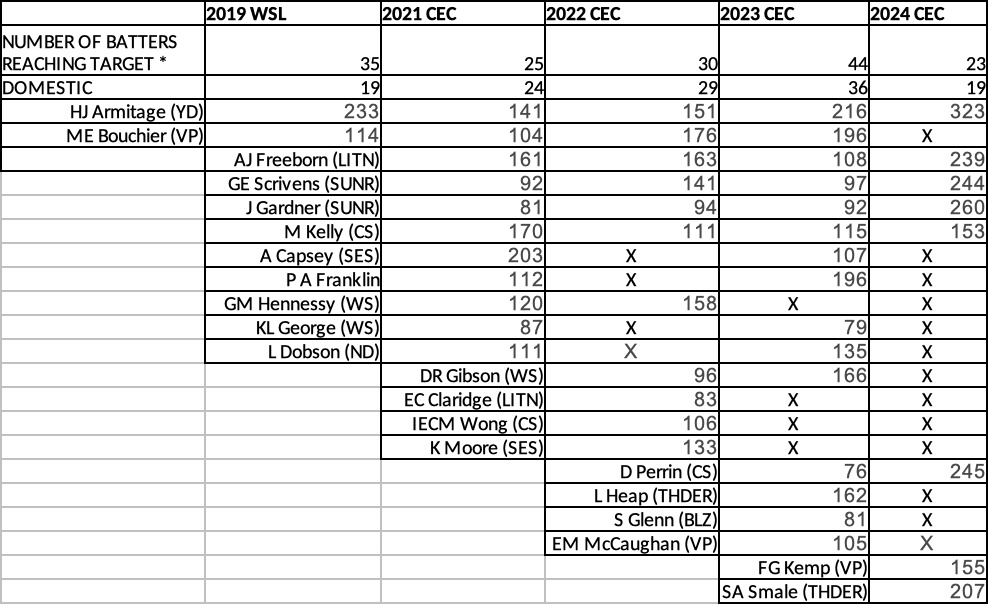
 CRICKETher