INTERVIEW: Alex Blackwell speaks about retirement, captaincy and being a “respectful agitator”

If there is one thing Alex Blackwell is known for, it is speaking up for what she believes in. When I interview her weeks on from the announcement of her retirement from international cricket, it is this that comes across most clearly. “I’ve got my own moral compass and values that make me as a person,” she says. “I can’t be anyone else other than myself.”

As still one of very few female cricketers who has felt able to be open about her sexuality – she married her partner, former England cricketer Lynsey Askew, in 2015 – Blackwell is keen to encourage others in the sport to follow in her footsteps. “What I’ve tried to do is break the silence. From my point of view I feel like while athletes are really comfortable to be themselves in their closed circles that’s wonderful, but there seems to be a bit of a silence about who people really are outside the sport.”

“It’s not always going to be possible for individuals to be completely transparent, but I do want to endorse that teams should continue to strive to be really inclusive and really welcoming, and celebrate everyone’s differences, because that gets the best out of those individuals and teams in terms of performance.”

This was one of the key reasons, she says, why she chose to come out publicly about her relationship with Lynsey. “I knew that being my whole, authentic and transparent self in every aspect of my life was going to allow me to perform better. And I honestly believe that without being my true self I wouldn’t have reached the heights I have.”

They are quite some heights. Blackwell first represented Australia in 2003, as a 19 year old. She was part of 5 World Cup winning teams and finished her career with 5250 runs to her name and 251 caps across all three formats, the most of any Australian female cricketer, ever. Just last summer she almost (but not quite) turned the 2017 World Cup semi-final on its head, in a record-breaking 10th-wicket partnership with Kristen Beams. She cites the 90 runs she made in that match as “probably her best ever effort with the bat for Australia”.

Recently ranked as the fifth best batsman in world cricket, her retirement rather took everyone by surprise; but she says it was the culmination of a lengthy thought process. “It’s something I’ve been thinking about for many years. Before the Ashes series in 2015 I was thinking, ‘could this be my last series?’ It could have been.”

She is, understandably, tight-lipped when I broach the subject of the appointment of Rachael Haynes ahead of Blackwell as stand-in captain for Meg Lanning during last year’s World Cup and Ashes series. She seems sanguine about the whole affair: “Captaincy’s not something that anyone has the right to,” she says. “It’s a decision that was made and the team just has to get on with doing the best job in whatever role they have.” But she was, after all, Australia’s official vice-captain, had done the deputy’s job for 7 years, and had led Australia to victory in the 2010 WWT20, standing in for Jodie Fields.

She says she is “very proud” of what she achieved as captain of both Australia and the New South Wales Breakers, who she captained to 7 state titles. What she doesn’t say is that her record as captain speaks for itself – which only makes last year’s decision all the odder.

I question whether she would still have retired, had the decision gone differently. “That’s an impossible question for me to answer,” is the response. It remains a baffling decision.

Retirement, though, seems to have opened up numerous opportunities for Blackwell. “I feel good about it,” she says. “I’ve been really busy. I’ve done quite a few speaking gigs and various events. I spoke at SBS, which is a TV broadcaster and they’re huge on diversity. I was on a panel with Matt Mitcham, an Olympic gold medallist, and Casey Conway, a former rugby league player, talking about the inclusion of LGBTI people in sport and the workplace. And I got 2 VIP tickets to watch the Sydney Mardi Gras. It was in its 40th year but also marriage equality occurred in the year gone by so it was particularly special.”

She was described in a recent interview with Gideon Haigh as a “quiet radical” – but how would Blackwell herself like to be remembered? “As a respectful agitator,” she says. “As someone who had strong views, shared them, and helped the sport ultimately get better.”

Wherever she goes from here, that legacy seems already secure.

OPINION: Wisden and Women – The Watershed Moment

I spend a lot of my life in the British Library, reading back editions of Wisden Cricketers Almanack. To get your hands on a copy, you have to go into the “Rare Books” reading room, sit in a special area and – as security – leave your readers card behind the issue desk. It’s the British Library’s equivalent of the Hope Diamond. The system reflects what most cricket fans know, instinctively, to be true: Wisden is special.

Today’s news – that 3 of the 5 Wisden Cricketers of the Year are women: Heather Knight, Nat Sciver and Anya Shrubsole – is also special.

The Almanack, published since 1864, did not feature women’s cricket until 1938; until then, one would have been hard-pushed, reading it, to see any evidence that women were playing the game at all. But they were, and in 1938 the editor Wilfred Brookes decided they warranted inclusion. “I found a good deal of support for the suggestion that some space should be given to women’s cricket,” he wrote.

“Some space” is perhaps an overstatement, implying something more than the reality: one page of the 1000-page volume would carry a women’s cricket report, having to cover – in approximately 500 words – the entire of the global and domestic women’s game in one calendar year.

Occasionally women broke through the barrier: in 1970, the first full page feature on women’s cricket was to be found, featuring leading England all-rounder Enid Bakewell, who in Australia in 1968/9 had become the first cricketer to score 1000 runs and take 100 wickets on tour. But such coverage was rare, to say the least.

Indeed the standing joke was that the women’s cricket page was to be found languishing near the back of the 1000-page volume, right next to the obituaries. Joking about it was the women’s cricket community’s way of shrugging off the fact that their achievements were often given less space than the Eton v Harrow fixture at Lords.

When Roedean School in Brighton submitted their averages for inclusion in the schools section of the 1991 edition, the editor Graeme Wright said they had presented him with “an editorial dilemma”. It was, apparently, shocking to believe that a girls public school might wish to feature alongside their male counterparts. (They were included, reluctantly, in the 1992 Almanack.)

Gradually in recent years more women have featured within the pages of the Almanack, including – in 2009 – the first woman to be featured as a Cricketer of the Year, Claire Taylor. Then editor Scyld Berry wrote that “there is no element of political correctness or publicity-seeking about her selection. The best cricketers in the country should be recognised, irrespective of gender.” Five years later, in 2014, Charlotte Edwards received the same honour. Still, though, a closer look at Almanacks in the decade between 2000 and 2010 reveals that more words were sometimes devoted to “cricketing wives” than any woman worthy of inclusion on her own merit.

It was not until 2015 that a full “women’s cricket” section was introduced, in the same year as the Leading Woman Cricketer in the World was inaugurated as a separate award – both the brainchild of current editor Lawrence Booth. Meg Lanning was the first recipient; Suzie Bates, Ellyse Perry and now Mithali Raj have followed in her footsteps.

Today, in 2018, we have women not just inside the pages of the “Bible of cricket”, but a triumphant Anya Shrubsole adorning the front cover as well.

There are many women in times gone by who would have been worthy Cricketers of the Year: Myrtle Maclagan, who hit the first ever century in an Ashes Test, in January 1935; Rachael Heyhoe-Flint, who in 1973 organised and starred in the first ever cricket World Cup; Cathryn Fitzpatrick, still the fastest bowler to have played the women’s game. To have ignored them has always been Wisden’s loss, not theirs.

Today, though, is a time to look forward, not back. This is not the end of the story for women’s cricketing equality – it never is – but it matters because Wisden matters. It represents – it is read by – the conservative cricketing establishment which ignored the women’s game for far too long. Suddenly, now a woman is on the cover, it becomes simply no longer possible to ignore women’s cricket. That’s worth celebrating.

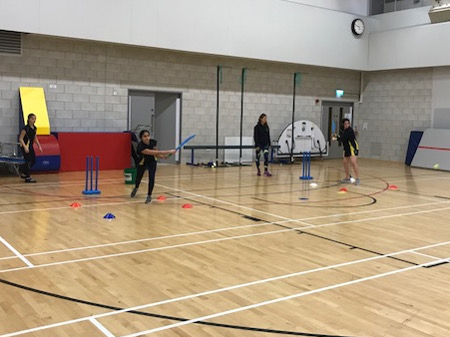
FEATURE: Cricket Taking Off At South Hampstead High School

In the wake of England’s World Cup victory last summer, one of the questions that was asked a lot was: would it encourage more girls to take up cricket?

For one school in London, the answer is an undoubted yes.

South Hampstead High School has recently reintroduced girls’ cricket to its curriculum, after many years of rounders being the main summer sport, and Head of PE Lucy Kench says that the girls are loving it: “We’ve had requests from girls to do more cricket, which is great. The success of the World Cup was a big thing for us.”

Back in the 1930s, South Hampstead High School was a hub of girls’ cricket; England’s Netta Rheinberg learned her cricket there. But somewhere along the way cricket was replaced by rounders – until last year when, following the Department for Education’s decision to remove rounders from the national GCSE curriculum, the decision was made to revert back to cricket.

Why? Lucy explains: “With rounders there’s not a lot of progression. If you play first team rounders at school, where do you then go and play rounders? There’s not very many opportunities.”

South Hampstead is also part of the Girls Day School Trust, a group of 24 leading independent schools, and in GDST schools across the country the feeling is that it is important to provide girls with more sporting options, beyond traditional ‘girls sports’ like hockey and netball. The key aim is to keep as many girls as possible actively engaged in sport in their teenage years and beyond; a range of sporting options is seen as the best way to sustain girls’ interest in sport.

At South Hampstead an indoor cricket club has run across the spring term. This will continue outdoors in the summer term, when Middlesex CCC will provide the girls with coaching. There is also a London GDST Cricket Hub which organises sessions for the girls with ex-professional female cricketers.

Girls Cricket at SHHS

Girls Cricket at South Hampstead High School

Girls from SHHS will also be attending the “MCC Women’s Day” at Lords next month alongside around 4,000 other schoolchildren to watch Middlesex Women play their first ever match on the main ground at Lord’s.

Generally the switch to cricket away from rounders has gone down well, but one issue has been getting teachers on board with the change. “Some people were really against it to begin with,” Lucy explains. “For some teachers who have taught rounders for lots of years, they find it very difficult to adapt the game.”

But GDST teachers have recently benefited from CPD training from Lydia Greenway, who runs nationwide coaching organisation Cricket for Girls and is helping them to understand the best ways to teach cricket to their pupils. “One of the barriers or challenges is getting teachers up to speed with the game of cricket, but also breaking down the barriers that it’s a complicated game, that it’s a technical game,” Lydia says. “And actually empowering them, giving them the confidence, and the skills and drills for them to deliver lessons. They’ve responded really well.”

CRICKETher recently attended a session at South Hampstead and the enthusiasm for cricket displayed by the girls – most of whom had never played cricket before this term – was evident. When asked what they most enjoyed about cricket, answers included: “Being in a team and working together”, and “You work in a team but you keep your own space, it’s nice because it’s not full on tackling and it’s more fun than other sports.”

NEWS: Sophie Ecclestone Wins Cricket Society Award

18 year old Sophie Ecclestone has received this year’s Cricket Society award for Most Promising Young Female Cricketer.

The award, made on the recommendation of Clare Connor, is awarded annually for the young female cricketer who showed the most promise in the preceding 12 months. It has run since 2002, with previous winners including Nat Sciver (2013), Heather Knight (2010) and Katherine Brunt (2004).

While Ecclestone missed last year’s World Cup due to exam commitments, she finished 2017 on a high, helping England draw the women’s Ashes series out in Australia.

She was also leading wicket-taker in Division 1 of the Women’s County Championship, and instrumental in Lancashire “doing the double” last season, winning both the County Championship and the T20 Cup. On the last day of the County Championship she tore through the Warwickshire batting line-up taking 6-12 – the performance that ultimately took them to Championship victory.

The award was presented at yesterday’s Society Lunch and while Sophie unfortunately could not be present to accept it – she is currently in India on England duty – her parents Elaine and Paul were delighted to do so on her behalf.

OPINION: Mixed Cricket – It’s Really Not Worth A Try

The Sydney Morning Herald has published an editorial today which suggests that the next step for women’s sport in Australia is to go fully mixed. Non-contact sports like cricket, the piece argues, should lead the way here. It might not work, but if it did, it could “break down the entrenched attitudes”, not just in sport but in other fields too. “It’s worth a try,” the author concludes.

Actually, no, it isn’t. Mixed cricket would be a disaster for the women’s game.

Of course there are a few women who could be successful playing in a mixed international side (Sarah Taylor is the obvious candidate who springs to mind). But, overall, there’d inevitably be less women playing international cricket. Think about it logically. Even if rules dictated that there had to be a mixed gender split in the Australian cricket team – say 6 men and 5 women, or vice versa – that would still mean that only about 50% of the women currently representing their country would get to keep doing so. How is that a good thing?

Secondly it would negatively affect the grassroots of the game, and narrow the available talent pool – at a time when many women’s sides are already struggling for survival. Why is it that so many clubs – including those in Australia which offer the Milo programme for 7-12 year olds – are beginning to run girls-only training sessions? Because they’ve realised that not all girls want to play mixed cricket. Girls develop at different rates, are often less confident, and have sometimes (sadly) had less grounding in the game from an early age. They feel happier playing surrounded by other girls. If we impose mixed cricket on them, then many of these girls will be lost to the game for good.

And lastly, and most importantly, to suggest that for women’s cricket to be taken seriously it needs to merge with the men’s game is actually frankly rather insulting. Our sport is worthy of respect in its own right. It isn’t inferior, it is different, and we don’t want it to be subsumed into male-dominated structures. We want players like Sarah Taylor to be granted media attention and prestige for their world-class performances within the women’s game, not for there to be endless speculation about how well they might perform in the men’s game. One of the great things about the World Cup last summer was that this really did seem to be happening: women’s cricket really did seem to be becoming respected on its own terms. To suggest that the next logical move is to make cricket gender-mixed totally undermines that.

Mixed cricket isn’t something to “try out”, something to be taken lightly and that we can abandon without a second thought if it doesn’t work out. Of course it would shake things up. But would it really be a progressive move? I don’t think so.

Random Thoughts: Women’s Ashes 2nd T20

Brunt Bounces Back

Something Mark Robinson’s England have in spades is resilience. To bounce back after throwing away the Ashes in the space of a few overs on Friday can’t have been easy, but the way they came out today, to not just win but wipe out their opponents, made an important statement about the way this side want to play their cricket.

No one epitomised that attitude more than Katherine Brunt. In tears after the loss on Friday, she somehow channelled all her disappointment and frustration into a sparkling innings of 32* – including the only 2 sixes of England’s innings – and then followed it up with a pace bowling T20 masterclass, conceding just 10 runs from her 4 overs. Sarah Taylor’s stumping of Elyse Villani was itself a masterclass, of course, but it was Brunt’s 3 dot balls up top in the over that forced Villani’s hand.

Basically, don’t upset Katherine Brunt. It’ll come back to bite you in the end.

Gunn Earns Her Spot

There have been question marks over Jenny Gunn’s inclusion in this T20 team, given that it’s Georgia Elwiss – the star of Day 4 at North Sydney – who appears to have given way for her. But Gunn’s bowling in T20 is incredibly precious – she is economical AND takes wickets – and today she really did provide the turning point for England, with her direct hit run out of Beth Mooney; plus that little matter of 4 wickets to boot.

Two Differing Approaches

There were times when you felt today that Matthew Mott had sat the Aussies down before their innings and told them they needed to hit all the runs in boundaries – far too many reckless shots were played, with Healy, Gardner and Haynes all caught trying to hit big. England were much more content to rack up singles and twos, leaving them with wickets in the bank for the crucial final 5 overs.

Nonetheless, the attacking approach has served Australia well over the years, and England might want to consider taking a leaf out of their book. The stats that Syd put out on Twitter earlier about Nat Sciver v Alyssa Healy provide a good point of comparison:

It’s not that Sciver isn’t capable of hitting big, more that she hasn’t often done so in a T20 situation for England – something that needs to change.

So England may have won this match, but there is no room for complacency: their batting, and power hitting in particular, has to be a key area of focus ahead of next year’s WWT20.

Wyatt Up Top

It’s still a bit of a mystery why Heather Knight opened in the first T20 of the series given that she has repeatedly said she doesn’t want to open while captaining – perhaps Robinson felt it was the best option, or perhaps it was just an experiment gone wrong. Either way, it was great to see Danni Wyatt rewarded for her 50 on Friday with a boost to the top of the order; and she certainly did the job required of her today, with quick runs up top to get England off to a positive start. She’s opened before in T20 – the last time was in Cardiff against Australia in 2015 – but has never had a sustained run at it, so maybe that time is now.

A Dead Rubber?

Some will argue that Australia took their foot off the gas today, relaxed about the whole endeavour now they have secured the Ashes trophy. If there’s any truth in that, it’s pretty poor – England could still go on and draw the series on points. They could also still win the T20 leg of the series; and a T20 series win in the year before a T20 World Cup is not to be sniffed at. In short, it’s all to play for come Tuesday.

Pink Ball Review: Did England Find Any Answers?

Last week I posed four big questions ahead of the Ashes Test match. Now that Test cricket is – sadly – behind them for another two years, did England find any answers?

1. What is their best Test XI?

Mark Robinson’s big call was to not only select Georgia Elwiss ahead of Jenny Gunn, but to bat her at 4, a position she’s never before occupied in her England career. At a crucial time for England, she came good. Her unbeaten 41 was, in my book, even more impressive than Knight’s own stoic effort – Elwiss was under more pressure (she must have known she was playing for her place in the side), and much rustier, having played no international cricket at all over the past 12 months. It’s perhaps too early to say whether she’s done enough to retain her place for the foreseeable future, but you’d have to conclude that she’s put herself back in strong contention.

Would having Gunn in the side have made any difference to the result? Probably not. Her great talent is bowling for long periods very economically, but that wasn’t really the issue here – England managed to restrict the Australian run rate reasonably successfully. What they really needed was wickets, and it’s difficult on this pitch to see Gunn having been much more successful than her counterparts there.

2. Can anyone “do a Heather Knight”?

Yes – sadly her name is Ellyse Perry, and she plays for the opposition (despite my job share suggestion!)

England lost this match by not batting long enough in the first innings. Though Tammy Beaumont and Heather Knight both passed 50, once again none of the England batting line-up could push on to 3 figures. Last week I said that at least two England players would have to get their heads down and dig in, if they were to have any chance of winning this match – that didn’t happen.

Somehow, with the limited opportunities available for multi-day practice before the next Test comes around, England need to resolve this. If they can’t, they aren’t going to win very many Tests!

3. Can they stop Australia batting them out of the game?

Yes, but it was perhaps more down to luck than judgement! England were fortunate enough to win the toss, which prevented the somewhat nightmare scenario of the follow-on rearing its ugly head. Australia then essentially ran out of time to bowl England out. Had Perry arrived at the crease on day one, who knows what might have happened?

4. Can they avoid a draw?

No. Obviously.

Of course, a draw actually looks like a good result, given what might have happened at the start of day 4! Even better, England have got the Canterbury 2015 monkey off their backs – they didn’t fold, they fought, and there’s no shame at all in the way that they dug in today.

Having said that, I still stick by my belief that it isn’t a good enough result for England. Above all else, it’s going to be very tough mentally for them to go into the T20 leg of the series knowing they have to win all 3 games.

Let’s hope they can prove me wrong!

Random Thoughts – Women’s Ashes Test – Day 3

The day England lost the Ashes?

England can’t now win this Test – that much was apparent even before the third session of the day began. Their best hope now is to hang on for the draw, but that means that in order to win the series, they’ll have to go on and win all 3 T20s, which is a big ask.

Given that England “won” day 2, and had set themselves up nicely with some late wickets falling last night, that’s quite a disappointing result.

… or the day Australia won them?

Having said that, did England do a lot wrong today? The ball wasn’t doing much, the pitch wasn’t doing much, and Australia just didn’t give them many chances. That was always the worry – Australia’s batting order is like waiting for a bus – you get one wicket and then two more world-class batsmen come to the crease!

People often seem to forget that at Canterbury in 2015, for example, England actually had Australia 99-5 – then Jess Jonassen walked in… and they ended up racking up 274-9! It was a similar story today.

Syd’s Worms [Ed: he really needs to go to the doctor’s about that] make the point pretty clearly: it wasn’t that Australia were ahead of the eight-ball the whole way through – they just bat longer than England, and in Tests, that’s crucial.

It’s looking more and more, in fact, like England really lost this match during the last session of the first day, with the mini-collapse where they lost those 3 wickets for 13 runs. That stat about 280 being a good 1st innings score in a women’s Test is actually quite an illusive one – the game has come on so much, even since that last Test in 2015, that I always had an inkling that 280 wasn’t going to be enough to put England into a winning position. Once again, for England, it’s the batting that’s been the real issue, not the bowling.

Ellyse Perry

There really isn’t much to say, is there? The craziest stat in cricket is that Ellyse Perry had never made an international century before today. But when Perry gets it right, she is unrivalled. She didn’t offer a single chance in the first 100 runs. There was barely a chance in the second.

It makes it even more poignant, in a way, that she might not get very many more opportunities in her career to bat with that level of depth, concentration and duration. The ICC don’t think Tests matter – they think people don’t care about women’s Test cricket.

The reactions today; the cheering of every dot ball that Megan Schutt faced while Perry was on 199* at the other end; Perry’s response (twice!) to hitting her 200th run – it matters. Please take note, ICC.

Can England survive?

They’ve made a decent start by not losing any wickets before the close, but if they’re going to save the game from here then England need to bat out at least two sessions tomorrow. The best advice Mark Robinson can give to his players is to play their natural game – going into their shells isn’t going to do anyone any favours (it didn’t work at Canterbury!) They definitely have the capability – it’s going to come down to whether they have the mental toughness to see it out.