KSL: Vipers v Storm – Random Thoughts: Fearless Farrant, Brilliant Bates And Level Luff

Fearless Farrant

For almost the whole of their run chase against Southern Vipers, Western Storm looked to be cruising to their 142-run target. On the two occasions their momentum was disrupted, though, one bowler was responsible: Tash Farrant.

Firstly, coming on to bowl the 11th over, with both Smriti Mandhana and Heather Knight looking set, Farrant outsmarted both – Smriti top-edging her slower ball to short fine leg, before Knight was castled 4 balls later. Then, after Sophie Luff and Fran Wilson had taken Storm to the brink, and with just 8 needed from the last 2 overs, Farrant again intervened: having Luff caught at mid off trying to go over the top, which in turn unsettled Wilson enough to run out her new partner Deepti Sharma.

It wasn’t quite enough for Vipers in the end, but Farrant – who England have, arguably, badly missed this summer after she lost her contract in February – at least gave them a sniff when it looked like the match was dead in the water. Farrant might no longer count as an “international” but she is still one of Vipers’ biggest assets.

Brilliant Bates

Suzie Bates has taken on a different role at the Vipers this summer: having handed the captaincy reins over to Tammy Beaumont, she is now simply the senior pro; and she seems to be quite enjoying it: “I’m a lot more relaxed off the field!” she said at close of play today.

It’s given her time to focus more on her own game, and while her 38-ball 33 was less than fluent today – “I didn’t time it from ball 1, and then tried to overhit” – she was the player trusted by Beaumont to bowl the 20th over, with Storm needing just 2 runs from it. It seemed an impossible task, but Bates breathed life into a game that should have been done and dusted.

How did she approach it? “I’ve watched enough T20 cricket to know that you’ve just got to stay in the game,” she said afterwards. “I thought if I could bowl it full and straight – sometimes you get to that point and to finish the game as a batter is the hardest thing. I thought I had nothing to lose, and if I could hit the stumps I’d be in with a chance.”

First ball she had Wilson LBW: “I fell over with excitement that she’d missed a full and straight one! Then I knew it was going to be nervy for the batters coming in, so I had my back up and wanted to take it as deep as I could.”

Next ball was a dot, that hit incoming batsman Anya Shrubsole on the pad. Her third ball then sent Shrubsole packing, swinging and missing at yet another straight one.

Fortunately for Storm, Sonia Odedra and Naomi Dattani both kept their heads – each scoring singles, to see the visitors over the line with one ball to spare.

Interestingly, Bates has barely featured with the ball of late in T20 cricket. This was the first match in this year’s KSL in which she has been called on to bowl her full allocation. She did not bowl once for New Zealand in their T20 series against Indian in February this year, and in the World T20 in the Caribbean last November she bowled just 2 overs across 4 group stage matches.

Bates, though, wants to change that. “I want to be that bowler for the White Ferns that bowls to the death,” she said today, “so it helps to get those opportunities for the Vipers.”

New Zealand could do a lot worse.

Level Luff

Heather Knight and Fran Wilson have stolen the headlines on both occasions, but in Storm’s two recent run chases – against Thunder yesterday and Vipers today – Sophie Luff, coming in at number 5, has played a key role. Today, her 58-run partnership with Wilson steadied the ship at a crucial stage in the game, the pair running hard between the wickets to ensure the run rate continued to tick over.

Yesterday against Thunder, Wilson’s half-century was made with Knight at the other end: today, with Luff, she was the senior partner, which you’d think would have added more pressure. Not according to Wilson: “I didn’t feel like that really,” she said. “I’d probably say yesterday was harder.”

“I especially like batting with Luffy. She’s really good to bat with – complements our order really well, she can hit the boundaries, but I also don’t know how she gets the singles she gets – she sees the gaps that a lot of us don’t see.”

It helps that the pair have known each other since they were both playing under-12s age-group cricket for Somerset. “A bit of psychic powers there, maybe!” Wilson joked after play. “We’ve always batted well together. We both like to run well. We’re quite different as personalities as well – she keeps me quite level.”

Storm threw away the chance to reach last year’s final after they collapsed in the semi against Surrey Stars: a bit of Level Luff in this year’s competition is just what the doctor ordered.
KSL: Stars V Thunder – Middle Over Slump Stills Lancashire’s Thunder

In the Good Old Days™ – 5 or 6 years ago – the powerplay didn’t seem to matter much in women’s T20 cricket. When 120 was often a match-winning score, players brought up in a 50-over mindset eschewed the risks of going “over the top”, and looked instead to accumulate.

It would be easy to look at the scorecard from yesterday’s Stars v Thunder match-up at Guildford and think how everything has changed. Lizelle Lee opened the innings for the Stars, who were chasing a no-longer-par 120, and smashed 66 off 45 balls – surely an example of putting the “power” into powerplay?

Except… that’s not quite what happened.

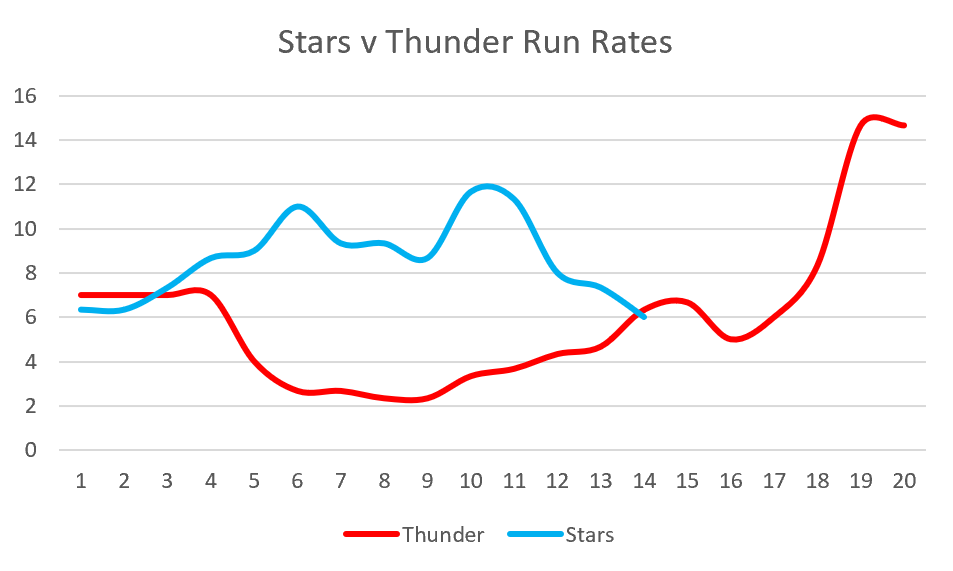
It was actually the post-powerplay overs that were the difference between the two sides, as the (smoothed average) run rate chart shows.

Stars v Thunder Run Rates

Batting first, the Thunder didn’t have a great powerplay – Marizanne Kapp was exceptional, a she always is, going at just 3.5 runs per over, bowling all 4 overs up-top – but when the Stars came to reply, the Thunder were actually ahead for the first 4 overs; and it wasn’t until the “boring” middle overs that Lee and the Stars really took off.

In contrast, the Thunder had totally slumped in the middle overs – they really were “boring”, with the boundary barely troubled.

Harmanpreet Kaur was at the crease that whole time, and though she eventually got going in a final assault which brought 44 runs off the last 4 overs, prior to that she’d been batting at well under 100 – at the end of the 17th she was on just 25 off 36 balls.

Ellyse Perry’s T20 innings used to follow a similar pattern – she’d often be 10 off 20 balls; 15 off 30 – but then accelerate to finish 60 off 40. On the final scorecard, it looked respectable; but there were a lot of wasted deliveries along the way, and she obviously realised it was a problem, because she worked hard to change it, and she now typically goes at a strike rate of over 100 from the off.

Talking to Thunder captain Kate Cross after the game, she said: “Harmanpreet batted superbly and gave us an opportunity – when she flipped that switch and decided to go, she proved what you can do on a pitch like that.”

And there’s no arguing with that, but… yes… there’s a but!

As the senior player – the big overseas star – was it perhaps her responsibility to flip that switch a lot earlier? To make the most of those middle overs, instead of wasting them?

Having an “opportunity” is better than not having one; but that middle over slump left the Thunder relying on an “opportunity” when they could have used that period to take command, with plenty of batting still to come, right down to Eve Jones coming in at 9.

Those middle overs are where the Thunder could have won that game.

Instead, it was were they lost it.

NEWS: ECB Hint At Reduction in Contracted England Players

Emails seen by CRICKETher possibly suggest that the ECB may be planning to reduce the number of contracted England players by almost a quarter, from 20-odd to just 16.

Currently there are officially 21 contracted players (though rumour has it (and you know how we love a rumour) that there are actually 22) which includes 3 players on “rookie” contracts, who are expected to train with the fully contracted players but are not paid a full-time living wage.

But two separate emails seen by CRICKETher suggest that when it comes to The Hundred, coaches will be selecting from a pool of just 16 centrally contracted England players – implying a reduction of five.

If so, this would bring the women more into line with the men, where there are generally around 15 centrally contracted players, though the men’s setup is split between separate red and white ball contracts, with some players holding just one and others both.

A year ago, this would have been very bad news for the five players losing their central deals. Although the players are paid for playing in the Kia Super League, it isn’t enough to support training full time, with the rest of the domestic setup being entirely amateur, and the players let go last year had just a few weeks to find jobs or literally face the dole queue.

However, the forthcoming changes to the setup of domestic cricket allow some scope for the ECB to make this reduction, because The Hundred and the newly aligned elite 20 and 50-over competitions are expected to pay a (small) full time wage, which could mean that the rookie players at least may actually be better off next year as a result; though if any fully contracted players were let go, they would probably have to take a hit, and they would lose their Kia Sportages – the lovely, big, shiny cars they get as part of Kia’s sponsorship deal with the ECB.

STATS: Women’s Ashes – Bowling Rankings

Player Matches Wickets Economy
1. Sophie Ecclestone 7 13 3.69
2. Ellyse Perry 7 15 4.28
3. Jess Jonassen 7 11 3.4
4. Megan Schutt 7 10 3.36
5. Laura Marsh 6 8 3.92
6. Katherine Brunt 6 8 4.04
7. Delissa Kimmince 6 8 4.76
8. Sophie Molineux 3 5 3.16
9. Ashleigh Gardner 7 5 3.25
10. Anya Shrubsole 6 5 4.66
11. Kirstie Gordon 1 3 3.24
12. Nat Sciver 7 5 5.65
13. Kate Cross 6 4 5.53
14. Heather Knight 7 2 3.72
15. Mady Villiers 1 2 5
16. Georgia Wareham 6 2 5.26
17. Tayla Vlaeminck 2 1 3.53
18. Georgia Elwiss 2 0 4.5

Bowling Ranking = Wickets / Economy

If there was one bright spot for England in a pretty miserable series it was the class of Sophie Ecclestone, who topped the bowling rankings taking 13 wickets at an Economy Rate of just 3.69 runs per over. Ecclestone worked harder than anyone else in the series – bowling 92 overs, of which 16 were maidens, and was England’s most consistent performer in a series where Australia were dominant with the bat.

As in the batting rankings, Ellyse Perry topped the headline number – talking more wickets than Ecclestone – but was ranked lower due to Ecclestone’s better Economy Rate. It is also possibly worth pointing out that if we caveated Tammy Beaumont’s batting numbers by pointing out that half her runs were scored in one innings, we should perhaps also do the same with Perry, who took 7 of her 15 wickets in that remarkable performance at Canterbury.

For all the pre-series hype about Australia’s young spinners, Georgia Wareham and Sophie Molineux, neither caused England too many problems. Wareham was expensive without having the wickets to compensate – taking just 2 wickets in 6 matches, and going at over 5 an over; while Molineux only made 3 appearances and was obviously still having problems with her shoulder, as confirmed by her subsequent withdrawal from the KSL.

Instead it was Jess Jonassen who finished the series as Australia’s leading spinner. Jonassen is only 26, but somehow already seems to qualify for the epithet of “veteran” – this was her 4th Women’s Ashes, and as well as taking 11 wickets she also scored more runs (128) than several of England’s top order batsmen, in an impressive allround performance by any normal standards – though those “normal” standards have obviously been somewhat overturned by Ellyse Perry in recent years!

STATS: Women’s Ashes – Batting Rankings

Player Matches Runs Strike Rate
1. Meg Lanning 7 359 85.27
2. Alyssa Healy 7 266 90.78
3. Ellyse Perry 7 378 60.09
4. Tammy Beaumont 7 190 98.44
5. Beth Mooney 7 228 81.72
6. Nat Sciver 7 208 59.94
7. Jess Jonassen 7 128 67.36
8. Lauren Winfield 3 71 118.33
9. Ashleigh Gardner 7 89 86.4
10. Rachel Haynes 7 148 40.77
11. Laura Marsh 6 101 57.71
12. Katherine Brunt 6 106 53.53
13. Danni Wyatt 5 55 90.16
14. Heather Knight 7 93 51.09
15. Sophie Ecclestone 7 59 76.62
16. Amy Jones 7 88 48.61
17. Sophie Molineux 3 62 61.38
18. Megan Schutt 7 8 400
19. Delissa Kimmince 6 32 76.19
20. Fran Wilson 3 40 49.38
21. Anya Shrubsole 6 36 31.57
22. Georgia Elwiss 2 14 31.11
23. Nicole Bolton 4 13 24.07
24. Kate Cross 6 9 22.5
25. Sarah Taylor 3 6 27.27
26. Georgia Wareham 6 0 0

Batting Ranking = Runs * Strike Rate

Unsurprisingly, given they won the series 12-4, the 2019 Women’s Ashes Batting Rankings are dominated by Australians, who make up 7 of the top 10. Overall, Australia’s batsmen scored 1,711 runs in the series, compared with England’s 1,076.

Although Player of the Series Ellyse Perry scored the most runs, she is ranked lower than team-mates Meg Lanning and Alyssa Healy due to their superior Strike Rates.

England’s highest-ranked player was Tammy Beaumont, although Nat Sciver scored more runs and was a bit more consistent – over half of Beaumont’s runs came in one innings – her century in the 2nd ODI at Leicester.

England’s batting woes are exemplified as much by who didn’t score runs as who did. Heather Knight and Amy Jones both made less than 100 runs in the entire series, despite playing every match; whilst Danni Wyatt totalled just 55 in 5 innings.

Lauren Winfield on the other hand, who came into the T20s off the back of some decidedly scratchy form in the county season, made the most of her window of opportunity to possibly even save her England career with a couple of good knocks down the order – not the easiest place to bat in T20.

Meanwhile Australia will fly home delighted with the form of Beth Mooney (228 runs in the series) who maybe hadn’t quite 100% cemented her place in the line-up as a pure batsman until now; but perhaps slightly concerned that the jury is still out on Ashleigh Gardner, who is yet to stamp her authority on the international game with the panache she has shown in WBBL; though to be fair, as with Winfield, you have to account for her not batting in the easiest position in the order to make really big runs in the shorter formats of the game.

Women’s Ashes 3rd T20 – England Play The Long Game

Before yesterday’s match, Syd and I discussed how England would approach what was a completely dead rubber. Afterwards, Heather Knight provided the answer:

“We talked after the second game about trying to draw a line in the sand after the series and try and treat today as Day One of us getting back to where we need to be.”

It was an approach that seemed to pay dividends: England bowled better lengths than they had all series, while Lauren Winfield took advantage of a final opportunity to prove to Mark Robinson that she deserves her spot on the plane to Australia next February.

After the match, Australia even looked momentarily downcast, having fallen at the last hurdle in their goal of going unbeaten through the tour. Alyssa Healy actually had to gather the team together and remind them that nothing should be allowed to spoil their celebrations: “There was great leadership from Alyssa Healy at the end there – she brought everyone in together and said ‘lets remember how great this tour’s been’,” Matthew Mott told the media.

Of course it’s easier to play good cricket when the series has already been and gone, but last night – likely to be the last international T20 cricket England play until their tri-series ahead of the World T20 in Australia – was important in showcasing that they can at least be competitive in that tournament.

“We’ve got a lot of hard work ahead of us to try and catch up with the Australians, to go back to where we need to be and where we want to go,” Knight said.

“That World T20 is going to be a big focus for us now over the next 8 months. The performance we put in is a sign of what we can do.”

It was also a chance to showcase that, far from the cupboard in England being bare, there are young talents emerging: 20-year-old Mady Villiers, who only joined the Academy in November, had a game to remember, taking the crucial wickets of Healy and Ash Gardner on debut.

“Mady was outstanding,” Knight said of the newest addition to her team. “You could see from the look in her eyes, she absolutely loved it out there. That’s what you want to see – you want someone desperate to go out and perform well and she really took the opportunity with both hands.”

All the talk over the past few weeks has been about the disparities between the English and Australian domestic set-ups. Even with the ECB’s proposed changes, the worry remains that England will move further behind Australia before they can even begin to think about catching up, as the new system takes time to bed down and only moves slowly towards becoming fully professional.

With that in mind, the question becomes: When might England next win an Ashes series – 2025? 2027?

A depressing thought. But as a great philosopher once said, “a journey of a thousand miles begins with a single step”. England took that step last night.

OPINION: Cricket Australia Have Broken The WNCL

The announcement of the expansion of the WNCL – the elite domestic 50-over competition in Australia – has been greeted with largely positive headlines… because it is a positive headline.

The WNCL – Women’s National Cricket League – has been running in more-or-less its current format since 1996-97, starting as a home and away league, with a 3-match final series.

This has slowly evolved over the years to the current setup, with 7 teams playing each other once in the league, followed by a one-off final between the top two.

One constant throughout has been New South Wales, who have never failed to reach the final, and have won the tournament 19 times. The only other teams to have won it are Victoria (twice) and South Australia (once).

As with the Women’s County Championship in England, the WNCL has for most of its history been an amateur affair; but the professionalisation of domestic cricket in Australia has now created an opportunity to expand the competition – something the top players have been demanding for a while.

However, instead of going the full distance, and expanding the WNCL (back) to a full “home and away” league, Cricket Australia have chosen the most bizarre compromise – adding just two more matches for each side, so some teams will play each other twice, and others only once.

Although there is a precedent for this in the (Men’s) BBL, where “extra” matches have been scheduled to double-up the number of highly profitable “derbies”, it is still a terrible idea, because it means two teams (ACT and Queensland this coming season) have to play perennial champions New South Wales twice, making a mockery of the balance of the tournament.

Admittedly, this is hardly the end of the world – outside of the women’s cricket bubble, few care about the WNCL, with matches typically attended by only a handful of spectators. But surely the opportunity here was to change that? Instead, Cricket Australia have bottled it and broken the tournament as a genuine sporting contest.

Cricket Australia have led the way in taking the women’s game to remarkable new heights in the past 10 years; but they’ve called this one wrong… and we shouldn’t be afraid to say so!

Women’s Ashes 2nd T20 – The Rise of the Machines

There was a point where England were technically ahead in this 2nd T20 at Hove.

With 37 balls bowled, where England had been 36-2, Australia found themselves 35-3.

“Trouble?” asked the blogger doing ball-by-ball on Cricinfo.

Yup – big trouble… for England!

Because that 3rd wicket brought together Meg Lanning and Ellyse Perry who, an hour or so later, closed out the innings on 43 and 47 not out respectively, to give the Southern Stars victory by 7 wickets with 13 balls remaining.

But where Perry had torn through England in the 3rd ODI with one of the great bowling performances of all time; and Lanning had torn not just through England, but also through her own world record book, at Chelmsford in the 1st T20; this was a more clinical… even cynical… affair.

Australia simply didn’t need to tear through anything – they just needed to score 6 runs per over, and that was all.

They didn’t even do that initially – Perry played out 3 dots to Laura Marsh, as the Aussies took just 3 off the 8th over; whilst through the 11th and 12th overs they failed to find the boundary at all.

Yet there was no panic – instead, Lanning and Perry found the gaps and ran hard, closing England down, slowly but surely.

Then the boundaries began to come too – not in a flurry, but relentlessly nonetheless – one 4 off the 13th over; one off the 14th; two off the 15th; and then a 4 and a 6 off the 16th. It was about as exciting as watching grass grow, but it was mighty effective.

England have faced bowling machines aplenty in the nets at Loughborough, but at Hove Lanning and Perry were batting machines – terminators, sent from the future to eliminate all of England’s hopes and dreams.

Listen and understand, as Reese says to Sarah Connor in The Terminator.

Meg Lanning and Ellyse Perry are out there.

They can’t be bargained with.

They can’t be reasoned with.

They don’t feel pity, or remorse, or fear.

And they absolutely will not stop.

Ever.

Until England are dead.

NEWS: New Pro Franchises To Be “Paired” With Women’s Hundred Teams, With Two Marquee England Players Per Side

The ECB has told stakeholders that the new “professional” franchises, or Regional CoEs (“Centres of Excellence”) as they are currently being termed, which will replace elite county cricket from next season, will be directly aligned with the corresponding Women’s Hundred teams.

As part of the ECB’s new £20m investment in women’s and girls’ cricket, the eight new CoEs are expected to be set up by the end of October at the latest, and “paired” with a local Hundred side.

A Director of Women’s Cricket in each CoE will be ultimately responsible for overseeing the operation in each region, and will take post as soon as possible after October.

Permanent coaching and support staff will then be hired by the CoEs and it is anticipated that the paired Hundred franchise will sub-contract these same personnel to provide “year-round” continuity.

However, due to the imperative to have coaches for the Hundred in place by the end of August to facilitate player allocation, interim appointments are likely to be made before then, in order for them to take part in the “I Can’t Believe It’s Not A Draft” process, which will see two marquee England players assigned to each side.

In the draft timetable for next season, the Women’s Hundred will run from 17 July to 14 August; and the CoEs will then participate in a 50-over competition in late August and September. Interestingly, the ECB are also anticipating England playing some international matches in September, which may (or may not) impact player availability for the CoEs.

Related: County Cricket Saved Until At Least 2021 As ECB Promise T20 Cup Funding

Women’s Ashes 1st T20 – If Perry Doesn’t Get You, Lanning Will

Back in March this year, England took on Sri Lanka in a T20 international in Colombo. It was the 3rd match of the series, and everything clicked for England – after a 96 run opening stand between Danni Wyatt (51) and Amy Jones (57), Tammy Beaumont (42) and Nat Sciver (49 off just 24 balls) took the score on past 200, to close on 204-2. In reply, Sri Lanka limped to 108-6 – England the victors by 96 runs.

It was the kind of eating that the big sharks often hand out to the minnows – it was also on the Subcontinent, at the 2014 Women’s World T20 in Bangladesh, that Australia had done similar to Ireland – Meg Lanning hitting the (then) record T20 individual score of 126 off 65 balls as the Southern Stars ran out 78 run winners.

Yesterday evening in Chelmsford we saw another huge win for a top side… and another explosive world record century from Meg Lanning; but the difference was that Australia’s victory wasn’t against Sri Lanka or Ireland – it was against England, the team who are currently the 2nd best in the world, according to the ICC’s rankings.

Are the ICC’s rankings wrong? No! Heather Knight was right post-match when she said that England hadn’t become a bad side overnight – in the past 18 months they have beaten all the teams immediately below them – New Zealand (in the T20 tri-series last summer); West Indies this summer; and India, out in India, in the spring.

England also reached the T20 World Cup final last November; but it was the result of that match – Australia strolling to victory – which in retrospect presaged the events of this Women’s Ashes, culminating in last night’s humiliation.

England aren’t a bad side; but in the last year, Australia have pumped themselves up to another level, and England are struggling to keep up.

During the last Women’s Ashes in Australia, the Southern Stars ran a marketing campaign which ran through the star players with the hook line: If X doesn’t get you, Y will! E.g.: If Healy doesn’t get you, Jonassen will! It seemed almost arrogant at the time, and proved so when England came back to level the series with some spectacular T20 cricket, including the famous double-century match in Canberra, where Beth Mooney hit 117 off 70 balls, only to be trumped by Danni Wyatt smashing 100 off 57.

But after what has happened in this series, If X doesn’t get you, Y will! doesn’t seem arrogant any more – it just seems like a statement of fact.

If Perry doesn’t get you in the 3rd ODI, Lanning will in the 1st T20.

And even if you are England – even if you are the second best side in the world – there’s nothing you can do about it.