OPINION: James Piechowski’s Deep Cover Points – England Without Edwards:­ Analysing Robinson’s Eclipse Theory

The events of the last few days have taken many people by surprise. To say it has been an eventful week is an understatement. Whatever your own opinion on whether Edwards should have continued as captain, or at least continued playing in the England side, as by all accounts she so desperately wanted to, you have to admit that there was a growing pressure for big change. Although many had questioned her captaincy lately, the biggest criticisms seemed to emanate from the more casual observer, who are less familiar with the nuances of the team.

From that perspective, it seems unthinkable. Why would Robinson even for a minute consider forcing the person who has undoubtedly been England’s best player to exit from the side? In order to try and justify a decision which at first glance may appear ridiculous, it requires an attempt at diagnosis of the current state of affairs at the top level of England women’s cricket. Robinson has a theory, I think, and not to be too presumptive I shall call it the “eclipse theory” here, for want of a better name. Let’s start with what Edwards has said:

“Mark spoke to me quite honestly and told me how he saw the next series as an opportunity to develop players and take the team in a new direction…He said the girls are hiding behind me sometimes and that they needed to develop.”

“We have a number of younger batters who have not shown their potential at that level. Mark sees the next couple of series as an opportunity to give them a chance with a new captain as well. He thinks there is not a place for me in the team.”

George Dobell at ESPNCricinfo expressed a similar thought:

“Robinson, the coach for six months now, noted that nothing seemed to grow in (Edwards’) shade. While that is no reflection of Edwards, he knew he had to act and made what Connor, the head of women’s cricket at the ECB, called ‘a ballsy decision’.”

It’s clear that Robinson has subscribed to the theory that Edward’s excellence has prevented other players’ development. Can this theory explain the logic, if any, behind pushing Edwards out of her role?

Support for the“eclipse” theory

A good theory must at least be internally consistent and have some explanatory power. On the surface, this theory appears to be onto something. Some players have been allowed to continue playing despite not making much contribution to the side. This is my take on the theory. And please be aware, I am playing devil’s advocate for this section.

The theory goes that winning cricket matches due to many runs scored by one superb player allows other individual poor performances to be overlooked. A side without any outstanding individuals, on the other hand, relies heavily on consistency throughout the batting order for any success they achieve. The England team of recent years has benefited in the short term from a massive glut of runs from one source, and so has not needed to tap into other sources very often.

Hence, we see players with somewhat unenviable records, such as Beaumont and Wyatt, still appearing for England despite a long track record which on paper looks more akin to failure than success. The theory would say that they have only done as well as they have needed to, to stay in the squad. With England still winning most series over the past few years, there has been little opportunity for upcoming players to break into a side which has, on the surface, looked fine as it is. The introduction of professional contracts, which have seen little change since 2014, has only cemented an already static group of players. Robinson, it would appear, wants to be the irresistible force to give momentum to this immovable object.

Robinson’s theory plays heavily into a narrative that we have seen him expound from the inception of his tenure. He’s come into the training set-up and immediately noticed that there are quite a few players who should be much better than they have been. A prime example is Tammy Beaumont: a very gifted player who looks superb in the nets and yet has looked timid for England out in the middle. She has only managed averages of 17 in ODIs and 13 in T20s despite playing over 60 matches in a career stretching from 2009. The fact is, she hasn’t needed to do any better, according to this theory. Despite what’s gone before, she’s still around the team now, and with Edwards’ exit, she looks a certainty for the Pakistan series as one of very few experienced specialist batsmen left in the contracted Performance squad.

Indeed, Robinson has been nothing if not consistent. A comment on the Cricinfo web site article covering Edwards’ retirement reveals how it’s very easy to not understand Robinson’s thinking. User BRUSSELSLION asks: “Only a month ago, he (Robinson) was saying that England needed more players like Edwards, now she’s surplus to requirements. What’s changed?” But actually, I’m not so sure these ideas are in direct contradiction. Robinson clearly wants players of Edwards’ skill to evolve from the existing squad; however having just one Edwards, Lottie, who so dominated the run scoring, he viewed as more of a hindrance to the other players, a roadblock to their evolution.

If Robinson could show that the average runs gained from having Edwards in the side was likely to be less than we could have expected from other “fully developed” players, he has some justification at least. But can he show that? With Edwards struggling to take quick singles and twos these days, it’s clear that some runs are being lost, not only from her own score but from her batting partners too. Quantifying this can be difficult. I think the total runs lost to this effect is unlikely to be more than 10 or 15 per T20 innings, and that assumes that Edwards batted for most of it anyway, and probably scored 60+ in the process.

Robinson cannot expect to backfill places from the development set-up as quickly as he could in men’s cricket. On the other hand there are several Academy players long overdue for a full England debut. The definition of the phrase”ready for International cricket” may have to change, because frankly (in my opinion) those in charge of selection have become too sure about certain players not being able to rise to International play. In reality, it is very difficult to be sure how well a player may adapt to it, unless they are given a good chance to show off their talents. What Robinson has done should help shake this up. Other teams blood their promising players at much younger ages. England may need to start debuting more teenagers in the near future.

Even if this is all true, I don’t necessarily agree with Robinson’s decisions to date, or his pet theory. Let’s look at some of the problems with it.

Criticism of the “eclipse” theory

There are several areas where we could criticise Robinson’s actions. Some have already been identified in articles and comments on this site. Certainly, it is a huge risk for England to lose their best player at a time where we desperately need more runs, not less. Hopes for victory in the 2017 Women’s World Cup were real and serious whilst Edwards was in the team, particularly as it would be a home series. Now, with Edwards gone, there can be little hope of that achievement, and even a semi-final seems like it would be a good result rather than an average one.

I’m sure it wasn’t Robinson’s intention but he seems to have set himself up to be able to make excuses. If England perform poorly for the rest of the year, he can always point to the fact that Edwards is not around and he needs more time with the squad. The other side of the coin is that he must be accountable for this decision, and I’m sure there will be many looking to criticise if England start to lose overall series in the next year or two. I sure will.

Those supporting Robinson’s decision have drawn comparisons with Alastair Cook’s forced exit from the ODI captaincy of the England men’s side. He scored a lot of runs, and didn’t want to go either. And Cook’s departure was followed by a complete change in approach from the rest of the team, which has led to much more exciting play and the side enjoying renewed success, really challenging the world’s best teams and indeed coming within an over of winning the WT20 final.

This argument doesn’t really work, though. The men’s team needed a change in approach only; the side already contained experienced, confident players with strong records, and fifties and hundreds in the bank, who had to adjust their mental and technical approach, but not fundamentally raise their whole game. Many of the England Women batsmen will have to do things they have never done before, set new standards, and advance their games to entirely new levels to make up for the loss of Edwards. This is, needless to say, a huge ask, and some of them may not be able to do it as well as Robinson demands.

On the flipside of the theory, a small number of players have excelled in addition to Edwards’ excellence. So this is a big problem for the theory. For example, Sarah Taylor is a player who has generally succeeded with the bat in recent years. She and Edwards stand apart from the rest. And yet Taylor was obviously not part of Robinson’s plans for “refurbishment” of the squad. It is possible, of course, that his attempts to change the status quo could prove ironically futile this summer. Maybe Taylor will score most of England’s runs now (she’s certainly done it before), and big contributions from other players will still be few and far between. In which case, Robinson has only passed the whole problem along a step, and really achieved nothing of note, all the while forcing the exit of our finest player in far from ideal circumstances.

Perhaps the biggest issue I have with Robinson’s decision and explanation, though, is that he has already disproved it with his first few months in the job. The South Africa series saw a more attacking approach from the batting line-up, with the likes of Jones in ODIs, and Beaumont in the WWT20, coming to the fore. If anyone had been previously eclipsed by Edwards, it was Beaumont. Except, by hook or by crook, the situation seems to have been turned around for her, and quickly – with Edwards still there. If Beaumont had done as well for England since 2009 as she had in the last few months, her record would be quite impressive. If we could see the same effect for some of the other underachieving players, this whole problem suddenly evaporates and along with it, Robinson’s entire justification.

So is it possible that this whole debacle could turn out to be a complete folly after all, even stretching into the long term? Perhaps.

Let’s look at some specific details. One way to identify players who have not been subject to any eclipsing effect is by looking at who has performed well when Edwards did not. So I have checked the scores made by our main batsmen in T20Is and ODIs since the start of 2014 (to roughly coincide with “professionalism” and also because going back further starts to look pretty desperate). The scores are only counted when Edwards scored less than 20 in a T20, and less than 40 in an ODI, and the player in question scored more than 20. There are less entries than you may think. As a rule of thumb, the more a player features in these lists, the less sense the “eclipsing”argument makes for them specifically.

England T20I Cricket from 2014 onwards: Edwards scores 19 or less, batsman scores 20+

# 20+ scores Batsman Runs Strike Rate
6 Taylor 246 115
5 Knight 131 120
3 Greenway 71 79
2 Winfield 122 103
2 Sciver 75 97
2 Beaumont 41 121

Edwards scored 19 or less in 12 out of 26 matches since 2014. England’s record in these games: won 8, lost 4 (67% win ratio). England’s overall T20 win ratio is 73% (source WCB)

So this is not a particularly good start for the theory. England’s win ratio when Edwards gets a sub-20 score is not much worse than their overall win ratio. This shows that the other players, overall, are largely making up for this deficit. We see no Jones, Gunn or Wyatt in the list, however, which shows that these players have not done it for England in T20Is when needed the most.

England ODI Cricket from 2014 onwards: Edwards scores 39 or less, batsman scores 20+

# 20+ scores Batsman Runs Strike Rate
5 Taylor 295 97
5 Knight 243 69
5 Sciver 231 93
3 Greenway 148 65
2 Elwiss 86 99

(Brunt, Jones and Shrubsole also feature once each in this list, but I’ve not included them in the table.)

Edwards scored 39 or less in 8 out of 16 matches since 2014. England’s record in these games: won 4, lost 4 (50% win ratio). England’s overall ODI win ratio is 69% (source WCB)

The results from the ODI analysis support the theory better, which is strange as Robinson made his decision after a T20 competition. I had to increase the range of Edwards’ scores for ODI, as there were so few entries in the list if you go much lower! The team record is significantly poorer when Edwards did not score heavily, which shows how vital she was to England in ODIs. However, I think we can say that Sciver, Taylor and Knight have not been negatively affected, as all tended to contribute when Edwards didn’t, and all have decent overall ODI records. Indeed Sciver’s performances for England have often outmatched those for Surrey.

The effect is only slight for Greenway, and Elwiss hasn’t played enough games to make any conclusions – a problem in the selectors’ hands and not Edwards’. Jones is in the same situation. The only remaining players who could have been eclipsed by Edwards are Gunn, Winfield and Wyatt. (I have already discussed Beaumont.) Is the development of just these 3 players really worth getting rid of Edwards for?

The only justification left for Robinson would be the idea that the likes of Beaumont, Knight and Winfield would be getting hundreds every other week had they been developed correctly. They should be absolutely superb players. To prove that, you’d have to show that their batting trend lines (average, strike rate) have been decreasing since coming into the England team. That is a statistical minefield, though, as any decline is more likely to be due to improving opposition than anything else. I’m left with the distinct impression that Robinson’s decision, and the eclipse theory, has more to do with a vague feeling than any hard data. It is merely a smokescreen for bringing about the change he wants. He wants a fresh start, and is placing too much faith in the hope that players can develop far further than we have seen. Let’s hope he knows something we don’t.

The fact is, we don’t know how any of these players would have performed had Edwards not been part of the team. But that’s the problem Robinson has. We don’t know how they will do going forward either, and that is a huge risk to take when you know you could have had Edwards still playing, particularly in ODIs, for the next couple of years. The number of players potentially eclipsed by her excellence is too small, and the effect too slight, to base any big decisions on. The transition option, with Edwards still in the ODI team (and possibly the T20 team as well) but not as captain, still seems more favourable to me.

NEWS: Coyte and Beams Head to Hong Kong

The Hong Kong Cricket Association has announced that Southern Stars Sarah Coyte and Kristen Beams are set to play two matches in the Hong Kong Women’s Premier League later this month.

The WPL is an on-going elite competition, akin to something like a “Super Twos”; and as well as playing in two games, Coyte and Beams will also participate in a 10-day training camp with Hong Kong’s national team.

The project is part of an initiative between Cricket Australia and the HKCA which also sees Michael Clarke playing men’s T20 cricket in the territory later this month.

The ICC see Hong Kong and China as a massive opportunity, particularly for the women’s game. Both participated in the 2014 Asian Games, ultimately won by Pakistan – China coming 4th and Hong Kong being knocked out in the first round proper.

Thanks to Seargent Awesome on Twitter for the tip!


OPINION: Robinson Risks It All On England Reboot

If you had asked me just two weeks ago whether I’d now be writing this story, I’d have said you were mad; and the table below shows exactly why:

Past 12 Months (ODI + T20) Runs Average
Edwards 486 30
Taylor 427 28
Knight 338 28
Greenway 192 27
Beaumont 164 23
Sciver 219 22
Winfield 31 5

In the past 12 months, which has included an Ashes and a T20 World Cup, Charlotte Edwards scored more ODI + T20 runs for England, at a higher average, than anyone else. Hence my instinct that she would remain a part of the team (and indeed would continue as captain) because her runs were just too important to let go.

Of course, this isn’t to deny that there were problems. I’m actually not convinced by the argument that the team “as a collective” was unfit, though certain players have perhaps arguably over-fixated on strength rather than conditioning recently. But it was undeniable that England had lost their edge; and Mark Robinson saw this too – concluding that, like a superhero movie franchise that had fallen flat under an ageing lead, what England needed was a “reboot”.

Robinson, however, clearly then faced a dilemma – he wanted to “reboot” the team under new leadership; but he realised that Edwards’ towering presence in the dressing room meant that it would have been very tough for any successor to step out of her shadow had she continued as a player.

So the coach did what he is, after all, paid the big bucks to do – he made the call of his life, and signed the skipper’s execution papers, wagering that what it cost him in gravitas and experience, he’d get back in vigour and renewed vision.

It is a huge gamble.

The World Cup is right around the corner – not just “any” World Cup, but one hosted at home in England – and England have sacked their iconic captain and most reliable player.

Robinson now has just 12 months to build a new team around a new captain.

If he succeeds… if Heather Knight (or Sarah Taylor… or even Sophie Luff?) lifts that trophy at Lords next July… it will be a triumph unmatched in the history of the women’s game.

But if he fails, there can be no hiding place – we all know where the buck stops now.

Charlotte Edwards Retirement: How Events Unfolded

When the England team returned from the T20 World Cup in India a little over a month ago, they had no inkling of events which were shortly to unfold, culminating in Charlotte Edwards’ tearful retirement at Lords today. The players were under no illusions – they knew they had let themselves down and there were “hard yards” ahead to improve their batting, their fielding, and most especially their general levels of fitness. But nonetheless, everyone still expected Edwards to remain at the wheel today… tomorrow… and through to the World Cup in 2017.

Coach Mark Robinson was, however, starting to come to the conclusion that something a bit more radical than a few extra trips to the gym might be necessary if England were going to reverse their slow decline.

Over the following few weeks, Robinson held a number of meetings with his boss – Clare Connor – having decided that England could only get the fresh start they needed with a new skipper at the helm.

For Edwards meanwhile, life was starting to get back to normal. Assuming that if she was going to be fired it would have been immediately, she appears to have genuinely thought her position was secure, as she prepared for the new season, getting things underway with a match-winning innings of 79 for Kent in the first round of the Women’s County Championship.

The following day, Kent played Sussex at Eastbourne. As is normal, Sussex encouraged their age-group girls to attend the game if possible, and one who did so was Ellie Robinson… accompanied by her father, Mark. During a 3 hour rain delay, with all the teams, press and spectators huddled into the tiny pavilion, Robinson warmly greeted all of his players… or rather almost all of them – there appearing to be one conspicuous exception to the general atmosphere of camaraderie.

In retrospect, it is hard to believe that this wasn’t playing on Edwards’ mind as she was bowled by Tara Norris for 1 off 5 balls in the second over.

Then, the following day, Edwards received a fateful text message from Clare Connor, the substance of which was simply: “We need to talk.”

The “talk”, Connor admitted today, was the hardest of her professional life – the pair had worked hand-in-hand for over two decades – Edwards was the person to whom Connor had handed over the England captaincy ten years previously; and it was now Connor’s duty to tell her friend that the decision had been made and that she had led England on to the field for the last time back in that semi-final in India.

But worse was to come.

Edwards understood and accepted the need for new leadership, but believed that she still had a lot to offer as a player. Indeed, why wouldn’t she? England might not have performed “as a team”, but Edwards herself had made 202 runs in the tournament (one more than Meg Lanning) including 2 fifties, at a Strike Rate of 115. She might not lead England into 2017, but she would still be there as a player!

However, her hopes were to be shattered as Robinson informed her that she was not part of his plans to rebuild the team, and she would not be considered for selection in the summer or autumn squads.

Devastated, Edwards realised that the time had come to face reality and begin the painful process of signing off. After informing Robinson and Connor of this, a press conference was hastily convened at Lords. Meanwhile, Edwards composed an email to her England teammates, which was sent yesterday evening – the first any of them were to find out about the situation.

Then, selfless to the last, she set off to attend a university awards evening in Southampton, to play her role as guest of honour; whilst unbeknown to her, the news of her retirement was sadly leaking on Twitter, achieving nothing but heaping extra indignity upon her situation.

Charlotte Edwards – an England “great” if ever there was one – deserved better than that.

We really will not see her like again.

NEWS: England Announce West Indies Tour Dates

The ECB have announced the dates for England’s Women’s International Championship ODI series v West Indies this autumn.

The 5-match series will take place in Jamaica in October, at Trelawny Stadium and Sabina Park, with the vital “WIC” points up for grabs in the final 3 games. England currently sit 6th in the Women’s International Championship standings, but with 3 games “in hand” against Pakistan, will hope to have returned to one of the top 4 World Cup qualifying positions by the time October rolls around.

Date Match Venue
8th October 1st ODI Trelawny Stadium, Trelawny
10th October 2nd ODI Trelawny Stadium, Trelawny
14th October 3rd ODI * Sabina Park, Kingston
16th October 4th ODI * Sabina Park, Kingston
19th October 5th ODI * Sabina Park, Kingston

Ruth Prideaux: A Remarkable Lady

Driving through Eastbourne on Monday on the way to see Sussex play Kent, I remembered the last time I had been there, almost two years ago. I remembered knocking on a door in a sunny street, and my knock being answered by a white-haired old lady.

Her name was Ruth Prideaux.

I was there to interview her as part of my PhD – to hear her memories of her time playing and coaching England. Of the many interviews I conducted, they sometimes went well, sometimes not quite so well. And some stick in the memory more than others.

This one? One of the most enjoyable, most memorable, of all. It was impossible not to warm to Ruth in the two hours or so that I spent with her, drinking tea and listening to her memories of playing and coaching the sport she loved. It was also impossible – even at the age of 83 – not to feel slightly in awe of her; and to get a sense of why the players she coached were in awe of her, too.

Ruth sadly passed away last month. I am thankful I was able to meet her before she died. She deserves all the plaudits in the world.

———

Ruth Prideaux (nee Westbrook) was a formidable lady because she had had to be. Born in Greenhithe, Kent in 1930, she learned cricket at Gravesend Grammar School, before attending Anstey College of Physical Education to train as a PE teacher. All this came after an early battle of wills with her father about the sport she loved. “My father was not pleased,” she told me. “I had three brothers at that time, and he thought they should be playing cricket and not me. He didn’t like the idea of his daughter playing cricket. And I was the only one that really wanted to!” What happened in the end? “He had to put up with it,” she recalled, her blue eyes twinkling.

By the time she was selected for England, to tour Australia and New Zealand in 1957/8, he had come round to her way of thinking! She described that tour as “wonderful” – but it was yet another struggle, both to gain leave from her teaching job, and then suffering the financial burden of having to forfeit six months of her salary (the length of Australasian tours in those days, thanks partly to the month-long boat ride there and back).

Then there was her coaching career. In 1962 – as the Times reported in their obituary – Ruth and Mary Duggan became the first women to attend an MCC coaching course, passing the advanced certificate with ease. Several male first-class county players failed. And yet when she was interviewed for the England Women coaching job in 1988 – the first time such an appointment had ever taken place – she told one of her daughters, in full knowledge that she was the best qualified candidate: “I’ll never get the job, because men always do.”

Contrary to her own expectations, she did indeed get the job.

———

That was not the end of the battle, though. By the time of her appointment, Ruth was working as a lecturer in the Sports Science department of Chelsea College of Physical Education, with radical new ideas about the way she wanted the England team to progress. She secured funding from the National Coaching Foundation for a five-year intensive training programme from 1989 to 1993, which incorporated both sport psychology and physiological testing.

Steve Bull, a colleague at Chelsea, became the team’s official sport psychologist, and worked closely with Ruth to plan the programme, which aimed to increase confidence, develop positive thinking skills, and provide team cohesiveness. There was also an intensive focus on both nutrition and physical fitness.

Ruth recalled in our interview:

I was quite determined that the whole squad, they wouldn’t be a member of the squad if they weren’t fit. And we worked a lot on fitness. They used to run up and down the beach [at  Eastbourne], on the shingle, which was tough…And then we started to introduce the importance of diet. That particular aspect was not popular, because they were very fish-and-chip girls!”

Ruth’s coaching programme was years ahead of its time; no other sport, including men’s cricket, had utilised sports psychology before. And much of Ruth’s work in these years now serves as the foundation for the elite coaching techniques which are used within both men’s and women’s cricket.

Yet it did not initially sit well with the traditionalists within the Women’s Cricket Association. It was reported in The Cricketer in 1988 that “the decision to appoint Prideaux…did not meet with universal approval within the WCA fraternity”. She recalled that:

“the [England] selectors were not a bit supportive. They thought it was all wrong. They expected them always to be doing something on the cricket line as it were, with the activities of batting, or bowling, or fielding. But they were not in any way supportive of that type of [fitness] work. So that was quite difficult.”

Yet Ruth persisted.

———

Fast forward five years to Lord’s, August 1st 1993. Jan Brittin takes the winning catch, New Zealand are all out for 128, and Karen Smithies and her team lift the World Cup, hugging each other and shedding tears of joy.

That white-haired figure looks on from the balcony, quietly satisfied at what she has achieved with her team. She knew they could do it before they could.

“We were in Australia for the semi-finals of the World Cup in 1988,” she recalled in our interview, “and we lost to Australia. And I said to the players, ‘we will NOT lose the next World Cup. We’ll beat everybody, and we’ll win it.’ They all felt, ‘oh, she’s off again!’ But actually, we did.”

It was a win that would never have been possible without Ruth’s confidence in both her innovative new coaching techniques, and in her squad of players – a confidence she instilled in a variety of ways. One of my favourite stories was about the team’s arrival at Wellington College, where the teams were put up for the duration of the tournament:

“When we arrived we arrived as a squad before anybody else, and they’d put us on the ground floor and the Australians were upstairs, above us. And I said, ‘well we’re not having that’. So before the Australians came, we settled ourselves above them, and I said, ‘remember we’re on the top here!’ 

So that was another thing that, although it sounds little, was a great contribution to their belief in themselves.”

Sure enough, England were actually left needing to beat their old enemy, Australia, in order to reach the final – and they did so in spectacular fashion, thanks to a wonderful innings from Carole Hodges, who finished on 105*.

Ultimately, England’s World Cup victory in August 1993 was largely the fruit of Ruth’s labour. Steve Bull reported that, by the time he concluded his work with the squad, “a feeling existed [among players] that success would not have been achieved without the provision of sport psychology support”.

Her pride at the achievement was still evident in our interview, 20 years after the event, as she recalled the tournament, eyes shining. It is an achievement made all the more impressive by the fact that in all her years working with the England team, she was never paid a penny.

———

Ruth retired as coach in the wake of the World Cup, but remained involved in women’s cricket, going on to become the Chairman of Sussex Women’s Cricket Association. What of her legacy? Certainly that 1993 victory helped begin to change attitudes to the women’s game in England. A few days afterward the final, then President of MCC, Dennis Silk, wrote to the Chairman of the Women’s Cricket Association: “It was the best day’s cricket at Lord’s this year and between you all, you created a magical atmosphere. You have done the whole of English cricket a great service.”

There were awards, of course – the National Coaching Foundation’s England Coach of the Year in 1993 being just one – and yet somehow I wonder if Ruth ever quite got the recognition she so deserved. Had she been a man – had she won a men’s World Cup – the whole world would know her name. Did anyone realise, I wondered as I left her house after our interview, that one of cricket’s greatest ever coaches was at that moment living in a little corner of sunny Eastbourne?

It is just one more reflection of the battle Ruth fought her whole life – the battle against being told she couldn’t do it because she was a woman.

———

The battle continues – and the impact of Ruth’s approach is still being felt within women’s cricket. I put it to her in our interview that what she had really been trying to do was bring professionalisation to an amateur game. “Yes,” she concurred. “But you wouldn’t put it like that.”

Why wouldn’t you put it like that? “Well, it would be far removed from anybody’s expectation. I mean, to become a professional was unheard of.”

Not any longer. And as Ruth herself recognised, she is partly responsible for that transformation.

“I think we supplied a good grounding for women’s cricket to develop,” she told me. “And set an example of what can be achieved. Which was all good, because it meant everything moved forward.”

That is quite some legacy, I told her. “Yes,” she agreed.

“I’d rather leave that legacy than any other.”

OPINION: Could England ‘Pass The Torch’ For Pakistan T20s?

England’s international series against Pakistan is still some 6 weeks away, but no doubt coach Mark Robinson is already considering his options for the squad… or squads… he will select.

The ODI series is a “must win” with England currently 6th in the Women’s International Championship table, albeit with 3 games “in hand”; so they have to field their strongest side as they look towards the 2017 World Cup.

But the T20 series is a different matter, perhaps? The next big T20 event is two years away, and the England that take the field then are likely to be a very different team, with a number of current players expected to retire after the World Cup.

With this in mind, one crazy suggestion might be to “pass the torch” for the T20 series – field a young side, with both eyes on the future – not just for the next year, but for the next decade.

What might such a team, with a five to ten years of cricket ahead of it, look like?

  1. Eve Jones
  2. Georgia Adams
  3. Fran Wilson
  4. Sophie Luff*
  5. Cordelia Griffith
  6. Sophia Dunkley
  7. Ellie Threlkeld+
  8. Steph Butler
  9. Freya Davies
  10. Tash Farrant
  11. Alex Hartley

Will this happen? Of course not – it is too crazy… by a lot more than half! But it would be nice to think that the management have got their eyes on one or two of these players for the Pakistan T20 series… and by “one or two”, I don’t mean the “one or two” who are already part of the squad – they are a given!

(The ones in bold are the ones outside the current contracted squad that I think they should be seriously considering – one batsman (Luff), one fast bowler (Davies) and one spinner (Hartley).)

OPINION: The Specialist’s Lament

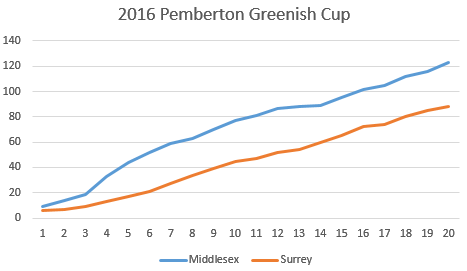
A very unusual scene unfolded at Eastcote Cricket Club last Sunday. In a 50-over Women’s County Championship match between Middlesex and Surrey, Middlesex skipper Izzy Westbury moved the field.

Leaving an enormous void on the leg side between backward square leg and long on, she packed the off side with attacking fielders, including a short (if not quite silly) mid off, and a slip and a gully just inches from the bat.

Such an aggressive field might not have looked out of place in an Ashes Test, but in a Women’s County Championship game it felt unprecedented, because 99% of the time the captain has to guard against “that” ball – the one which you know is coming, once or twice an over – the one that is pitched too short, or not pitched at all, or which slides down the leg side. And when it does come, a field like that leaks runs you can ill-afford; so the skipper plays it safe – square leg, midwicket, mid on – hoping to build pressure by saving runs – defence as a form of attack.

Westbury’s daring move – attack as a form of attack – was made all the more so because Middlesex were defending a lowish total (165) against an opposition batsman (Bryony Smith) who looked well set on 23 off 36 balls. Yet it was possible because the bowler was Alex Hartley – perhaps, with the retirement of Holly Colvin, the one bowler left in the county game who you can rely on not to bowl “that” ball.

That Hartley’s action puts one in mind of a ballerina reaching for a pirouette, is somehow appropriate, because for all the grace of the performance, what lies behind the execution is an iron will and an obsessive sense of discipline, to which few care to aspire and fewer still achieve.

So Westbury was able to set the field with a rare confidence in her bowler… and was rewarded with two wickets in two balls, both caught at gully as pitch-perfect deliveries turned away from the right-hander – a special moment, made possible by a special bowler.

But sadly “special” still comes at a price – Hartley bats at 11 even at county, where England tail-enders usually consider themselves all rounders; and she has to be hidden in the field, so they say. Thus when England needed to fly a spinner out to the Women’s World T20, they turned elsewhere – to a “steady hand”, who can “bat a bit”; who “turns the odd one”… but better keep that midwicket in there, just to be on the safe side.

And who is to say it wasn’t the right decision? England’s batting was fragile! They did need shoring-up in the field! So they demand excellence in two of the three disciplines – bat, ball or field – and brilliance in one is not enough any more.

Pragmatically, it makes sense; but romantically, there is still a longing for a bygone age, when a specialist… could just be special.

Catching Them Young: Girls Cricket in Toronto

Guest writer Aparna M tells of her experiences setting up a cricket academy in Toronto.

Cold, dark, long winters. Staying indoors for almost 7 to 8 months a year. Hardly an ideal setting for the game of cricket. But at the other end of spectrum you have a large, South Asian community. Mostly new immigrants. Trying to find a footing in a new country, environment and culture.

Throw economic hardships into the mix, and what do you get? Young families with children trying to find space to play sport, to stay engaged in some physical activity, where they do not have to spend a fortune. Organized sport is largely out of question for children of new immigrants struggling to make ends meet. In this setting was established a multisport academy which began its operations with cricket only, keeping in mind the largely South Asian population in the neighborhood in Toronto.

The first year of operation saw limited numbers both for boys and girls (there was just one girl). She too dropped out after a couple of weeks. The reason given by her father was that they tried to work out the timings but without success. This could have been discouraging both for the organizers as well as for other potential girl participants. However, the efforts to bring in girls to the program did not stop.

And these efforts did not go to waste. The second year of the academy saw more girls coming along. About six of them. No, it was not a lot. But it was the beginning. Most of them tagged along with their brothers. But that was okay. What mattered was that they were enjoying their time at cricket. That they wanted to learn the sport. They wanted to learn how to hold the bat, how to move their feet, how to bowl without bending their elbow and of course, they wanted to master the art of fielding, both catching and throwing.

Toronto Article 1

It was heartening to see these little girls all excited, and being part of the games after the practice session. They were developing game awareness. You could see it in their running between the wickets. Calling for a run. Or responding to their partner’s call. Throughout the summer, they would show up every day for five days a week, for seven weeks. And their numbers too went up.

Once summer was over, and the school year started, the program shifted to once a week in the evenings. Some from the summer dropped out, but other girls joined in. While almost all of them were still tagging along with their brothers, there were a few who were coming there on their own. Because they were enjoying the new sport. They were enjoying playing cricket!

It was heartwarming to see girls enjoying the sport at such an early age. It was important to keep the environment fun, with the aim for them to develop a liking for the game – hopefully a lifelong one. While of course it is too early to say whether they would ever be able to take up the sport professionally while they are in Canada, it certainly would do no harm if they could continue their association with the sport by playing it regularly.

The program saw success in the younger age group of 5-10 year olds, but it was difficult to attract the slightly older girls in the program. Separate sessions were set up for the 12-and-up age group after initial interest was shown by some of the older girls. However, once the schedule was set the response was extremely poor.

The reason was the pressure of studies. Of assignments and exams. Of coping with domestic chores. There was the peer influence aspect as well. The girls wanted to be part of the program as a group, but once a couple of them dropped out, the group’s participation fell apart. This for sure was a setback, but hopefully things could still be turned around in future. For example, some programs could be offered during school time, or even as part of after-school programs.

However, the participation of the younger girls is a definite positive. Hopefully by the time they are 12-13 they will have a few years of cricket under their belts, and will have developed a love for the game and a desire to continue playing it, even at recreational level. With women’s T20 leagues being set up across the globe, there might even be the chance to take up the sport professionally, if these girls continue to seriously develop their skills.

MATCH REPORT: Devon v Essex at Felsted School

Devon (265-5) bt. Essex (98-10) by 167 runs.

After being inserted on a green but hard pitch, openers Amara Carr and Aylish Cranstone played positively to build a solid foundation, before Carr was adjudged lbw for 38. Jodie Dibble started in a spritely fashion before being caught out by the lack of pace and gave a simple catch for Bird at mid wicket for 13.

Cranstone and Rosalie Fairbairn rebuilt and rotated the strike after an early flurry of boundaries, and the batting powerplay added some impetus, before Fairbairn was dismissed, caught for 29, a partnership of 99.

Cait O’Keefe was positive from the start with 26 off 21 balls, before being run out in an unlucky fashion when a dropped return catch was parried onto the stumps. Cranstone continued to hit the gaps and target a short boundary, bringing up her maiden county championship century, with 15 fours and one six in her 134 not out from 140 balls.

Essex’s reply showed intent from the start but they lost their first wicket in the second over, caught by Hazelle Garton at mid on off Sophie Mackenzie. A stunning catch from Alli Kelly at point accounted for England development player Cordelia Griffith, easing some concerns over her big hitting potential.

The building clouds were a concern, with the Met Office forecasting rain at 4pm, and Devon just completed the 20th over required to constitute a game just as the first drops of rain came down. Essex were still well behind the run rate, losing their sixth wicket in the 21st over, with the score on 75.

The light rain continued, but the pressure of the constantly increasing required run rate meant wickets fell at regular intervals. Pick of the bowlers were Hazelle Garton with 4-20 and Rebecca Donohue 3-23, Cait O’Keefe 2-20, as Devon wrapped up a convincing victory in the 30th over with maximum bonus points.

Players’ Player, sponsored by Wadey Polden LLP: Aylish Cranstone.