This week:
- England v NZ T20s: Bouchier and Filer positives for England
- England A lose to NZ: Has the regional system failed?
- 2025 Women’s Ashes: Cricket Australia want to #FillTheMCG again

This week:
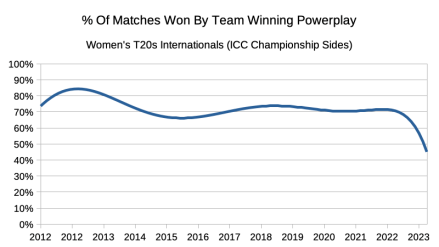
During the recent England v New Zealand T20 series, Alex Hartley observed on comms that for the first 4 games in the series, the team that had “won” the powerplay went on to lose the match. This was definitely an interesting titbit. In the entire history of T20s between the sides that now make up the ICC Championship, the team that won the powerplay went on to win the match 72% of the time.
One of the other commentators then went on to assert two further things.
Let’s look at the numbers! (For the mathsy among you, this is using a polynomial trend.)
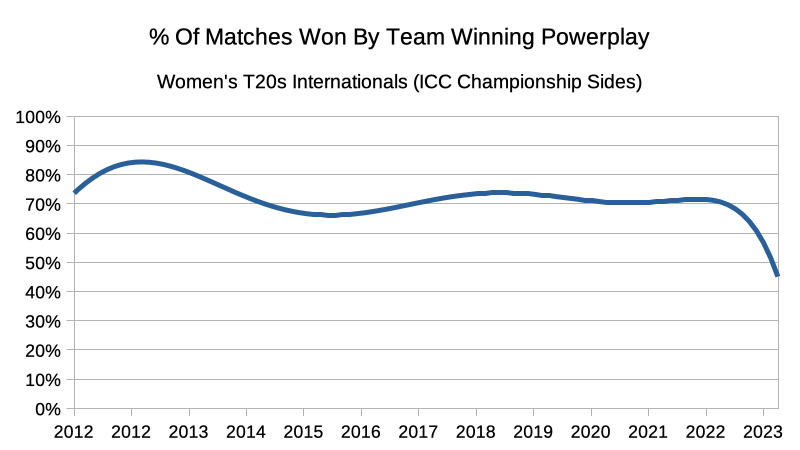
It is true that there has been a distinct downward tick recently – for several years, from 2014 to 2022, the number hovered at around 70%, but has now crashed down to below 50%, so it does look like something is going on.
But… is it?
Although we are talking about hundreds of matches overall, hundreds aren’t actually very big numbers in stats terms, especially when you are looking at trends like this. So although the downtick shown here looks fascinating, it might not actually be very significant.
In order to illustrate this, let’s look at what happens if I change the results of just 3 recent matches.
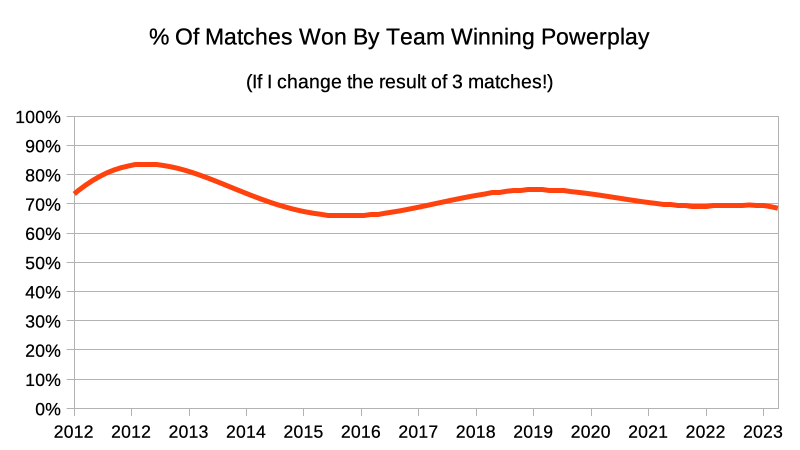
If the outcome of as few as 3 games had been different, that startling downtick completely disappears, and we are back at the long-term trend of around 70%!
So to conclude, although there is a recent downward trend in the relationship between winning the powerplay and winning the match, it is probably just “noise”. The number fluctuates up and down – this is the “down”, but it will go up again, and there is no exciting new trend. (Sorry commentators!)
Moving on to the commentator’s second point, and admittedly somewhat more subjectively, even if it is not noise, the idea that it is due to improvements in middle order batting is palpably not upheld by what happened in the England v New Zealand series.
In the games New Zealand lost, they won the powerplays because they went of at 90mph, like that kid on parkrun who always sprints to the front at the start, but their middle order was completely unable to maintain that pace, so they fell off a cliff in the middle overs and went on to lose the game. Furthermore, in England’s case the game they lost was also due to a middle order collapse.
There definitely have been trends in batting over recent years, most obviously in the absolute number of runs scored; but this doesn’t appear to be one of them: the team winning the powerplay usually goes on to win the match 70% of the time, and the likelihood is that it will stay that way.
A businesslike performance from England allowed them to win the final T20 in Wellington by 5 wickets, with 7 balls to spare, to close out the series 4-1.
With Lauren Bell sitting this one out, England’s one change was to bring back Lauren Filer for her second outing of the series. It was a “like for like” replacement, in the sense that they are both “fast bowlers” but Filer’s plans today were not plans you’d have given Bell.
Filer’s directives today were straight out of men’s county cricket, where her coach and mentor Jon Lewis plied his trade for nearly 20 years – rough up the Kiwis by bowling short and targeting the body. You don’t see these kinds of tactic much in the women’s game, I think partly because the women’s game is just less aggressive, and partly because you need to be bowling pretty rapidly for it to work. Indeed, I have an inkling that if you asked England directly whether this was the tactic they’d probably deny it, but the evidence is clear to see – almost every delivery was missing the stumps but hitting the batter, forcing them to fend-off in a way that they aren’t comfortable or accustomed to doing.
And it worked – there might not have been any reward in the wickets column on this occasion, but Filer bowled 12 dots and finished with England’s best Economy Rate on the day, going at just 5.5 per over. The prospect of Filer bowling with these plans in next year’s Women’s Ashes Test at the MCG, with close fielders to pile the pressure on the batters, is… intriguing, shall we say?
With Filer and Nat Sciver-Brunt bowling most of the powerplay, New Zealand struggled. NSB produced a beauty to get Bernadine Bezuidenhout in her first over; and then had Amelia Kerr caught in the deep in her second. In fact, Kerr’s wicket might say “c Capsey b Sciver-Brunt” in the scorebook, but it should really read “c Capsey b Filer” because it was undoubtedly the 5 dots bowled by Filer to Kerr in the previous over that induced an uncharacteristically adventurous shot from Kerr, who is not a power hitter and is normally smart enough to know that – she had one of the lowest boundary percentage of any of the top 20 batters in WPL.
New Zealand finished the powerplay 29-3 – the lowest powerplay score of the series. Alex Hartley observed on comms that the team that has “won” the powerplay has gone on to lose the match in every prior game in this series; but I think that is more an artefact of the way New Zealand’s top-heavy batting tends to mean they hare-off at 90mph before falling away later. So credit to them, because that’s not what happened today.
A 28-ball 51 from Izzy Gaze was the key innings, allowing New Zealand to plunder 41 runs at the death. It was all a bit madcap, but it took them to a score of 136, which is bang-on average for a T20 international between the championship sides these days – so definitely a score where you’re in the game.
With Maia Bouchier barely troubling the scorers for once, England too got off to a slow start. Neither Alice Capsey nor Danni Wyatt really got going, and were eventually dismissed for similar returns trying to accelerate their scoring: Wyatt stumped coming down the wicket and Capsey… you’re not going to believe this… caught in the outfield trying to smash it ten ways to Timbuktu.
But the key thing from both Capsey and Wyatt was that, despite not having their best days at the office, they still kept England chugging along – the required rate never went above 8, and that meant Nat Sciver-Brunt and Heather Knight had a platform to gradually chip away at the total through the middle overs.
This took England to within touching distance, allowing Sophia Dunkley and Amy Jones to do the drying-up, with the help of a couple of no-balls just when New Zealand really didn’t need them, taking the pressure off two players who haven’t had great series and who might just have cracked if the Kiwis had been able to really turn the screw at the death.
So here endeth the T20 series, with a final 4-1 scoreline in England’s favour that will have surprised no one. Maia Bouchier was named Player of the Series – her 223 runs almost twice the total amassed by New Zealand’s top run-scorer, Amelia Kerr, who led their way with 114, despite missing the first match on her way back from WPL.
With those two big performances in the 3rd and 4th T20s, Bouch has seized that spot at the top of the order and hopefully will now get the kind of run at that role that Dunkley had and ultimately could not convert. She does seem to have made genuine progress in the past year or so, and I wonder if she’ll one day look at being banned from bowling as a blessing in disguise, allowing her to focus on one thing and move it on to a new level? If so, this will have been where the step up started.
At the halfway point of the fourth T20 at Wellington, the cameras zoomed in on New Zealand captain Sophie Devine, sitting away from the action, nursing a freshly-inflicted quad injury. Her gloomy face told a thousand stories: she knew, as we all did, that – with England having put 177 on the board – the game was as good as over before New Zealand even faced a ball.
All of the talk ahead of this game had been about the return of England’s four WPL superstars, but Maia Bouchier completely stole the show with a smart, powerful innings of 91 off 56 balls – her highest ever score in T20 cricket – after Jon Lewis wisely chose to promote her to the opening spot in place of Sophia Dunkley. You can’t say she hasn’t earned it.
New Zealand should have come into this match full of confidence after England’s messy collapse handed them the third T20 on a plate, but they didn’t field like it. Five balls in, Bouchier (on 1*) edged Rosemary Mair through slip: oddly, Devine ducked out of the way, seemingly assuming that keeper Izzy Gaze would dive for it – it wasn’t clear if Gaze had called for it or if Devine just misjudged it?
Bouchier was put down twice more, on 31* and 44* – a missed caught and bowled from Jess Kerr followed what we might term an anti-double-play by Gaze, in which she first fumbled Bouchier’s edge and then missed a stumping chance, off the same delivery. Gaze is still young (just 19 years old) so this might sound a bit harsh… but if she is going to be New Zealand’s wicketkeeper of choice, they just can’t afford for her to be that much of a liability when she is stood up to the stumps.
Bouchier took full advantage, going on to hit 12 fours and two sixes in an innings which could have been tailor-made to promote NZC’s Poi initiative – plenty of Poi Whiua (twirl your poi and cheer) going on in the crowd.
England’s post-powerplay consistency was remarkable – only one over after the six-over mark went for less than 8. (That was the 14th, the only one bowled by Suzie Bates, who followed up her magical death over in the last game by being NZ’s most economical bowler in this match, which does rather beg the question as to why she doesn’t bowl more these days?)
Perhaps surprisingly after such a good WPL, Alice Capsey struggled for fluency, but to her credit recognised this and ran hard, in order to give the strike to Bouchier as much as possible. Then, after Bouchier was dismissed in the 18th, Heather Knight and Nat Sciver-Brunt upped the pace even more, with a partnership of 35 off 14 and an enormous 18-run final over.
In reply, New Zealand were actually ahead of England at the end of the powerplay, with 47 runs to England’s 35. But with both Bates and Melie Kerr already back in the dugout, and Devine unable to bat, you couldn’t help but feel that it was only a matter of time. There was a strong feeling of deja vu from the first match of the series: as soon as the field went out, New Zealand just couldn’t find the necessary boundary options to keep up with the required rate.
In the end, the only question was whether or not they would get bowled out. It was a fate they managed to avoid, finishing 7 down – but with England winning the match by a huge 47 runs, and with it the series, it will be scant consolation.
This week:
It was “Maia way or the highway” for England in Nelson… and they chose the highway, undoing all the good work of what should have been a match-winning 71 off 47 balls from Maia Bouchier. England collapsed from 126-2 at the end of the 15th over, with just a run-a-ball 30 required, to 152-8, falling 4 short of victory.
Bouchier was in early, after Sophia Dunkley was run out for a duck in the second over. (It was a sharp single, but the kind England take all the time and Dunkley was beaten by an inch – if she’d only have dived, she’d have made it.) Bouchier was quickly up and at the New Zealand bowling, hitting her first and third balls for 4s off Hannah Rowe; with Rowe having come in to the New Zealand XI for Jess Kerr, who didn’t seem to have done a lot wrong, but we assume was dropped to slightly strengthen the batting?
If you were penning a match report just from the scorecards, you’d probably write now that “Bouchier built on the 43* she’d made in the 1st T20” but that would be a total mischaracterisation. Having looked slightly timid and afraid in the earlier match, Bouchier’s mindset appeared completely different today, and she played the situation to perfection. She was very positive, without being reckless, as her and Tammy Beaumont motored towards the highest powerplay score of the series so far, taking them to 60-1 off the first 6 overs.
The final tally for Bouhier and Beaumont was a partnership of 92 off 61 balls, putting England in control – 25 runs ahead on where New Zealand had been at the end of the 12th over in which Beamont was dismissed.
Having starred in the first two matches, Heather Knight was happy to sit back and watch from the other end as Bouchier pushed on. Knight ran single after single to get Bouchier back on strike, and the reward was another 24 runs from 15 balls, which should have put the match beyond doubt.
TV commentators aren’t supposed to admit the match is done until the very last ball is bowled. (“So it’s 19 required from the final ball, but if they can just hit 3 consecutive no-balls for six, they could still take this to a super over…”) But Alex Hartley was right when she basically said we could start the car. England, however, had other ideas, instigating one of the most calamitous collapses I’ve ever seen from a supposedly “top” international side, losing 5 wickets for 21 runs in the death phase as the ship went down.
It’s unfair to pick on one player… but I’m going to do it anyway.
[Bess Heath… if you are reading this… please look away now – it definitely wasn’t really your fault.]
Bess Heath… what were you thinking? You were the last recognised batter, aside from accidental debutante Hollie Armitage. You needed 9 off 9 balls. You had time – not much of it, but enough. Now was not the time to roll out the glory mow. And yet… roll it out you did, with entirely predictable consequences.
England’s up and coming generation, of which Bess Heath is part, are an exciting prospect; but they are like a radio with the volume stuck on 11 – every ball is theirs to slog-sweep!
Heath’s recklessness left poor Hollie Armo holding a live grenade on a day which must have seen her run a whole marathon of emotions. She will have been bitterly disappointed not to be named in the starting XI – she will have known that this was almost certainly her final chance to be an international cricketer, and to have come so close yet so far, must have been dismaying. Then the head-injury to Sarah Glenn thrust her in, initially as a substitute fielder and then as a concussion sub, meaning she gets a full England cap that no one can ever take away from her. Then to be thrown in at the deep end in the midst of a storm, and have to walk off having been bowled by Suzie Bates’ first ball of the day. It was a day she’ll want to remember for ever… and a day she’ll forever want to forget.
A day to forget for England was of course a day to remember for New Zealand – a famous victory from the jaws of defeat. And what they have shown today is that when things go their way, they have the resources to beat the top sides, even if they are (if we are brutally honest) no longer one of them. Sophie Devine’s 60 runs to gift her side that huge death phase, giving them (just) enough to bowl at; the support from Amelia Kerr; Suzie Bates stepping up in that final over. You only need to win two big games to win a T20 World Cup. This match was notice – they could yet do that later this year.
England recovered from the precarious position of 77 for 6 to post 149 for 7, enough to overcome New Zealand by 15 runs at Nelson.
Heather Knight posted a second consecutive half-century, and shared crucial partnerships of 45 off 30 with Charlie Dean, and 27 off 12 with Sarah Glenn. England’s most productive game-phase was the last 4 overs, by far:
Linsey Smith, selected in place of Lauren Filer, then proceeded to take a wicket with her first ball in international cricket in almost 5 years – Suzie Bates top-edging an attempted slog sweep to short fine leg – as New Zealand hared off after the target a bit more aggressively than they actually needed to, and ended up tripping over their own shoelaces.
This has been a very important start to the tour by Knight, who (including her 52 v India in December) has now hit three fifties in as many T20 innings. Believe it or not, prior to that she hadn’t hit a T20 half-century since BC (Before Covid) – February 2020 to be precise – and there were starting to be rumbles, including here at CRICKETher Towers, about whether she should actually still be part of England’s T20 team at all, let alone skippering it. Whatever happens in the next 6 months, she’s now put that question to bed, at least until after the World Cup.
It’s interesting, as well, that Knight has bowled in both these opening matches. England have used her very sparingly with the ball of late, partly due to injury – the last time she sent down overs in back-to-back T20s was actually also in February 2020 – but could it be that they see her as an extra bowling option on those spin-friendly pitches in Bangladesh later this year?
England’s innings showed the value of a long batting line-up: Dean still seems absolutely wasted at No.8, while Glenn – lest we forget – was once touted as a possible T20 opener for England. (Not that they actually need another one of those at the moment!) But England should also count themselves lucky, because a side with even slightly more batting depth than New Zealand would surely have made them pay for some sloppy decisions by the top order.
Syd’s blood pressure gradually RAMPED up (gettit?) as Maia Bouchier, Dean and finally Melie Kerr all perished to a particular shot (ahem).
Melie Kerr’s was perhaps the least forgivable of all – New Zealand needed 50 off 33 balls at the point at which she got out, which was perfectly feasible, and didn’t call for a gung-ho approach.
A continent away, Australia have recently pulled a rabbit out of a hat in their first ODI against Bangladesh – posting 213 after being 112 for 6 – proving that the best teams never say die. New Zealand, by contrast, seem quite happy to wave a white flag at the earliest opportunity. With Kerr back in the dugout, the hosts proceeded to lose a further 4 wickets for 8 runs and the game was done and dusted.
Syd’s Matterhorn tells the story – look at how New Zealand’s line dips under England’s, pretty much straightaway after Kerr’s wicket in the 15th over:
Realistically, New Zealand probably have one more crack at winning a match this series, before England’s four best players return to the XI after their WPL-enforced absence. It doesn’t feel massively likely, does it?
Between 2010 and 2016, the average first innings score in a women’s T20 international was 119*. Had they been chasing 119, New Zealand would have won today’s game in the 19th over, rather than losing by 27 runs, after England had set them a target of 160 at the University Oval in Dunedin.
It is a new era now, and there is no better illustration of how the Women’s Premier League has changed everything than that even England’s innings felt slightly pedestrian, lacking the swagger and joie de vivre that we’ve become accustomed to watching the WPL these past few weeks. There was only one six in the entire match – struck by Heather Knight shortly before she was dismissed – and a general air of caution throughout, with just 9 wickets falling across both innings.
Tammy Beaumont opened the batting as expected, and tried to be positive, but looked a little bit like a player who hasn’t picked up a cricket bat in anger for 4 months, possibly because… she was a cricket player who hadn’t picked up a cricket bat in anger for 4 months – not counting last week’s warm-ups, her last match was at WBBL in November.
Maia Bouchier and Sophia Dunkley, both under a certain amount of selection pressure with Danni Wyatt and Alice Capsey returning from WPL for the final two games of this series, gave the impression that their main priority was not getting out cheaply. In that, both succeeded, and hopefully it will give them confidence to open up and express themselves a bit more in the next couple of matches.
(Note to Maia and Dunks: that doesn’t mean you need to go “Full Metal Capsey” and try to ramp your first ball for six – there’s a balance!)
Even Heather Knight, the backbone of England’s performance with the bat today, took her time to get going, struggling to generate power early in her innings, and needing 11 balls to find the boundary for the first time. Having done so though, she picked up the pace nicely and continued to run hard between the wickets to give her strike rate that extra bump which England rightly believe might be the difference in those big matches to come.
Having seen England make 160, New Zealand needed to go fairly hard, and initially they achieved that, bettering England’s total of 41-1 from the powerplay to reach 44-1 after 6 overs and give themselves a glimpse of hope.
But the detail reveals a more complicated picture than the headline suggests. Georgia Plimmer was 16 off 14 balls at the end of the powerplay, but she had hit just one boundary for that 16, relying instead on getting through the ring and running. As soon as the field went out her options closed down, and the next 10 deliveries she faced produced just 5 runs, with Sarah Glenn producing a masterclass in control to lock her out of the scorebook and eventually claim her wicket.
Glenn’s destiny is probably to spend her entire career fighting for her place in the side with Charlie Dean, given that Sophie Ecclestone is the best in the world, and England are mostly unlikely to play three spinners. But a World Cup in Bangladesh might be the one time they do take that option, which is going to make things easier for the selectors, given how brilliantly both Dean and Glenn bowled today.
Glenn and Dean’s case to both play as part of a Spin Trident was helped by the fact that the second seamer options looked particularly unappetising today. Dani Gibson opened the bowling ahead of Lauren Filer, despite Filer basically being picked on pace alone, which you’d have thought warranted giving her the new ball. Gibson was… fine; but she’s a long way from the definite article as a bowler at this stage of her career.
And then when Filer did get the ball, she demonstrated exactly why Heather Knight didn’t have the confidence in her up-top, as Suzie Bates casually introduced her to the boundary rope 3 times. Filer ended up conceding 22 from 2 overs, and wasn’t called on again.
Meanwhile Lauren Bell denied anyone the excuse that “it wasn’t a quick’s wicket” by having – and I appreciate that I’m sticking my neck out a bit here – perhaps the best game of her England career. That might sound somewhat strange, given that we saw no fireworks and she failed to find the swing that Jess Kerr had earlier in the day; but what we did see was a player who looked completely comfortable and in control of her own game – there were plans, and she executed them.
As for New Zealand, maybe it is unfair to judge them, without their two best players, Amelia Kerr and Sophie Devine? But they just look like a team stuck in a bygone era, when getting 133 would win you the game. The fact that Hollie Armitage, who has never been capped by England and who didn’t get a game today despite the absence of Wyatt, Capsey and Sciver, tore up the Super Smash, perhaps says something rather uncomfortable about where the domestic game is at in New Zealand? It just isn’t preparing the younger players for the way that cricket is played now. I love history. I majored in history. But I wouldn’t want to go there.
—————
* Based on 143 matches between what are now the ICC Championship teams in the cricsheet.org catalog.
This week:
| Bowling Rankings | Wickets | Dot % | Boundary % | Wide % | Economy |
|---|---|---|---|---|---|
| 1. M Kapp | 11 | 49 | 17 | 2 | 6.50 |
| 2. S Ecclestone | 11 | 46 | 15 | 2 | 6.57 |
| 3. JL Jonassen | 11 | 40 | 14 | 7 | 7.22 |
| 4. RP Yadav | 10 | 39 | 15 | 1 | 7.04 |
| 5. TP Kanwar | 10 | 41 | 17 | 1 | 7.14 |
| 6. DB Sharma | 10 | 31 | 14 | 0 | 7.23 |
| 7. S Ismail | 8 | 58 | 12 | 4 | 5.96 |
| 8. S Asha | 9 | 42 | 20 | 2 | 7.52 |
| 9. A Reddy | 8 | 35 | 14 | 7 | 7.65 |
| 10. S Pandey | 8 | 39 | 18 | 3 | 7.77 |
| 11. S Molineux | 8 | 39 | 18 | 2 | 8.07 |
| 12. S Ishaque | 7 | 36 | 15 | 2 | 7.36 |
| 13. NR Sciver-Brunt | 8 | 42 | 18 | 9 | 8.57 |
| 14. EA Perry | 6 | 52 | 18 | 2 | 6.60 |
| 15. A Gardner | 7 | 39 | 18 | 1 | 7.75 |
| 16. AC Kerr | 7 | 35 | 25 | 2 | 9.09 |
| 17. SFM Devine | 6 | 48 | 20 | 7 | 7.80 |
| 18. SR Patil | 7 | 35 | 24 | 2 | 9.21 |
| 19. G Wareham | 6 | 32 | 17 | 5 | 8.46 |
| 20. RS Gayakwad | 6 | 31 | 20 | 0 | 8.78 |
| Ranking = Wickets / Economy | ©CRICKETher/cricsheet.org | ||||
 CRICKETher