This week:
- Will the ICC change the format of the next T20 World Cup?
- Will England make changes ahead of the SA tour / the Ashes?
- Melie Kerr: a victim of the relentless schedule?
- Cricket booted out of the Commonwealth Games

This week:
World Cup Special:
It was classic Jon-Ball™ – exciting, big-hitting, fearless cricket. It was inspiring. It was entertaining. And it knocked England out of the World Cup in the final match of the group stages.
England 141-7 v West Indies 142-4 #T20WC
— CRICKETher (@crickether.bsky.social) 2024-10-15T17:15:20.954Z
It was that West Indies powerplay that changed the game – England had made a pretty reasonable 141, which is (just, but a single run) better than the average first innings total in T20s between the sides competing at this World Cup over the past 2 years. West Indies couldn’t afford to be complacent chasing a total like that, and 9-and-a-half times out of 10 you’d have backed England, who haven’t lost to the West Indies since their group stage defeat to the then-hosts of the 2018 T20 World Cup in St Lucia.
West Indies needed something special and they got it from Qiana Joseph, who has never made an international 50 before. She attacked England’s bowling and the gods willed her on, as she was dropped 5 times on her way to 52 off 38 balls, with 2 6s and 6 4s. The dropped catches weren’t all easy chances, especially the 3rd and 4th ones, with Maia Bouchier running round the boundary, though we have seen Bouchier pouch more difficult opportunities. But Dunkley in the 2nd over, and Capsey in the 5th, could have… should have… would have… made all the difference if they’d held on. Catches win matches.
Those 67 runs off the powerplay – a Strike Rate of over 180 – put the West Indies in such a commanding position that they could afford to slow down substantially, which is just what they did – pootling along (at least by the standards they’d set in the first 6) at around 6 an over through the middle overs.
In fact, they almost pootled a little too much, with a required rate which had been well under 6, getting back to a run a ball in the last 5 overs, with two new batters at the crease. On the sofa next to me, Raf Nicholson was contemplating the possibility of a rewrite to her “on-the-whistle” (yes – they still call it that!) report for the Guardian. But cometh the hour, cometh Deandra Dottin, as if the scriptwriters had known it all along, walloping Charlie Dean for a 4 and then 2 6s to claw back the initiative. Ecclestone ultimately nailed Dottin in what turned out to be the final over, but it was all too late. Aaliyah Alleyne came in and stroked her first ball beautifully through the covers for 4, then finished the job 3 balls later with another 4. Game, set and match to the Windies.
Do England have any excuses? Jon Lewis pointed out afterwards (whilst saying that he “wasn’t making excuses”) that it was England’s first chance to play in this stadium, with it’s “Ring Of Fire” lights which can make it challenging to judge the high ball; but on the other hand, England have had far more chances to play under lights in general than the West Indies over the past few years – they’ve played 17 T20s under lights in the past 3 years (only Australia (19) have played more) whist the West Indies have played just 9.
The truth is that England probably did score enough runs to win on any other day, but this wasn’t any other day. They had their own big bit of luck with Nat Sciver-Brunt being given not out LBW after the West Indies had already burned both their reviews – if they’d had another review, NSB would have been walking off and England would not have got to 141.
The Heather Knight situation didn’t help. Despite England literally having had Knight sit out of a match last summer to simulate her being unavailable, England didn’t really know how to manage the game without their all-powerful skipper. Nat Sciver-Brunt is a remarkable player, but she is not a captain, and she just looked slightly lost, trying to bring both Amy Jones and Sophie Ecclestone into the decision-making as England faltered.
Arguably, Knight choosing to not come out to field was an interesting decision of itself – she walked off, and she was fit enough to have been ready to bat again at the end of the innings if required, so could she have fielded? It was almost like she was protecting herself ahead of a semi-final which didn’t come partly because she wasn’t out there.
What this did show is that there isn’t another captain in this group, and that Heather Knight will be right to continue in the T20 captaincy through to the 2026 World Cup in England (as we expect to happen) because there is no other option – Knight has played a blinder in ensuring that there are no successors breathing down her neck. But Grace Scrivens has to be be brought in to the ODI side now to allow her to take over the ODI captaincy after the 50 over World Cup in India, and the T20 leadership in 2026. The tours to South Africa and Australia are what England need to be looking to now, and Scrivens absolutely must be on those planes.
This week:
England made their statement of intent with the most emphatic win we’ve seen yet, chasing Scotland’s 109 within 10 overs after England’s openers were apparently advised that winning within 10 overs would put them ahead of West Indies on Net Run Rate and mean they could lose their final match (v the Windies) and still qualify for the semi-finals.
Scotland 109-6 v England 113-0 #T20WC
— CRICKETher (@crickether.bsky.social) 2024-10-13T13:18:11.459Z
In fact, the circumstances where this would happen are quite narrow (though obviously still possible), and England certainly shouldn’t be relying on it; but if it got the England openers focused and playing the way they did, that’s what matters, and maybe that’s what Jon Lewis had in mind – we already know that he isn’t above playing psychological games with his players! The unbeaten Wyatt-Hodge-Bouchier partnership of 113 off 100 balls was probably the most entertaining hour of the tournament so far – there were no 6s, which have been incredibly hard to find at Sharjah; but there were 19 4s as England conquered the Bryces’ army and sent them homeward to… think again?
Actually, that wouldn’t be fair – Scotland should really go homeward in the knowledge that everything has gone pretty well. They might not have won any games, but they weren’t humiliated – they didn’t get bowled out for 24 or anything like, and they made over 100 twice, against Bangladesh and England. For a first World Cup, it is a pretty good return.
England march on, but they still really need to beat West Indies in their final group game to guarantee a semi-final spot – there are a few scenarios where they lose narrowly and still go through, but not many of them. And it was the other group that was supposed to be the Group of Death!
England will obviously be delighted with the result, given the romp with which the game ended, but there should be some reflection on the bowling, which (stop me if you’ve heard me say, stop me if you’ve heard this before, before!) lacked penetration – it took them 10 overs to take 2 wickets, which is going to be a problem if it is repeated in a semi-final against Australia or India.
Lauren Bell was brought into the XI, it seems to give her some game time in case England want to play her later in the competition, with Linsey Smith missing out. Sarah Glenn didn’t have a great game, and my guess is that Smith will be back for the West Indies, and probably the rest of the tournament, in place of either Glenn or (more likely) Bell – not because Bell did much wrong, but because the entire exercise confirmed that UAE is a slow bowler’s paradise. (Unless your name is Megan Schutt, who does seem to have mastered the conditions in a way that none of the other “pace” bowlers have.)
Scotland 109-6 v England 113-0 #T20WC
— CRICKETher (@crickether.bsky.social) 2024-10-13T13:18:39.119Z
On the other hand, if England can bat like this a couple more times, they won’t need to take too many wickets – the World Cup is now just 3 wins away, and England are motoring.
Any England win, the group is decided on points and NRR becomes irrelevant:
| Team | Points | NRR |
|---|---|---|
| England | 8 | ? |
| South Africa | 6 | ? |
| West Indies | 4 | ? |
For completeness, if the match is rained off, the group is also decided on points:
| Team | Points | NRR |
|---|---|---|
| England | 7 | ? |
| South Africa | 6 | ? |
| West Indies | 5 | ? |
If West Indies win, things get more interesting – all 3 teams will be level on 6 points, and NRR comes into play. Let’s assume England bat first and score 130.
West Indies chase 130 in 20 overs:
| Team | Points | NRR |
|---|---|---|
| South Africa | 6 | 1.382 |
| England | 6 | 1.247 |
| West Indies | 6 | 1.244 |
West Indies chase 130 in 15 overs:
| Team | Points | NRR |
|---|---|---|
| West Indies | 6 | 1.836 |
| South Africa | 6 | 1.382 |
| England | 6 | 0.863 |
So if England score 130 and lose very narrowly, they can go through; but if they lose anything other than narrowly, they will fall behind South Africa on NRR and go out. This goes for scores up to 134 – if England score 135+ and West Indies win even narrowly, England will fall behind West Indies and South Africa on NRR.
What if they score 199?
West Indies chase 199 in 20 overs:
| Team | Points | NRR |
|---|---|---|
| West Indies | 6 | 1.428 |
| South Africa | 6 | 1.382 |
| England | 6 | 1.380 |
West Indies chase 199 in 15 overs:
| Team | Points | NRR |
|---|---|---|
| West Indies | 6 | 2.109 |
| South Africa | 6 | 1.382 |
| England | 6 | 0.938 |
So England still go out if they lose!
Finally… let’s try 201!
West Indies chase 201 in 20 overs:
| Team | Points | NRR |
|---|---|---|
| West Indies | 6 | 1.433 |
| England | 6 | 1.384 |
| South Africa | 6 | 1.382 |
West Indies chase 201 in 15 overs:
| Team | Points | NRR |
|---|---|---|
| West Indies | 6 | 2.117 |
| South Africa | 6 | 1.382 |
| England | 6 | 0.940 |
So… South Africa are through unless England very narrowly lose a very high-scoring game; and England will out out if they lose, unless they lose very narrowly and score either 134 or less or 201+.
(Or am I wrong?!?!)
A totally different approach to batting on the low, slow wicket at Sharjah carried England through to a vital win over their main Group B rivals, South Africa. It may have gone to the final over, but it felt like England were always in control, managing the chase with precision.
South Africa 124-6 v England 125-3 #T20WC
— CRICKETher (@crickether.bsky.social) 2024-10-07T16:54:50.217Z
Batting first versus Bangladesh on Saturday, England made 118 – on paper a very similar total to today’s 125 runs – but they were such different runs. Against Bangladesh, England looked to drive everything, and eschewed the sweep shots that have been such a productive, trademark area for them in recent years. Just 13% of England’s runs against Bangladesh were scored backward of square – and in so-doing they made it all look like very hard work.
Today’s approach was totally the opposite: 43% of their runs scored behind square. On the scorecard that meant 42 runs scored to fine leg/ square leg, compared with just 11 versus Bangladesh; and suddenly batting looked a lot easier. Of course, it was a different wicket, but it wasn’t like they had suddenly relocated to Derby – it was still essentially the same conditions, but a whole new approach adopted.
Marizanne Kapp kept things quiet in the powerplay, pulling two maidens out of the bag; but then Alice Capsey, helped by coming in at her more natural position of 3 rather than 5, gave England’s chase the little jolt they needed with a quick cameo of 19 off 16 balls, pulling out that sweep shot for a couple of boundaries early in her innings. Capsey’s impetus got the run rate up to within touching distance of where it needed to be, and England were able to keep it there as Nat Sciver-Brunt and Danni Wyatt worked the gaps and ran hard.
Acknowledging that boundaries were going to be tough to find, they poked the ball into the pockets with the metronomic regularity of a snooker player potting red after red. For those who remember the glory-days of snooker in the 1980s, it was more Steve “Boring” Davis than Alex “Hurricane” Higgins, but it bears remembering that Davis won 6 World Championships, whilst Higgins won just 2.
With 4 overs left, England still needed a run a ball; but Kapp was bowled-out by that point, and though they lost Danni Wyatt off the last ball of the 18th over, it didn’t affect their momentum in any way, partly because Heather Knight faced just 1 ball, taking a leg-bye off de Klerk, leaving NSB to finish what she’d started at the other end, potting the final black with 4 deliveries to spare.
Earlier, England had delivered an efficient bowling performance to restrict the South Africans to 124.
South Africa 124-6 v England 125-3 #T20WC
— CRICKETher (@crickether.bsky.social) 2024-10-07T16:55:15.100Z
The middle overs were where South Africa let themselves get behind the game a little bit, particularly overs 7-11 as Anneke Bosch delivered the finest masterclass in anti-nominative-determinism since former Conservative cabinet minister James Cleverly – struggling to bosh anything much at all. It was a barely disguised blessing for South Africa when Bosch failed to get bat on an attempted ramp, and Kapp was able to come in and get things going for South Africa, making a quick 26 at a strike rate of 150, before Annerie Dercksen added an even more handy 20 not out off 11 at the end.
Dercksen hasn’t had much opportunity to show what she can do with the bat for South Africa – she has played 15 T20s now, and has only batted in 7 of them. But in those 7, she is averaging 22 at a strike rate of over 140, and there is definitely a case that she should be coming in above Chloe Tryon, who wasted 5 precious balls for 2 runs at a crucial point in the game. Had Dercksen faced those deliveries, and South Africa put another 10 on the board… who knows?
As it was, the result put England in pole position in Group B and means that South Africa really can’t afford a slip-up now – if they win both their remaining games (v Scotland and Bangladesh) they should be okay, but there is actually one scenario where even if they win both those games they don’t qualify, so they may end up cheering for England in their last match v West Indies, should it come down to it!
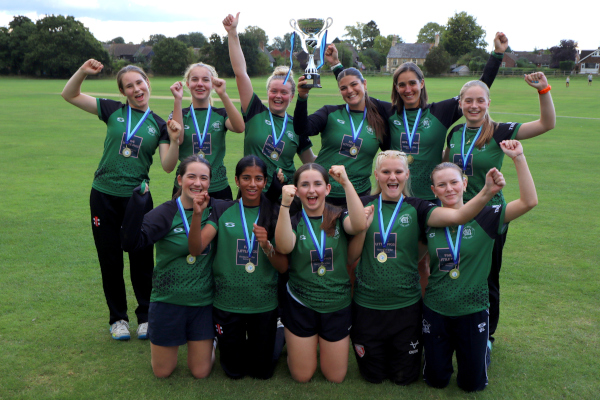
North Moreton near Wallingford (population 328) has had a cricket club since 1858, but it took until 2011 to start a women’s team, and a further 2 years before they won a game.
Fast forward to 2024 and Moreton Mavericks, as the club are known, have now won The Home Counties Women’s Premier League. Defeating some of the biggest cricket clubs across five counties is a true “giant killing” performance by the South Oxfordshire team, and they lost just one match in the process, finishing 32 points clear of their nearest rivals.
Club President Mike Howat said: “The growth of the women’s section at Moreton has been a truly remarkable story and we now compete successfully with clubs of a much higher profile and status.”
26 different players, with an age range of 14-46, contributed to winning this title. Captain Georgia Haworth (23) said: “I am hugely proud of all the players who have helped us become Home Counties champions; it’s been a real team effort from everyone involved.”
Celebrations continue in their clubhouse, which is actually the village pub, The Bear of North Moreton, handily overlooking the pitch.
If you are interested in joining the club, based near Wallingford, please contact Tim Haworth tim@busbar.biz
Club Website https://moretoncc.org/women_and_girls.php
Club Results https://moreton.play-cricket.com/website/division/117954
This week:
England ground out the ugliest of ugly wins – Heather Knight admitting post-match that “it’s not going to be sexy all the time” – in their first match of the World Cup in Sharjah, beating Bangladesh by 21 runs.
England 118-7 v Bangladesh 97-7 #T20WC
— CRICKETher (@crickether.bsky.social) 2024-10-05T16:57:54.727Z
Having chosen to bat, England got off to a decent start – 47 is by a fair distance the most runs scored in the powerplay in the 4 matches to have taken place so far at Sharjah. Maia Bouchier showed a willingness to go on the offensive in tough conditions – she looked disappointed after getting caught on the ring, but 23 off 18 balls was job done for her.
England 118-7 v Bangladesh #T20WC
— CRICKETher (@crickether.bsky.social) 2024-10-05T15:27:31.515Z
But England then seriously slumped thereafter, making just 44 runs in the following 10 overs as Bangladesh’s spinners pegged England back. Wyatt-Hodge battled her way to a run-a-ball 41, but struggled to get value for her shots. With long boundaries in place for this tournament, and the ball plugging in the outfield, anything that bounced more than a couple of times was running out of breath before it got to the rope.
The openers aside, the rest of England’s batters couldn’t deal with Bangladesh’s spinners, who kept them stuck in the crease – unable to move their feet much, and oddly reluctant to sweep.
Alice Capsey in particular looked like she was playing a game of The Floor is Lava in reverse (The Floor is Glue?) fending delivery after delivery back to the bowler, before being caught off a reverse sweep by one of the not-one-but-two fielders in place for that shot.
This isn’t entirely her fault though – coming in at 5 really isn’t where she is going to be at her best. I understand why England do this – to try to ensure that Nat Sciver-Brunt is batting in the overs in which she is likely to be at her most productive, after the powerplay, but while the ball is still newish. NSB has no doubt the right to have others juggled around to accommodate her; and to be fair, Capsey has repeatedly insisted that it isn’t a problem for her; but it leaves her in her own personal No Man’s Land in the middle order where she obviously isn’t comfortable, and her coming in earlier might have averted that middle overs slump.
Fortunately for England, they were able to up the rate in the final phase, helped by a Sophie Ecclestone Special – 8 off 2 balls, after hitting her first ball for the only 6 of England’s innings.
The interesting aspect to this game for England was going to be how the bowling went, with the decision to go with 4 specialist spinners, including Linsey Smith playing her first World Cup game since the group stages of the 2018 tournament in the West Indies, and her first England game not against New Zealand since 2019. In contrast with her other recent outings for England, Smith had the chance to operate in her preferred role, getting the new ball in the powerplay.
She didn’t quite find her rhythm in her first over, but she then switched ends and things fell into place. The ball that got Rani wasn’t the best Smith has ever bowled – it invited a shot that Rani just didn’t quite have the power to cash in on, caught by Ecclestone at mid off – but what followed was 5 tight deliveries to complete a wicket maiden, and set the pattern for Smith to fully justify her selection as she finished with 2-11 off 4 overs – half the Economy Rate of the rest of England’s attack.
England 118-7 v Bangladesh 97-7 #T20WC
— CRICKETher (@crickether.bsky.social) 2024-10-05T16:58:24.328Z
Bangladesh’s innings was a mirror image of England’s – after a limp powerplay, they outscored England 59-44 in the middle overs, but still left themselves with too much to do at the death to be in with a shot of winning, and they ended up shutting-up shop a bit towards the end. What they did achieve was getting close enough that their Net Run Rate didn’t take too much of a hammering, unlike Sri Lanka against Australia earlier in the day.
England will need to do better than they did today if they are going to beat South Africa and top the group, which (now that India have already lost a match) will presumably be the way to avoid Australia in the semi-finals; but for now it is a win and 2 points and that’s what matters.
 CRICKETher