WORLD CUP SEMI-FINAL: England v South Africa – The End

If you score a century in Women’s ODIs, you will almost certainly win the game: a whopping 86% of the 348 centuries scored in Women’s ODIs before today resulted in a win. (Intriguingly, this is far higher than in the men’s game where it is only 73%.)

So the writing was on the wall for England when Laura Wolvaardt went past 100 in the 40th over; but to ensure that South Africa reached their first 50-over World Cup final, there was still work to do. With 10 overs remaining, Wolvaardt was on 102 and South Africa were 202-5, 80-100 runs short of where they needed to be. England were still in the game, especially a ball later when Annerie Dercksen tried to reverse sweep Sophie Ecclestone and played-on. South Africa had the platform, and the long middle order right down to Nadine de Klerk – a very handy player to have coming in at 9 – but Wolvaardt’s job was still to turn a good innings into a great one.

South Africa 319-7 v England 194 #CWC25 🏏

CRICKETher (@crickether.com) 2025-10-29T16:23:02.898Z

The “Milwaukee” (so-called because unlike the Manhattan, it has just a few towers on its skyline) says it all. In those last 10 overs, South Africa built an Empire State Building – 117 runs, at a Strike Rate of almost 200. Wolvaardt herself scored a further 68 runs off just 27 balls, at a Strike Rate of 252, as South Africa posted 319. Australia might have chased that; India could possibly have on their day; England were never going to.

Charlotte Edwards said after the game that she felt like England could have chased 280; and I accept there’s a certain logic there, that when faced with a chase of 320 you have to take risks and are more likely to get bowled out. But given that England were 1-3 after losing Amy Jones, Heather Knight and Tammy Beaumont, all for nought before a single run had been scored off the bat, Edwards’s assertion feels like a “Would’ve, Could’ve, Should’ve” too far.

Notwithstanding that England’s assassin was 35-year-old Marizanne Kapp – who took 5-20 in one of the great performances of her long career – there’s a certain irony in the fact that the real problem here is age. At 32 (Jones) and 34 (Knight and Beaumont) the years are starting to take their toll, and while experience can counterbalance that to a certain extent, no one is immune to the march of time on the eyes in particular – you just aren’t seeing the ball as well as you were when you were 25. Yes, Jones and Beaumont got good balls (I’m not so sure Knight did); but good balls is what you get at this level – cook ’em, or get out of the kitchen!

Although I tipped England to win this World Cup just a couple of days ago (with the caveat that they didn’t deserve to!) I’ve been pretty consistent in saying this was the wrong team to take to this tournament. They had already proved during the Ashes that they weren’t good enough, and this is the same team – the only new player in this squad, Em Arlott, barely got a look-in – playing just one match when Lauren Bell was unwell.

I’m not suggesting a side led by Grace Scrivens would have won the World Cup – far from it, there’s a good chance they wouldn’t have even made the semi-finals. But at least the rebuild would have begun for the World Cups in 2029 and 2033, by which time Scrivens will still be nearly 4 years younger than Nat Sciver-Brunt is today.

2029 and 2033 are where we need to be looking now, which means it is (or should be) the end of the road for Jones, Beaumont, Knight, Sciver-Brunt, Danni Wyatt-Hodge and probably Sophia Dunkley too. None of them will thank me for saying it – they are all desperate to continue long enough to play in a home T20 World Cup next summer, and the Olympics in the summer after that. And perhaps there is a case for giving them one more shot in the T20 format in 2026; but where the squad for this World Cup (particularly the batting) looked to the past, the next ODI team that England select needs to be looking towards the future.

As someone once said: Every new beginning comes from some other beginning’s end. The beginning that begun in 2016 under Mark Robinson, has now ended under Charlotte Edwards – the very player he sacked to usher in his new era. Now it’s her turn to wield the knife.

You’d hope that some of these players will see the writing on the wall and go with dignity; but in her post-match presser, NSB said: “This will hurt but hopefully in time we’ll be able to take the learnings from it and move forward.” Sadly, that suggests that she doesn’t get it – this team wasn’t good enough to beat the best in January 2025; it wasn’t good enough to beat the best in October 2025; and it won’t ever be good enough. It’s time to hand over to a new group of players that one day might be.
WORLD CUP: England v New Zealand – Guwahati Here We Come (Right Back Where We Started From)

Following Australia’s romp to victory against South Africa yesterday, England already knew coming into the match that they’d be playing their semi-final against South Africa in Guwahati, in the far north-east of India, on Wednesday. Both sides will feel a sense of deja-vu: Guwahati was the setting for their opening match of this World Cup, with England winning by 10 wickets after bowling South Africa out for 69.

But in a tournament already scarred by washouts the weather is once again threatening to play a role, with the chances of rain during the scheduled hours of play in Guwahati being from 40-52%. The good news? There is a reserve day! The bad news? The chances of rain on the reserve day are 19-64%!

We’d obviously be desperately unlucky to have two days of possible play rained off, but given the way things have unfolded during this World Cup, it would hardly be a shock; so it’s important to consider what would happen in those circumstances, which is that the higher-ranked team from the group stages would go through to the final.

And thanks to their win versus New Zealand today in Vizag, that team would be England, who leapfrogged South Africa to finish in 2nd place behind Australia.

New Zealand 168 v England 172-2 #CWC25 🏏

CRICKETher (@crickether.com) 2025-10-26T10:57:57.202Z

England may have finished the group stages in 2nd place, but they’ve done so despite being about as mediocre as a middle-aged white man on a committee, in particular with the bat. But determined to show that anything the batters could do, they could do too, it was England’s bowlers who picked up the mantle of mediocrity today, sending down a succession of half-trackers and full tosses which New Zealand’s batters contrived to either miss or send straight into the hands of fielders, as if both sides were conspiring to prove the old mantra that s*** gets wickets.

Suzie Bates, whose (final?) World Cup finished with a grand total of 40 runs, got the party started by spooning a full toss from Linsey Smith straight down the throat of Emma Lamb. Not for the first time in her career, Smith appeared to temporarily totally lose her radar. (Long-suffering followers may remember her getting monstered by Lizelle Lee in a KSL final in Brighton.)

Fortunately, England have lots of bowling options in these situations. Oh… no… hang on… I’m getting breaking news: they don’t! Especially when Sophie Ecclestone loses her footing on the boundary and crashes over on her left shoulder. It says a lot about just how much England don’t want Nat Sciver-Brunt bowling 10 overs, that England’s management initially kept Ecclestone out there; then after she’d had some treatment, sent her back out again to bowl 4 balls before she called a halt to it, having taken a wicket with… well… shall we just say it wasn’t the best ball she’s ever bowled, and leave it at that?

I don’t really blame the selectors in there here-and-now for England’s lack of options in these situations – they are playing the hand in front of them. But there is a long-term issue going back to the early days of professionalism under Paul Shaw, of focusing on primary skill-sets rather than all-round performance. Bowlers are coached to bowl, and batters are coached to bat; and if you are in the England squad as a bowler, you’ll get surprisingly little specialist batting coaching.

Hence Danni Wyatt-Hodge’s bowling was allowed to lapse, as was Sophia Dunkley’s – she basically doubled the amount of overs she’s bowled in professional cricket this year when she was wheeled-out in an emergency today. Similarly, Charlie Dean’s batting has improved only marginally in the 4 years she’s been a centrally contracted professional cricketer. It’s difficult to believe Australia would have similarly overlooked the opportunity to see the potential and make an allrounder of Dean.

There might be rain forecast for Guwahati, but England will be sweating on the fitness of Ecclestone, whose shoulder is currently “on ice”.

On a more positive note, England will be happy to have got another score out of Amy Jones, who started slowly, scoring just 26 runs off her first 50 balls, before accelerating to finish 86* off 92 balls. With England finally putting Emma Lamb out of her misery, Danni Wyatt-Hodge also got a run-out, though by the time she came to the crease England only needed 11 from 23 – 23 overs, that is, not balls! The thing in these situations is to keep cool and not do anything silly, and she didn’t, finishing 2* off 11. The assumption has to be that she will now play in the semi-final, and (if England should make it) the final.

After the game, all of the attention was on Sophie Devine, with this being her final ODI. It’s been a long and winding road from her debut in 2006, with the pinnacle being lifting the T20 World Cup last year. She’s made a few bucks in recent years, but it is worth recalling that for the first 10 years of her career she was doing it purely for the love of the game. She was always the same enthusiastic, positive personality, even when she was slumming it over in England playing county cricket over the New Zealand winter, back in the days when all you went home with at the end of the summer was the smile on your face.

Perhaps we sometimes over-romanticise those days of players sleeping on each other’s sofas for weeks just to play a few county knocks on a Sunday, but those days made people like Sophie Devine the women they are, and we’ll not see their like again. If Sophie shed a tear as she left the field one last time in ODI cricket, that’s ok. And if I did… that’s ok too.

WORLD CUP: England v Australia – Ash to Ashes; Dust to Dust

Ash Gardner scored a swashbuckling hundred as England were ground to dust in the their penultimate match of the group stages of the World Cup.

The rules of Indoor Cricket dictate that a batter has to retire out when they reach 25 runs; but unfortunately for England the rules of Indore Cricket contain no such stipulation, with Gardner and Annabel Sutherland putting on the Ritz as they raced to be the first to reach a hundred before the runs required ran out. In the end, despite Gardner blocking out the last 3 deliveries of the 40th over to give Sutherland the chance to reach 3 figures, the latter decided to be content with 98* – telling Gardner to get it done after they’d run a single which left her off strike 3 balls into the 41st.

That Sutherland had that opportunity was entirely within England’s gift. When Nat Sciver-Brunt taunted New Zealand the summer before last, by blocking ball after ball to allow Maia Bouchier to get a century at Worcester, I said at the time that if I’d been Sophie Devine I’d have told Jess Kerr to bowl 4 wides; and I’d have done the same if I’d been NSB here. I suspect it’s what Meg Lanning would have done too; but that’s not NSB’s style, and Sutherland was given the chance, making two attempts to convert it with big slogs, before accepting that it wasn’t to be this time – there will be other centuries, of that I’m certain.

England 244-9 v Australia 248-4 #CWC25 🏏

CRICKETher (@crickether.com) 2025-10-22T15:59:05.142Z

Gardner won the race despite being 10 runs behind Sutherland on just 81 going into the 39th over; but three 4s off a somewhat perplexed-looking Sophie Ecclestone took Gardner into the 90s, and she didn’t look back from there. Having gone at just-shy of 8-an-over in the Middle phase, Australia turned the volume up again, hitting 86 runs in the Late Middle phase as they romped to a win that was at one stage looking very unlikely.

England 244-9 v Australia 248-4 #CWC25 🏏

CRICKETher (@crickether.com) 2025-10-22T16:00:05.470Z

Four cheap wickets early on had England on 92% win probability at the 20-over mark. They were “proper” wickets too. Lauren Bell, who has always had a bit of a rep for struggling to bowl to left-handers, found a pearl to bowl Phoebe Litchfield; while Linsey Smith bowled Georgia Voll, who slightly naively tried to slog-sweep the master of the top-spinner; and then caught-and-bowled Ellyse Perry. (The latter looked like just batter error, but the regularity with which Smith seems to get these wickets caught and bowled suggests that something deeper is going on.) Finally, a brilliant catch at cover by Sciver-Brunt saw off Beth Mooney, and Australia were up the creek.

But it turns out that they had not just one paddle, but two; and as a result England lost for the first time in this tournament.

However, although Gardner and Sutherland flogged them, England’s problem once again wasn’t really the bowling but the batting. They weren’t awful collectively, but despite a strong finish, with Charlie Dean and Alice Capsey helping them put on 76 runs in the last 10 overs, they couldn’t quite recover from a middle over lull that saw them add just 26 runs between overs 21 and 30. Wasting 10 overs like that just isn’t going to win you many games of cricket at the highest level, and it left England 30-50 short of par. They’d probably still have lost, but maybe not quite so bleakly.

Charlotte Edwards continues to show faith in her chosen XI, which has only changed once in this tournament when Lauren Bell and Sophie Ecclestone were unwell. In terms of the batting, this has meant that Emma Lamb has kept her spot despite a run of low scores and a highest of just 13. Consequently there was only one question on the lips of England fans: Where’s Waggy*?

Where's Waggy? The new puzzle book all England cricket fans are trying to solve!Available now, in all good bookshops! #CWC25 🏏

CRICKETher (@crickether.com) 2025-10-22T14:09:42.284Z

(*Danni Wyatt-Hodge – legend has it that it was Edwards herself who gave a teenage Danni Wyatt the nickname “WAG” due to her love of high fashion.)

Lamb looks so low on confidence that I think it would be kinder to put her out of her misery, and bring Wyatt-Hodge back for the final group match against New Zealand. That match is completely irrelevant to England – they are now guaranteed to finish either 2nd or 3rd whatever happens, and so will play the loser of Australia v South Africa in the semifinals.

Australia look unbeatable right now, but I still think India are the one side that could upset them; so I finish once again by repeating my prediction that we are going to see a rerun of 2017: England will progress to the final by beating South Africa, while India finally click and beat Australia. But the pressure of a home final will tell, and England will win the World Cup. You read it here first.

WORLD CUP: England v India – Death By A Thousand Cuts

At the end of the 38th over of this huge World Cup match in Indore, with India 218-3 chasing 288, Andrew Miller on Cricinfo’s live text wrote:

England are dying a death by a thousand cuts right now

(As an aside, I can exclusively(!) confirm that Miller is a bit of a Swiftie, so this was a reference to Taylor Swift’s song Death By A Thousand Cuts.)

Our WinHer Win Predictor agreed with Miller – at 40 overs, it had India on 87% likelihood of the win, with Deepti Sharma and Smriti Mandhana looking very much in control of what would have been India’s highest successful chase in ODIs.

But in the end it was India who died the death by a thousand cuts, as England’s death bowling and especially their fielding kept the pressure on India, who lost both their set batters to catches in the deep as they tried to play the big shots they were starting to need. Ultimately, Deepti’s methodical batting – scoring 50 off 57 balls – was both what kept India in the game until the final over; but ironically also what left Amanjot and Sneh Rana with too much to do in the last 18 balls.

England 288-8 v India 284-6 #CWC25 🏏

CRICKETher (@crickether.com) 2025-10-19T17:07:52.137Z

It is a story which will be familiar to anyone who followed our coverage of the English domestic One Day Cup semi-finals. We saw two big, long, drawn-out chases, but the successful one was the one where Hampshire kept the Rate just above the Required Rate.

The difference between Blaze's (unsuccessful) chase yesterday and Hampshire's (successful) chase today in two charts.Blaze were always behind the Required Rate; Hampshire were always ahead.

CRICKETher (@crickether.com) 2025-09-17T19:38:37.787Z

In the unsuccessful one – Blaze v Lancashire – Blaze stayed close and looked in touch, but the Rate was always below the Required Rate, and just like India today, it left them with too much to do at the death.

The bottom line is that if you don’t bat at over the rate, you are relying on the other team to eff it up at the death, but whilst there is undoubtedly pressure on both sides, especially with semi-final qualification on the line, the bowlers have an advantage over the batters – the batters can afford no mistakes. Deepti Sharma doesn’t quite get hold of a slog-sweep off Ecclestone, and she’s walking back to the dugout. In contrast, Lauren Bell can bowl a terrible full toss which is hit for 4 to Sneh Rana off the first ball of the penultimate over, but come back to keep India to just 5 further runs off the over, and leave Linsey Smith a defendable 14 off the last.

Linsey Smith bowled out that final over for 9 (of which 4 were from the final ball, which was moot by that point) to conclude another fantastic performance. Don’t look too hard at the wickets column for her today – an economy rate of 4 off 10 overs is worth far more than the 1 wicket.

Earlier, England’s batters had notched-up 288 in pretty much the way you’d have predicted if you’d watched any of their previous outings at this World Cup. Heather Knight and Nat Sciver-Brunt looked good; everyone else looked wobbly, including Amy Jones, who nonetheless did manage to hit her highest ODI score since her back-to-back 100s against West Indies last summer.

It was Heather Knight though who did the hard yards for England on the day she won her 300th cap for her country. It feels slightly surprising that this was only her sixth hundred in all that time. (Tammy Beaumont has scored 14 centuries in nearly 50 fewer matches.) It was a brave and battling innings, which showed she retains the steel backbone that kept her in the captaincy for almost 10 years.

Yesterday, Charlotte Edwards told the press that she was “not concerned” about England’s batting. Edwards is always consciously playing a role in these media situations, so it almost feels unfair to quote her quite so badly, but it is pretty clear once again that she should be concerned. Even if England go on to win this World Cup – and they are now just two wins away from doing so – we have seen that they remain totally dependent on a couple of aging old soldiers in Knight and Sciver-Brunt, for whom this tournament is undoubtedly starting to feel long and relentless. How long they can keep it up, remains to be seen.

Women's World Cup – Qualification Analysis 🏏

CRICKETher (@crickether.com) 2025-10-19T16:46:40.399Z

The result means that England have qualified for the semis, despite looking pretty mediocre. India meanwhile still have their destiny in their own hands – win their remaining two matches, and they will definitely still qualify. They’ve got New Zealand next, who are in the exact same boat – it isn’t quite a virtual quarter-final, because they’ll each have one more still to play and the hope that the other will slip-up; but it is set to be the the key match now prior to the knockouts. My advice? Beg, borrow or steal a television on Thursday to see how it unfolds.

WORLD CUP: England v Pakistan – A Hard Rain’s A-Gonna Fall

To be fair to the ICC, no one really “decided” to co-host a World Cup in Sri Lanka in October. Given the political situation between India and Pakistan, they needed somewhere in the vicinity of India, and there weren’t too many other options. (The UAE was one I guess, but the heat was almost too much for 20-over cricket during the T20 World Cup last year, so it would not have been a good one for 50-over games.)

Nonetheless, if you were going to pick a month not to host these matches in Colombo, this would have been it: Colombo gets an average of 19 rainy days during a typical October – more than any other month of the year. For comparison, Manchester typically gets 17 rainy days in October – we’d literally have had less chance of rain if we’d scheduled these games at Old Trafford!

After England’s match against Pakistan was rained off, we’ve now had 3 “No Results” from 7 games so far in Colombo in this World Cup. The “winners” on this occasion were England, who you’d imagine would almost certainly have gone on to lose a 50-over game, having been reduced to 79-7 – totally unable to cope with Pakistan’s military-medium-paced seamers keeping the stumps in play.

With England’s openers dismissed cheaply again (Tammy Beaumont didn’t play a shot, while Amy Jones might as well not have done, to balls that nipped back in) social media was alive with calls for one or both of them to be dropped / dropped down the order. But given what subsequently transpired, with all 7 of England’s top order batters dismissed bowled or LBW, I’m not sure shooting Jones and / or Beaumont really solves the problem.

From a Pakistan perspective, they were robbed blind. Their tactics were simple but effective – keep the seam and the stumps in play, and let the ball do the rest – and the high-fives the coaches were giving each other in the dugout as each wicket fell, were well deserved. I predicted… admittedly slightly mischievously… that Pakistan could actually be the “4th” side in the semi-finals at this World Cup – partly due to not having the punishing travel schedule everyone else has; but also because they can be an effective side in the right circumstances – they are well-drilled in the basics, and sometimes that’s all you need. They didn’t deserve to come out of today with just a single point.

Women's World Cup – Qualification Analysis 🏏

CRICKETher (@crickether.com) 2025-10-15T16:40:32.129Z

As it stands now, England  remain unbeaten and atop the table. The “Magic Number” for qualification is now 9 points (India and New Zealand are yet to play each other, so they can’t both get 9) meaning England need to win just one of their 3 remaining matches to guarantee a semi-final spot. They barely deserve it, but baby… that’s show-business cricket for you.

WORLD CUP: England v Sri Lanka – 7½ Out Of Ten

A run-a-ball century – 117 off 117 balls – from Nat Sciver-Brunt was the difference between England and Sri Lanka in Colombo, putting England top of the table as we approach the halfway mark in the group stages of this World Cup.

Women's World Cup – Qualification Analysis 🏏

CRICKETher (@crickether.com) 2025-10-11T16:48:24.533Z

Requiring 254, Sri Lanka lost the wicket of bright young hope Vishmi Gunaratne after Chamari Athapaththu had retired hurt; but Hasini Perera and Harshitha Samarawickrama made decent progress and at the 20-over mark, Sri Lanka had the edge on the WinHer Win Predictor, with a 61% chance of victory.

England 253-9 v Sri Lanka 164 #CWC25 🏏

CRICKETher (@crickether.com) 2025-10-11T16:45:44.827Z

But the introduction of Sophie Ecclestone turned that equation on its head, with the spinner taking wickets in the 20th, 22nd and 24th overs, to put England in charge – turning a 61% chance of victory for Sri Lanka into an 83% chance for England, from which they never looked back.

Sophie added the cherry on top of the Eccles Cake with one more key wicket – that of the returning Athapaththu, as she bowled 10 overs straight through the middle phases.

The ball of the day however was reserved for Charlie Dean, with that early wicket of Gunaratne, who had no answer to one that pitched outside off before turning in between bat and pad to take the top of the leg bail.

With Linsey Smith finishing the day with an Economy Rate of 2.5 from 8 overs, plus the last wicket, it was a fantastic day for England’s specialist spinners, which is good news for everyone except possibly Em Arlott, who looks set to be the 2025 version of Beth Langston – one of only two members of England’s winning squad in 2017 to not get a single outing in the tournament. (Pop Quiz: Who was the other? Answer at the bottom!)

The one caveat with England’s bowling remains filling in those extra overs that Nat Sciver-Brunt can’t bowl. NSB bowled 5 overs today, briefly leaving the field after her first spell – we were officially told this was for a “bathroom break”, but the timing was “interesting” and if she accidentally bumped into the physio whilst she was back in the dressing room, I wouldn’t be surprised.

Alice Capsey again filled-in those additional overs, and did so competently, but if England really want her to be a proper, front-line spinning all-rounder, there is still work to do with the bowling coaches.

Earlier in the day, England had posted a decent total, but once again it was almost wholly reliant on a huge slice of luck, and one player – NSB on this occasion – taking advantage and going on to score almost half their runs. Sciver-Brunt was horribly dropped by Udeshika Prabodhani at midwicket when she was still in single-figures; and if that catch had been taken, the game could have turned out very differently, with no other England batter making more than Tammy Beaumont’s 32.

Beaumont and Amy Jones both looked unconvincing again. Jones was doubly-guilty for her own run out – ball watching as Beaumont called her through for a quick single, and then failing to dive in as she was run out by 6 inches; whilst Beaumont danced down the wicket and was far too early on a ball which she ended up toe-ending to extra cover.

With Heather Knight inexplicably pulling out a reverse sweep and oh-so-predictably being caught at short third, there was a lesson to be learned, and NSB learned it – keep it simple, and run hard.

NSB Boundary % in International Cricket #CWC25 🏏

CRICKETher (@crickether.com) 2025-10-11T13:59:40.519Z

NSB’s boundary percentage in international cricket has been falling for the past couple of years, and it was even lower than normal at just over 9% today; but it was what the situation demanded – efficiency was the watchword, and she watched it like a hawk. The 6 that brought up her century was typical – it wasn’t a Big Shot™ but it went far enough, safely enough, to get the job done.

England 253-9 v Sri Lanka 164 #CWC25 🏏

CRICKETher (@crickether.com) 2025-10-11T16:45:27.126Z

As we’ve seen a few teams do in this tournament, England waited and waited before going big at the end, sacrificing wickets in the last 5 overs to put on 49 in that final push. They finished 9 down, but wickets at that point are worth very little compared to runs on the board. With Athapaththu having already said in her pre-game interview that she felt Sri Lanka could chase 230, the implication was that much more would be tough to get. And so it proved.

This was far from the perfect England performance – I’d give it 7½ out of 10. The bowling was solid; but England really need their batting line-up as a whole to find some form, and with just one “easier” game remaining – their next outing against Pakistan – there isn’t much time to do it.


The other member of the 2017 squad not to play a game? Georgia Elwiss.

Katie Mack

WNCL: NSW v WA – Battle of the Analysts

By Helen Maynard-Casely

One of the interesting things to note about the WNCL as a competition, is the pairing of matches with the same opponents facing each other twice during a round, with only one day in between. The second rubber of each match-up can be an interesting study of who has taken on the lessons from the first game, studied the opponent and found the chink of armour to exploit in the second. After a close first game on Thursday, it was the battle of the analysts during the rest day to find what to target when Saturday rolled around.

A stonker of a day greeted the players – Sydney’s weather had cleared, the pitch bathed in bright sunshine. Was this also going to bring about a change? NSW won the toss, and decided to keep with the plan that had (narrowly) won the first game – putting out an unchanged side. WA swapped Shay Manolini for Charis Bekker, a right-hand bat but left-hand spin allrounder into their side.

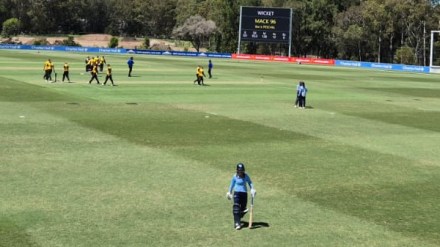
NSW openers Katie Mack and Tahlia Wilson put on a show for the few spectators (was everyone else at the beach?) putting on 157 runs before Wilson fell for 60 to an excellent diving forward catch from Bhavisha Devchand of Bekker’s bowling. This proved an excellent backbone to the NSW batting total, and gave the rest of the batters freedom to play at run-a-ball with the knowledge that there were ample wickets yet to come. So though wickets fell (notably Mack for 96 lbw by Peschel) the runs kept going up, with the majority of the batters contributing well. By 50 overs NSW had 301 runs on the board – just passing their total of 298 from Thursday’s game.

The eight wickets taken had included 2 from Amy Edgar, who had also put the most pressure on NSW, bowling 30 dot balls in her 10 overs. It would seem that though WA had found a way to take wickets they hadn’t taken them quickly enough, was NSW going to take advantage of this?

The short answer: yes they were! NSW proceeded to execute a masterclass in working out the WA batters’ weak spots. Lauren Cheatle’s captaincy and bowling were en point, not only taking early wickets and being on a hat trick in the 6th over, but also setting attacking fields with a tailored gameplan for each weary WA batter as they came to the crease, and soon marched back. This was especially the case when Sam Bates came on to bowl – she proceeded to work her way steadily taking the wickets of WA’s middle order – disrupting partnerships in turn with her four wickets in her 10 over spell, only conceding 26 runs. WA opening batter Maddy Darke fought valiantly, but had to watch from the other end as each of her batting partners were dismissed, she finished not out on 75, with WA reaching 158 all up.

NSW will be happy with the big win, which also landed them a bonus point in the chase for top of the table. Bates was awarded player of the match, and NSW breakers march forward undefeated into the big break before they next appear in round 4 of the WNCL. They are looking hard to beat.

Helen (Crystallised Cricket) is a writer based in Dharug and Gundagarra country, and here is writing about a game played on Dharug country. She acknowledges the traditional owners of the lands that she writes from.