
There have been a few one-sided games in this competition, but today takes some beating. On a glorious batting pitch, Lancashire Thunder somehow conspired to fall over themselves to get out; and the Surrey Stars then absolutely hammered them with the bat from ball 1 of over 1. With both teams having struggled so far at points in KSL, this level of dominance really wasn’t the match I was expecting to see when I woke up this morning.
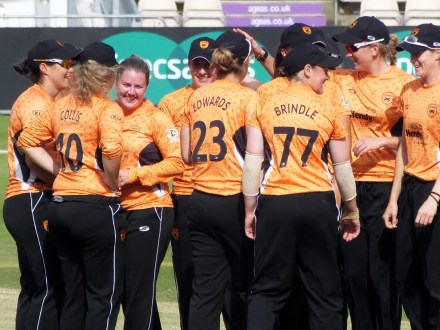
So what happened? Well, for one, the Stars have clearly been doing exactly what Nat Sciver told us they’d be doing after that dramatic loss to Western Storm on Sunday – working on their fielding. Diving stops; skilful catches; and three run-outs. Perhaps the best was Cordelia Griffith’s effort to dismiss Tash Miles from short fine leg: she spotted that Miles was starting a run, used her head, quickly grabbed the ball and threw it straight to Beaumont behind the stumps, who had ample time to remove the bails. Really neat work.
It could have been so much worse for Thunder – the one catch that did go begging today was by Alex Hartley, who missed a caught and bowled chance off Amy Satterthwaite when the captain was on just 10* (she went on to make 34*). It’s a little ironic that the overseas player who Thunder only called in as a last-minute replacement when Sarah Coyte bowed out is now their leading run-scorer in the competition (with 130 runs to date).
Fortunately Hartley – who admitted after play that she was “really angry with myself” after the drop – kept her cool, her captain kept the faith and Hartley went on to take 2 wickets in her very next over. Whether or not the Stars qualify for Finals Day – that will depend on whether they can beat Loughborough Lightning on Friday – this competition has vindicated our long-held belief that Alex Hartley is one of the best spinners in England. With 7 wickets across 4 games, she also happens to be the KSL’s (joint) leading wicket-taker to date, and her scalps include Lauren Winfield, Sara McGlashan and Deandra Dottin – not bad going!
Surprising stat of the day: top run-scorers so far in KSL are Nat Sciver (169), Amy Satterthwaite (130), Tammy Beaumont (112) and…Emma Lamb (also with 112). With scores of 25, 26, 34 and 27, Lamb hasn’t rivalled the sheer dominance of the innings we’ve seen from the likes of Sciver, but her strike rate has been well over 100 and, as Satterthwaite put it after close of play, “She’s played exactly like we would want her to”. At just 18, she’s got a bright future ahead of her.
Talking of bright futures, Bryony Smith is clearly loving life right now – as the cheeky ramp shot she played over her shoulder for four today showed. Amy Satterthwaite, speaking after close of play, said that the opening 6 overs of the Stars’ innings had been vital: “I thought from the way the wicket was feeling at the time that [our score] would be just enough to try and scrape the win. The way they started left us in a pretty sore position to try and come back after the first six… In Twenty20 that first six can win or lose you the game.” Smith may have gotten herself out in the 7th over, but her 30 off 26 balls was an essential part of those crucial first 6. After Linsey Smith’s effort yesterday with the ball, perhaps we should be renaming this competition the Smith Super League?
 CRICKETher