INTERVIEW: Salliann Briggs on KSL, the Academy Restructure and Female Coaches in Cricket

Ffion Wynne speaks to Loughborough MCCU and Loughborough Lightning KSL Head Coach Salliann Briggs.

2016 has been a very impressive year for Salliann Briggs. Alongside her continued success in the role of Loughborough Women’s MCCU Head Coach, she was granted the same role for Loughborough Lightning in the first season of the Kia Super League (KSL). There were many doubts over Loughborough’s inclusion in the KSL – whether the sole university-based side would be able to compete against the top counties, or whether their lack of county stadium would affect their campaign regarding spectators and local support. However, under Briggs and Assistant Coach Lisa Keightley, England’s Georgia Elwiss captained the side to a place in the Finals Day, losing to Western Storm to narrowly miss out on a top two finish. More recently, following the revamp of the England Pathway, Briggs was appointed to yet another key role in the development of the women’s game in coaching the Academy squad.

Following this exciting summer for women’s cricket in England, it seems the future is looking even brighter, especially with the Women’s World Cup being played at home in 2017 and the prospect of the second Super League claiming more success than its breakthrough season. With all this ahead, it seemed that Briggs, as one of the leading coaches in the women’s game today, would provide the perfect insight into the upcoming plans.

2016 was certainly a big year for the women’s game. As you were heavily involved in the action of the KSL, how would you assess its first year on the whole?

I think the KSL definitely exceeded everyone’s expectations. For me personally, I didn’t actually have much awareness of the impact it would have, with it being a new competition. The only indicator for me was the amount of work that was put in from Loughborough in particular; the meetings and the build up seemed to go on forever. But I think the crowd sizes we had here definitely showed its success, because here at Loughborough we were expecting capacities of around 200-500 and yet we ended up with more than 500 each game. It’s definitely important, though, that we build on this after year one.

It was an incredible experience for all the girls but funnily enough, as coach, I didn’t capture it as my mind was on the game and therefore didn’t manage to experience the atmosphere as much. But now we know that Sky Sports want to be involved I think it’s definitely going to go from strength to strength.

There were concerns over Loughborough’s status as the only side without county support. Were you pleased with the match day experience that was provided at the university?

Yes definitely. When I did interviews prior to the KSL a lot of people asked me about it, but if you speak to them now or even our opponents, many say that it was the best match day experience they had. The downside to big stadiums sometimes is that the atmosphere can get lost, and we felt that when we played at away venues where they were trying to fill half a ground, you didn’t get the all-around atmosphere we had. We got so much positive feedback, and a lot of the girls really enjoyed it. The feedback I got from the girls playing here was that it was the first time they felt they were really ‘number one’, because often when they are linked to counties they’ve always felt pushed aside for the men. But here, whether it was a training session, in the gym or at the ground, they were given number one priority so I’m pretty confident we gave the best experience overall.

Before the tournament began, what was your target for the Lightning?

It was always to make Finals Day. We were pretty pleased that we got into that position, but there were some disappointing games along the way as well. Particularly Lancashire Thunder, as they finished bottom but on the day some of their players were excellent. It would’ve been nice to have a closer game against the Vipers as it was our last game before Finals Day, just for the players’ confidence, but we made it and played some great cricket throughout the competition. I was really pleased with how our county players rose to the occasion, they worked particularly hard during the build up to get themselves ready to perform under pressure. I think we put up a good fight, but I think the main thing we learnt was that in the space of only two weeks, you can’t afford many big mistakes. Of course we were disappointed not to make the final in itself, but in the first year we were definitely very pleased.

There are 6 KSL teams, compared to the 36 that play in the Women’s County Championships. Do you believe that this structure is able to prepare players effectively for the international stage?

Well to start we’re obviously targeting Twenty20, so if the better players are filtering through to the KSL teams then we are definitely making progress in that format and building significant bridges. As a whole I think we’ve still got a lot to look at within the counties, and how they can be more involved in that pathway of preparing players. It’ll be interesting to see how the 50-over contest progresses, and where the counties sit in that, but I think it is still a work in progress in how to involve them more – I’m not too clear on the landscape of how that’s going to happen yet.

Some critics still question the sustainability of the introduction of professionalism in the England setup, and that the team’s results haven’t reflected the true benefits over the past few years. What are your thoughts on this criticism?

I can’t say I’ve taken too kindly to that belief, mainly because I’ve been in and around the England environment and the one thing they truly are is professional, they work hard and they’re all immensely passionate about learning and striving to be better. I think that’s definitely an unfair judgment. It’s certainly been a bit of a transition recently with some changes to the squad, but ultimately if you look at their past few series they’ve won every single one. Yes, they haven’t won as convincingly as they have done in the past, but this time is about building for the future and making sure that the perfect squad is in place for the World Cup next year.

Australia have recently begun live streaming of their state matches, which has been considered a great step forward. Do you think this would be successful if it was introduced to England’s County Championship games?

I think we need to work from the top first here in England, so obviously we’ll be broadcasting a lot more KSL games now but they won’t all be covered, and I really think these should be streamed live moving forward. The thing with streaming games is that you want a good representation of what you’re selling, so it’s definitely important that we get the domestic structure right in order to show what talent we’ve got coming through. When we do start streaming it’s important that the feedback we gain from viewers is positive, therefore the types of games we stream are important. Like you’ve already mentioned, being put in the spotlight puts you in line for quite a lot of criticism, so I think the KSL needs to be given time to develop and grow before we begin streaming other competitions.

The Academy pathway has recently been restructured, alongside your appointment as the Head Coach of the Academy. Can you explain the purpose of these changes?

The main thing is that we wanted to make sure that the wording and the way it looks shows a clear progression between the pathways. There aren’t too many changes to be honest as I’m still looking after the same programme as before, but we’re just trying to show from a development and performance element that our programmes work together. We mainly aligned the titles to emphasise how both Stanny’s [John Stanworth – Head Coach of the Senior Academy] programme and the one I lead will be working much closer than previous years, which I think is important to help players to transition through the pathway. The Senior Management team introduced the idea, and it works really well between us at the moment.

Do you see the development of female coaches as an integral part of improving the women’s game?

Yes! Definitely. It’s always a difficult one for me because we are still in a male dominated sport, and it’s something I’m quite passionate about. We still need to keep in mind, though, that if there are female coaches that want to progress, they still need to be at the right level and have the right skills, but on the other hand we also need create opportunities for female coaches to develop. It’s quite exciting as there is quite a lot of work going into it, like the female coaching conferences that the ECB started last year, which were a huge success. It’s one of those things that I am always willing to put myself forward to help in any way that I can.

What are your aims and aspirations in the next few years as a leading coach in the game?

Personally I just want to keep developing myself as a performance level coach. I’ve worked as a development coach both at Loughborough University and with England for some time now and like anyone, I want to coach at the highest level. I’ve been really lucky to be given the chance to go out to Perth, so I’ll be going for the back end of the Women’s Big Bash League, which will continue my development and expand my coaching experiences. Loughborough as an organisation have always supported me when a good opportunity has come along, and I’m grateful they’re allowing me to seize this one. The experience will be invaluable. I’m also still committed to working as the Lightning Head Coach ensuring that the players have the right structure and environment in place for them to grow. For me, it’s not just about aiming for the trophy at the end of it, but mostly making sure the players are able to fulfil their potential and go as far as they can within the game.

If you could change one thing in women’s cricket today, what would it be?

The easy answer would be for people to see women’s cricket for what it really is, and that we get more resources to actually go out there and show the world that we can be an incredibly exciting sport that engages a significant number of followers. We definitely do have a lot of work to do around that though. It also does frustrate me when we always get compared to the men, I don’t think that should ever happen, I want the women’s game to be considered in its own right – deservedly so. I guess it will take its time, and hopefully this will come in the next few years or so, but I’m definitely impressed with the example that New South Wales are setting by investing in their state players by becoming professional, so if the English cricket world could get on board with that then we’ll be making some impressive strides forward.

NEWS: Charlotte Edwards Leaves Kent

Kent CCC have announced that captain Charlotte Edwards is to leave the county after 16 seasons and over 6,000 runs, during a period in which Kent have dominated the women’s county game.

In a statement released by the club, Edwards said:

It’s been a really tough decision to leave Kent but ultimately I feel it’s the right decision for me and more importantly the current team. Having won the double in 2016 I feel this is a fitting end to my time as a Kent cricketer.”

“I would like to thank everyone at Kent County Cricket Club for all their support over the past 16 years. I’m immensely proud to have played for the county and what the team has achieved within that time.”

Edwards, who is currently in Australia playing WNCL/WBBL, was recently appointed as a management board director of Hampshire CCC and the Southern Vipers, and has committed herself to playing for the Vipers next year; but it is currently unknown if she will continue to play county cricket.

GAME REVIEW: Big Bash 16

Have you ever dreamed of hitting Ellyse Perry for 6? Well now you can, with Big Bash 16 – the new, completely free, mobile game from the folks behind Don Bradman Cricket – which gives you the chance to have your own Big Bash in the palm of your hand, playing through a WBBL season with any one of the 8 women’s teams… or even one of the men’s teams, if you are that way inclined!

The first thing to say is that this game is genuinely “free” – there are no in-app purchases tugging at the purse-strings, or “third-party” ads.

All the players are present and correct, as far as we can see; but some of the likenesses are better than others. In the Hobart Hurricanes line-up, Hayley Matthews is spot-on and instantly recognisable; but Heather Knight is “generic girl with ponytail”… and even that is wrong! (Hint for next year’s BB17: Heather always bats with her hair tied up guys!)

This being cricket, there is batting and bowling to do; but all the fielding is automatic. Batting is fun and pacey, swiping across the screen to execute different shots; but bowling is a bit tedious and clunky – you have to place a marker for the length, and then when the ball is delivered you can then swipe to add outrageously “arcadey” swing or spin… and whatever you do Ellyse Perry still smashes it to the boundary, so at least that is realistic!!

Overall, you’d have to admit that on a gaming level, Big Bash 16 suffers from the problem of all cricket games, which is that it is really hard to replicate bowling in a manner that is in any way intuitive or exciting; and it just serves to remind us why the “king” of all mobile cricket games – Stick Cricket – dispensed with it entirely, and just focussed on the batting!

But still, the chance to play through a season with your favourite WBBL team feels like a another one of the Big Bash’s Big Breakthroughs – and considering the price (did we say… it’s free?) it’s more than worth every penny!

Get Big Bash 16 on iPhone/ iPad here and on Android here!

STATS: Women’s International Championship All-Rounder Rankings

At the head of the field in our all-rounder rankings is Australia’s Ellyse Perry. Though only 26 years old, Perry has already sealed her place in history as probably the last person ever to play both football and cricket at the very top international levels of those games – the professional commitments required of both sports are now just too big for it to be likely that anyone will ever achieve this again.

Indeed, Perry herself has basically been frozen-out of international football in recent years for her refusal to commit to it as her one sport; but the Mathilda’s loss has been the Southern Stars gain, as Perry has marched up the batting rankings to become a true all-rounder – having made her debut back in 2007 at number 9, over the past year or so, with Lanning dropping down to 3, she has come in at 4, where she averages 111 in ODIs in 2016, whilst continuing to chip-in with the ball. TL;DR: She’s quite good!

At No. 2, Suzie Bates has continued to show the form that made her Wisden’s Woman Cricketer of the Year in 2015 – she also had a spectacular domestic season in England over the summer, winning the County Championship, T20 Cup, and the Super League – and her ability to adapt to English conditions, perhaps a little more adeptly than Perry did in her Super League stint, could be the key for New Zealand in next year’s World Cup.

England captain Heather Knight, at No. 3, has always been considered primarily a batsman, and indeed only starting bowling regularly at international level when a hamstring injury forced her a couple of years ago to adapt her medium-paced seamers to off-spin.

I was there the day that Knight first unleashed her off-spinners for Berkshire after returning from her injury, and with little change to her action, I remember messaging a friend and saying: “Heather is back bowling… but really, really slowly!” Later that afternoon, I was messaging again: “Heather’s got a 5-fer!”

This impact was soon also reflected at international level, and though she has been bowling a bit less recently, over the course of the Women’s International Championship her all-round contribution has been a key part of why England have won 70% of their matches in the competition.

Further down the list, we see a number of other players like Knight, who we also tend not to think of as all-rounders, but who have nonetheless made an all-round impact.

South Africa’s “official” all-rounder is new captain Dane van Niekerk; but it is actually “bowler” Marizanne Kapp who has made the bigger all-round contribution.

West Indies’ Deandra Dottin has the reputation as a destructive batsman, but whilst her batting has perhaps not quite been what it once was recently, she has made herself very handy with the ball.

Another “bowler” – South African leg-spinner Sune Luus – the leading wicket-taker in the world in 2016 – has forced her way up the order to open against Australia in their on-going series – scoring two 50s and earning the title of all-rounder in the process.

Player Runs Wickets
1. Ellyse Perry (AUS) 985 23
2. Suzie Bates (NZ) 978 16
3. Heather Knight (ENG) 642 29
4. Stafanie Taylor (WI) 857 16
5. Amy Satterthwaite (NZ) 763 16
6. Hayley Matthews (WI) 478 22
7. Marizanne Kapp (SA) 418 23
8. Deandra Dottin (WI) 592 17
9. Nat Sciver (ENG) 533 11
10. Dane van Niekerk (SA) 460 17
11. Shikha Pandey (IND) 239 17
12. Sophie Devine (NZ) 431 11
13. Sana Mir (PAK) 333 20
14. Jhulan Goswami (IND) 203 17
15. Sune Luus (SA) 238 23
16. Asmavia Iqbal (PAK) 249 14

Ranking = Runs * Strike Rate * Wickets / Economy – Min 200 Runs + 10 Wickets

BOOK REVIEW: All Wickets Great and Small by John Fuller

All Wickets Great and SmallSubtitled “In Search of Yorkshire’s Grassroots Cricket”, journalist John Fuller’s first cricket book is a gentle meander through the hills and dales of the amatuer game in Fuller’s home county of Yorkshire.

During the summer of 2015, Fuller embarked upon something of a cricketing pilgrimage, visiting thirty-odd of the 778 registered clubs in the White Rose County, in an attempt to rediscover the soul of the game.

The result is this series of tales, typically beginning with a train journey, then a short walk to a ground great or small, at which tea is drunk for the love of tea, cake eaten for the love of cake, and cricket played for the love of cricket.

Given the title at the top of this site, it bears stating that this is not a book about “women’s” cricket – there is but a single chapter focussed on the women’s game, centered on a chilly County Championship clash between Middlesex and Yorkshire at Harrogate. (It is nonetheless a very interesting chapter, however, especially for one inside the game to see it from the perspective of the outsider.)

In fact, in some ways, this is not a book about cricket at all, but about the places where cricket is played. The evocative descriptions which will live with you long after you turn the final page, are not of cover drives or turning deliveries, but of red-brick pavilions, iron gates and wooden benches; the fading facades of the once-great Park Avenue in Bradford, where Don Bradman hit but a single run as Yorkshire took on the touring Australians in 1930; or the modern pavilion at Thirsk, close-by to where Thomas Lord (or “Lords” fame) was born, blending into the nearby racecourse “like an outbuilding containing horse feed or a stretched residential bungalow.”

All Wickets Great and Small is not a joyful book – but if a sense of melancholy pervades, it might only be because, in so many ways, the game of which Fuller goes in search, sadly really has seen better days. It is nevertheless, a book written with love and honesty, which is worthy of its place on any cricketing bookshelf.

STATS: Women’s International Championship Bowling Rankings

As regular readers will know, it’s Spin City in women’s international cricket, these days more so than ever, and the top 6 players in our Women’s International Championship bowling rankings are all spinners.

Australia’s Jess Jonassen was the leading wicket-taker in the Championship, with 31 wickets, though she was a little bit more expensive than some: her best figures – a 5-fer against New Zealand – came at the expense of 50 runs off 9 overs that day.

At No.2 Anisa Mohammed – the first bowler ever (male or female) to take 100 wickets in T20 internationals – has been crucial to the West Indies’ cause in ODIs too, as they scrapped their way to the final direct World Cup qualification spot.

At No. 3, Rajeshwari Gayakwad is perhaps the surprise entry in the top 10 – an orthodox left-armer, she first really announced herself against England at Scarbados back in 2014, when she took 4-42, including the scalps of Sarah Taylor and Nat Sciver. She has been remarkably consistent throughout the Championship, taking 2 wickets here and 3 there, finishing with 2 more 4-fers in the series versus the West Indies.

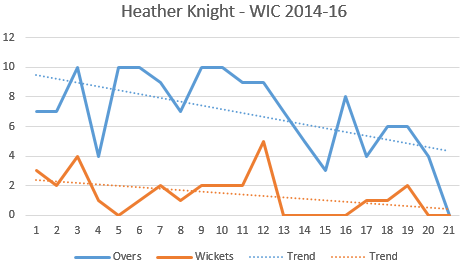
England’s leading bowler across the Championship, at No.4, has been now-captain Heather Knight, but it is interesting to look at the graph of her bowling, match by match, over the course of the competition:

Heather Knight Bowling Analysis

It shows that she has been bowling less and less – especially since she took over the captaincy. My experience watching Knight captain at Berkshire for many years suggests that she tends to bowl herself when she feels they are in trouble, which they rarely have been with the ball at least over the past year or so.

Player Wickets Economy
1. Jess Jonassen (AUS) 31 3.86
2. Anisa Mohammed (WI) 27 3.67
3. Rajeshwari Gayakwad (IND) 25 3.43
4. Heather Knight (ENG) 29 4.19
5. Kristen Beams (AUS) 24 3.55
6. Hayley Matthews (WI) 22 3.66
7. Shabnim Ismail (SA) 22 3.69
8. Anya Shrubsole (ENG) 24 4.12
9. Katherine Brunt (ENG) 20 3.58
10. Ellyse Perry (AUS) 23 4.14
11. Marizanne Kapp (SA) 23 4.24
12. Jhulan Goswami (IND) 17 3.19
13. Deepti Sharma (IND) 16 3.02
14. Inoka Ranaweera (SL) 24 4.57
15. Lea Tahuhu (NZ) 19 3.72
16. Erin Bermingham (NZ) 18 3.59
17. Morna Nielsen (NZ) 18 3.64
18. Sune Luus (SA) 23 4.66
19. Sana Mir (PAK) 20 4.15
20. Stafanie Taylor (WI) 16 3.43
21. Leigh Kasperek (NZ) 13 2.88
22. Ekta Bisht (IND) 15 3.34
23. Dane van Niekerk (SA) 17 3.9
24. Shikha Pandey (IND) 17 3.95
25. Anam Amin (PAK) 16 3.73
26. Laura Marsh (ENG) 15 3.5
27. Dani Hazell (ENG) 15 3.51
28. Amy Satterthwaite (NZ) 16 3.8
29. Suzie Bates (NZ) 16 4.16
30. Shashikala Siriwardene (SL) 15 4.02
31. Ayabonga Khaka (SA) 15 4.05
32. Sugandika Kumari (SL) 16 4.47
33. Deandra Dottin (WI) 17 4.8
34. Shakera Selman (WI) 12 3.46
35. Megan Schutt (AUS) 15 4.57
36. Afy Fletcher (WI) 11 3.4
37. Jenny Gunn (ENG) 13 4.03
38. Rene Farrell (AUS) 14 4.46
39. Sarah Coyte (AUS) 11 3.83
40. Tremayne Smartt (WI) 11 3.85
41. Erin Osborne (AUS) 12 4.36
42. Sophie Devine (NZ) 11 4.22
43. Nat Sciver (ENG) 11 4.26
44. Grace Harris (AUS) 9 3.5
45. Holly Huddleston (NZ) 11 4.41
46. Asmavia Iqbal (PAK) 14 5.79
47. Alex Hartley (ENG) 9 3.8
48. Maduri Samuddika (SL) 8 3.55
49. Sadia Yousuf (PAK) 11 5.17
50. Ama Kanchana (SL) 12 5.69

Ranking = Wickets / Economy

STATS: Women’s International Championship Batting Rankings

Australia’s 3-0 series victory versus South Africa this week brings to a close the largest international cricket tournament ever staged – 84 matches* played over 2½ years – offering the perfect opportunity to pull-together some pretty definitive rankings for batsmen, bowlers and all-rounders.

There will be little surprise as to who tops the batting rankings – Wisden’s 2014 women’s award winner, Meg Lanning, who scored 5 centuries and another 5 fifties in the championship, amassing well over 1000 runs in total.

The good news for the opposition though is that if you get Lanning out… in walks Ellyse Perry, ranked at No. 3 on our list! Martin Davies from WCB commented to us the other day that Perry is becoming more and more a batsman who bowls a bit, and there is little doubt that she would merit selection in anyone’s World XI, even if she didn’t bowl at all.

Only one batsman finished the tournament with a Strike Rate over 100 – Nat Sciver – the highest-ranked England player at No. 7. Though a few tail-enders also achieved a Strike Rate of 100+ on a handful of innings, Sciver did it across 16 innings, scoring 533 runs in total, including 6 fifties.

Also worth a mention are Chamari Atapattu and Javeria Khan, ranked at 14 and 15 respectively – it is one thing to score your runs against Pakistan and Sri Lanka (76% of Tammy Beaumont’s runs came against those two bottom-placed sides) but arguably more impressive to score them for those sides against the higher-ranked teams. (For the record, just 27% of Atapattu’s runs came against Pakistan, and only 27% (sic.) of Javeria’s runs were scored v Sri Lanka.)

Player Runs Strike Rate
1. Meg Lanning (AUS) 1232 95.28
2. Suzie Bates (NZ) 978 82.25
3. Ellyse Perry (AUS) 985 77.86
4. Amy Satterthwaite (NZ) 763 79.39
5. Stafanie Taylor (WI) 857 69.84
6. Nicole Bolton (AUS) 817 71.35
7. Nat Sciver (ENG) 533 102.89
8. Rachel Priest (NZ) 688 73.89
9. Lizelle Lee (SA) 616 82.35
10. Tammy Beaumont (ENG) 543 92.19
11. Heather Knight (ENG) 642 68.22
12. Deandra Dottin (WI) 592 71.67
13. Alex Blackwell (AUS) 513 80.28
14. Chamari Atapattu (SL) 591 65.66
15. Javeria Khan (PAK) 605 62.69
16. Smriti Mandhana (IND) 494 73.51
17. Hayley Matthews (WI) 478 69.98
18. Lauren Winfield (ENG) 480 69.16
19. Bismah Maroof (PAK) 546 60.26
20. Mithali Raj (IND) 535 61.07
21. Charlotte Edwards (ENG) 476 67.51
22. Mignon du Preez (SA) 529 59.1
23. Sophie Devine (NZ) 431 71.59
24. Trisha Chetty (SA) 482 62.92
25. Marizanne Kapp (SA) 418 71.45
26. Dane van Niekerk (SA) 460 59.89
27. Georgia Elwiss (ENG) 277 91.72
28. Harmanpreet Kaur (IND) 417 59.82
29. Prasadani Weerakkody (SL) 441 54.44
30. Kycia A Knight (WI) 372 57.49
31. Merissa Aguilleira (WI) 359 58.66
32. Shikha Pandey (IND) 239 87.54
33. Veda Krishnamurthy (IND) 290 69.37
34. Sarah Taylor (ENG) 223 81.68
35. Asmavia Iqbal (PAK) 249 70.53
36. Sana Mir (PAK) 333 49.92
37. Eshani Lokusuriyage (SL) 212 75.71
38. Elyse Villani (AUS) 237 64.93
39. Jhulan Goswami (IND) 203 73.28
40. Chloe Tryon (SA) 198 75
41. Dilani Manodara (SL) 261 55.76
42. Britney Cooper (WI) 207 66.99
43. Sune Luus (SA) 238 53.24
44. Nain Abidi (PAK) 231 53.59
45. Shemaine Campbelle (WI) 224 53.08
46. Marina Iqbal (PAK) 218 50.23
47. Shaquana Quintyne (WI) 187 55.16
48. Shashikala Siriwardene (SL) 199 51.28
49. Nipuni Hansika (SL) 186 52.99
50. Chamari Polgampolai (SL) 199 45.43

Ranking = Runs * Strike Rate

* In theory at least – though of course a few of those matches weren’t actually played! The next largest was the 1997 ICC Trophy – 82 matches, excluding warm-ups – thanks to Peter Griffiths of cricketarchive.com for the info on this!

OPINION: England’s Year – Win Percentage Doesn’t Tell The Whole Story

Having completed a 4-0 series whitewash against Sri Lanka last week, England have reached the end of their busiest year ever, and the time seems to have come to reflect on the preceding 12 months. The latest press release from the ECB tells us that during 2016, England have played 26 matches across all formats of the game, and won 21 of them – giving them a win percentage of 81%.

Now of course that is pretty impressive. (For the record, in 2015 their win percentage was 50% – 6 games won, 6 games lost across all formats.) But it’s also pretty obvious that a team’s win percentage doesn’t tell the whole story of their year.

For England, given that nearly half of their victories (10 games in total – about 48%) have come against teams we would have expected them to easily beat anyway (Sri Lanka and Pakistan), it’s perhaps more pertinent to look at the lost games – and particularly at the manner in which they were lost.

Of the 5 games in which England were defeated in 2016, 3 of them were lost when chasing. More significantly, all 3 of these losses were matches which, at the half-way stage in their chase, England looked on course to win easily:

1. The WWT20 semi-final. England chasing 132, and at the 10-over mark were 67-1, coasting along. They subsequently collapsed to finish on 127-7, missing out on a spot in the final by 5 runs.

2. The second ODI in the Caribbean at the Trelawny Stadium. England were chasing 148, were 56-3 after 24 overs – and collapsed to 110 all out.

3. The fourth ODI at Sabina Park. Target 224. England reached 95 before losing their first wicket. They were all out for 181.

I’ll mention one other match here which England did ultimately win: the final ODI in Sri Lanka. Nonetheless, it’s pertinent that at one point England were 58-6 in this game, following a rather embarrassing middle-order collapse. They ended up reliant on Nat Sciver and Dani Hazell to bat out of their skins in order to take them to respectable total. Against almost any other team in world cricket, being 58-6 at any point would have been fatal.

When Mark Robinson sacked his best batsman, back in May, his justification was that the rest of the team were “hiding behind” Charlotte Edwards. The argument seemed to go as follows: when Edwards gets out, the rest of the team no longer believe that they have the capacity to win the game. That’s when the collapse happens. Get rid of her, and other players will step up; get rid of her, and the problem disappears.

I never quite bought this argument. And the evidence above seems to suggest that I was right. Old weaknesses die hard, and the tendency for England to collapse in a heap doesn’t seem to have vanished quite yet.

I don’t want to put a downer on what has been a pretty positive 6 months for England – with the rise of Alex Hartley; the exciting debut of Sophie Ecclestone; the return of Fran Wilson from the wilderness; and a new captain in Heather Knight who seems to be relishing the responsibility. But ignoring a problem, pretending it no longer exists, isn’t going to make it go away. It certainly isn’t going to win you a World Cup.

The last time the Women’s World Cup was played in England, back in 1993, England had a coach – Ruth Prideaux – who knew that so much of cricket is mental. She had her players chanting “we will win”, at a time when sports psychology wasn’t even a thing. It paid off. England beat Australia, got to the final, and won it. Afterwards, most of the players recognised that believing they could do it was one of the most crucial factors in that victory.

Do England have the players at their disposal who can win a World Cup? Yes, I’d say they do. But whether they’ve got it in them mentally is another question entirely. So many of their losses in recent years haven’t been to do with talent, but with not being able to withstand the mental pressure that comes when you know you should be able to make the runs, but you just aren’t quite sure if you can do it. That’s when the collapse happens.

Unfortunately for England fans, you won’t get much greater psychological pressure over the course of a career than playing in a home World Cup. It’s going to be a stern test. If I was Mark Robinson, I know what I’d be focusing on this winter – and let’s just say it wouldn’t be cardio training.

NEWS: ICC India v Pakistan Ruling – India Forfeit Points + NRR – World Cup Qualifiers Confirmed

The ICC’s Technical Committee has ruled that India are responsible for not playing their Women’s International Championship series with Pakistan – awarding Pakistan all 6 points, and mandating that India’s Net Run Rate be adjusted to award 0 runs from 50 overs in each of the 3 “missing” matches.

The series was supposed to have been played earlier this year, with Pakistan hosting; but the BCCI are currently unwilling to participate in bilateral series with Pakistan, in either the men’s or women’s games, due to the ongoing geopolitical situation between the two countries, and India are understood to have simply never replied to Pakistan’s invitation to play the matches in the UAE.

Perhaps unsurprisingly, the BCCI are reportedly not happy with the outcome, and according to the web site news18.com, are making threatening noises about the (men’s) Champions Trophy, also taking place in England next summer, with a BCCI spokesperson quoted as saying: “If ICC does not backtrack, the men’s team in solidarity with our women’s team won’t play in [the] Champions Trophy.”

Assuming that the decision is upheld, it confirms the final standings in the Women’s International Championship, with Australia, England, New Zealand and the West Indies going directly to the World Cup in England next year; whilst South Africa, India, Pakistan and Sri Lanka will join Ireland and Scotland, plus Zimbabwe, Bangladesh, Papua New Guinea and Thailand, in a qualifying tournament in Sri Lanka next February to decide the other 4 teams who will compete in England.

NEWS: This Week In Brief

England

  • Having sealed their World Cup qualification with a win in the first game, England went on to complete a 4-0 ODI series win against Sri Lanka.
  • Things looked dicey for England in the final ODI, as they collapsed to 58-6, before a century-stand between Nat Sciver and Dani Hazell dug them out of the hole. England then bowled their hosts out for 78, with Laura Marsh taking 4-21.

New Zealand

  • The White Ferns completed a whitewash of their own against Pakistan, with a 5-0 series victory, which guaranteed their qualification for the World Cup.
  • After her recent success in South Africa, Amy Satterthwaite took just 6 wickets in this series…
  • But on the other hand she did finish it with a series batting average of 197! Satterthwaite scored 3 centuries, all at well over a run-a-ball, to finish the calendar year with a massive 977 international runs, having also chipped-in with 21 wickets.

India v West Indies + South Africa

  • There was yet another whitewash in the India v West Indies series – 3-0 to India; but it looks like it will still be West Indies heading directly to the World Cup.
  • Even if the ICC decide later this week that the points should be shared from India’s unplayed series versus Pakistan, leaving both India and West Indies on 21 points, West Indies will go through on games won, and India must play the qualifying tournament, along with South Africa, who forfeited their outside chance of direct qualification, losing the 1st ODI to Australia.

WNCL

  • The final weekend of round-robin matches saw Queensland Fire and New South Wales Breakers qualify for December’s final.
  • With the Southern Stars occupied against South Africa, it was up to the domestic squads to step up. For the Fire, Beth Mooney hit a century (146 off 144 balls) as they beat Vic Spirit to finish top of the table; whilst for the Breakers Sarah Aley took 3-33, as they bowled-out the ACT Meteors to win their shoot-out by 13 runs and grab the other final spot.