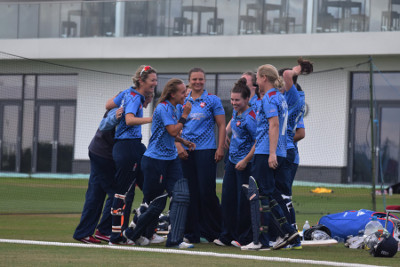
MATCH REPORT: Varsity Twenty20 – Kelly’s Class Too Much For Cambridge

CRICKETher reporter Ben Gardner was at Friday’s Varsity match to see a memorable innings by Oxford’s Sian Kelly.

Oxford v Cambridge, T20, The Parks, Friday 20 May

Result: Oxford won by 162 runs.

Toss: Cambridge won and elected to field

Sian Kelly produced a sustained and controlled assault on the Cambridge bowlers, paving the way for a victory by 162 runs, the margin of which did not flatter Oxford in the slightest.

Kelly’s innings, of 102* from 61 balls, was so brutal and calculated, it seemed remarkable that it wasn’t her best; Kelly made 127* in the reverse fixture last year. From the moment she put away Holly Tasker’s first ball to the square leg boundary to when she walked off the field 61 balls and 102 runs later, she exuded control, rarely seeming troubled by the bowling.

Runs were plundered all around the ground, with the favouring of the leg side being more a result of the full tosses bowled by Cambridge, invariably pumped between square leg and midwicket, than any lack of ability through the off side, as demonstrated by perhaps her best shot, a drive behind point for four, which brought up fifty.

The pacing of Kelly’s innings too was something to behold. To begin with, she exploded. After 6 overs Kelly was 46 off 24, Oxford were 74/0, and Cambridge were chasing the game, four consecutive fours of one Holly Tasker over being a particular highlight. Then, with the Powerplay finished, she switched gears, content to push the ball around, while still picking up regular boundaries, before accelerating again, moving from 83 to 97 in just 5 balls.

This was a masterful innings, and Kelly simply was a class above the bowling. She looks ready for greater challenges, and perhaps more game time alongside her twin sister Marie, Warwickshire’s captain, awaits.

Wagon Wheel of Sian Kelly's innings

Wagon Wheel of Sian Kelly’s innings

Tina Gough, who turned over the strike well and played some excellent shots of her own, was an excellent foil for Kelly. When she was out, for 52 off 50, the scoreboard read 173/1 off 16.3 overs, and the match was almost over as a contest but Cambridge did well to keep their heads up and stick to the task.

It mattered little in the grand scheme of things, but Cambridge bounced back well to restrict Oxford to 33/2 off the last 4 overs, and on a different day, without two batters in such fine form, such a recovery could have been the difference. While the full toss and no ball counts show there is much improvement to be had, this was certainly an attack with potential.

Still, a target of 205 seemed a tall order, and Oxford put the result beyond any doubt with an immaculate bowling display, with perhaps the only disappointment being that Cambridge bettered their 36/8 against Oxford in a league match 2 weeks ago by 6 runs.

The first three bowlers used by Oxford all represent various counties, and their extra quality showed. Sam Moore moved the ball away at pace, while her Oxfordshire colleague Helen Baxendale was metronomic in her line and length. Captain and Berkshire opening bowler Immy Brown was even more impressive, picking up 3 of the top 4 batters with her skiddy pace, as well as running out the 4th.

Away from the county stars, Oxford showed impressive depth; Sarah Attrill’s loopy accurate bowling especially is so difficult to get power behind, and therefore ideal for a T20. In the field too Oxford were sharp, and though there were a couple of missed run outs, these were more a result of smart work to earn the opportunities in the first place.

However, while it would be difficult to overstate how well Oxford played, there were some simpler areas where Cambridge could have improved. Their fielding was one such, but perhaps more inexcusable was their running between the wickets. There were several occasions where they chose not to push the fielders, or to attempt to rotate the strike, which meant Oxford were under almost no pressure. The boundary balls weren’t there to be hit to be sure, but the fact that no batter had a strike rate over 50 tells its own story. This was in stark contrast to earlier in the day, when Oxford wasted no opportunity to score runs, turning the strike over regularly and always looking if the second was on.

Cambridge, it has to be said, were missing key players. Most notable was Frankie Barber, who made fifty in the Varsity match at Lords last year. She is the only full Blue currently at Cambridge. Oxford and Cambridge examinations do not take place at the same time so finding a date when one university is not unfairly disadvantaged is tricky. However, making Cambridge play away while it is their students more likely to be affected is unfair, and something you’d hope the organisers would look at for coming years.

Still, to focus on such small details would be to miss the greater joy of the day, which was of a well-trained and extremely talented team playing to their potential, and of one special batter playing an innings that will be remembered by all who witnessed it.

NEWS: Ireland “A” To Play England Academy + South Africa Fixtures Confirmed

An Ireland “A” side will play England Academy in 4 50-over matches at Loughborough next month. Although this is an “A” side, it still looks a pretty strong team, led by new skipper Laura Delany and including her predecessor Izzy Joyce; and they will provide a good test for the Academy girls looking to turn the eye of Head Coach Mark Robinson as he adjusts to life without Charlotte Edwards and (for the moment) Sarah Taylor.

Cricket Ireland have also reconfirmed a slightly rejigged series against South Africa later in the summer. The fixtures clash with Super League, so South Africa will be without some of their biggest stars, which means it should be a competitive tour.

Ireland v South Africa Tour

01-Aug T20 YMCA
03-Aug T20 YMCA
05-Aug ODI Merrion
07-Aug ODI YMCA
09-Aug ODI Malahide
11-Aug ODI The Hills

(For those considering travelling, all of the above fixtures are in the Dublin region.)

NEWS: Knight Looks To Wilson & Jones To Replace Edwards & Taylor

Sounding very-much like a captain-elect, Heather Knight has tipped Fran Wilson and Amy Jones to step into the roles vacated by Charlotte Edwards and Sarah Taylor this summer.

Speaking to @SWLondoner at a Royal London event to launch the One Day season, Knight is quoted as saying:

“There will be spaces in the line-up and the order will look very different but there is some real talent in our squad at the moment… Amy Jones is a big one with a hell of a lot of potential and it will be a big year for her, and Fran [Wilson] as well.”

Wilson for Edwards is in many ways a like-for-like replacement – they are both unflashy, but highly reliable, “accumulators”.

Jones meanwhile has been Taylor’s “under-glove-butler” for some years now, and is the only member of the current squad who does the job regularly at county.

Perhaps a more interesting question is whether England will bring in someone else to cover Jones. The current Academy glove-butler – Ellie Threlkeld – is just 17, which has led to suggestions that Berkshire’s Carla Rudd or Surrey’s Kirsty White may get a call-up. Of the two, Rudd is undoubtedly the better keeper, but has always struggled for runs at county. White, on the other hand, has had an excellent start to the season with the bat, averaging 49.

Alternatively, England could turn back to Tammy Beaumont, who actually made her England debut behind the stumps back in 2009; but who does not currently keep even at county.

NEWS: Sarah Taylor “Taking A Break From Cricket”

The ECB have today confirmed to CRICKETher that Sarah Taylor is currently “taking a break from cricket, having decided to take some personal time away from the game.”

Taylor has already missed the first three fixtures of the county season for Sussex, and it now appears likely that she will remain absent from domestic cricket for the foreseeable future. It is as yet unclear whether she will return before England’s series against Pakistan, due to commence on 20 June.

An ECB spokesperson told CRICKETher that they were continuing to monitor the situation and that the ECB would: “support her, keep in touch and talk with her prior to selection for the Pakistan series and the start of the Kia Super League.”

Following on from the announcement of Charlotte Edwards’ retirement last week, this will come as a particular blow to an England team who are already without their best batsman and may now be facing losing their second best one as well.

It also effectively rules Sarah Taylor out of becoming the next England captain, in response to speculation in various media outlets that she was a likely candidate to succeed Edwards.

Taylor took a break from cricket six years ago, missing an Ashes tour in the process, but returned to the sport four months later to become the leading wicketkeeper batsman in the world.

MATCH REPORT: Lanning Lets Loose as Bears Batter Beavers

Aussie import Anna Lanning top-scored for Warwickshire as they beat Berkshire to stay top of the Women’s County Championship.

With Daisy Gardner out injured, Lauren Bell and Immy Brown opened the bowling for Berkshire, and both had early chances to take the wicket of Amy Jones, who was dropped by Alex Rogers at backward point off Bell and then bowled off a no ball by Brown.

Fortunately, it didn’t prove too costly, as Jones was then bowled by Bell for 1; but that brought Lanning to the crease, who built a series of partnerships through the middle order as she struck her way to a very nice 54, finding the long boundaries either side of the wicket 6 times, before being bowled by Alex Rogers.

Lanning’s fall could have spelled trouble, but Laura Crofts then took up the anchor role, making 47 as the tail wagged; before a quick-fire 20 off 19 balls from Becky Grundy finally drove Warwickshire on to exactly 200 and the 4th batting bonus point!

Berkshire’s reply started solidly enough, as Linsey Smith (40) kept pace with Heather Knight to put on 97 for the first wicket. Knight continued to look her usual assured self, but the rest of the lineup largely collapsed around her – Sherissa Gumbs (16) the only other batsman to reach double-figures, as Georgia Hennessy took 4-32. Knight (92) was last out, in the 48th over, as Warwickshire celebrated another 18-point victory, to remain out front as the only unbeaten side in the Championship.

Afterwards Warwickshire skipper Marie Kelly was full of praise for their Australian superstar:

“Anna Lanning has been pure class – watching her bat today, she was unbelievable; and as a player, she has come into the squad and fitted in so well – she was the perfect addition to our team.”

And Kelly insisted Warwickshire could win the County Championship:

“Somebody just compared us to Leicester Football Club – if we can just keep going, we could hopefully get there!”

The Bears’ still have some tough fixtures to come – not least Kent, who absolutely tonked Middlesex today; but with everyone else already having lost at least one game, it could just be opening up nicely for them to cause the Championship’s biggest upset in years.


NEWS: Coyte and Beams Head to Hong Kong

The Hong Kong Cricket Association has announced that Southern Stars Sarah Coyte and Kristen Beams are set to play two matches in the Hong Kong Women’s Premier League later this month.

The WPL is an on-going elite competition, akin to something like a “Super Twos”; and as well as playing in two games, Coyte and Beams will also participate in a 10-day training camp with Hong Kong’s national team.

The project is part of an initiative between Cricket Australia and the HKCA which also sees Michael Clarke playing men’s T20 cricket in the territory later this month.

The ICC see Hong Kong and China as a massive opportunity, particularly for the women’s game. Both participated in the 2014 Asian Games, ultimately won by Pakistan – China coming 4th and Hong Kong being knocked out in the first round proper.

Thanks to Seargent Awesome on Twitter for the tip!


Charlotte Edwards Retirement: How Events Unfolded

When the England team returned from the T20 World Cup in India a little over a month ago, they had no inkling of events which were shortly to unfold, culminating in Charlotte Edwards’ tearful retirement at Lords today. The players were under no illusions – they knew they had let themselves down and there were “hard yards” ahead to improve their batting, their fielding, and most especially their general levels of fitness. But nonetheless, everyone still expected Edwards to remain at the wheel today… tomorrow… and through to the World Cup in 2017.

Coach Mark Robinson was, however, starting to come to the conclusion that something a bit more radical than a few extra trips to the gym might be necessary if England were going to reverse their slow decline.

Over the following few weeks, Robinson held a number of meetings with his boss – Clare Connor – having decided that England could only get the fresh start they needed with a new skipper at the helm.

For Edwards meanwhile, life was starting to get back to normal. Assuming that if she was going to be fired it would have been immediately, she appears to have genuinely thought her position was secure, as she prepared for the new season, getting things underway with a match-winning innings of 79 for Kent in the first round of the Women’s County Championship.

The following day, Kent played Sussex at Eastbourne. As is normal, Sussex encouraged their age-group girls to attend the game if possible, and one who did so was Ellie Robinson… accompanied by her father, Mark. During a 3 hour rain delay, with all the teams, press and spectators huddled into the tiny pavilion, Robinson warmly greeted all of his players… or rather almost all of them – there appearing to be one conspicuous exception to the general atmosphere of camaraderie.

In retrospect, it is hard to believe that this wasn’t playing on Edwards’ mind as she was bowled by Tara Norris for 1 off 5 balls in the second over.

Then, the following day, Edwards received a fateful text message from Clare Connor, the substance of which was simply: “We need to talk.”

The “talk”, Connor admitted today, was the hardest of her professional life – the pair had worked hand-in-hand for over two decades – Edwards was the person to whom Connor had handed over the England captaincy ten years previously; and it was now Connor’s duty to tell her friend that the decision had been made and that she had led England on to the field for the last time back in that semi-final in India.

But worse was to come.

Edwards understood and accepted the need for new leadership, but believed that she still had a lot to offer as a player. Indeed, why wouldn’t she? England might not have performed “as a team”, but Edwards herself had made 202 runs in the tournament (one more than Meg Lanning) including 2 fifties, at a Strike Rate of 115. She might not lead England into 2017, but she would still be there as a player!

However, her hopes were to be shattered as Robinson informed her that she was not part of his plans to rebuild the team, and she would not be considered for selection in the summer or autumn squads.

Devastated, Edwards realised that the time had come to face reality and begin the painful process of signing off. After informing Robinson and Connor of this, a press conference was hastily convened at Lords. Meanwhile, Edwards composed an email to her England teammates, which was sent yesterday evening – the first any of them were to find out about the situation.

Then, selfless to the last, she set off to attend a university awards evening in Southampton, to play her role as guest of honour; whilst unbeknown to her, the news of her retirement was sadly leaking on Twitter, achieving nothing but heaping extra indignity upon her situation.

Charlotte Edwards – an England “great” if ever there was one – deserved better than that.

We really will not see her like again.

NEWS: England Announce West Indies Tour Dates

The ECB have announced the dates for England’s Women’s International Championship ODI series v West Indies this autumn.

The 5-match series will take place in Jamaica in October, at Trelawny Stadium and Sabina Park, with the vital “WIC” points up for grabs in the final 3 games. England currently sit 6th in the Women’s International Championship standings, but with 3 games “in hand” against Pakistan, will hope to have returned to one of the top 4 World Cup qualifying positions by the time October rolls around.

Date Match Venue
8th October 1st ODI Trelawny Stadium, Trelawny
10th October 2nd ODI Trelawny Stadium, Trelawny
14th October 3rd ODI * Sabina Park, Kingston
16th October 4th ODI * Sabina Park, Kingston
19th October 5th ODI * Sabina Park, Kingston

Ruth Prideaux: A Remarkable Lady

Driving through Eastbourne on Monday on the way to see Sussex play Kent, I remembered the last time I had been there, almost two years ago. I remembered knocking on a door in a sunny street, and my knock being answered by a white-haired old lady.

Her name was Ruth Prideaux.

I was there to interview her as part of my PhD – to hear her memories of her time playing and coaching England. Of the many interviews I conducted, they sometimes went well, sometimes not quite so well. And some stick in the memory more than others.

This one? One of the most enjoyable, most memorable, of all. It was impossible not to warm to Ruth in the two hours or so that I spent with her, drinking tea and listening to her memories of playing and coaching the sport she loved. It was also impossible – even at the age of 83 – not to feel slightly in awe of her; and to get a sense of why the players she coached were in awe of her, too.

Ruth sadly passed away last month. I am thankful I was able to meet her before she died. She deserves all the plaudits in the world.

———

Ruth Prideaux (nee Westbrook) was a formidable lady because she had had to be. Born in Greenhithe, Kent in 1930, she learned cricket at Gravesend Grammar School, before attending Anstey College of Physical Education to train as a PE teacher. All this came after an early battle of wills with her father about the sport she loved. “My father was not pleased,” she told me. “I had three brothers at that time, and he thought they should be playing cricket and not me. He didn’t like the idea of his daughter playing cricket. And I was the only one that really wanted to!” What happened in the end? “He had to put up with it,” she recalled, her blue eyes twinkling.

By the time she was selected for England, to tour Australia and New Zealand in 1957/8, he had come round to her way of thinking! She described that tour as “wonderful” – but it was yet another struggle, both to gain leave from her teaching job, and then suffering the financial burden of having to forfeit six months of her salary (the length of Australasian tours in those days, thanks partly to the month-long boat ride there and back).

Then there was her coaching career. In 1962 – as the Times reported in their obituary – Ruth and Mary Duggan became the first women to attend an MCC coaching course, passing the advanced certificate with ease. Several male first-class county players failed. And yet when she was interviewed for the England Women coaching job in 1988 – the first time such an appointment had ever taken place – she told one of her daughters, in full knowledge that she was the best qualified candidate: “I’ll never get the job, because men always do.”

Contrary to her own expectations, she did indeed get the job.

———

That was not the end of the battle, though. By the time of her appointment, Ruth was working as a lecturer in the Sports Science department of Chelsea College of Physical Education, with radical new ideas about the way she wanted the England team to progress. She secured funding from the National Coaching Foundation for a five-year intensive training programme from 1989 to 1993, which incorporated both sport psychology and physiological testing.

Steve Bull, a colleague at Chelsea, became the team’s official sport psychologist, and worked closely with Ruth to plan the programme, which aimed to increase confidence, develop positive thinking skills, and provide team cohesiveness. There was also an intensive focus on both nutrition and physical fitness.

Ruth recalled in our interview:

I was quite determined that the whole squad, they wouldn’t be a member of the squad if they weren’t fit. And we worked a lot on fitness. They used to run up and down the beach [at  Eastbourne], on the shingle, which was tough…And then we started to introduce the importance of diet. That particular aspect was not popular, because they were very fish-and-chip girls!”

Ruth’s coaching programme was years ahead of its time; no other sport, including men’s cricket, had utilised sports psychology before. And much of Ruth’s work in these years now serves as the foundation for the elite coaching techniques which are used within both men’s and women’s cricket.

Yet it did not initially sit well with the traditionalists within the Women’s Cricket Association. It was reported in The Cricketer in 1988 that “the decision to appoint Prideaux…did not meet with universal approval within the WCA fraternity”. She recalled that:

“the [England] selectors were not a bit supportive. They thought it was all wrong. They expected them always to be doing something on the cricket line as it were, with the activities of batting, or bowling, or fielding. But they were not in any way supportive of that type of [fitness] work. So that was quite difficult.”

Yet Ruth persisted.

———

Fast forward five years to Lord’s, August 1st 1993. Jan Brittin takes the winning catch, New Zealand are all out for 128, and Karen Smithies and her team lift the World Cup, hugging each other and shedding tears of joy.

That white-haired figure looks on from the balcony, quietly satisfied at what she has achieved with her team. She knew they could do it before they could.

“We were in Australia for the semi-finals of the World Cup in 1988,” she recalled in our interview, “and we lost to Australia. And I said to the players, ‘we will NOT lose the next World Cup. We’ll beat everybody, and we’ll win it.’ They all felt, ‘oh, she’s off again!’ But actually, we did.”

It was a win that would never have been possible without Ruth’s confidence in both her innovative new coaching techniques, and in her squad of players – a confidence she instilled in a variety of ways. One of my favourite stories was about the team’s arrival at Wellington College, where the teams were put up for the duration of the tournament:

“When we arrived we arrived as a squad before anybody else, and they’d put us on the ground floor and the Australians were upstairs, above us. And I said, ‘well we’re not having that’. So before the Australians came, we settled ourselves above them, and I said, ‘remember we’re on the top here!’ 

So that was another thing that, although it sounds little, was a great contribution to their belief in themselves.”

Sure enough, England were actually left needing to beat their old enemy, Australia, in order to reach the final – and they did so in spectacular fashion, thanks to a wonderful innings from Carole Hodges, who finished on 105*.

Ultimately, England’s World Cup victory in August 1993 was largely the fruit of Ruth’s labour. Steve Bull reported that, by the time he concluded his work with the squad, “a feeling existed [among players] that success would not have been achieved without the provision of sport psychology support”.

Her pride at the achievement was still evident in our interview, 20 years after the event, as she recalled the tournament, eyes shining. It is an achievement made all the more impressive by the fact that in all her years working with the England team, she was never paid a penny.

———

Ruth retired as coach in the wake of the World Cup, but remained involved in women’s cricket, going on to become the Chairman of Sussex Women’s Cricket Association. What of her legacy? Certainly that 1993 victory helped begin to change attitudes to the women’s game in England. A few days afterward the final, then President of MCC, Dennis Silk, wrote to the Chairman of the Women’s Cricket Association: “It was the best day’s cricket at Lord’s this year and between you all, you created a magical atmosphere. You have done the whole of English cricket a great service.”

There were awards, of course – the National Coaching Foundation’s England Coach of the Year in 1993 being just one – and yet somehow I wonder if Ruth ever quite got the recognition she so deserved. Had she been a man – had she won a men’s World Cup – the whole world would know her name. Did anyone realise, I wondered as I left her house after our interview, that one of cricket’s greatest ever coaches was at that moment living in a little corner of sunny Eastbourne?

It is just one more reflection of the battle Ruth fought her whole life – the battle against being told she couldn’t do it because she was a woman.

———

The battle continues – and the impact of Ruth’s approach is still being felt within women’s cricket. I put it to her in our interview that what she had really been trying to do was bring professionalisation to an amateur game. “Yes,” she concurred. “But you wouldn’t put it like that.”

Why wouldn’t you put it like that? “Well, it would be far removed from anybody’s expectation. I mean, to become a professional was unheard of.”

Not any longer. And as Ruth herself recognised, she is partly responsible for that transformation.

“I think we supplied a good grounding for women’s cricket to develop,” she told me. “And set an example of what can be achieved. Which was all good, because it meant everything moved forward.”

That is quite some legacy, I told her. “Yes,” she agreed.

“I’d rather leave that legacy than any other.”

MATCH REPORT: Devon v Essex at Felsted School

Devon (265-5) bt. Essex (98-10) by 167 runs.

After being inserted on a green but hard pitch, openers Amara Carr and Aylish Cranstone played positively to build a solid foundation, before Carr was adjudged lbw for 38. Jodie Dibble started in a spritely fashion before being caught out by the lack of pace and gave a simple catch for Bird at mid wicket for 13.

Cranstone and Rosalie Fairbairn rebuilt and rotated the strike after an early flurry of boundaries, and the batting powerplay added some impetus, before Fairbairn was dismissed, caught for 29, a partnership of 99.

Cait O’Keefe was positive from the start with 26 off 21 balls, before being run out in an unlucky fashion when a dropped return catch was parried onto the stumps. Cranstone continued to hit the gaps and target a short boundary, bringing up her maiden county championship century, with 15 fours and one six in her 134 not out from 140 balls.

Essex’s reply showed intent from the start but they lost their first wicket in the second over, caught by Hazelle Garton at mid on off Sophie Mackenzie. A stunning catch from Alli Kelly at point accounted for England development player Cordelia Griffith, easing some concerns over her big hitting potential.

The building clouds were a concern, with the Met Office forecasting rain at 4pm, and Devon just completed the 20th over required to constitute a game just as the first drops of rain came down. Essex were still well behind the run rate, losing their sixth wicket in the 21st over, with the score on 75.

The light rain continued, but the pressure of the constantly increasing required run rate meant wickets fell at regular intervals. Pick of the bowlers were Hazelle Garton with 4-20 and Rebecca Donohue 3-23, Cait O’Keefe 2-20, as Devon wrapped up a convincing victory in the 30th over with maximum bonus points.

Players’ Player, sponsored by Wadey Polden LLP: Aylish Cranstone.