WORLD CUP: England v Sri Lanka – 7½ Out Of Ten

A run-a-ball century – 117 off 117 balls – from Nat Sciver-Brunt was the difference between England and Sri Lanka in Colombo, putting England top of the table as we approach the halfway mark in the group stages of this World Cup.

Women's World Cup – Qualification Analysis 🏏

CRICKETher (@crickether.com) 2025-10-11T16:48:24.533Z

Requiring 254, Sri Lanka lost the wicket of bright young hope Vishmi Gunaratne after Chamari Athapaththu had retired hurt; but Hasini Perera and Harshitha Samarawickrama made decent progress and at the 20-over mark, Sri Lanka had the edge on the WinHer Win Predictor, with a 61% chance of victory.

England 253-9 v Sri Lanka 164 #CWC25 🏏

CRICKETher (@crickether.com) 2025-10-11T16:45:44.827Z

But the introduction of Sophie Ecclestone turned that equation on its head, with the spinner taking wickets in the 20th, 22nd and 24th overs, to put England in charge – turning a 61% chance of victory for Sri Lanka into an 83% chance for England, from which they never looked back.

Sophie added the cherry on top of the Eccles Cake with one more key wicket – that of the returning Athapaththu, as she bowled 10 overs straight through the middle phases.

The ball of the day however was reserved for Charlie Dean, with that early wicket of Gunaratne, who had no answer to one that pitched outside off before turning in between bat and pad to take the top of the leg bail.

With Linsey Smith finishing the day with an Economy Rate of 2.5 from 8 overs, plus the last wicket, it was a fantastic day for England’s specialist spinners, which is good news for everyone except possibly Em Arlott, who looks set to be the 2025 version of Beth Langston – one of only two members of England’s winning squad in 2017 to not get a single outing in the tournament. (Pop Quiz: Who was the other? Answer at the bottom!)

The one caveat with England’s bowling remains filling in those extra overs that Nat Sciver-Brunt can’t bowl. NSB bowled 5 overs today, briefly leaving the field after her first spell – we were officially told this was for a “bathroom break”, but the timing was “interesting” and if she accidentally bumped into the physio whilst she was back in the dressing room, I wouldn’t be surprised.

Alice Capsey again filled-in those additional overs, and did so competently, but if England really want her to be a proper, front-line spinning all-rounder, there is still work to do with the bowling coaches.

Earlier in the day, England had posted a decent total, but once again it was almost wholly reliant on a huge slice of luck, and one player – NSB on this occasion – taking advantage and going on to score almost half their runs. Sciver-Brunt was horribly dropped by Udeshika Prabodhani at midwicket when she was still in single-figures; and if that catch had been taken, the game could have turned out very differently, with no other England batter making more than Tammy Beaumont’s 32.

Beaumont and Amy Jones both looked unconvincing again. Jones was doubly-guilty for her own run out – ball watching as Beaumont called her through for a quick single, and then failing to dive in as she was run out by 6 inches; whilst Beaumont danced down the wicket and was far too early on a ball which she ended up toe-ending to extra cover.

With Heather Knight inexplicably pulling out a reverse sweep and oh-so-predictably being caught at short third, there was a lesson to be learned, and NSB learned it – keep it simple, and run hard.

NSB Boundary % in International Cricket #CWC25 🏏

CRICKETher (@crickether.com) 2025-10-11T13:59:40.519Z

NSB’s boundary percentage in international cricket has been falling for the past couple of years, and it was even lower than normal at just over 9% today; but it was what the situation demanded – efficiency was the watchword, and she watched it like a hawk. The 6 that brought up her century was typical – it wasn’t a Big Shot™ but it went far enough, safely enough, to get the job done.

England 253-9 v Sri Lanka 164 #CWC25 🏏

CRICKETher (@crickether.com) 2025-10-11T16:45:27.126Z

As we’ve seen a few teams do in this tournament, England waited and waited before going big at the end, sacrificing wickets in the last 5 overs to put on 49 in that final push. They finished 9 down, but wickets at that point are worth very little compared to runs on the board. With Athapaththu having already said in her pre-game interview that she felt Sri Lanka could chase 230, the implication was that much more would be tough to get. And so it proved.

This was far from the perfect England performance – I’d give it 7½ out of 10. The bowling was solid; but England really need their batting line-up as a whole to find some form, and with just one “easier” game remaining – their next outing against Pakistan – there isn’t much time to do it.


The other member of the 2017 squad not to play a game? Georgia Elwiss.

Katie Mack

WNCL: NSW v WA – Battle of the Analysts

By Helen Maynard-Casely

One of the interesting things to note about the WNCL as a competition, is the pairing of matches with the same opponents facing each other twice during a round, with only one day in between. The second rubber of each match-up can be an interesting study of who has taken on the lessons from the first game, studied the opponent and found the chink of armour to exploit in the second. After a close first game on Thursday, it was the battle of the analysts during the rest day to find what to target when Saturday rolled around.

A stonker of a day greeted the players – Sydney’s weather had cleared, the pitch bathed in bright sunshine. Was this also going to bring about a change? NSW won the toss, and decided to keep with the plan that had (narrowly) won the first game – putting out an unchanged side. WA swapped Shay Manolini for Charis Bekker, a right-hand bat but left-hand spin allrounder into their side.

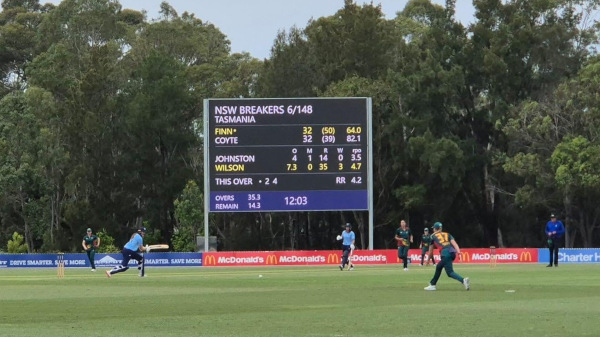
NSW openers Katie Mack and Tahlia Wilson put on a show for the few spectators (was everyone else at the beach?) putting on 157 runs before Wilson fell for 60 to an excellent diving forward catch from Bhavisha Devchand of Bekker’s bowling. This proved an excellent backbone to the NSW batting total, and gave the rest of the batters freedom to play at run-a-ball with the knowledge that there were ample wickets yet to come. So though wickets fell (notably Mack for 96 lbw by Peschel) the runs kept going up, with the majority of the batters contributing well. By 50 overs NSW had 301 runs on the board – just passing their total of 298 from Thursday’s game.

The eight wickets taken had included 2 from Amy Edgar, who had also put the most pressure on NSW, bowling 30 dot balls in her 10 overs. It would seem that though WA had found a way to take wickets they hadn’t taken them quickly enough, was NSW going to take advantage of this?

The short answer: yes they were! NSW proceeded to execute a masterclass in working out the WA batters’ weak spots. Lauren Cheatle’s captaincy and bowling were en point, not only taking early wickets and being on a hat trick in the 6th over, but also setting attacking fields with a tailored gameplan for each weary WA batter as they came to the crease, and soon marched back. This was especially the case when Sam Bates came on to bowl – she proceeded to work her way steadily taking the wickets of WA’s middle order – disrupting partnerships in turn with her four wickets in her 10 over spell, only conceding 26 runs. WA opening batter Maddy Darke fought valiantly, but had to watch from the other end as each of her batting partners were dismissed, she finished not out on 75, with WA reaching 158 all up.

NSW will be happy with the big win, which also landed them a bonus point in the chase for top of the table. Bates was awarded player of the match, and NSW breakers march forward undefeated into the big break before they next appear in round 4 of the WNCL. They are looking hard to beat.

Helen (Crystallised Cricket) is a writer based in Dharug and Gundagarra country, and here is writing about a game played on Dharug country. She acknowledges the traditional owners of the lands that she writes from.
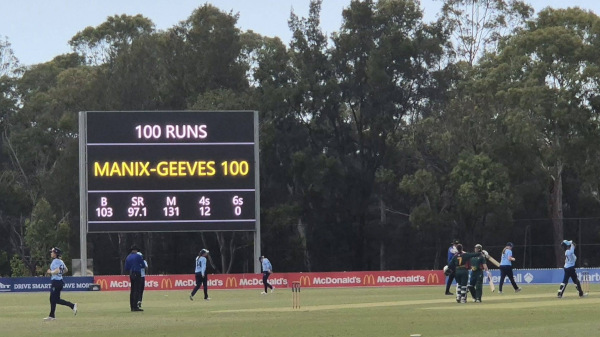
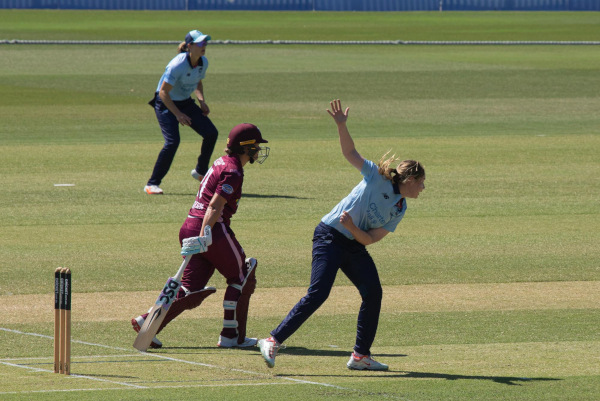
NSW v WA

WNCL: NSW v WA – Jailbreak for NSW in Thriller at Cricket Central

By Helen Maynard-Casely

A bleary cloudy day greeted spectators at Cricket Central, probably matching the weary badgers who had watched Australia’s wobble and recover against Pakistan late the night before. But this game was game much brighter than the dull clouds skirting the sky: NSW won the toss, elected to bat, and so started a proper WNCL classic.

The NSW team was unchanged from the side that won twice against Victoria in round one, while WA made one change from their travails against Queensland. This was due to Heather Graham’s call-up to the national side, meaning Rebecca McGrath gained her first WA cap.

WA started well, pinning down openers Mack and Wilson with the new ball, the culmination of which was an easy catch by Hinkley at mid-on of Wilson off Peschels’s bowling. This brought Anika Learoyd to the middle, who with Mack set in to build a sizable partnership. Overs of worker-like rotation of the strike kept the scoreboard ticking over, and by drinks after the 17th over, the WA bowlers didn’t quite know what to do.

Spinner Manolini came on, but Mack and Learoyd continued to match each other both in runs scored and balls faced – bringing up their fifties in overs 23 and 24 respectively. Following a mini-drinks break after the 25th over it was clear the batters wanted to move things on, with both Mack and Learoyd advancing down the wicket – intimidating and pushing up the run rate. The conclusion came in the 29th over with Mack being caught at mid-off by a reaching Piparo off McGrath’s bowling. She returned to the pavilion with 69 runs off 85 balls.

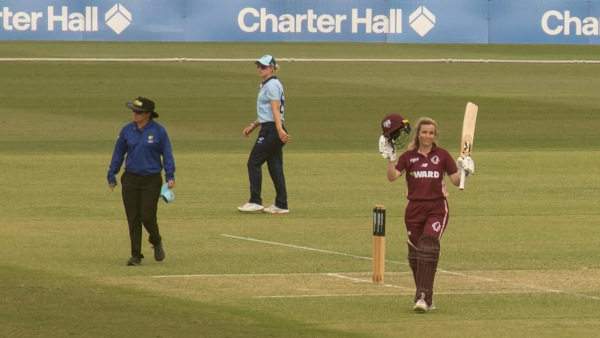
Learoyd and Claire Moore picked up where Mack had left off, running singles and giving WA fielders quite the run around. Learoyd pushed into the 90’s courtesy of a square leg boundary, looking relatively untroubled by the bowling attack throughout, even after catching an earlier delivery on the glove. She powered to her century with consecutive boundaries. However, soon after Learoyd was run out at the non-strikers end, bowler Ebony Hoskin tapping the return from Moore onto the wicket – a whimper of an end to an excellent batting innings. Moore continued in a similar vein, lofting a massive 6 that had the WA fielder vaulting the advertising hoarding to retrieve. She fell just after reaching 50, caught at deep mid-on. An entertaining cameo partnership between Georgia Adams and Maitlan Brown at the end, saw the total inflate to 298 after 50 overs.

Pescel was the pick of the WA bowlers, her nippy skiddy balls returned an excellent economy of 2.62 from her 8 overs, leaving spectators slightly perplexed why Hoskin (economy rate 5.2) and Mills (6.60) were bowled out in her stead. New cap McGrath picked up two wickets, but NSW were largely able to bat as planned with WA unable to put them under enough pressure. 299 was the target.

After the innings break WA’s openers got off to a flying start, making the most of the powerplay, and getting to 56 runs by the end of the 9th over. Maddy Darke in particular drove several boundaries off the opening seam bowling. The wily spin of Samatha Bates in the 9th over brought about the change, with Chloe Piparo caught at mid-off by Lauren Kua executing an excellent running catch. This brought Mikayla Hinkley to the crease. Piparo’s wicket at the end of the powerplay began a swing of momentum back to NSW, as Caoimhe Bray and Bates teamed up with some tight bowling to slow WA’s run rate down. By the 16th over the strain showed on the WA batters with Hinkley hampered by some serious cramping. She batted for two more overs before retiring hurt on 21.

Hinkley was replaced by Mathilda Carmichael, who formed a steady partnership with Darke, working similarly to Mack and Learoyd and keeping the required run rate in check. At 25 overs, WA were neck-and-neck with the NSW score (each being 126/1 at this point), and again at 30 overs (157/1 vs 157/2 for NSW at the same point). This matching continued to over 40 – WA were 213/2 after losing Darke for 73 to a sharp direct hit run-out from Kua, and nothing separated them from NSW who were 214/2 at the same point.

Tension built though the last 10 overs, the school holiday vibe of the first innings into the second (kids running everywhere, liberal shouts of ‘great shot’) waned, and finger nails started to be bitten. The 40th over was a flashpoint with the dangerous Bhavisha Devchand run out on 33 by some brilliant work by Tahlia Wilson behind the stumps, despite a slightly wayward throw from fielder Kua. Any relief that NSW may have felt at this point disappeared as Hinkely marched back to the crease – cramp or no cramp she was there to get her team over the line. Teaming with Carmichael, they wrestled the momentum back to WA for the next few overs. The grit particularly from Carmichael batting was evident, but she fell to a full toss from Brown, chipping over her shoulder to a waiting Bates.

McGrath joined Hinkey, who was limping again by this stage, and each took on Brown’s bowling, with McGrath getting a 6 into the trees. Hinkley brought up her 50, and by the start of the 49th over, with 19 needed off 12, it looked like WA were going to make it. But with one shot too many, Hinkley was caught at square leg by Sarah Coyte, one of two wickets during an excellent penultimate over from captain Cheatle. This was the final stumble for WA, and after a tidy final over from Bates, they finished just short on 291.

It was a match for the ages – the closest WNCL match so far this season – WA’s heroic efforts meaning that Saturday’s second match-up could be a classic again.

Helen (Crystallised Cricket) is a writer based in Dharug and Gundagarra country, and here is writing about a game played on Dharug country. She acknowledges the traditional owners of the lands that she writes from.
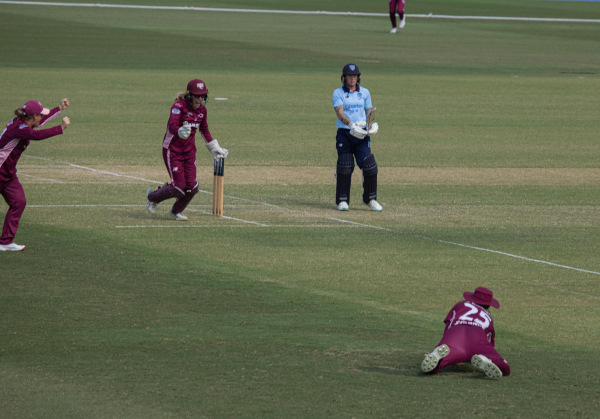
WORLD CUP: England v Bangladesh – Charmed Knight Invokes the “Power of Three”

England might have recorded one of the largest margins of victory in their history against South Africa in their opening match last week, but against Bangladesh it was so nearly a different story – a charmed innings of 79 from former captain Heather Knight being the only difference between the teams.

Knight was forced to invoke the “Power of 3 (Reviews)” – dismissed thrice by the on-field officials, she survived each time by appealing to the third umpire.

In the third over of their chase, with England already one down having lost Amy Jones, Knight was given out after the ball squeezed between bat and pad and was taken by the keeper. It was unclear whether the on-field dismissal was for caught behind or LBW – Knight indicating that the ball had hit her pad, suggesting she thought she’d been given out caught, but the TV umpire appeared to think the on-field decision was LBW. Regardless, the TV umpire concluded that there was no LBW case to answer, but also that there was insufficient evidence that she’d hit it to give her out caught, with the Ultra-Edge spike clear but not clearly attributable to the ball hitting the bat. (And if you are confused… welcome to the club!)

Then in the 7th over, with England Tammy Beaumont have joined Jones back in the pavillion, Knight was given out LBW on 8; but was reprieved once more by the third umpire – this time uncontroversially, with the ball clearly missing the stumps according to the ball tracking system.

The third review was perhaps the most disputable. In the fifteenth over, Knight drove towards extra cover and appeared to be spectacularly caught by a low-diving Shorna Akter. Knight (who probably had the best view in the ground) was walking off when the on-field officials asked for the catch to be double-checked, with the third umpire re-adjudicating the decision apparently on the grounds that it wasn’t clear the ball hadn’t touched the turf, even though all the available angles seemed to suggest Shorna’s fingers were underneath it.

Whilst the middle decision was obviously correct, the other two were much less obviously so, and if they’d gone the other way, England could have had few complaints. But Knight survived, and dug in for one of the slowest half-centuries of her career; and although England’s other batters fell one-by-one, a partnership of 79 with Charlie Dean got England the win they needed to go top of the table… albeit partly because Australia dropped a point to the rain on Saturday; because (as I warned on last week’s vodcast) England’s Net Run Rate was only ever going to go down from where it was following the South Africa result, and it is now already lower than Australia’s.

Bangladesh will be pleased to have pushed England so close in a match they definitely didn’t expect to win, but they will also doubtless be disappointed that they got so close to what would have been a famous demon-killing but couldn’t strike the final death-blow.

So often the smaller teams go into these matches with a survival mentality, but Sharmin Akhter got Bangladesh off to a bright start, striking at a run-a-ball early in the powerplay. However, with the loss of a couple of wickets Bangladesh shut up shop and had crawled to 121-5 after 40 overs.

Bangladesh 178 v England #CWC25 🏏

CRICKETher (@crickether.com) 2025-10-07T12:41:38.301Z

But a strong death phase added 57 runs, 43 of them from the impressive bat of Rabeya Khan, to get them to a total which proved enough to make it tricky for England.

It was a result which told us far more about where England are than the South Africa match, which was very much a self-inflicted implosion on the part of the South Africans. Against Bangladesh, England wobbled badly, got lucky with some DRS calls, but ultimately came through. They now sit atop the table thanks some marginal umpiring calls against a team who expected to win two games in this tournament at best. Of course, the fates always have a part to play in these things; but if England are going to stay on top, they need to find a more convincing way of winning than drawing magic circles in the sand.

WORLD CUP: England v South Africa: Oftentimes it doesn’t feel so glamorous to be South Africa

I woke up at 5am this morning full of excitement for a day I’d been looking forward to for months – I refer, of course, to the release of the new Taylor Swift album Life of a Showgirl on which the American singer reflects that “oftentimes it doesn’t feel so glamorous to be me”.

I know how you feel Tay! Like… one time back in 2017, I was one of a handful of people schlepping up to oh-so-not-very-glamorous Leicester to watch a Women’s World Cup match between South Africa and West Indies. And let’s put it this way – it wasn’t one of the fixtures everyone was clamouring to cover!

Nonetheless, it turned out to be one of the most memorable matches of the tournament – South Africa bowling West Indies out for 48 on their way to one of the fastest victories in World Cup history, winning with 262 balls to spare.

Manifesting 2017 today! 🏏 #ENGvSA

CRICKETher (@crickether.com) 2025-10-03T09:18:08.952Z

Appropriately, I was wearing my official 2017 World Cup press polo today, to watch from the sofa as South Africa were again involved in a low-scoring mugging; but this time the boot was on England’s foot, and South Africa were the victims.

England will have been mightily relieved to win the toss and have the opportunity to insert South Africa – there has been big pressure on the team batting first in the opening matches of this World Cup, and we’ve seen wobbles from both India (124-6 at one stage) and Australia (128-5) already this week, whilst Pakistan were skittled for 129.

With Nat Sciver-Brunt having admitted in the pre-match press conference that she wasn’t going to be able to bowl 10 overs, somewhat contradicting what coach Charlotte Edwards had said the day before, England’s selections were driven partly by the need to find some extra overs from somewhere, meaning Alice Capsey and Emma Lamb getting the nod over Danni Wyatt-Hodge, who to be fair has some decent experience running drinks in India, having spent an entire WPL doing it for UP Warriorz in 2024!

But neither Capsey nor Lamb were required, with either bat or ball, as South Africa imploded in the 30° heat of Guwahati.

After a bit of a loosener of an opening over from Lauren Bell, Linsey Smith picked up the ball at the other end, and within two deliveries she had South Africa in trouble. Natalie Germanos on comms called it “the big wicket”, because… that’s what she always says! But on this occasion she was right, with captain Laura Wolvaardt being the first dismissal – a classic Linsey Smith Caught & Bowled.

In her following over, Smith took another – Tazmin Brits, bowled by a drifting quicker delivery that ended up somewhere between an arm-ball and an inswinger.

By the time the 3rd wicket fell, leaving South Africa in what looked like real trouble at 17-3, Charlie Dean was not so much celebrating in the England huddle as shaking her head in disbelief, whilst I texted a friend that South Africa must have been wishing they had selected Tumi Sekhukhune so they could just send her in to block out the next 45 overs.

The wobble was well and truly happening, as it had for both India and Australia; but unlike those two, South Africa could not pull out of the skid they were in. One by one, they fell, mostly to pretty basic bowling – simply bringing the stumps into play, and letting the ever-increasing pressure do the hard work.

Only Sinalo Jafta (22) made it to double-figures, and she should have been stumped by Amy Jones on 8 – a relatively straightforward chance, of the sort which you’d generally expect Jones to be taking in her sleep.

It was one of two or three mistakes from the England keeper, who for the first time since she took the gloves following the retirement of Sarah Taylor, might be starting to feel some selection pressure, at least in terms of her keeping, with the brilliant form of Rhianna Southby. Southby was always capable of moments of brilliance, but is now backing them up with the more bread-and-butter sustained spells of competence which you need from a keeper in 50 over cricket – hence her “selection” as a non-travelling reserve for this tournament.

In the end, South Africa were bowled out for 73. It was 25 more than West Indies had made in Leicester that day in 2017, but I don’t suppose that even if it occurred to any of them (and several of them were there that day, including Wolvaardt and Marizanne Kapp) it was much consolation. Oftentimes it doesn’t feel so glamorous to be South Africa, and this time was one of those times.

South Africa 69 v England 73-0 #ENGvSA 🏏

CRICKETher (@crickether.com) 2025-10-03T12:25:49.729Z

Having got themselves into the position they did, it was important for England to go out and back up the bowling with a 10-wicket win, as South Africa had done in 2017. There were obviously a few nerves, and Marizanne Kapp threatened to  make it interesting with her usual fire. England didn’t go particularly hard, and in terms of runs scored, the teams were even-stevens at the end of the powerplay – England on 39 where South Africa had been 38; although of course the difference was that South Africa had lost 5 wickets!

In what could turn out to be a critical moment in England’s progress through this tournament, Amy Jones was dropped by Masabata Klaas off her own bowling, just as she was looking to accelerate. Jones is a Confidence Player™ and if she’d gone then, there could have been ramifications well beyond this match; but she went on to finish strongly on 40* hitting back-to-back 4s off Ayabonga Khaka as England reached for the… well, it is hard to call 73 “the stars”, but you can only chase the total you are chasing, and England will be heading now into a run of (theoretically!) easier games against Bangladesh, Sri Lanka and Pakistan with some momentum behind them.

Rushden & Higham

CLUB OF THE MONTH: Rushden & Higham Town Under 11 Girls

Congratulations to the Under 11 Girls of Rushden & Higham Town, whose first season has just concluded. It was certainly an eventful one, including helping provide a guard of honour at the Northamptonshire County Ground, growing from 4 members to 12, and winning their last game of the season (against Earls Barton CC) by a single run!

The girls’ section was formed by Ben and Lisa Hodges. Ben had been coaching the under-9s for a couple of seasons and volunteering as an All Stars Activator, and could see that more girls were coming through but could also see that they were sometimes intimidated by the loud and over-confident boys. It was clear that there were girls with talent, but they needed their own space to find it.

The girls play at Short Stocks in Rushden, featuring an astroturf wicket, an astroturf net and a nice bar – always appreciated by parents during the Friday night training sessions!

Ben and the girls threw themselves into the deep end by entering a league in their first season, playing in the Corby and District Youth U11 League (East). Sadly one of the teams dropped out and fixtures were a bit erratic this season, but they held their own.

“Music and dance play a big part in the team!” says coach Ben Hodges. “Cartwheels in the outfield between overs can often be seen. We are fortunate (or unfortunate sometimes when we are trying to get the girls to focus) that six of our girls all dance together at Starlight Dance in Rushden. So, whatever the latest song is that they are dancing to, you can guarantee that it will be heard and the six will be doing their best to teach the others the moves.

“Special mention to Jennifer, who during one training session was practicing singing her part as Anne Boleyn for her school’s performance of the musical ‘Six’ while bowling at her teammates.”

They were fortunate to be mentored by the Northants County Cricket Club Steelbacks in the Community Team who assisted with putting on the fixtures, including providing some of their girls from the Young Leaders programme to act as scorers and umpires.

They were also lucky to be successful in bidding for a Metro Bank Girls in Cricket Fund award this season, which funded 20 hours of mentoring from community coaches from Steelbacks in the Community. A big thanks to Liam, Patricia, Beth and Louise.

Meanwhile Ben continues to coach and manage the team and has secured funding through Northamptonshire Sport to top up his coaching qualifications before next season.

Ben says that his season highlight was the team’s first victory, which came against Earls Barton when Jess Hambleton-Clark hit a six in the final over: “It was the last game of the season and the victory felt incredible. Seeing how chuffed the girls were and seeing how hard they had worked all season, and it was finally paying off.”

He also wants to give a shout out to the Committee at Rushden & Higham Town Cricket Club for supporting and embracing the girls team this season, and to all the parents for ferrying their daughters to matches, helping set up, and adding to a great family atmosphere at the club.

Aims for 2026 include developing a women’s softball team, doubling the number of girls playing, and perhaps playing some hardball cricket. Good luck to all involved!

If anyone is interested in joining the club, they should contact Ben Hodges on womenandgirls@rushdenhighamtowncc.com

Nicola Carey

WNCL: South Australia vs Tasmania – The Green Machine Kicks In

By Helen Maynard-Casely

And so we returned to Karen Rolton Oval for the second WCNL game between South Australia and Tasmania, where conditions could not have been more different to those of Friday. Bright warm sunshine gave way to overcast grey mizzle, classic early season cricket weather. Play was delayed by half an hour while umpires, ground staff and players alike waited for conditions to brighten. South Australian captain Jemma Barsby again won the toss and decided to bat first, with both sides fielding unchanged sides from Friday’s game.

The contrast in the weather also reflected the contrast in SA’s batting innings from Friday – with the side struggling from the very first ball. Nic Carey’s glorious in-swinger took the bails off Emma de Broughe’s wicket leaving the batter stunned as she walked right back to the pavilion. Then, by the fourth over fellow opener Bridget Patterson had been tempted into lofting a shot to Gibson fielding at mid on. Any hopes that Penna and Webb would fill the run void at this point were dashed by the next over, with Penna falling into a trap set by Carey again for her second wicket.

Carey’s bowling continued to be crafty all through the innings, and also claimed the wicket of Friday’s player of the match Courtney Webb for 14 with a shorter delivery. By this point SA were still in the powerplay, but severely struggling on 36/4. Excellent captaincy by Tasmania’s Elyse Villani kept the South Australian batters under wraps, with the next wicket brought about by a change of the bowling, Larosa caught at mid-off off Gibson’s ball.

South Australia continued to grind out some runs with the highlight being Ellie Johnston’s 63 off 82 balls.  She and Barsby weathered a long section of tight bowling from Tasmania, and chipped away, only being able to pick the field for the odd precious boundary. Johnston brought up her 50 with a stylish 6 over covers off Kathryn Bryce’s bowling just before second drinks. She looked to be finding her stride, but as is often the way was bowled by Carey the next ball after successfully threading through to the boundary.

Carey now sat on 4 wickets, but was denied her 5-fer by a belligerent Amanda-Jade Wellington who hit her for 6 and 4 in Carey’s tenth over. Wellington’s aggressive cameo of 20 runs came to an end with her run out at the non-strikers end, after chasing runs in the back of the innings. The tail fell cheaply, leaving South Australia on 196. Carey was the pick of the bowlers with 4-48 after 10 overs, but an honourable mention to Bryce’s 1-35 off her 10 overs, an economy rate that definitely helped keep the total limited.

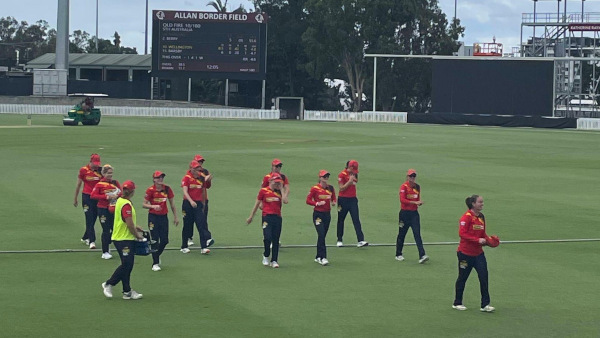
By the time Tasmania’s inning’s commenced, Karen Rolton Oval was bathed in warm afternoon sunshine. With the outfield drying out it seemed that boundaries would come easier – but that proved not to be the case. Openers Lizelle Lee and Rachel Trenaman, unhurried by the chasable total, kept the scoreboard ticking over – but boundaries were hard won in the very early stages.  By the seventh over, however, the outfield was nipping and both Trenaman and Lee had the measure of the new ball and SA’s opening bowlers Courtney Neale and Ella Wilson.

But never count SA out, especially with a bowling attack that includes Amanda-Jade Wellington, now ably assisted by Isabella Malgioglio. Between them the run rate was brought down, and in the 15th over Wellington affected a breakthrough with Lee succumbing for 60 off a great running catch by Penna, followed by Carey being bowled for a duck. Villani worked to support Trenaman as Adelaide life literally flew past (a helicopter swooping over the Oval on its way to the next door hospital). But the temptation to knock the runs off at a fast rate saw Villani go for a boundary in the air, but find opposing captain Jemma Barsby instead. A few overs later Kathryn Bryce was at the crease, and together with Trenaman weathered the tight mid-innings spin, keeping the score ticking along.  It was all they needed to do, and by the 36th over a cover drive by Trenaman found the boundary to both make the total and see her carry her bat for 75 not out.

So brought to a close a fascinating weekend of cricket. Tasmania had done their homework over the rest day, and came up with successful plans to combat the SA batting attack. They capitalised on the momentum of a first ball wicket to keep SA to 196, quite a feat on a famously batter-friendly Oval.

Helen (Crystallised Cricket) is a writer based in Dharug and Gundagarra country, and here is writing about a game played on Kaurna country. She acknowledges the traditional owners of the lands that she writes from.
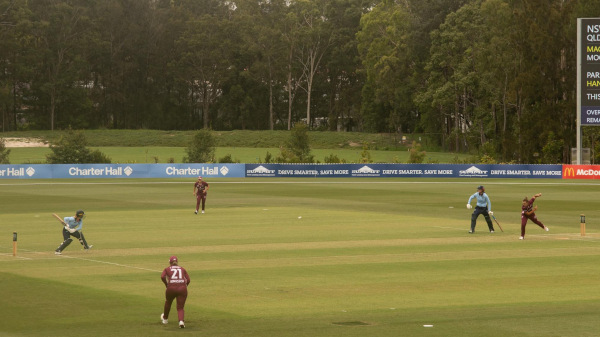
PLAYER RANKINGS: One Day Cup

Batting Rankings

Batting Rankings Matches Runs Dot % Single % Boundary % Strike Rate
1. EL Lamb 12 794 46 38 11 93
2. AN Davidson-Richards 13 595 35 49 11 105
3. KE Bryce 14 632 53 31 10 84
4. ME Bouchier 14 539 53 26 14 97
5. HJ Armitage 13 624 54 31 9 81
6. GA Elwiss 13 543 45 41 9 88
7. A Capsey 10 448 48 35 14 99
8. SW Bates 10 467 55 27 12 89
9. A Wellington 11 282 36 36 22 140
10. GL Adams 13 525 53 36 7 73
11. FG Kemp 6 298 38 39 17 127
12. E Jones 9 456 58 28 10 77
13. NAJ Wraith 13 339 39 40 9 99
14. G Scrivens 12 429 56 30 9 76
15. S Smale 15 391 45 41 7 83
16. BF Smith 12 357 59 23 14 89
17. D Perrin 11 364 57 24 10 85
18. R Southby 13 381 54 32 10 81
19. FC Wilson 13 333 45 39 9 90
20. SIR Dunkley 6 319 45 39 8 89
Ranking = Runs * Strike Rate ©CRICKETher/cricsheet.org

Bowling Rankings

Bowling Rankings Matches Wickets Dot % Boundary % Wide % Economy
1. KA Levick 13 21 54 6 2 4.55
2. GK Davis 13 23 52 8 2 5.03
3. LCN Smith 7 16 60 5 0 3.71
4. PE Turner 13 22 59 10 5 5.17
5. A Wellington 11 19 56 6 2 4.53
6. FR Davies 14 19 61 8 3 4.54
7. KE Bryce 13 18 55 7 2 4.50
8. G Ballinger 13 18 58 10 2 4.86
9. MK Villiers 13 16 55 8 3 4.73
10. KL Cross 15 15 61 9 2 4.49
11. G Potts 11 16 51 7 6 4.91
12. HE Jones 10 14 54 7 1 4.44
13. D Gregory 13 19 41 10 3 6.09
14. EL Arlott 7 14 60 9 3 4.63
15. E Gray 14 15 56 10 4 5.19
16. FMK Morris 11 15 40 6 2 5.43
17. C Skelton 12 15 49 10 2 5.55
18. E Anderson 12 16 59 13 7 5.93
19. GL Adams 14 14 47 7 2 5.20
20. R MacDonald-Gay 9 15 59 12 10 5.59
Ranking = Wickets / Economy ©CRICKETher/cricsheet.org
Maddie Penna celebrates her century on Karen Rolton Oval en route to her 109

WNCL: South Australia vs Tasmania – The ladies in red have a bright start to the season

by Helen Maynard-Casely

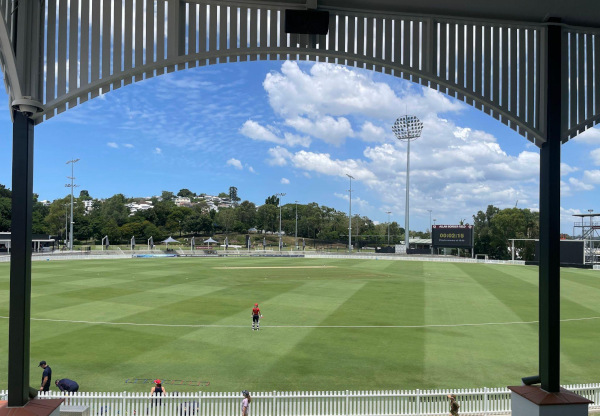
A stunning Wirltuti (Spring day) marked the start of the WNCL for South Australia and Tasmania. It was held at Karen Rolton Oval, which sits very much in the thick of Adelaide life – traffic bustling around the ground, commuters able to glimpse pitchside as they scurry about their lives in Australia’s cathedral city. Those who paused and took in the match were treated to batting masterclasses followed by a remarkable stint of fielding captaincy.

The teams could be forgiven for first-game nerves, but neither of them showed it – instead the trepidation was only shown by the ground’s scoreboard which took until the 19th over of the game to be tamed to show updates from the pitch. South Australia had won the toss, and elected to bat – preferring to start the season on their own terms it would seem. What followed was a perfect attritional innings – with the teamsheet batters building a skyscraper of a total for the SA women to defend.

South Australian openers Emma de Broughe and Bridget Patterson played it perfectly, with a new-ball soaking 50 run partnership – including a lofty six from B Pat in the 6th over. With both falling within a couple of overs, Courtney Webb and Madeline Penna found themselves together at the crease by the end of the 14th over. And there they dug in, in spectacular style – building a match-winning 197-run partnership which saw both players reach centuries, textbook middle order batting. Webb remained to the end of the innings, and saw SA put a total of 330 on the board.

Though Tasmania didn’t seem to show too many nerves, the players who took their honours in the field were those on debut for the team – Scotswoman Kathryn Bryce took three wickets for 60 runs. Queenslander-in-search-of-cooler-climate Courtney Sippel took most of the high-impact catches, as well as the bonus wicket of Eleanor Larosa late in the innings. In fact, Sippel was highly visible on the field, and was in amongst most of the big fielding moments. Bowling changes seemed a little haphazard, with Tasmanian captain Villani choosing to bowl Lauren Smith out with the finish of the innings, rather than turning to end-of-innings specialist Nicola Carey.

With 330 to defend, a relaxed South Australia took to the field after the innings break. Opening bowling from Courtney Neale and Ella Wilson squeezed the Tasmanian openers and had the run rate starting to climb. Tasmanian opener Lizelle Lee brought a level of restraint to her shots not often seen, suggesting the ball around the field rather than her more usual slog/insistence way of playing shots. Along with Rachel Trenaman, Lee built a good partnership weathering the aggressive spell of bowling, particularly from Neale. Here, though, was where the genius of Jemma Barsby’s captaincy became clear – preventing the batting side from finding stride to shoot for the total. Four of the seven wickets taken from Tasmania were straight after bowling changes, coupled with fielding set and bowling executed in a way that prevented the batters from getting into the rhythm they needed. This was exemplified in the 18th over, which saw Barsby both bowling and commanding the fielders with the authority that only bowling captains show.

Then the openers were gone. Trenaman skied a ball which was caught by Busby off debutant Isa Malgioglio’s bowling and Lee was caught by Penna off the bowling of stalwart Amanda-Jade Wellington. Nicola Carey and Ellyse Villani were now in batting for Tasmania and fought valiantly to keep the required run rate under control. At times it seemed like they were grappling with a slippery fish, it writhed and wriggled, but by over 29 it looked like they might be starting to wrestle it under control. Then Carey got a metaphorical fin-slap – she tonked a ball towards mid-on, only to see bowler Barsby snatch it from the air, leaving Carey to depart the crease for 24.

From there the maths started to hurt, and the required run rate steadily climbed, while wickets ticked over. A seventh wicket stand from Hayley Silver-Holmes and Sippel was entertaining at the back of the innings, but ultimately Tasmania reached 294/7, 36 runs short.

A win on the table for South Australia, and on Sunday they return to face Tasmania again. Conditions for Sunday’s game are starkly different – cloudy with a slight chance of rain. Will this aid the Tasmanian spinners, perhaps preventing SA from getting the two-fer at their home ground? Or will SA brazen it out – Sunday’s match awaits.

Helen (Crystallised Cricket) is a writer based in Dharug and Gundagarra country, and here is writing about a game played on Kaurna country. She acknowledges the traditional owners of the lands that she writes from.