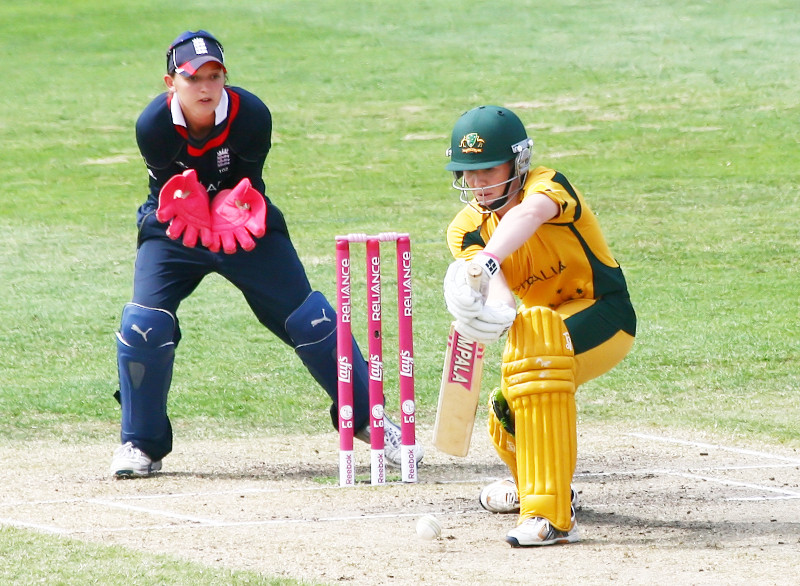
WOMEN’S ASHES: TEST DAY THREE – And Then The Rain…

With the final two sessions of day 3 entirely lost to the rain, and similar weather forecast for tomorrow, a draw now looks like the most likely outcome of the Women’s Ashes Test in Canberra.

The play that we did get mostly went England’s way, as Heather Knight overhauled her previous Test best score of 157 to finish on 168*. Over 60% of England’s runs off the bat came off Knight’s eponymous SM “HK” – surely one of the great individual performances in the history of women’s Tests.

There was much talk on comms of whether England would declare behind, but in my view they did the right thing of pursuing what you might call a “de-facto declaration” strategy – playing much more freely in order to close the gap on the Australian total before the inevitable final two wickets fell. This meant they didn’t take too much time out of the match, but also got much closer to the Australians than it looked like they were destined to when they took tea yesterday at 120-6. In the end the deficit was just 40 runs; and a tricky twenty minutes at the crease for Australia before lunch.

The stage was set for Katherine Brunt, and she strutted on to it as only she can – taking two quick wickets: Rachael Haynes caught by Tammy Beaumont fielding up-close off bat/pad; and Alyssa Healy caught behind by Amy Jones. It was the nightmare scenario for Australia, and gave England a real chink of light – perhaps Brunt had been right when she told the media yesterday that England could still win this?

And then the rain…

WOMEN’S ASHES: TEST DAY TWO – Dark Knight of the Soul

A towering undefeated 127 from Heather Knight was enough… just… to keep England in the game at Manuka Oval; but an Australian victory now feels like the most likely outcome to this Test.

The day began with Katherine Brunt completing her 3rd Test 5fer thanks to a remarkable 6th catch behind the stumps for Amy Jones – both have been brilliant for England; and Jones’ “6fer” is the joint most catches ever taken in a Test innings.

Australia had promised to push on towards 400, but instead unexpectedly declared on 337 after losing their 9th wicket. Mind games? From Meg Lanning? Matthew Mott later denied it, saying they’d changed their minds to take advantage of favourable bowling conditions in the morning; but who’s to say that wasn’t more mind games? (Mott’s entire pitch-side interview during the afternoon session was a master-class in saying absolutely nothing. Would you use the follow-on Motty? Well… it’s an interesting question… we might… or we might not! Seriously: the man should consider going into politics when he’s done with cricket!)

England walked out to bat knowing the ball had been doing all-sorts – swinging in for Anya Shrubsole and moving away off the pitch for Brunt – and the Australians soon had it singing too. There was a lot of nearly-playing and nearly-missing early on, and it felt like wickets were coming. Ever the optimist, I attempted the old “reverse jinx”, snarkily texting a friend: “I think England will be one or two down at the close… in their second innings, having followed on!”

Unfortunately, I wasn’t a million miles away – England settled into something of a routine of losing a batter roughly every 10 overs, with only Heather Knight holding them together. Knight scored 58% of England’s runs off the bat on her way to her second Test century – soul-food for starving England supporters.

But with conditions continuing to assist the Australians, the other full-time batters struggled to keep their heads above water, and it wasn’t until Charlie Dean came in that the tail started to… well… not “wag” exactly, but at least not “roll over and die”.

I’ve often worried that the English “CAG” (County Age Group) system teaches girls to value their wickets too much over actually scoring runs, which is a problem when you are mainly looking to develop white-ball batters; but at the point Dean – a player who has really only just emerged from the CAG system – came in, that was exactly what England needed. Dean blocked and blocked, allowing Knight to continue to make progress at the other end, and it was only when she lost her concentration and started to try to score runs, that she found herself walking back to the dugout. (Her CAG coach would have been furious at the limp slog-sweep she got herself out to!)

Nonetheless, Dean had showed the way, and with more support from Shrubsole and then Ecclestone, Knight took England past the follow-on target. It wasn’t a victory obviously, but much like the boy’s draw in the men’s series at the SCG at few weeks ago, it somehow felt like one; and certainly the Australian’s will have been frustrated not to finish England off before the close.

England still officially believe they can get a result from this match, with Katherine Brunt saying at the close: “I think you can win from anywhere” and promising that England would “fight like hell” for the victory. But they still trail by 102, and Australia are now in pole position to wrap up England’s first innings early tomorrow morning and then bat them out of the game. Then, as long as the weather holds (which is looking 50/50) they’ll still likely have time to bowl England out again and retain the Ashes before the ODI series even starts.

NEWS: Women’s Hundred Truncated To Accommodate Commonwealth Games

The 2022 Women’s Hundred competition will be truncated to just 6 games per side in the group stages, in order to accommodate the Commonwealth Games, which runs from 28th July to 8th August in Birmingham.

The men will play two rounds of “stand-alone” fixtures prior to the women’s competition starting on Thursday 11th August, with the rest of the competition running as double-headers, following the success of this model in 2021. This means that rather than the women’s group stages being a true “round robin”, every team will effectively skip one opponent.

As with last year, the group stages will be followed by an “Eliminator” between the second and third placed sides (played at the Ageas Bowl on Friday 2nd September), with the winner meeting the top-placed team in the final at Lord’s on Saturday 3rd September.

Although this outcome is disappointing from a sporting perspective, the ECB faced an unenviable dilemma given the timing of the Commonwealth Games, in which almost all of the top England and overseas stars are likely to be involved. There were only bad options, such as starting the competition without the big-name players, or ditching the link-up with the men’s comp completely, so on reflection this was probably the least bad choice.

CRICKETher understands that the plan is to return to a full program of 8 group fixtures (the 7 “round robin” fixtures, plus the additional “derby” match between the local rivals) in 2023.

WOMEN’S ASHES: TEST DAY ONE – Australia Take Command

This might be controversial, but I’ll call it as I see it: already, at the end of Day One, England are in a position where it will be almost impossible for them to win this Test.

At the toss, we finally got a glimpse of Heather Knight and Lisa Keightley’s Masterplan: bowl first, chuck in your most experienced quick bowlers (Katherine Brunt, Anya Shrubsole and Kate Cross), and hope for the best. With Brunt and, in particular, Shrubsole moving it around up top, it looked like it might just have been a genius move: Australia were 4 for 2 before I’d had time to boil the kettle.

When Ellyse Perry miscued a Nat Sciver bouncer to Amy Jones, who took an excellent running, diving catch (to add to her two smart grabs behind the stumps to see off Alyssa Healy and Beth Mooney), England were ecstatic.

But their celebrations proved to be premature, especially in the face of Australia’s insanely long batting line-up. Slowly, that early momentum slipped through England’s fingers – literally slipped through them, in the case of Knight and Sciver, who between them cost England 121 runs after they put down Meg Lanning and Rachael Haynes at first and second slip respectively. Australia finished the day on 327 for 7. As Syd pointed out on Twitter, no one has ever won a women’s Test where the other team have scored over 300 on first innings.

So was England’s strategy the wrong one? Selection-wise, it’s hard to know if Lauren Bell would have outbowled Brunt, Shrubsole or Cross – although I would have liked to have seen her given the chance. But I am a bit baffled by the decision to bowl first.

This isn’t just about “the benefit of hindsight”. I’ve long argued that it’s extremely difficult to win a four-day women’s Test if you don’t bat first, and today’s events are merely a case in point. After two sessions, during which Australia scored 199 runs and lost just 3 wickets, England’s window of opportunity to control the game had all-but-closed. If they’d opted to bat, that window would (bar a horrendous collapse) have lasted a lot longer – they could have forced the pace when they chose; dug in if they’d lost a few quick wickets; and assuming they’d batted out the day, it would have been in their hands whether they came back out to bat again tomorrow.

Instead, all those decisions – including whether England’s tired bowlers have to come back out and do it all again on Day Two – are now in Lanning’s hands.

The decision to bowl first is even odder given that all the “noise” coming out of the England camp before the Test was about how challenging it is to take wickets in women’s Tests – variously blamed on pitches that are too long, batter-friendly wickets, and / or the inability to use a Dukes ball.

And so we face the first test of Australia’s own “going for the win” approach: how long will they keep batting? The truly aggressive move would, frankly, have been to have declared half an hour before the close once they’d reached 300, and given England a horrible period to negotiate. But given that they didn’t do that, they surely now have to declare overnight? 327 runs is already a VERY formidable first-innings total in the context of women’s Test cricket, and with the forecast as it is, declaring now is the only way to guarantee that they will have the time to take 20 English wickets. Plus, the pressure will all be on England, who have a big runs-deficit to overhaul before they can even think about doing anything else. (See what I mean about no longer dictating the game?)

Australia have talked a good talk over the last three Tests they’ve played about wanting to avoid yet another draw. Now’s the time for them to walk the walk as well… the question is, will they?

ANALYSIS: England Take Note – Wickets Do Matter in T20 Cricket

In the first Women’s Ashes T20 this week in Adelaide, England were sent in and put 169 on the board – a big total on a ground with long boundaries square of the wicket, and one which Tammy Beaumont said afterwards she’d have “bitten your hand off” for going into the game.

But it wasn’t a winning total – Australia cruised to victory with a massive 18 balls to spare, for the loss of just 1 wicket, with Meg Lanning finishing 64 not out off 44 balls, and Tahlia McGrath 91 not out off 49.

It’s often said that wickets don’t matter in short-form cricket, and there is an element of truth in that – a bowler that takes a couple of wickets but concedes an absolute hatful of runs is probably on balance doing more harm than good. But for England, it is the mantra that seems to now exclusively govern their bowling selections – you can’t pick Kirstie Gordon or Lauren Bell because ‘they’ll be expensive’. (And to be fair, it isn’t just England – Australia made similar arguments picking Alana King over Amanda-Jade Wellington.)

But the problem is that this is focussing too much on individual bowlers and not enough on the team, because overall wickets do actually matter… and the numbers prove it, especially when you are defending a total, however big.

Looking at data from a sample of over 100 T20s* between the ‘Top 5’ teams (Australia, England, India, New Zealand, and South Africa) there is a clear trend to the graph**.

Long story short: it is virtually impossible to win a T20 international defending a total unless you can take at least 5 wickets, and you need 7 wickets before the odds really tip in your favour. Taking just 1 wicket, as England did in that 1st T20, is never, ever, ever going to win you the game.

This is why England need to be picking a couple of proven attacking bowlers – the likes of Kirstie Gordon and Lauren Bell, who might be a tad more expensive, but will actually take wickets. This doesn’t mean they need to pick every bowler on this basis – all-out attack is just as bad as all-out defence (just ask the Light Brigade!) but there’s a balance, and England don’t have it right now.

———-

* The matches for which ball-by-ball data is available from https://cricsheet.org

** Graph smoothed to show the trend, rather than the exact percentages

NEWS: Lord’s Final for Rachael Heyhoe Flint Trophy & Double Headers in Charlotte Edwards Cup

The 2022 domestic regional season is set to end on a high note, with the Rachael Heyhoe Flint Trophy Final being played at the Home of Cricket – Lord’s – on Sunday 25th September.

Additionally, the Charlotte Edwards Cup will include a number of Double-Header matches with the men’s Vitality Blast, clustered around the double-Bank Holiday weekend and half-term week at the end of May. At least one of these CE Cup matches will be televised, and one (possibly the same one) will also be an evening fixture under lights.

Alan Fordham, Head of Cricket Operations at the ECB, said:

“The rationale for having double-headers are twofold: one to make an event, a number of them are at the beginning of June which is half-term week when we’ve got the double Bank Holiday, so an opportunity to attract some support when spectators might be more able to attend. And it’s also an efficient way to be staging matches, because we want them staged if we can at our most prestigious venues… putting the women’s game on an equal platform.”

Presumably the success of The Hundred, which achieved record-breaking crowds last summer, was also a factor.

The format of the RHF Trophy is unchanged for 2022, with a round-robin group stage where everyone plays everyone else, with the table leader going straight through to the Lord’s final, to be joined by the winner of a play-off between the second and third-placed sides.

The season will begin with the T20 Charlotte Edwards Cup, with also essentially the same format as last year – two groups, with a 3-team Finals Day at the County Ground, Northampton on Saturday 11th June.

The group names are “TBC” but the groups themselves are: Vipers, Thunder, Lightning, and Diamonds in one group; and Sparks, Storm, Sunrisers, and Stars in the other.

Following the CE Cup, the regional teams will embark on their RHF campaigns from 2nd July. Although the schedule for The Hundred has not officially been announced, the RHF will take a break between 24th July and 9th September. With the Commonwealth Games taking place from 28th July to 8th August, we can assume that The Hundred will then take place during the 4-week window after that, with the final likely on the weekend of 3rd/4th September.

There is no confirmation yet of the dates of the England fixtures (aside from the Commonwealth Games), so the extent to which the England players will be involved in regional cricket is still unknown. For the RHF, much will depend on whether the ECB intend to schedule a series in September as they did in 2021, or whether they will feel that is one bridge too far in what is going to be another exhausting season.

WOMEN’S ASHES: 1st T20 – England Eaten By Big Mac

Four short months ago, Tahlia McGrath was yet to play a T20 international, though she’d won a handful of ODI caps, plus one Test cap, mostly during in the 2017 Ashes. No one disputed that she was a very good domestic player, but aged almost 26 it looked a good probability that she’d nonetheless end her career without troubling the international honours boards too much.

Her T20 debut against India, on October 7th 2021, was ended prematurely by rain without McGrath (or any other Australian) having the opportunity to bat; but in the final two games against India she scored 42* and 44*, snagging two Player of the Match awards, plus Player of the T20 Series.

If there were any remaining questions over whether she belonged at this level, they were comprehensively answered today against England.

After playing a crucial role with the ball, taking the wickets of Danni Wyatt and Nat Sciver in the 17th over, when both were in full flow and England were threatening 180, she then topped that with the bat, scoring 91* off just 49 balls to win her third straight Player of the Match gong. She has now scored 177 runs in 3 T20 innings without being dismissed – it will happen one day, but that day wasn’t going to be today, and she still hasn’t got a T20 average!

England looked to have made a decent enough total, after Tammy Beaumont and Danni Wyatt were given the chance to shake off some of their winter rust, hitting their straps by the end of the powerplay, and taking England to 82-0 at the halfway mark. Wyatt went on to make a 54-ball 70, but England stuttered slightly with the dismissals of Wyatt and Sciver. It was a situation made for someone like Alice Capsey to come in and start striking from the get-go; but instead England faltered, and despite hitting 14 off the final over, were probably 10 short of par in retrospect.

Not that it would have made any difference – with McGrath in the form of her life, and Meg Lanning looking back to her ominous best, Australia simply cruised to their highest ever successful chase. Par? Pah!

Would it have been a different story if Amy Jones had held on to a relatively straightforward chance to dismiss Lanning early on off Sarah Glenn? We’ll never know, and Australia still had a lot of batting to come, but those are the chances England need to take if they are going to have any chance of winning the toughest prize in cricket – Nat Sciver’s brilliant catch to dismiss Healy (and it was a much more difficult take than it looked, with the ball on a trajectory so close to the ground) was what England need to do more of if they are going to come back into this series.

Dave Tickner joked on Twitter: “At least the men never tricked us into thinking they might be competitive.” I’m not sure it is quite that bad… yet! But England can’t afford to fall too much further behind – Saturday’s 2nd T20 already feels like a “must win”. Top Tip for England: Make it the day Tahlia McGrath finally gets a T20 average!

NEWS: Amanda-Jade Wellington Set To Be Omitted From Australia’s Ashes Squad

In a bizarre move, Cricket Australia are set to announce a squad for the forthcoming Women’s Ashes series which does not include Amanda-Jade Wellington, despite the leg-spinner finishing as the leading wicket-taker in the 2021/22 WBBL.

According to reports in Sydney’s Daily Telegraph, Wellington has been edged out by Alana King, who has received her premier call-up to the national side. She will be included in the Australia A side which will be in action against the England A side during the main Ashes series, but there is unlikely to be a chance of “promotion” to the main side as the two squads are being kept separate for Covid biosecurity purposes.

Wellington last played for Australia in 2018 and since then has been consistently and inexplicably snubbed by the Australian selectors, despite consistently being a top performer in domestic and franchise cricket. She was the top-ranked bowler in our Women’s Hundred rankings and a key factor in Southern Brave’s progression to the final.

Other notable inclusions in the squad, which will be announced officially tomorrow, are Adelaide Strikers captain Tahlia McGrath, who enjoyed success in Australia’s recent series against India, and teenage pacer Darcie Brown.

The squad looks set to be as follows:

  • Meg Lanning (c)
  • Rachael Haynes
  • Darcie Brown
  • Nicola Carey
  • Alyssa Healy
  • Ashleigh Gardner
  • Jess Jonassen
  • Alana King
  • Tahlia McGrath
  • Beth Mooney
  • Ellyse Perry
  • Megan Schutt
  • Molly Strano Hannah Darlington*
  • Annabel Sutherland
  • Tayla Vlaeminck

[Amended 12 Jan 2022.]

NEWS: Heather Knight Promises “Bold” Approach As England & England ‘A’ Squads Named For Australia

England have announced two squads, totalling 29 players, who will travel to Australia in January, with the main team contesting the multi-format Women’s Ashes series, and an ‘A’ team set to play 3 T20 and 3 One Day matches against Australia ‘A’.

There are no surprises in the main squad, which is just the contracted players, plus last summer’s two debutantes – Maia Bouchier and Charlie Dean – minus the injured Katie George and Georgia Elwiss, who is relegated to the ‘A’ squad.

However while the personnel might be largely familiar, Heather Knight has indicated that the approach to the Ashes series will not be, with a promise that the team would be “bold” – a word she used 5 times during her press conference – as they take on the Aussies for the first time since their 12-4 humiliation at home in 2019.

“We’re going to have to play very well,” Knight said. “We’re going to have to play out of our skin. We’re going to have to be bold, and we’re going to have to stand up to the Australians.”

“We’ve got to meet fire with fire – we’ve got to make sure we’re trying to punch first and be aggressive towards them.”

With regards to the ‘A’ squad, England have chosen to mostly play it very safe. The squad has an average age of 24, and includes only two teenagers – Alice Capsey and Issy Wong. It means they are more likely to win what are certain to be very competitive matches; but it also means no spot for Grace Scrivens for example, who (Capsey aside) is the most talented of the up-coming generation, and would arguably have really benefitted from the experience.

With just 12 players named in the ‘A’ squad, it also seems highly likely that the ‘A’ team will be bolstered by players from the main squad left out of the concurrent Ashes games. So for instance, with the ‘A’ T20s scheduled at the same time as the Ashes Test, there’s a chance that England could play Danni Wyatt in the ‘A’ T20s, in preparation for the Ashes T20s which are scheduled for the week after.

But according to Knight there will also be the opportunity for players to go the other way, and step up to the main squad if they play really well.

“If those ‘A’ girls have a really good series and impress in those Australia a games, they’ve got the chance to make it into the full squad.”

However, Knight did (again!) admonish the media for getting over-excited about Alice Capsey, saying:

“She’s definitely one for the future; but I do think we need to be careful not to over-egg our players. Her time will come I’m sure, whether that’s at some point in the Ashes, in the World Cup, or down the line in a few years.”

England

Heather Knight (Western Storm, captain)
Tammy Beaumont (Lightning)
Maia Bouchier (Southern Vipers)
Katherine Brunt (Northern Diamonds)
Kate Cross (Thunder)
Freya Davies (South East Stars)
Charlie Dean (Southern Vipers)
Sophia Dunkley (South East Stars)
Sophie Ecclestone (Thunder)
Tash Farrant (South East Stars)
Sarah Glenn (Central Sparks)
Amy Jones (Central Sparks)
Nat Sciver (Northern Diamonds, vice-captain)
Anya Shrubsole (Western Storm)
Mady Villiers (Sunrisers)
Lauren Winfield-Hill (Northern Diamonds)
Danni Wyatt (Southern Vipers)

England ‘A’

Emily Arlott (Central Sparks)
Lauren Bell (Southern Vipers)
Alice Capsey (South East Stars)
Alice Davidson-Richards (South East Stars)
Georgia Elwiss (Southern Vipers)
Kirstie Gordon (Lightning)
Eve Jones (Central Sparks)
Beth Langston (Northern Diamonds)
Emma Lamb (Thunder)
Bryony Smith (South East Stars)
Ellie Threlkeld (Thunder)
Issy Wong (Central Sparks)