Australia v New Zealand: Bowling Rankings – Teenage Kicks for Wellington & Kerr

Our bowling rankings, covering the T20 and ODI Rosebowl series between Australia and New Zealand, see a number of unexpected new faces in the leading positions: of the top 4, only New Zealand’s Holly Huddleston has played more than 10 internationals, and the “Hudd Missile” herself has played less than 30 – a number she now looks nailed-on to add to at the World Cup in England in the summer.

After an underwhelming WBBL with wooden-spooners the Adelaide Strikers, 19-year-old Amanda Wellington has come roaring back to the top of her game with 15 wickets, including a best of 4-16 to restrict New Zealand to just 113 in the 3rd T20 – a match-winning platform which the Southern Stars batsmen then proceeded to throw away in spectacular fashion, as they were bowled out for just 66.

New Zealand’s own new teenage sensation – sixteen-year-old Amelia Kerr – also took her best figures in a losing cause – 4-54 in the 2nd ODI. They weren’t just any wickets either, but included a set Meg Lanning and Beth Mooney (on 44 and 57, respectively) and Elyse Villani for a golden duck. Kerr also finished the series with the best economy rate of any of the leading bowlers – just 4.5.

Having made her Southern Stars debut in this series, Molly Strano played just the 3 T20s and already has an international fifer to her name – 5-10 in the 2nd T20. But guess what? That was also in a lost match, as Australia fell short chasing a Duckworth-Lewis adjusted target of 70 off 13 overs, limping to 61-9.

Player Matches Wickets Economy
1. Amanda Wellington (AUS) 6 15 5.1
2. Holly Huddleston (NZ) 6 11 4.7
3. Amelia Kerr (NZ) 4 6 4.5
4. Molly Strano (AUS) 3 7 5.3
5. Lea Tahuhu (NZ) 6 7 5.3
6. Anna Peterson (NZ) 6 6 4.8
7. Jess Jonassen (AUS) 6 5 4.9
8. Ashleigh Gardner (AUS) 5 4 5.3
9. Kristen Beams (AUS) 4 4 5.4
10. Suzie Bates (NZ) 6 4 5.5

Ranking = Wickets / Economy

NEWS: World Cup Schedule Released – All The England Games

The ICC and ECB have this morning announced England’s schedule for the up-coming World Cup this summer, with the home side playing at all 4 “host” grounds – Derby, Leicester, Taunton and Bristol – during the round-robin stages; followed by a semi-final at either Bristol or Derby, and (if they get there, of course) the final at Lords on July 23rd.

England begin by hosting the subcontinental trio – India, Pakistan and Sri Lanka. You’d think they’d have to be looking to win all 3 of those games to put themselves in a strong position for the tougher tests to come, when a slip-up somewhere along the line is probably inevitable. England certainly won’t want to be going into the last couple of games, versus New Zealand and the West Indies, with semi-final qualification in doubt, though that will possibly depend very-much on how evenly all those other results fall.

With everyone playing everyone else in the group stages, it is going to be a huge tournament – 31 matches in just 30 days – so whoever eventually lifts that trophy at Lords will truly have earned the title of “World Champions”.

England’s Schedule Match Venue
Saturday 24 June v India Derby
Tuesday 27 June v Pakistan Leicester
Sunday 02 July v Sri Lanka Taunton
Wednesday 05 July v South Africa Bristol
Sunday 09 July v Australia Bristol
Wednesday 12 July v New Zealand Derby
Saturday 15 July v West Indies Bristol
Tuesday 18 July Semi Final 1 Bristol
Thursday 20 July Semi Final 2 Derby
Sunday 23 July Final Lord’s

Australia v New Zealand: Batting Rankings – Meg Lanning In Not Top Shock!

She might be the best player in the world right now… she might have more ODI centuries than any other woman ever, after she passed Charlotte Edwards record 9 during this series… but for once Meg Lanning isn’t at the top of our batting rankings, covering the T20 and ODI Rosebowl series between Australia and New Zealand.

Instead, it is Amy Satterthwaite who rules the roost with the blade – she has been in spectacular international nick over the past few months, and after dominating New Zealand’s series with South Africa last October, she continued her rich vein of form here, including a match-winning century in the 1st ODI.

For the Australians, Beth Mooney had a break-out series, almost certainly confirming her ticket to England in the summer; but Elyse Villani was actually arguably even more important, with a big Strike Rate of 118, coming in a bit further down the order at 4 or 5, having usually opened in her international career to date; and it clearly worked, so you’d think this is probably where we are likely to see her batting during the World Cup.

Player Matches Runs Strike Rate
1. Amy Satterthwaite (NZ) 6 269 86
2. Meg Lanning (AUS) 6 237 91
3. Elyse Villani (AUS) 6 179 118
4. Beth Mooney (AUS) 6 232 83
5. Suzie Bates (NZ) 6 204 82
6. Katey Martin (NZ) 6 171 86
7. Alex Blackwell (AUS) 5 149 86
8. Rachel Priest (NZ) 6 146 74
9. Katie Perkins (NZ) 5 108 99
10. Alyssa Healy (AUS) 6 77 99

Ranking = Runs * Strike Rate

NEWS: 2017/18 Women’s Ashes Schedule Announced Including First Ever Day-Night Test

The ECB and Cricket Australia have today announced that the forthcoming women’s Ashes series will begin on 22 October 2017 at Brisbane, and will include the first ever day-night women’s Test match, to take place at the North Sydney Oval.

The format is identical to the 2015 series in England, beginning with 3 ODIs (worth 2 points apiece), followed by the Test (worth 4 points) and concluding with 3 T20s (also worth 2 points apiece).

Unlike on previous occasions, the decision has been taken to stage the entire series prior to the men’s Ashes, which begins on 23 November. This will make the North Sydney Oval Test the first ever day-night Ashes Test in either men’s or women’s cricket, as it will fall prior to the men’s Adelaide Oval encounter in December.

The series will take place across 4 venues: the Allan Border Field, Brisbane; the Coffs Harbour International Stadium; the North Sydney Oval; and the Manuka Oval, Canberra. These have – according to Cricket Australia Chief Executive Officer James Sutherland – been selected as the “result of a strategic decision to give this series the opportunity to gain as much exposure as possible”.

The full schedule is below.

ODIs:

First ODI – AB Field, Brisbane – 22 October 2017

Second ODI – Coffs Harbour International Stadium – 26 October 2017

Third ODI – Coffs Harbour International Stadium – 29 October 2017

Test:

Test match (Day-Night) – North Sydney Oval – 9-12 November 2017

T20s:

First T20 – North Sydney Oval – 17 November 2017

Second T20 – Manuka Oval, Canberra – 19 November 2017

Third T20 – Manuka Oval – 21 November 2017

NEWS: Millions Watch World Cup Qualifier Live Streams

The ICC have announced remarkable viewing numbers for the live streams from the Women’s World Cup Qualifying tournament, held recently in Sri Lanka. A total of 1.75 million people watched the live streams, whilst the highlights packages attracted an amazing 18 million viewers – and all for a tournament which didn’t even feature the top 4 teams!

Tournament Director Holly Colvin, the ex-England spinner who now works for the ICC, said:

“It’s great to know that so many people took interest in the competition and watched the live-stream and highlights.”

“I’m extremely excited for the Women’s World Cup which will take the game to the next level and set the stage to attract even more fans to the global game.”

Sadly one thing we do know is that the World Cup itself will not attract these kinds of numbers – certainly not in England anyway, where it will be hidden away behind Sky’s paywall, where new fans will simply be unable to stumble across it.

Nevertheless it is certainly still great news. After the success of the WBBL live-streams, “online” really does appear to be the way to go for the future of women’s cricket; and with numbers like these, it might even be possible to fund such coverage through advertising and sponsorship, so the old “we don’t have the budget” excuses won’t apply. And if this is the future… we can’t wait!!

CLUB OF THE MONTH: Appleton Tigers

Here at CRICKETher, we’re passionate about women’s cricket at all levels, including club cricket. It’s our mission to offer coverage of women’s (and girls’) club cricket wherever we can! Our ‘Club of the Month’ feature will focus on one women’s or girls’ club every month, giving you the lowdown on their highs, lows, and everything in between.

If you’d like to see your club featured here, get in touch – we’d love to hear from you!

The Appleton Tigers are part of Appleton CC, who play their home games at their Lyons Lane ground in the village of Appleton, in the south of Warrington, Cheshire. Appleton have promoted women’s cricket ever since 1996, when – as part of the Lottery Sports Fund application to purchase the ground – the club’s development strategy included increased participation and opportunities for girls to play cricket. By 1999 there were enough players for Colin Smethurst to start a junior girls’ team.

Over the next four years the number of players and the standard of cricket continued to rise and the team played friendlies against Appleton boys, private schools and other local clubs who were trying to start girls’ sections. By 2002, four of the team were playing league cricket for Brooklands and Birkenhead Park, alongside their friendly matches with Appleton CC. Colin decided that the time was right to give the squad a new challenge by joining the Cheshire Women’s Cricket League in 2003.

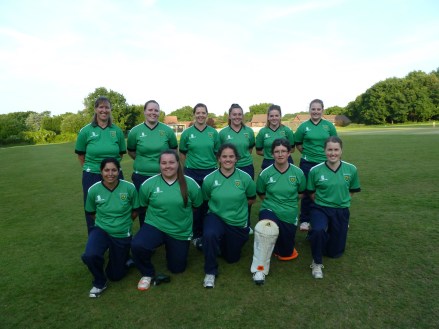
Coloured kit 2016.JPG

Sue Barlow subsequently took over managing the team and worked tirelessly for over ten years to make Appleton into one of the most successful and best integrated women’s sections in the county. Sue is also the oldest player to have represented the club, aged 67 at her most recent appearance in which she scored a career best 11 runs. Several players have made their women’s debuts at the age of 12, including Natalie Lyons, Jen Regan and current rising star Georgia Heath. They are currently coached by Jess Lewis, who is also the Women and Girls Development Coaching Officer at the Cheshire Cricket Board.

Appleton play in Division 1 of the Cheshire Women’s Cricket League and have won it 4 times in the past 7 years. After joining the league as a very young team in 2003, Appleton developed into a force to be reckoned with, winning their first trophy in the form of the T20 Plate in 2008. The 2010 season was the best in Appleton’s history as they won Division 1 for the first time as part of a league and cup treble. Their achievements was recognised when the Tigers picked up the Warrington Guardian Sports Personality Team of the Year award and Sue Barlow was honoured as Unsung Hero of 2010.

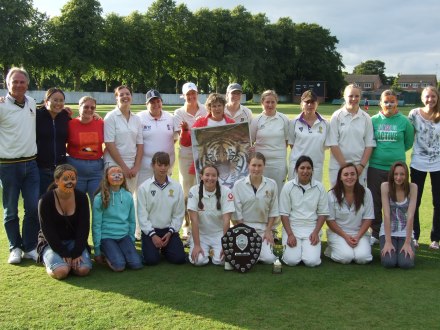
cup-final-win-2010

2010 Cup Final win

Girls as young as seven years old enjoy training at Appleton, who compete at under 11, under 13 and under 15 age groups in both the Cheshire Junior Girls League and as part of mixed teams in the North Cheshire Junior Cricket League Cheshire County Cricket League. The thriving girls’ section has been a key factor in Appleton’s success by providing a series of key players to the senior side.

The club’s success has been built on the backing they have received from those on the club committee at Appleton CC, especially Al Rogers, Ant Hurst and Dave Hurst. When the girls’ team started they had a small pavilion with very basic facilities, until in 2006 the club built a modern new pavilion with the help of member loans and grants. Since the arrival of the Cheshire T20 Cup competitions in 2008, the team have gone by the name Appleton Tigers and been roared to success by an array of soft toy tigers and face painted supporters.

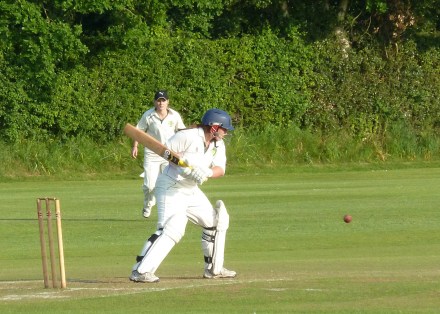
Jess Lewis batting 2016.JPG

For more information about the club you can contact current captain Nathalie Long by email at appletoncricket@gmail.com or check out the club website, www.appletoncc.org.uk. They describe themselves as “a friendly club welcoming anyone who wants to give cricket a go, from total beginners through to county standard players.”

Coverage Of World Cup Qualifiers Encouraging For Women’s Game

As I write this, I’m watching the live stream of the final of the Women’s World Cup Qualifiers – India against South Africa – via the ICC’s website.

Not being able to be in Colombo myself, the ability to watch the action online is the next best thing – and the coverage has been both high-quality and multi-camera.

Of course not all the games have been shown, but with multiple matches taking place simultaneously, it would have been difficult to offer complete coverage. Importantly, too, the ICC have offered up daily highlights from the tournament.

I’m certainly not averse to giving the ICC some stick when they get things wrong. But it follows that, when they do a good job, we should give them some credit – and ultimately they’ve done a pretty good job with this tournament.

It’s also been encouraging to see such good coverage on Wisden India. Particularly in the early stages, the dedication of Sidhanta Patnaik and Karunya Keshav to offering up some really interesting stories has been fully apparent. I’ve certainly learned a lot from them about some of the lesser-seen teams.

Let’s hope that, when the World Cup itself begins on 24 June, we see a similar commitment to ensuring it receives the coverage it deserves.

NEWS: Women’s World Cup Qualifying Teams Confirmed

The final round of matches in the Women’s World Cup Qualifiers in Colombo has concluded, with the top four teams confirmed as India, South Africa, Pakistan and Sri Lanka.

These sides will join England, Australia, New Zealand and West Indies to compete for the World Cup trophy this summer.

Team Played Won Points
India 5 5 10
South Africa 5 4 8
Sri Lanka 5 3 6
Pakistan 5 2 4
Bangladesh 5 1 2
Ireland 5 0 0

The tournament results also confirm that the same eight sides who competed in the inaugural Women’s International Championship will go on to fight out the second version of the Championship over the coming four years.

Overall, it’s been a disappointing experience for the other two sides with ODI status, Ireland and Bangladesh, who might both have realistically hoped to break through into the top eight. Ireland failed to win a game in the Super Sixes; while Bangladesh managed just one win, against Ireland.

The tournament concludes on Tuesday with a final between India and South Africa, to decide who takes home the Qualifying trophy.

INTERVIEW: Scotland’s Kathryn White Retires From International Cricket

Jake Perry reflects on the end of an era for Scotland.

As Scotland’s Women arrive home from Sri Lanka and begin to plan for the 2017 season they do so in the knowledge that they will be without the services of their two most experienced campaigners. The retirements of Kathryn White and Kari Carswell (nee Anderson) either side of the ICC Global Qualifier will be keenly felt both on and off the field as an era ends in Scottish cricket.

With a collection of caps second only to Carswell, White has been one of the most consistent performers for her country for the best part of two decades. In 132 appearances she scored 2165 runs at 20.62, with five fifties and a best of 99, and claimed 126 wickets at 22.02. It has been a career full of highlights and the decision to bring it to an end did not come easily.

“It was very difficult,” she said. “But I suppose I got to that point where I realised that having not been selected for Sri Lanka the time was right to make the call.

“I’m thirty-eight now, I have a four year old at home and I work full time, so I was trying to get that balance of full time job, family as well as putting in all my training and it reached that point where something had to give.

“It was hard. Cricket has been a huge part of my life for so long.”

Since her debut in 2000 White has watched the funding and profile of the women’s game change almost beyond recognition. The all-rounder has been part of the Scotland team from its very earliest days and she looks back over the evolution of the side with pride and considerable satisfaction.

“Both myself and Kari know where we started all those years ago, we know how few games we played and how few women were playing at the time,” she said.

“To see where we have got to now, to see the team and the set-up we have, the Under 17s coming up behind us, the regional squads and so on, and then watch us perform on the international scene as we have over recent years is very satisfying.

“In Scotland there is much more professionalism now. The support we get from Cricket Scotland has totally changed over the last five or six years in terms of the facilities that we use, how often we get to meet together and so on. We’ve now got our strength and conditioning coaches, we get help with travel allowances… It’s the things like that that make a huge difference.”

And although sad to no longer to be a part of it, White is excited at the prospect of how the team might continue to develop.

“I think we’re in a really strong position,” she said. “Yes, with 284 caps between us it is a loss losing myself and Kari so close together but there are plenty of girls coming up behind us.

“Abbi [Aitken] has already reached a hundred caps and most of the remaining squad are if not already past fifty caps then certainly nearing it. So there is a lot of experience there and there is a chance now for new people to step up to the plate and produce the goods too.”

As to the future, White will continue to be around the game she loves.

“I’m still going to be involved in cricket. I’d find it really difficult to move away from it totally,” she said.

“I was lucky to get an extra year out of what I could have. I had a potentially career ending injury eighteen months ago and I worked very hard to get back on the pitch. Cricket was so much of my life that when I was almost told that I wouldn’t play again I was determined to fight to get that opportunity again.

“I’m still going to be involved with the Scotland Under 17s as Assistant Coach/Manager. I do a lot of coaching myself down in the Borders, too, and I’ll still be playing club cricket.

“But I’ll miss the friends that you make. Some of the girls that I’ve had the opportunity to play with for Scotland and in club cricket I wouldn’t have had the opportunity to meet otherwise, friends that I now have for life.

“Kari, for example, it was a huge decision for her to have to take as well. She has had a fantastic career and I’ve enjoyed every second of being on the pitch with her.

“I’ll miss it all, the team spirit and being together on the field representing your country. There’s really no better feeling.”

———————

Jake Perry writes on Scottish cricket for Cricket Scotland and CricketEurope and is a regular contributor to HoldingWilley.

Twitter: @jperry_cricket / Facebook: Jake Perry Cricket

Thoughts On The Batter / Batsman Debate

The first time my PhD supervisor read a draft of my thesis she highlighted the following quote, from Women’s Cricket magazine’s article on ‘Courtesies’ in 1954:

“If the backing-up batsman leaves his crease before you bowl, it is quite legal to run him out, but it is only sporting to warn him the first time.”

“Interesting choice of language,” she noted. “Why batsman?”

The debate over the choice of language in cricket has recently raised its head again on Twitter, after the commentators at the Women’s World Cup Qualifiers in Colombo queried use of the term “batsman” in the women’s game:

Snehal Pradhan’s view, eloquently expressed in this piece for Wisden India, is that use of the term “batsman” might send a message to young girls that cricket is really a man’s sport, and ensure their continued exclusion.

I’m not convinced – and I’m as feminist as they come.

I, too, was initially surprised to find – when I started researching the history of the women’s game almost a decade ago – that the language used by the English Women’s Cricket Association, from its foundation in 1926, was riddled with references to “batsmen” (not to mention “third man”, “twelfth man” and “man of the match”). This was particularly interesting given that in so many other ways the WCA were the epitome of conservative femininity. They were obsessed with their appearance on the cricket field: there were rules about skirt length and sock colour, and caps were strictly forbidden. When there was a push for players to be able to wear trousers, as recently as the 1990s, there was enormous resistance to a move which would mean that female cricketers “no longer looked like women”.

And yet use of the word “batsman” did not bother them in the least.

Why? Because – just as with the terms “third man” and “twelfth man” – it was seen as part of the terminology of the game. Former international Megan Lear summed it up pretty well in Pete Davies’ book on the 1997 World Cup:

“You don’t call third man third woman, do you? It’s a fielding position, and it’s called third man, and a person with a bat in her hand’s a batsman.”

This was the approach adopted by the WCA in the 1920s; and since then female players have in almost all cases referred to themselves as “batsmen”, indiscriminately using words that – to the casual observer – might look rather gender-specific.

So where has this move towards using “batter” come from? The minutes of the International Women’s Cricket Council tell an interesting story. The issue was first tabled for discussion at the 1985 IWCC meeting, held in Melbourne, and was debated as follows:

“As the media is concerned with altering the cricketing terms for women’s cricket to ‘batters’ etc, a determination by IWCC was requested. After discussion it was agreed that the conventional cricketing terms be retained (eg batsman, manager, 12th man).”

This is extremely telling. The point is that it was the media who insisted on trying to alter the terminology of the women’s game from that of “batsman” to “batter”. It was the media (and still apparently is the media!) who seem determined to pigeon-hole female cricketers into the “batter” box, somehow uncomfortable with the idea of labelling them as “batsmen”. “The press,” the IWCC reported at their subsequent 1987 meeting in London, “still finds difficulty in coming to terms with the present terminology.”

And yet the players themselves rejected this pigeon-holing by the media. To them, “batsman” was the conventional cricketing term – so why should they not use it to describe themselves?

None of this is to deny that language matters. But, by taking up the term “batsman”, the WCA were attempting to ensure that the word (just like actor, waiter and author) would become gender-neutral. In fact the WCA rather anticipated the issues that we seem to be dogged with at the moment: they recognised that trying to insert a word like “batter” into the cricketing lexicon would simply mark the women’s game out as different and strange. Why overcomplicate things? Do we really want those commentating on the women’s game to have to stumble over odd and intrusive new terminology?

I’d rather just take my cue from the WCA founders and continue with the term we’ve got.

In any case, given that we’ve now been using the term “batsman” to describe female cricketers for nearly a hundred years, as far as I’m concerned the WCA have been successful: “batsman” doesn’t suggest a man to me, but any cricketer of either gender holding a bat. Perhaps what we really need to do is to educate the people who don’t know any better about the fact that our sport has its own long and interesting history – and that throughout that history, none of women’s cricket’s pioneers ever felt the need to call themselves “batters”. That’s what I always try and do, anyway, when asked – which I often am – whether it’s okay to use “batsman”.

I guess if people want to use “batter”, then I’m not going to try and stop them (although you will find short shrift with me if you try to use “batswoman” or “batsperson”, I’m afraid). But the people who seem determined to use it – often journalists who pay little attention to the women’s game generally – aren’t those who it really affects.

If the players are okay with it… if the founders of our sport were okay with it… then “batsman” is good enough for me.