MATCH REPORT: Stars v Vipers – A Story Of Two Bowlers Turned Batters

South East Stars got their 2024 Rachael Heyhoe Flint Trophy campaign off to a winning start with a 4-wicket win against reigning champions Southern Vipers.

But, on a freezing cold day at Beckenham, Vipers made them fight for the win tooth-and-nail, taking the match right down to the 50th over before Ryana MacDonald-Gay finally hit the winning run.

Elsewhere, Storm were bowled out for 114, Blaze for 135 and Thunder for 165 in three one-sided contests. By contrast, this had all the feel of the two strongest sides in the competition laying out their cards early.

Jon Lewis doesn’t seem to frequent regional cricket, but if he did, he would certainly have watched this match with interest. The story of the day was two England bowlers-turned-batters – Freya Kemp and Tash Farrant.

Kemp, who sadly reignited her old back injury over the winter and didn’t even warm up to bowl today, came to the crease in the 30th over with Vipers 150 for 3. Ella McCaughan (30), Charli Knott (41), Georgia Adams (33) and Georgia Elwiss (44) had got Vipers off to a solid but by no means rollicking start, but it was the more aggressive approach from Kemp (50 off 47 balls) which catapulted their total above 250.

It might have been enough were it not for Tash Farrant’s spectacular effort – 94 off 97 balls, the only bum note being the missed sweep which saw her adjudged LBW to Knott, six runs short of a century.

Given that Farrant has played only a handful of matches in the past couple of seasons due to a stress fracture in her spine, and the highest she has batted for Stars previously is no.4, chucking her in at the top of the order felt like a big call from Johann Myburgh. But it paid off handsomely: Farrant hitting an opening stand with Bryony Smith of 165 runs, which is Stars’ highest partnership for any wicket, ever.

When you suffer recurring back injuries as a fast bowler, life is tough. Could Farrant rewrite her future career as a very good domestic batter? Could Kemp rewrite hers as an international pinch hitter in T20 cricket?

It was after Farrant and Smith were dismissed, within 6 overs of each other, that things got a bit sticky for Stars. With 10 overs remaining, they still needed 60 runs at a run-a-ball – they had 7 wickets in hand, but it felt like the pressure was on.

But at the best possible moment Sophia Dunkley finally found some form, hitting an unbeaten 48 from 60 balls which was almost certainly the difference between her side starting the season with a win and starting with a loss.

Even with wickets falling at the other end in the death overs – ADR bowled swiping across the line, Phoebe Franklin run out looking for a second run that wasn’t there, and Aylish Cranstone skying one to mid-off – Dunkley kept her head, doing enough to keep Stars on track until they finally got over the line with 3 balls remaining.

CRICKETher understands that the England players were mostly given a choice about whether they turned out for their regions this weekend. After a long winter (she only got back from New Zealand 10 days ago!), no one would have blamed Dunkley for sitting this one out. But no – she showed up, and Stars (and the comp) were richer for it.
The CRICKETher Weekly – Episode 212

This week:

  • We’re gearing up for a strange final season of regionals
  • Who is the best overseas signing?
  • Can Vipers do the double again?
  • PCA report highlights continued issues with pay & facilities
  • We review 2 documentaries: Cricket Actually and Bring The Thunder

NEW ZEALAND V ENGLAND: 3rd ODI – England Wither on Devine

An 8th ODI hundred for Sophie Devine, brought up with a 6 off the final ball of the game, gave New Zealand victory in the final T20 at Hamilton.

Although New Zealand had already lost the series 2-1, they will take consolation from two crucial ICC Championship points, which could well be the difference between direct entry to the World Cup in India and having to schlep off to a qualifying tournament. Having drawn the short-straw of missing out on playing thus-far-winless Ireland (every team “skips” one of the 9 possible opponents) New Zealand are currently evens, having won 8 games and lost 8, with 2 no-results. However, their last two series are against Australia and India, so there is a good chance that they will finish on 18. I’ve not run the Alligator analysis software on the Championship table – with so many games remaining, it would take several days to run – but my guess is that 18 points will… just… be enough.

New Zealand’s win was assisted by a vintage England collapse, after England had chosen to bat first, presumably with the intention of proving something. And to be fair, they did prove something – just not the thing that Heather Knight would have had in mind when she won the toss.

England didn’t get the ideal start, but these things happen, and Heather Knight and Nat Sciver-Brunt had rebuilt to 82-2 by the end of the 17th over. Just 6 overs later, they were 95-6, having lost 4 wickets for 13 runs. Sciver-Brunt was first to go, holing out trying to accelerate her strike rate; but, again, these things happen – you will lose wickets, but the key is to not let 1 turn into 2 turn into 4. And that is exactly what England did.

Dunkley failed to move her feet and ended up playing the ball she hoped she was going to get, not the one she actually got, which was a pretty regulation delivery on off stump; Wyatt tried to sweep a full toss without accounting for the fact that Amelia Kerr might not get much turn if she doesn’t pitch it, but she will still get plenty of dip; and finally Knight was run out by a couple of inches after momentarily ruminating on a quick single.

Knight wasn’t happy with Amy Jones, but England have drilled themselves to grab these sharp singles, to the point where it is an instinct thing, and the run was there if Knight hadn’t taken that fraction of a second to procrastinate.

It was left to Jones and Charlie Dean once again to salvage something from the sinking ship, and for the second time in the series they did that; although it came to a somewhat disappointing end when Jones was guided straight into a trap, with a big neon sign above it saying “Trap”, by Suzie Bates and Eden Carson both wearing t-shirts with “Welcome To Our Trap!” written on them.

Dean did sterling work once again at No. 8, holding up her end while Amy Jones went at a run-a-ball at the other, to take England to within walking distance of respectability. It is taking nothing away from Dean in this series however, to point out that anyone suggesting that England should push her further up the order after this, needs to put their glasses on and read the scorecard. Scores of 38 off 64 balls (today) and 42 off 70 (in the first ODI) are what England needed from her in that role, but they aren’t strike rates that are going to cut it at the top levels of international cricket these days, and as soon as Dean tried to accelerate today she signed her own death warrant. Dean might yet become a top 6 ODI batter – at the same age (23) Tammy Beaumont was averaging 18, with a highest score of 44, and still 3 years away from her breakthrough summer of 2016 – so Dean has time… but she is not there yet.

Thanks to Jones and Dean, England got close to the 200 that might have been enough had Sophie Devine not put on the Ritz with a perfectly timed century. Devine is closing in on 35 years young, but still averaging 55 in ODIs in the past 12 months; and while she’s smashing 6s on decent boundaries like she did today, who knows how long she can go on?

Devine was one of the very first “professionals” – prior to the first KSL in 2016, at a glamorous (really!) launch party in Manchester (really-really!), Raf and I went around all the players in the room asking them what their favorite Nandos was. (It was for a piece… we aren’t that socially awkward… well… Raf isn’t, anyway!) Most said chicken, a couple said salad. Sophie Devine said: “I’m a professional athlete – I don’t eat that s***!” And yet in a strange sort of a way, Devine has also ended up becoming one of the very last “amateurs” – those who keep playing above-all because it’s fun. And for that, you can’t not love her. Even if you’re England today.

NEW ZEALAND V ENGLAND: 2nd ODI – England Do The Hard Yards In Hamilton

England recovered from 166 for 7 to post 252 in Hamilton, eventually winning the match at a canter (by 56 runs) and with it the series.

But the scoreline rather belies the fact that England very much did the hard yards to get the win under their belts.

Tammy Beaumont was named Player of the Match for her 81 from 96 balls, continuing an emotional rollercoaster of a tour which has so far involved picking up her 100th T20 cap after a two-year wait, only to find herself dropped from the team for the final two matches of the T20 series.

Her runs were crucial today but – as Beaumont herself admitted post-match – it was all rather scrappy at times; and someone really needs to have a gentle word about her overuse of the ramp shot. And of course, she could really have done with pushing on to three figures – instead, her wicket sparked off the loss of six English wickets for 59 runs. Deja vu, anyone?

For once, New Zealand put up a fight with the bat without relying on the usual suspects – Izzy Gaze and Brooke Halliday’s 100-run partnership between the 20th and 40th overs slowly ramping up the pressure.

But New Zealand didn’t have a Beaumont-esque platform to fall back on: they were already way behind the required rate when Gaze and Halliday came together, and the pair never quite managed to catch up, meaning it was always possible that things would go belly up at the death – as indeed they did.

There was a slightly weird moment of anti-climax at the end where no one seemed to know if Bernadine Bezuidenhout (having limped off nursing a hamstring injury during England’s innings) would be batting or not. The cameras showed her sat padded up, but when it came to it, with an unlikely 50-odd runs required in 5 overs, the decision was made not to send her in. The commentators were incredibly critical of this, and in one case even vocally criticised her “lack of commitment to her country”, which seemed unfair given that we have no way of knowing how serious her injury might be.

From England’s perspective, it was great to see another confident knock from Amy Jones, following hot on the heels of her 92* in Monday’s game. A hallmark of Jones’s career has been the “coming of age knock” – every couple of years, she has one good outing with the bat, and the media then proclaim that Jones Has Finally Arrived™️. Next game, she clambers firmly back into her shell… and so the cycle goes on. After Monday’s match, Jones talked about having put in “a bit of work around my mental game” – let’s hope she is right and the boom-and-bust cycle is well and truly broken.

After a record-breaking partnership with Charlie Dean on Monday, this time Jones shared the stage with Kate Cross, who as Alex Hartley reminded us on comms, knows her way around a bat. England scored 63 runs in the final 10 overs:

The flip side of this, of course, is that the middle order failed again. Serious questions have to be asked about their mindset – one collapse can be disregarded as an accident, but three in the space of one tour looks like carelessness. England have done what they went to New Zealand to do, claiming two series wins… but there is certainly no room for complacency.

NEW ZEALAND v ENGLAND: 1st ODI – Jailbreak!

England got out of jail free, passed ‘Go’, and collected 2 ICC Championship points, in the 1st ODI against New Zealand in Wellington.

The win leapfrogs England over New Zealand and Pakistan, from 5th place into 3rd in the ICC Championship, though the table does have to be read with some caution right now, with New Zealand having played 3 more games than England, and Pakistan 6 more.

Chasing a sub-par 207, England had collapsed to 79-6 at the end of the 17th over when Wyatt, who had already hinted that she couldn’t pick Amelia Kerr’s wrong’un, confirmed the fact as Kerr ghosted one through her defences. To be fair to Wyatt, she’s not the first and she won’t be the last. In fact, I remember one Amy Jones once admitting in a press huddle after a game that she couldn’t pick Kerr, before rather sheepishly adding “Perhaps I shouldn’t have said that?”

And who was at the other end from Wyatt today? The last recognised “proper” batter in England’s lineup? Ah… hello Ms Jones – fancy seeing you here!

England had carded Sophie Ecclestone to come in next, but they tweaked the batting order slightly and Charlie Dean walked out to the middle. With 129 runs still required, it felt like an impossible ask, but 25 overs later Dean hit the winning runs, with Jones 92* at the other end, and England celebrated the unlikeliest of victories.

Sending in Dean was a masterstroke, because she is so unflappable – a trait she has inherited from her father, who had a long minor-counties batting career and someone once described to me as “The best batter never to have played professional cricket”. The great Australian bowler Merv Hughes allegedly once summed-up Dean Sr. even more succinctly, after a tour match against a minor counties XI, exclaiming simply: “Who is this c***?” And whilst I’m sure that kind of language would never pass the lips of any of today’s White Ferns, they could be forgiven similar sentiments after Dean finished 42* off 70 balls.

Dean really was the key, despite scoring half the runs Jones did, because her indefatigability seemed to rub off on Jones, who is prone to the odd rush of blood to the head, especially in high-pressure situations, of which today was among the highest. Between the two of them, they suddenly made batting look easy, and towards the end it felt like they could have chased at least another 30 with ease, as they passed the winning post with a country mile to spare.

New Zealand’s bowlers will probably be held culpable for letting the win slip through their hands, but the truth for me is more that the White Ferns’ bowlers almost pulled off a heist after the batting department had really let them down.

The Milwaukee tells the story – New Zealand hit just 30 runs in the powerplay, putting them behind the game from the off. And it could have been even worse – the Kiwis were extraordinarily lucky not to lose any wickets early on, as Kate Cross made Bernadine Bezuidenhout in particular look totally clueless. Alex Hartley kept mentioning on comms that Cross hadn’t played any white-ball cricket for six months, having sat on the bench at WPL – almost like Hartley was getting the excuses in early for her old mate; but she didn’t need to: Cross delivered the full pizza, conceding just 10 runs from 5 overs in the powerplay, with 24 dots from 30 balls in that phase.

Bezuidenhout and Suzie Bates were able to up the run rate a bit during the 10 overs that followed the powerplay, and having (somehow!) kept wickets in hand, more by luck than anything else, New Zealand were in a position to start throwing the bat a little bit in the second half of their innings. Unfortunately for them however, they decided to throw the bat a little too much and wickets tumbled, leaving them all out for 207.

A typical score in women’s ODIs between the championship sides since the start of 2021 is 247, so this felt somewhat light.

It was a good day for England’s bowlers no doubt, but the TV commentators, distracted by Cross’s early numbers (which were remarkable) did make a tad too much of The Dot Thing. England’s bowling dot percentage in this game was 58%. Their overall percentage in ODIs since the start of 2021? 58%!

England’s reply got off to the worst possible start as Tammy Beaumont was bowled off an accidental full toss from Jess Kerr. It was a legal delivery as the laws stand, there’s no doubt about that, but it does feel like maybe it shouldn’t be – at least, not a delivery you can get out from. Maybe it should be a dead ball under those circumstances, though I admit I haven’t really thought that one through. (Feel free to have your say below, if you have an opinion – I’d be interested to hear your views.)

Heather Knight never really got the motor started, but Maia Bouchier was going along nicely and Nat Sciver-Brunt had just hit consecutive 4s off Jess Kerr, to take England to 54-2 at the end of the 11th over, when it started to go south for England. With the T20 side having procured a titanic collapse in the 3rd T20, their ODI sisters gave it the full “Hold My Beer” losing 4-25. Defeat looked certain; but we’ve seen miracles at Easter before – there was a famous one about 2,000 years ago – and we can now add another to that list.

STATS: How Often Does The Team Winning The Powerplay Win The Match?

During the recent England v New Zealand T20 series, Alex Hartley observed on comms that for the first 4 games in the series, the team that had “won” the powerplay went on to lose the match. This was definitely an interesting titbit. In the entire history of T20s between the sides that now make up the ICC Championship, the team that won the powerplay went on to win the match 72% of the time.

One of the other commentators then went on to assert two further things.

  1. That there had been a recent downward trend in that number.
  2. That this was due to improvements in middle-order batting.

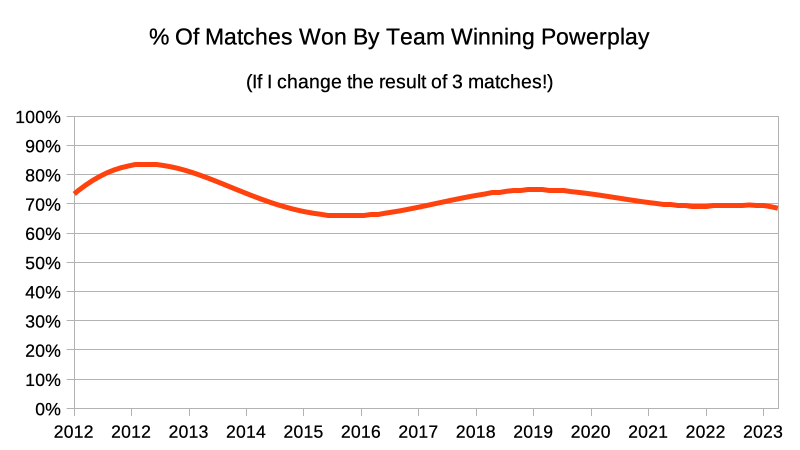
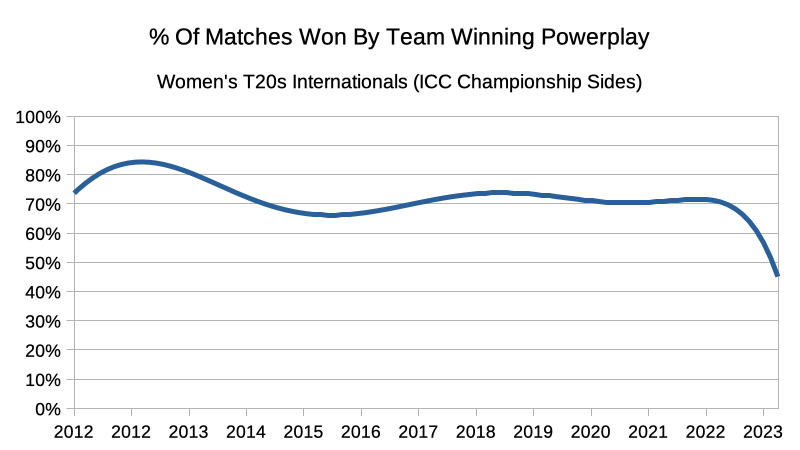
Let’s look at the numbers! (For the mathsy among you, this is using a polynomial trend.)

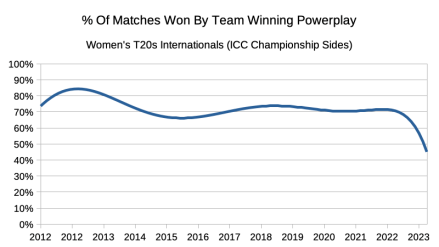
It is true that there has been a distinct downward tick recently – for several years, from 2014 to 2022, the number hovered at around 70%, but has now crashed down to below 50%, so it does look like something is going on.

But… is it?

Although we are talking about hundreds of matches overall, hundreds aren’t actually very big numbers in stats terms, especially when you are looking at trends like this. So although the downtick shown here looks fascinating, it might not actually be very significant.

In order to illustrate this, let’s look at what happens if I change the results of just 3 recent matches.

If the outcome of as few as 3 games had been different, that startling downtick completely disappears, and we are back at the long-term trend of around 70%!

So to conclude, although there is a recent downward trend in the relationship between winning the powerplay and winning the match, it is probably just “noise”. The number fluctuates up and down – this is the “down”, but it will go up again, and there is no exciting new trend. (Sorry commentators!)

Moving on to the commentator’s second point, and admittedly somewhat more subjectively, even if it is not noise, the idea that it is due to improvements in middle order batting is palpably not upheld by what happened in the England v New Zealand series.

In the games New Zealand lost, they won the powerplays because they went of at 90mph, like that kid on parkrun who always sprints to the front at the start, but their middle order was completely unable to maintain that pace, so they fell off a cliff in the middle overs and went on to lose the game. Furthermore, in England’s case the game they lost was also due to a middle order collapse.

There definitely have been trends in batting over recent years, most obviously in the absolute number of runs scored; but this doesn’t appear to be one of them: the team winning the powerplay usually goes on to win the match 70% of the time, and the likelihood is that it will stay that way.

NEW ZEALAND v ENGLAND: 5th T20 – Filer That One Under “Job Done”

A businesslike performance from England allowed them to win the final T20 in Wellington by 5 wickets, with 7 balls to spare, to close out the series 4-1.

With Lauren Bell sitting this one out, England’s one change was to bring back Lauren Filer for her second outing of the series. It was a “like for like” replacement, in the sense that they are both “fast bowlers” but Filer’s plans today were not plans you’d have given Bell.

Filer’s directives today were straight out of men’s county cricket, where her coach and mentor Jon Lewis plied his trade for nearly 20 years – rough up the Kiwis by bowling short and targeting the body. You don’t see these kinds of tactic much in the women’s game, I think partly because the women’s game is just less aggressive, and partly because you need to be bowling pretty rapidly for it to work. Indeed, I have an inkling that if you asked England directly whether this was the tactic they’d probably deny it, but the evidence is clear to see – almost every delivery was missing the stumps but hitting the batter, forcing them to fend-off in a way that they aren’t comfortable or accustomed to doing.

And it worked – there might not have been any reward in the wickets column on this occasion, but Filer bowled 12 dots and finished with England’s best Economy Rate on the day, going at just 5.5 per over. The prospect of Filer bowling with these plans in next year’s Women’s Ashes Test at the MCG, with close fielders to pile the pressure on the batters, is… intriguing, shall we say?

With Filer and Nat Sciver-Brunt bowling most of the powerplay, New Zealand struggled. NSB produced a beauty to get Bernadine Bezuidenhout in her first over; and then had Amelia Kerr caught in the deep in her second. In fact, Kerr’s wicket might say “c Capsey b Sciver-Brunt” in the scorebook, but it should really read “c Capsey b Filer” because it was undoubtedly the 5 dots bowled by Filer to Kerr in the previous over that induced an uncharacteristically adventurous shot from Kerr, who is not a power hitter and is normally smart enough to know that – she had one of the lowest boundary percentage of any of the top 20 batters in WPL.

New Zealand finished the powerplay 29-3 – the lowest powerplay score of the series. Alex Hartley observed on comms that the team that has “won” the powerplay has gone on to lose the match in every prior game in this series; but I think that is more an artefact of the way New Zealand’s top-heavy batting tends to mean they hare-off at 90mph before falling away later. So credit to them, because that’s not what happened today.

A 28-ball 51 from Izzy Gaze was the key innings, allowing New Zealand to plunder 41 runs at the death. It was all a bit madcap, but it took them to a score of 136, which is bang-on average for a T20 international between the championship sides these days – so definitely a score where you’re in the game.

With Maia Bouchier barely troubling the scorers for once, England too got off to a slow start. Neither Alice Capsey nor Danni Wyatt really got going, and were eventually dismissed for similar returns trying to accelerate their scoring: Wyatt stumped coming down the wicket and Capsey… you’re not going to believe this… caught in the outfield trying to smash it ten ways to Timbuktu.

But the key thing from both Capsey and Wyatt was that, despite not having their best days at the office, they still kept England chugging along – the required rate never went above 8, and that meant Nat Sciver-Brunt and Heather Knight had a platform to gradually chip away at the total through the middle overs.

This took England to within touching distance, allowing Sophia Dunkley and Amy Jones to do the drying-up, with the help of a couple of no-balls just when New Zealand really didn’t need them, taking the pressure off two players who haven’t had great series and who might just have cracked if the Kiwis had been able to really turn the screw at the death.

So here endeth the T20 series, with a final 4-1 scoreline in England’s favour that will have surprised no one. Maia Bouchier was named Player of the Series – her 223 runs almost twice the total amassed by New Zealand’s top run-scorer, Amelia Kerr, who led their way with 114, despite missing the first match on her way back from WPL.

With those two big performances in the 3rd and 4th T20s, Bouch has seized that spot at the top of the order and hopefully will now get the kind of run at that role that Dunkley had and ultimately could not convert. She does seem to have made genuine progress in the past year or so, and I wonder if she’ll one day look at being banned from bowling as a blessing in disguise, allowing her to focus on one thing and move it on to a new level? If so, this will have been where the step up started.

NEW ZEALAND v ENGLAND: 4th T20 – The Mighty Bouch Strikes Again

At the halfway point of the fourth T20 at Wellington, the cameras zoomed in on New Zealand captain Sophie Devine, sitting away from the action, nursing a freshly-inflicted quad injury. Her gloomy face told a thousand stories: she knew, as we all did, that – with England having put 177 on the board – the game was as good as over before New Zealand even faced a ball.

All of the talk ahead of this game had been about the return of England’s four WPL superstars, but Maia Bouchier completely stole the show with a smart, powerful innings of 91 off 56 balls – her highest ever score in T20 cricket – after Jon Lewis wisely chose to promote her to the opening spot in place of Sophia Dunkley. You can’t say she hasn’t earned it.

New Zealand should have come into this match full of confidence after England’s messy collapse handed them the third T20 on a plate, but they didn’t field like it. Five balls in, Bouchier (on 1*) edged Rosemary Mair through slip: oddly, Devine ducked out of the way, seemingly assuming that keeper Izzy Gaze would dive for it – it wasn’t clear if Gaze had called for it or if Devine just misjudged it?

Bouchier was put down twice more, on 31* and 44* – a missed caught and bowled from Jess Kerr followed what we might term an anti-double-play by Gaze, in which she first fumbled Bouchier’s edge and then missed a stumping chance, off the same delivery. Gaze is still young (just 19 years old) so this might sound a bit harsh… but if she is going to be New Zealand’s wicketkeeper of choice, they just can’t afford for her to be that much of a liability when she is stood up to the stumps.

Bouchier took full advantage, going on to hit 12 fours and two sixes in an innings which could have been tailor-made to promote NZC’s Poi initiative – plenty of Poi Whiua (twirl your poi and cheer) going on in the crowd.

England’s post-powerplay consistency was remarkable – only one over after the six-over mark went for less than 8. (That was the 14th, the only one bowled by Suzie Bates, who followed up her magical death over in the last game by being NZ’s most economical bowler in this match, which does rather beg the question as to why she doesn’t bowl more these days?)

Perhaps surprisingly after such a good WPL, Alice Capsey struggled for fluency, but to her credit recognised this and ran hard, in order to give the strike to Bouchier as much as possible. Then, after Bouchier was dismissed in the 18th, Heather Knight and Nat Sciver-Brunt upped the pace even more, with a partnership of 35 off 14 and an enormous 18-run final over.

In reply, New Zealand were actually ahead of England at the end of the powerplay, with 47 runs to England’s 35. But with both Bates and Melie Kerr already back in the dugout, and Devine unable to bat, you couldn’t help but feel that it was only a matter of time. There was a strong feeling of deja vu from the first match of the series: as soon as the field went out, New Zealand just couldn’t find the necessary boundary options to keep up with the required rate.

In the end, the only question was whether or not they would get bowled out. It was a fate they managed to avoid, finishing 7 down – but with England winning the match by a huge 47 runs, and with it the series, it will be scant consolation.