Two weeks ago, Lauren Winfield-Hill faced a decision: Yorkshire were through to the final stages of the Tier 2 One-Day Cup, which directly clashed with the Women’s Caribbean Premier League that she was due to play in.
Guyana or a freezing cold, rainy September day at New Road? What a choice!
Except that Winfield-Hill is Yorkshire through-and-through – to the extent that, even when it became apparent 18 months ago that they had lost their bid for Tier 1 status to Durham, she still chose to remain with her home county (presumably their automatic promotion into the top tier in 2026 helped sweeten the pill, but even so).
So she stayed in England, and kissed goodbye to something in the region of $16,000.
But in Sunday’s final at Worcester, she made no mistake, racing to a 27-ball half-century as Yorkshire rode roughshod over Glamorgan to win a shortened 20-over match by 9 wickets with 8.4 overs to spare. One-sided isn’t quite the word.
When I asked Winfield-Hill about the WCPL afterwards, she was pretty unequivocal: “I’ve got a long-term contract with Yorkshire, and I’m very loyal to them. And to be honest it was a no brainer – Yorkshire is my priority, that’s why I wanted to stay.”
Minutes after lifting the trophy, surrounded by her Yorkshire teammates and about to crack open the champagne, she added: “It’s a blessing because I get to share these moments with the girls.”
Three years ago, at Lord’s, Winfield-Hill won the Rachael Heyhoe-Flint Trophy with Yorkshire Northern Diamonds. How does this compare?
“It’s a different feeling, it’s a very different group and a different occasion, but it’s really special. Today was about being able to do it when it mattered,” Winfield-Hill said.
Back in June, Yorkshire lost their T20 Blast final to Middlesex by 10 wickets, after putting just 101 on the board. (As a reminder, they were full strength, with both Winfield-Hill and Sterre Kalis in their XI.) Agreeing to foreshorten a 50-over game therefore felt, to me, like something of a gamble.
Winfield-Hill, though, described it as “common sense”: “It was probably going to be one of those where you win the toss, you bowl 50 overs, then you didn’t get to bat, which as a batter really sucks.”
“So it just made sense to make it a T20. Both teams were very much in agreement that we wanted to get a game on today and get a result. You don’t want to share a trophy.’
I must say, I feel slightly uncomfortable about the decision. Yes, it hosed it down at New Road about 10 minutes after the match ended – and it was still raining when we left the ground at 2pm.
But if you aren’t going to follow the playing conditions, what’s the point of having them in the first place?
Once the decision was taken, and agreed by the ECB, the toss became all-important: with heavy rain forecast from 1pm, making it likely that the second innings would be cut short, the team batting second would know exactly what they needed to do to stay ahead of DLS.
In fact, the toss was so critical that when the umpires oversaw it prematurely, and the commentators requested it be repeated so that it could be shown on TV, Winfield-Hill put her foot down and said she wouldn’t redo it “because I’ve already won it” – fair play to her!
As it turned out, Glamorgan’s batting effort – which started so positively – eventually fizzled out, allowing Yorkshire to get ahead of the DLS from the second ball of their chase and stay miles out in front of it the whole way through. Winfield-Hill was in her element: “I strangely quite like the pressure of DLS to frame a chase.”
For Yorkshire, the eventual result was an important one in countering some of the embarrassment felt by both the players and the ECB when they failed to win the Tier 2 Blast back in June.
“A lot of these girls were hurting from that T20 loss,” Winfield-Hill said. “There’s a bit of subconscious, ‘you’re being invested in so you should be producing the goods’. And to be honest, on reflection, in that T20 final, maybe that was a bit of the added pressure as well, that people turned up and, ‘oh Yorkshire are here, they’re paid’. I think a lot of girls felt the pressure of that.”
“Whereas today was just a really nice continuation of what we’ve been doing. I couldn’t wait to rewrite our wrong.”
Middlesex Director of Cricket Alan Coleman has told CRICKETher that the club intend to self-fund professional contracts by 2029, in order to ensure they are best-placed to progress into Tier One.
Last year, Middlesex failed in their bid to host a Tier One side, meaning they will be locked out of the top tier of women’s domestic cricket for at least the next 4 years.
But the club have embarrassed the ECB with their results this season, winning 18 of their 21 matches, beating Yorkshire twice, and finishing as inaugural champions in the Tier Two Women’s Vitality Blast.
“The game at Northants where we won the T20 was an astounding effort – I’ve never seen a team go through a whole Finals Day without losing a wicket,” Coleman said.
“It’s a challenge that the team have embraced, being amateurs, against professional teams – not only Yorkshire but Glamorgan, who are going to be Tier One in 2027.”
Middlesex’s challenge now is how best to keep together and develop a team of amateurs, many of whom are doing demanding full-time jobs – as typified by all-rounder Gaya Gole, who works long hours as a Management Consultant in the City.
For Coleman – who was present at Middlesex’s semi-final against Yorkshire on Sunday – the answer is for the club to directly invest in their women’s squad.
“Middlesex are incredibly ambitious and desperately want to invest in our women’s team,” he said. “There’s no greater deserving team for that investment.”
“Our challenge is to keep improving and keep developing across this period to ensure that we are as ready as possible for Tier 1 cricket as and when hopefully the ECB decide to open it up.”
“This is year 1 of a 4-year plan to be professional at the end of that period. And we almost want to, without sounding arrogant, take it out of the ECB’s hands and say, ‘You have to make us professional because of the performances that our players have put in, in Tier 2’.”
“So that’s the plan, and a part of that will be ensuring that our players are rewarded for the cricket that they play.”
The club are still working out exactly what that looks like, but we shouldn’t be surprised if we see the first tranche of part-time contracts awarded ahead of next season.
“We need to continue to invest in this very, very talented group of players to ensure they get the opportunity they deserve,” Coleman added.
Southern Brave will go into Sunday’s Hundred final with an unbeaten record of 8 wins from 8 matches, after pulling a rabbit out of a hat to defend 106 at the Utilita Bowl.
It makes them the first team in the history of the competition to finish the group stages undefeated. When Brave won the tournament previously, back in 2023, their one loss in 8 games came against Fire at home in Southampton – but Fire couldn’t spoil their party again today.
Meerkat Match Hero Lauren Bell added to her chart-topping wicket-tally (19 at 7.47) with extraordinary figures of 4 for 6, including a third set during which Tammy Beaumont and Jess Jonassen both holed out to fielders in the deep.
But Bell was the beneficiary of a team bowling effort in which Brave’s four spinners – Chloe Tryon, Tilly Corteen-Coleman, Georgia Adams and Mady Villiers – put a stranglehold on Fire’s chase. Even before the wickets started to fall, Fire’s lack of runs had swung the Win-Her dial in Brave’s favour:
“It was a tricky pitch,” Bell said afterwards. “We chatted about it before we went out, that dots were going to be massive, almost as important as wickets, and as soon as the run rate got above a run a ball on that pitch we knew it would be a tricky chase. Mads [Villiers] and Coco [Corteen-Coleman] and Gads [Adams] bowled some really important sets.”
Bell gave the credit to her teammates but the fact that Fire scored just 47 runs in their first 50 balls, despite only being 1 wicket down, is symptomatic of just how miserable their efforts with the bat have been this season. Between them, Fire’s top five batters have managed two half-centuries this season – both scored by one Sophia Dunkley. Hayley Matthews – who was talismanic for Fire in their 2024 campaign – has barely scraped a run together, averaging 19.
Today, she was scratchiness personified, managing just a single boundary before failing to get the necessary elevation to clear Villiers at deep midwicket. With Matthews in a slump-spiral as deep as this, it’s perhaps a good thing that West Indies won’t be featuring in October’s World Cup.
Brave had themselves struggled with the bat, sinking to 14 for 2 early on after Fire put them in to bat on a pitch made sticky with rain. With Sunday’s final looming, Brave chose to fiddle around with their middle order to offer chances to Freya Kemp, Chloe Tryon, Villiers and Georgia Adams, who have had very little to do with the bat this season. Adams, for example, had faced just 11 balls prior to today’s match; but her elevation to number 6 against the Fire gave Brave’s skipper (who finished 30 not out from 26 balls) to bat herself into a modicum of form.
Not only did that ensure Brave got to a total which was (just about) defendable, it could end up mattering a lot on Sunday if the final proves to be a tight match.
The fact that I waited half an hour after play ended in the Brave v Invincibles match on Monday to speak to Sophie Devine is typical of the player and the person. How did she spend those 30 minutes? Signing autographs and taking selfies with kids on the boundary at the Utilita Bowl. In the end, she had to be physically ushered away by security as they geared up for the men’s match.
Earlier this year Devine took a mental health break, missing out on the WPL and the second part of the New Zealand domestic season, presumably partly out of sheer exhaustion caused by simultaneously captaining her country and being her side’s best player. Now, she is back out there and – as she says – “enjoying herself” again.
“It’s pretty obvious that I’m nearing the end of my career, and for me, it’s being as happy as possible out on the cricket field,” she says.
What’s keeping her motivated these days? Unsurprisingly, she isn’t focused on personal milestones. “Giving to others has been a massive focus for me,” she says. “I want to help and encourage anyone and everyone, wherever they’re from. It’s about improving the standard of the game, because there’s so many talented kids out there now.”
She cites England and Southern Brave’s 20-year-old all-rounder Freya Kemp as an example: “She is going to be a freak. To be able to rub shoulders with her is what’s motivating me at the moment.”
After a few years spent with Birmingham Phoenix, Devine was picked up by Brave in this year’s Hundred draft and is thus far proving something of a lucky charm – largely with the ball, having taken 9 wickets so far opening up alongside Lauren Bell.
In Monday’s game, she bowled a magic ball which curled away from Meg Lanning and hit the very top of her off-stump, beginning the rout which saw Brave beat Invincibles by 89 runs. Brave’s bowling coach Jenny Gunn was apparently so delighted with the Lanning dismissal that she played the delivery on loop in the dressing room when the players came off the pitch.
“Playing around the world in different competitions you have to fill different roles, and here when we’ve opted to only have a couple of seamers, responsibility falls on me and Belly. I’m enjoying that,” Devine says.
“And I’ve certainly enjoyed my time here at the Brave,” she adds. “Everyone knows how well Lottie [Charlotte Edwards] has set this club up – it’s evident in the way that it’s run.” The 2023 winners are already in pole position to qualify for this year’s final, with five wins in five matches and (according to our Alligator analysis) a 99% chance of reaching at least the Eliminator stage.
After that, Devine heads to the UAE to warm-up for the 50-over World Cup in India – a tournament which she has already said will be her last in the ODI format. “It’s a big weight off the shoulders,” she admits. “That was the whole point behind announcing my retirement, was to get it out there nice and early, so I don’t distract from the group and the team being at the World Cup.”
“I’ve always been strong on my feelings of, the team comes first, personal milestones are secondary. I’m enjoying every moment because I know my time’s coming to an end soon.”
And the rest of us will continue to enjoy every moment of watching her, for as long as we can.
As we departed Taunton at an ungodly hour on Sunday morning, we knew the journey up the M5 to Edgbaston would be worth it. We were at last going to reveal one of the great mysteries of women’s cricket… how to pronounce Tilly Kesteven’s last name.
The answer? Ker-steven.
Tilly herself was only too happy to provide the answer, after scoring 29 from 37 balls for Lancashire in their 5-run win against Bears – although we did have to hare around the outfield at Edgbaston to ensure we caught her just before she disappeared into the dressing room!
Despite the result, if we’d been asked to name a Player of the Match today, I’d have chosen Nat Wraith, who finished unbeaten on 58 from 34 balls. With Bears reduced to 101 for six in the 14th over, it seemed like the match was all-but over, but Wraith’s innings at least made a game of it, taking the equation down to 14 runs required from the final over.
Nat Wraith has had an interesting few months. In October, the perennial Western Storm wicketkeeper unexpectedly signed for Bears, saying that she was excited to “be part of a new environment“. So far, the move has proved Somerset’s loss: Wraith has already helped Bears achieve a record run-chase (the highest ever in women’s List A cricket in England).
Here, she did something which none of the England batters managed over the winter, and found the measure of Alana King, effortlessly lofting the leg-spinner over deep midwicket for six before doing the same thing to Sophie Morris two overs later. Fi Morris did shell her in the deep on 41*, in a move that for a while looked like it might have cost Lancashire the game.
Had Wraith’s ramp shot off the first ball of Grace Potts’s final over made it to the boundary, it still might have done… but the aforementioned Kesteven (Ed: remember, it’s Ker-steven) dived to cut it off, and instead, Wraith and Hannah Baker ran two.
Wraith found the boundary next ball, pulling through midwicket to leave the equation 8 from 4… but a wily Potts then spotted Wraith moving back across her stumps and followed her, meaning her cut was not quite clean enough to pierce the ring.
A dot ball was worth its weight in gold at that point – it meant Wraith felt compelled to run on the next ball, leaving Baker on strike, who miscued a catch to cover.
With one ball remaining of the innings, Potts sent down a leg-side wide and the crowd held their breath… until Potts sealed the deal with another dot ball, after a huge swing-and-a-miss from Hannah Hardwick yielded nothing. Wraith, stranded at the other end, could only watch on in frustration.
For the Bears, the real issue was their failure to capitalise on an excellent start, having reduced Lancashire to 37 for 4 at the end of the powerplay. Emma Lamb, having herself hot-footed it over from Taunton early this morning (Ed: we might even have passed her on the motorway!), lasted just 4 balls before being bowled through the gate by Issy Wong, while Abbey Freeborn took an excellent leaping catch to snaffle Morris’s attempted cut.
But – not for the first time in this competition – Lancashire’s middle-order bailed them out: Kesteven and Ailsa Lister shared a 69-run partnership for the fifth wicket, before Alana King and Tara Norris enabled Lancashire to add 43 runs from the last four, despite a 20-minute rain interruption between the 19th and 20th overs.
In reply, Davina Perrin got the Bears off to a flyer, but the 20-year-old Grace Johnson – who is rapidly becoming One To Watch – took out her stumps in the final over of the powerplay. Laura Harris couldn’t match her Friday fireworks with a Sunday showstopper, skying a catch miles in the air after managing just one boundary, and Bears were left struggling… at least until Wraith breathed life into the game.
Oddly, the match has done little to impact on current standings: at the time of writing, Lancashire remain in 6th place, while Warwickshire sit at number 3.
But the Blast has an odd, lopsided schedule, with Warwickshire already having played 5 games, while Surrey (who are top) have played just 3 – so today’s result might yet come back to bite the Bears.
Saturday proved to be a good day for batting at Old Trafford, as Lancashire racked up a respectable 169 for four in their first home fixture of the T20 Blast – only for it to be bettered by visitors The Blaze, who finished up winners by six wickets, despite a nervous run-chase.
After over a decade of reporting on the women’s game, this was CRICKETher’s first outing at Old Trafford (as well as our first experience of the new-look Women’s T20 Blast). In a match which went down to the final over, the cricket didn’t disappoint – it rarely does – and Lancashire had clearly made an effort: when we arrived half an hour before play there was music blaring, food stands open, bar staff aplenty and a ton of children’s activities.
Perhaps the only downbeat note was the crowd. The “official” number for the women’s game, we’re told, was 2,600 – as compared to 4,378 spectators at the Utilita Bowl yesterday.
Rare are the days in Manchester when you don’t need a mac. Meteorologically, this was one of them – an uncommonly sunny day in a place which has a reputation has England’s rainiest city (although apparently this is very unfair).
But while the crowd might have been making more use of sunhat than raincoats, on the pitch Lancashire were relying on their own Mack – one with the first name Katie!
Aussie overseas Mack top-scored with 59 from 37 balls after Lancashire were put in to bat by The Blaze. Mack might not have the fireworks of the Harris sisters – down in Birmingham, Laura Harris was practically setting the ground on fire – but she does have stickability. She’s already scored two half-centuries for Lancashire this summer in the One-Day Cup and this one, her third, was just as solid.
The 20-year-old left-hander Tilly Kesteven, fresh from her breakthrough innings of 77 in Monday’s County Cup final, also looked in good touch here. Sarah Glenn, having hot-footed it up from Derby last night in order to play in this fixture, had a bit of a shock after being bunted for 12 from her first over by the youngster. The only disappointment is that Lancashire still haven’t managed to get a named shirt sorted out for the player who won them their first silverware in eight years – I’d be sorting that out pronto if I were them!
Glenn did take an excellent catch at point to see off Mack, jumping to her right to snatch the ball out of the air in the 13th over – and that was where the problems started for Lancashire. Mack and Kesteven had laid a platform of 81 for one after 10 overs – but after Mack departed, a couple of slower overs prevented the hosts from quite fulfilling their early potential, and they finished on 169 for four.
In reply, The Blaze proved just how good conditions really were at Old Trafford, finishing the powerplay with 63 runs on the board – admittedly helped out by Tara Norris sending down some American Pies (blame Syd thanks to Syd for the Dad Joke).
Blaze’s opening pair in the one-day comp have been outrageously poached by Charlotte Edwards (and between them had a pretty decent outing yesterday), but Marie Kelly and Georgia Elwiss together put on 100 in the first 11.1 overs as The Blaze looked to be racing to victory.
But the pair were dismissed in consecutive overs – both caught trying to power the ball down the ground – and when Sarah Bryce fell miscuing Mahika Gaur to cover in the 17th over, 37 runs were still needed off 23 balls. Had The Blaze choked?
Mack could have been the all-round hero for Lancashire if she’d managed to clutch onto the catch proffered up by Kathryn Bryce in the 18th over – instead, running in from deep midwicket, her dive left her with nothing but a bruised knee to show for it.
Faced with a choice of two left-arm spin options, Lancashire captain Ellie Threlkeld then opted to save Sophie Ecclestone for the 20th over, and instead hand the ball to the 21-year-old Sophie Morris. It proved a costly mistake: Bryce struck back-to-back boundaries, while overseas Maddy Green topped it off with a six struck sweetly down the ground.
By the time Ecclestone came on to bowl the 20th, just two runs were needed, and the result was a formality. Lancashire will need to regroup quickly ahead of tomorrow’s match against Durham up at Chester-le-Street.
We’ll be there, on the third and final day of our Epic CRICKETher Northern Roadtrip! (Watch out for our travelogue video, coming later in the week on our YouTube channel.)
Many commentators have described the north-west regional team – whether they have been known as Lancashire Thunder, Thunder or Manchester Originals – as the perennial underachievers of the regional era that began in 2016 with the launch of the Super League.
The match against Diamonds where Thunder made just 90 was supposedly from the regional era, yet almost all of that day’s eleven hailed from Lancashire, even with most of that year’s home matches being played at grounds in Cheshire.
The ironic thing is that, with the team free to call themselves Lancashire this year, and with the regional era supposedly consigned to history, last Monday’s win in the final of the Vitality County Cup owed a great debt to the north-west region as a whole.
Of the eleven Lancashire players in the final, four are products of Cheshire’s county system: Sophie Ecclestone, Sophie Morris, Tilly Kesteven and Seren Smale. Grace Potts has played in the Cheshire Women’s League, while a sixth member of the team, Emma Lamb, has played a great deal of cricket in the Cheshire men’s leagues.
Morris is perhaps the breakthrough player of the year at Old Trafford, while Kesteven chose the perfect moment to make her first significant score of her professional career, making 77 from 60 deliveries in the final.
Of the Lancashire squad not involved in the final, Hannah Jones, Eve Jones, Danielle Collins and Olivia Bell are all no strangers to anyone who has followed women’s club cricket in Cheshire in recent years.
From a personal point of view, the question is, how much can I celebrate Lancashire Women’s newfound success? I was born and bred ten miles from Old Trafford and was introduced to supporting the Red Rose men’s team by my father at an early age. The fact that I’ve always lived ‘south of the river’ in Cheshire is not really an issue here, with Cheshire forever destined to be a minor county in the men’s game.
I was, however, heavily involved in the administration of the Cheshire women’s team between 2007 and 2013. In these heady times, Cheshire and Lancashire were actually rivals, indeed Cheshire won both of their 2009 matches against Lancashire by a significant margin. In 2011, Lancashire were back on the rise, but still only beat Cheshire by one run, and there was another closely fought match between the counties in 2012.
So, after all those years of seeing Lancashire as a deadly rival, can I now reconcile myself to supporting the county’s women’s team and celebrating their successes? I think I’ve decided that the answer is most definitely Yes. The number of players in the team with Cheshire connections makes my decision much easier for sure. Many observers have voiced the opinion that Cheshire still does women’s club cricket much better than Lancashire, and I have no doubt that the strength of the club game in Cheshire will continue to provide Lancashire with a steady supply of talented players for many years to come.
One also has to accept the fact that the women’s cricket scene continues to evolve rapidly. Lancashire are destined to be a Tier 1 county in perpetuity, while current indications are that Cheshire, and all of the other traditional ‘minor’ counties, cannot aspire to anything other than Tier 3. (Although it will be interesting to see if Tier 2 really does operate with just six teams once Tier 1 has expanded to 12 counties in 2029.)
While the smaller counties may no longer be able to aspire to reach the highest level, it must be considered that no one ever suggests that the Cheshire men’s team is not a viable proposition simply because it can’t be promoted to the main County Championship. Likewise, few cricket followers in the county see any issue at all with supporting both the Cheshire and Lancashire men’s teams.
In summary, the new era of county women’s cricket is something we have to accept as a necessary evil, so I see no conflict between celebrating what Lancashire Women have achieved, while also wishing the newly relaunched Cheshire Women every success.
Our first experience of the new Women’s County Cup takes place on a blustery, bright day in Northampton and concludes with something of an upset, as hosts Northamptonshire beat Worcestershire by 5 wickets.
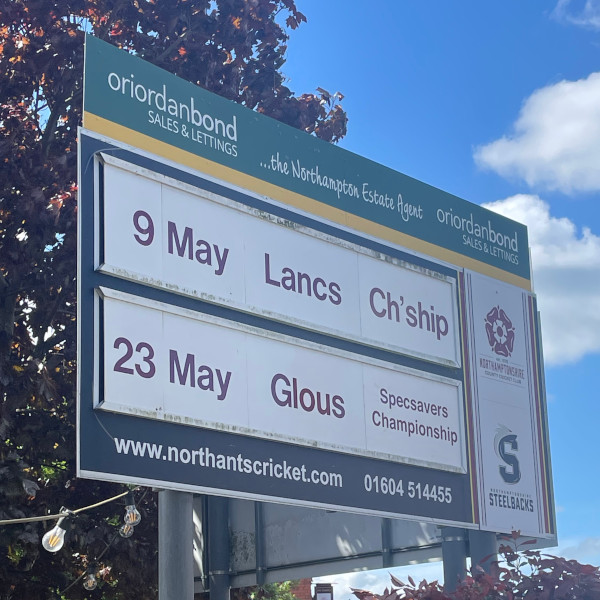
We have an inauspicious start to the day when we arrive at the Northamptonshire County Ground 2 hours before play, to find the gates locked and the fixture board outside the ground merrily suggesting that this match was merely a figment of our imagination.
It turns out that we’re at the wrong gate. Once we find the right entrance, things improve: we are able to easily park at the ground, find the press box open, listen to the PA warming-up, and go to watch Chloe Hill batting ferociously in the nets. The only other person inside Wantage Road at this point is a particularly loyal Northants member in a tartan cap, tucked away at the top of the Turner Stand eating his sandwiches.
This is cricket’s first all-inclusive, all-levels knockout competition, involving 37 teams from across all 3 of the new “tiers” – a brave new world for player, spectator and journalist alike. Syd and I have perhaps got a bit complacent of late, having got used to watching players who we know well, with a live scorecard which always has the correct information, and a stream which at the very least allows you to watch all the wickets back.
But this? This is right back to the Golden Days of the Women’s County Championship, of scrambling for binoculars to see who just fielded the ball, of turning to each other to ask: “I missed that – did you see it?”
I also do something I haven’t done in years: count the number of spectators. I reckon 130-odd – presumably, that’s what happens if no one knows that a match is actually happening.
Worcestershire certainly win the “most confusing team for scorers” award, with 2 Davies’s (Gwen and Poppy) and 1 Davis (Ruby), as well as a Beech (Sophie) and a Beach (Jess). We enjoy a delightful, unofficial running commentary from two of the Northants old-handers (“Clare Boycott?” “No relation”, etc, etc), as Worcestershire unhelpfully collapse to 11 for 3 within the opening 3 overs. This is the team who made the early running in Tier 2 by beating Yorkshire on the opening weekend of the season, so it’s something of a surprise to see them struggling.
Seamer Bethan Robinson is zippy and accurate, clean bowling Bryony Gillgrass second ball before returning at the death to do the same thing to Phoebe Brett with a perfect yorker. There’s a smart piece of fielding from Abby Butcher on the deep backward square leg boundary, which not only saves four but results in the run-out of Poppy Davies, before off-spinner Lenny Sims tempts a leading edge from Hill up to mid-off and the Worcestershire batting effort gradually fizzles out.
Northants are left chasing just 97; and the county’s proactive approach to recruitment over the winter ultimately pays off, as former Hertfordshire duo Gemma Marriott (24) and Amelia Kemp (23) lay the foundations with some well-placed boundaries for an easy win.
Afterwards, I go pitch side and manage to speak to the winning skipper, Marriott, who is delighted with both the result and the entire concept of the County Cup.
“It’s a great idea,” Marriott says. “It gives exposure to so many more teams to play against different levels. We know next week we’ve got Shropshire, so it’ll be interesting to see what a Tier 3 team is like now, and then if we win that, we know we’re going to get a Tier 1 team to play against which, if we get there, is going to be a great experience.”
She admits, though, that it is a little strange to not actually know where they will be playing in just 5 days time. “The Steelbacks will play Shropshire in the next round. Please check the website for details of the fixture,” says the ground announcer, helpfully, as we depart.
Welcome to the era of the Women’s County Cup, where uncertainty and opportunity sit hand in hand.
After all the kerfuffle of last year’s domestic restructure, we’re about to find out what it is all going to look like in practice. There has been a reasonable amount of player movement in the off-season (Durham, after all, had to build an entire team from scratch!) so for some teams, it will also be a chance to see how these new squads are hanging together… or not, as the case may be.
Our Big Plan here at CRICKETher Towers is to try to attend at least one home game of each of the eight Tier 1 counties this season, partly to try to get a genuine sense of how well teams are being supported behind the scenes. So watch out for a more even geographical spread of match reports than usual!
In the meantime, here are some predictions for the season (full squads at the bottom of the page):
Who’s going to win the One-Day Cup?
Raf: Counties were told by the ECB that they had to offer contracts to a minimum of 15 players. The deep pockets at Surrey decided that wasn’t good enough and have offered out 17 full contracts – that’s in addition to the 4 contracted England players in their squad, who as we now know will be available for the first 6 rounds of the One-Day Cup. There could be a lot of thumb-twiddling going on, but it’s also hard to look past such a well-stocked team (which is almost identical to last year’s Stars squad) for silverware.
Syd: Don’t ask me… ask the data! I carved-up the impact stats (full data here and here) from the regional era and added up the scores for the best 11 players in each squad.
That brought a clear winner to the surface: The Blaze. With their England players likely to be available for the key fixtures at the start of the season, I’m backing them to build up a sufficient head of steam to power them through the group stages. There will still be the knockouts to come in September of course, but assuming the Bryces are not off to the World Cup (which unfortunately looks unlikely at the time of writing) I think they can still do it.
Who’s going to win the T20 Blast?
Syd: The data above shows the squads with their England players included, but of course they aren’t going to be available for a chunk of the season, which particularly affects the Blast. So I took the England players out and re-ran the numbers:
This paints a very different picture, with Surrey and serial-underperformers Lancashire at the front; so I’m backing Surrey’s power-batting lineup, led by Bryony Smith, to knock the Blast out of the park.
Raf: The Blaze are the reigning champions [Ed: are you still reigning champions when the competition changes its name?] and I can see them pulling it off again this year. Similarly to Surrey, they have the same core squad as 2024 – and this time they will have both Bryces available for the whole season. The only question is whether the trophy will be emblazoned (gettit??!) with the name “Blaze”, or whether Notts might put their foot down at that point!
Who will get the wooden spoon?
Raf: Rumour has it that negotiations were a bit tricky behind the scenes at Central Sparks / Warwickshire last year, with the upshot that the squad they’ve ended up with isn’t necessarily the one they thought they would get. That’s always a difficult dynamic to negotiate – players may feel aggrieved or anxious to prove themselves – so while they’ve got some brilliantly talented young players (I’m excited to see what Dav Perrin does this season), I think they might struggle overall.
Syd: The numbers don’t look good for Warwickshire, but they look a lot worse for Somerset especially without their England players. A lot depends though on what Charlotte Edwards decides to do with a certain Heather Knight – I think she’s likely to continue playing ODIs, but if she gets dropped from the T20 format she’ll play a lot more domestic cricket and could single-handedly haul Somerset to something like respectability.
Who’s our one to watch?
Raf: I’m intrigued to see how Rhianna Southby gets on for Hampshire. We got a sneaky peek at her in their warm-up against Surrey at the Utilita Bowl last week (she hit a run-a-ball 42) and her batting looks to have come on leaps and bounds over the winter. Her keeping has always been top-notch; it’s been her batting which has kept her out of contention as a possible Amy Jones successor – could this be the season where she defies those expectations?
Syd: The wicket-keeping succession battle is certainly an interesting one, and I’ll be keeping a close watch on two of the other contenders – Seren Smale and Bess Heath. Heath’s move to Durham is a sensible one, ensuring she is their first-choice with the gloves for the first time in her professional career, having played second-fiddle (second-glove?) to Lauren Winfield-Hill at Diamonds previously. Smale, though, still has that problem with Ellie Threlkeld playing first-glove at Lancashire, so will really need to kick on with the bat to nudge the eyes of England’s soon-to-be-appointed new selector.
Who’s our golden oldie?
Raf: Hilariously, Sophie Luff was already considered a “golden oldie” by Syd last time we wrote one of these previews in 2021. To be fair, she does seem to have been a mainstay of women’s domestic cricket for eons (despite only being 31), and has been the face of most of the “revolutions” we’ve seen in the past decade (the KSL, regionals, The Hundred… phew!) Even after the ECB tried to abolish county cricket via the back door in 2019, Luff continued to spearhead Somerset, so it seems only fitting that she now leads them into the professional era.
Syd: Let’s go back all the way to 2010 – Berkshire are playing in the final of the T20 Cup against mighty Yorkshire. The top scorer for Yorkshire is one Dani Hazell (you might have heard of her) but Yorkshire can’t overhaul Berkshire’s 1st innings total of 173, of which 61 (off 46 balls) were scored by an exciting young player called “Alice” Macleod. Arguably, Lissy (she’s a mononym these days, like Elvis with a cricket bat!) didn’t quite fulfill her potential. She never played for England, but she went on to win the KSL with two different teams, and when Sunrisers won the RHF Trophy last season, she was a big part of that too. Now in her 30s, she’ll be wearing an Essex shirt this season, and playing a valuable role there as the “senior pro” as well as skippering the side if / when Grace Scrivens gets her England call-up.
Who’ll be the overall MVP?
Syd: Possibly my most left-field cricket take (yes… even more left-field than that Grace Scrivens one!) is that Katie George could still end up with 50 England caps… but as a batter rather than a bowler! I agree with Raf that Warwickshire are likely to struggle this season, but if they don’t then George will have been a big part of why they didn’t. She has been much more in control of her bowling in the last couple of years, both in terms of consistency and looking less like a lower-back injury waiting to happen; and her batting is starting to develop from “late-middle-order” to “proper middle-order”. If she can fulfil that promise, it will make her a very valuable asset indeed as she enters her peak years between 26 and 30.
Raf: From a marketing perspective, you’d have to say Ellyse Perry! As the most high-profile signing ever in the history of women’s county cricket, she’s certainly going to get the punters flocking to the Utilita during July, which is why Hampshire are (we assume) paying her the big bucks…
And what about Tier 2?
Raf: Well, it’s going to be quite embarrassing for Yorkshire if they don’t manage to finish on top, given that they are meant to be joining Tier 1 in a year’s time! They are also the only Tier 2 county who are actually handing out paid contracts to their players this year (thanks to the, ahem, largesse of Colin Graves).
Syd: Tier 2 is going to be… interesting. Which, as the apocryphal proverb about “interesting times” implies, isn’t always a good thing. Yorkshire aside, the standards are not going to be anywhere near professional, because these aren’t professional cricket teams. That doesn’t mean it can’t be competitive and exciting, and huge for the players involved; but I worry that fans that come to watch Tier 2 expecting the kind of women’s cricket they’ve seen on TV at the WPL or the World Cup are going to experience a reality-check that could leave them with a bitter aftertaste on the way home.
Raf: One thing which is still very much TBC is how the dynamic will work between Tier 1 and Tier 2 counties. Will “benched” Tier 1 players be permitted by their counties to go out on loan? Even if they are, will Tier 2 counties get parochial and promote their own players ahead of loaned-pros? Hopefully the counties can find a way to work together to present the best face of the women’s game to “new” spectators lending their support from men’s teams.
New Zealand Cricket have confirmed to CRICKETher that they have no immediate plans to reintroduce women’s Test cricket, after the ICC issued a new FTP which appeared to rule out any Tests for the White Ferns until at least 2029.
The new FTP – available here – shows a significant increase in scheduled Tests, with Australia, England, India, South Africa and the West Indies all agreeing to play multi-format series. West Indies will be participating in the format for the first time since 2004.
The new FTP leaves New Zealand out in the cold, as the only top-six nation who refuse to support women’s Test cricket.
A spokesperson for New Zealand Cricket told CRICKETher: “We haven’t got any plans to re-introduce Test cricket for the White Ferns at this stage.”
New Zealand’s recent victory in the T20 World Cup had sparked hopes that New Zealand Cricket might be persuaded to change their stance, but it seems not.
The spokesperson added: “Our thoughts are that we’re better to concentrate our current resources and investment on T20I and ODI cricket in order to grow the women’s game in New Zealand.”
“The limited overs formats have proven to be very effective in terms of attracting and retaining young players, which is a significant factor in the health of the women’s game here. In time, this will provide a bigger base from which talented players will emerge to ultimately play for the White Ferns.”
“Focussing on formats which include ICC global events (such as World Cups) is our preference for now.”
The spokesperson did offer a small glimmer of hope – concluding: “Never say never.”
Sadly, that might not be soon enough for Suzie Bates & co.



 CRICKETher