The CRICKETher Weekly – Episode 227

This week:

  • The privatisation of The Hundred – will the new owners care about gender equality?
  • Is Bangladesh the right place to host a World Cup right now?
  • Deandra Dottin and Cricket West Indies sign a mutual desperation pact
  • More details about Australia’s new T20 Spring Challenge competition

The CRICKETher Weekly – Episode 226

This week:

  • The issues with NZ’s domestic structure & how the ICC could help
  • Why NZC turned down a Test for the White Ferns, & was it the right call?
  • ECB’s plan to sell The Hundred goes belly up…
  • …as do plans for a Super T10 in Scotland

EXCLUSIVE: New Zealand Cricket Refused ECB’s Offer Of A Women’s Test

New Zealand Cricket turned down the chance to play a Test match as part of their recent women’s tour to England, CRICKETher can reveal.

The ECB officially invited NZC to play a Test in March 2022, when tour arrangements were initially being made, but the offer was declined.

Instead, the tour – which concluded at Lord’s on Wednesday – consisted entirely of 50-over and 20-over matches. All eight of the games were won by England.

New Zealand have not played a women’s Test since August 2004, but the recent revival of the format – with England, Australia, India and South Africa now regularly participating in Tests – had sparked hopes that New Zealand might also consider adding multi-day cricket to their schedule.

England played their first Test in India for 18 years in December, while last summer the ECB hosted the first five-day women’s Test since 1992 as part of the multi-format Women’s Ashes series. 

A spokesperson from New Zealand Cricket said: “This decision (to decline) was based on strength and conditioning and preparation rationale, and most importantly, playing as much white ball cricket as possible in the lead-up to the 2024 ICC T20 World Cup.”

CRICKETher also notes that participating in a single Test would have cost New Zealand Cricket over $100,000 in match fees due to the recent equalisation of match fees with the men – a substantial sum which they can presumably ill-afford.

Suzie Bates, who has represented New Zealand since 2006 but never had the opportunity to play a Test, told the BBC this week: “In my long career, there hasn’t been a Test match. I have a little bit of envy when I watch the Ashes, of players that are playing the same sport as you that have those opportunities. You wonder what it would be like.

“With the limited resources that we have currently, they [NZC] see more bang for their buck in the 20-over and 50-over format. It comes down to resources and time and money. They’ve made the decision that Test matches are not the priority right now.

“I’m still hopeful that [a Test] may come in the future – that once the growth of the global women’s game starts to get more traction, the boards will see value in that.”

ENGLAND v NEW ZEALAND: 5th T20 – England End Early Summer On Lucky 13

England won the 5th and final T20 at Lord’s to complete a clean sweep of sorry New Zealand, who have lost all 8 matches played between the sides on this tour. It was England’s 13th win in 14 games this summer, with the only blemish being the rained-off ODI against Pakistan at Taunton.

There was an awful lot of hype around this game, with England players drafted into the marketing efforts at Lord’s, and the BBC going all-out to make a splash with their coverage – the second of the two England women’s matches per season they have the rights to.

With the official England Cricket Twitter feed claiming “last tickets remaining” the expectation was of a near sellout, but in reality the Tavern Stand and the upper tier of the Grandstand were closed and there were big gaps elsewhere, which made for a slightly deflating picture as Fran Jonas ambled in to deliver the first ball of the evening. Slightly over-promising and slightly under-delivering is becoming a bit of a hallmark of English cricket, so it was perhaps appropriate that Danni Wyatt’s one and only shot of the innings was a classic of over-promising and under-delivering – promising to sail into the stands, but delivering a catch to Melie Kerr at deep midwicket.

It was Wyatt’s second duck of the series and her 4th single-figure score of the summer. On the plus side, she did make two big fifties – 87 against Pakistan at Headingley and 76 versus New Zealand at Southampton – in keeping with the general story of her life recently: one match-winning knock per series, and not a lot else. It is definitely enough to keep her in the side, but the big innings somehow make the small ones feel even more frustrating – we know she’s better than them, and her body-language on the way back to the pavillion said that she knows it too, but she’s one of the old dogs of this team now, and new tricks are probably a lot to ask at this point in her career.

For the third time in this five-match series, it meant Capsey coming in very early after one of the openers has bagged a duck. Unlike Wyatt, Capsey took a little bit of time, and was 4 off 8 balls before she hit her first boundary – whacking Lea Tahuhu straight back over the stumps to the (quite short) boundary at the Nursery End. It will go down as a drop, because Tahuhu got a couple of fingers on it, but Capsey hit it so hard that it blasted straight through them. Capsey continued to play within herself, and was the only one of England’s top 6 apart from Wyatt to finish with a Strike Rate under 100, when she was stumped off a decent ball from Eden Carson.

At 66-4 after 10 overs, after Fran Jonas had taken a brilliant caught-and-bowled to send Nat Sciver-Brunt back up the pavillion steps, England weren’t exactly “in strife” but they were on the edge of the blade. The match could have turned either way, and it looked to be going against England with Amy Jones falling to another soft catch, and Freya Kemp getting bowled by an arm ball that was basically a very slow in-swinger from Jonas, which the young Kiwi described in the post-match press conference as her perfect delivery.

But Charlie Dean came to England’s rescue, giving Heather Knight the support she needed to push the scoring rate on in the last few overs. With the help of a big 18th over, Knight taking Carson for 15, Knight and Dean ensured that England accelerated through every phase of the match to get to 155 without having to expose either of the Genuine No. 11s™ sitting nervously in the dugout.

Given New Zealand’s form this tour, it felt like enough and it was enough. But let’s be clear, England did not bowl especially well. Having rested Sarah Glenn, who the written press unanimously agreed was the outstanding player of the series, they went in with 2 front-line seamers – Laurens Bell and Filer – plus Kemp. Bell stuck to her basics of inswingers up top and slower balls at the end, and got a decent return of 3-21. (We are definitely still in the territory of being relieved that she has rediscovered her mojo, so we aren’t going to criticise!)

Filer had a very odd game – she didn’t concede a heap of runs (just 22 from 4 overs) and she caused Suzie Bates all sorts of problems (and eventually took her wicket) but bowling short outside off felt like the wrong plan to anyone not called Suzie Bates, and I just hope she and the coaches realise that, because a Beth Mooney or an Alyssa Healy would have punished her ruthlessly for it.

New Zealand made it to 15 overs only 3 down and 9 runs behind where England had been, but their attempt to push on the final quarter resulted in a clatter of wickets and they ultimately fell 20-odd short, having been unable to quite keep pace with England in any phase.

So ends England’s international summer, barely half way through July, and with the kids (at least those who go to state schools) still having a week more of lessons before their summer holidays start. Jon Lewis, in a typically frank post-match presser, lamented the huge gap between now and the World Cup in Bangladesh, saying that he wanted to be flying out now, with the players where he wants them to be. It is 78 days between today and England’s opening match in Dhaka; but with the ECB having locked themselves into the decision to prioritise domestic cricket in August, we are where we are. (And given the success of The Hundred in terms of crowds, who’s to say it’s not where we want to be?)

One player who will be looking forward to The Hundred probably more than anyone is Bess Heath. Whilst England have switched-up the batting, and chopped and changed the bowling, “BAM” had had little chance to do any BAM-ing at all, having been the one player to remain glued to the bench through the summer. Given that England have explicitly said that they are trying to prep for every scenario, not preparing for the possibility of having to play without wicket keeper Amy Jones – the one player you can’t shuffle your way around losing – is odd.

Asked about Heath in the press conference, Lewis chose his words carefully, but reading between the lines it feels like they aren’t happy with where her keeping is at, though they still see her as the backup to Jones because of her batting. With England’s last wicket-keeping coach having apparently suffered a case of Chuck Cunningham Syndrome there’s a new man on the job – former Sussex glove-butler Nick Wilton. He’ll be working with Heath at Northern Superchargers over the next 6 weeks and hopefully the opportunity to play a regular keeping role in The Hundred with the Popchips will start to bring her glovework on towards where it need to be, should the worst happen with Jones. If not… it isn’t beyond the realms of possibility that the name “Jon Lewis” pops up on Tammy Beaumont’s phone one day in September.

OPINION: Five years on … and where are the emerging batters?

By Andy Frombolton

Underpinning Project Darwin is the ECB’s belief that ownership and accountability is key to the future growth and success of women’s cricket.

But whether a regional or a county-based structure is better will be moot unless the standard of cricket is high enough to attract tv deals and spectators. And with considerable extra funding being put into the women’s game and an ever-increasing cohort of professionals, expectations are quite rightly growing against a rapidly-rising datum.

In many areas the results of increased funding are apparent; there’s an abundance of quality bowlers, both slow and fast; several keepers are making their case for higher honours; and the quality of fielding is so much higher than it was even a few years ago.

But for all the investment in regions and academies, and despite hundreds of talented youngsters passing through the academy system, the same trend is simply not evident in terms of batting.

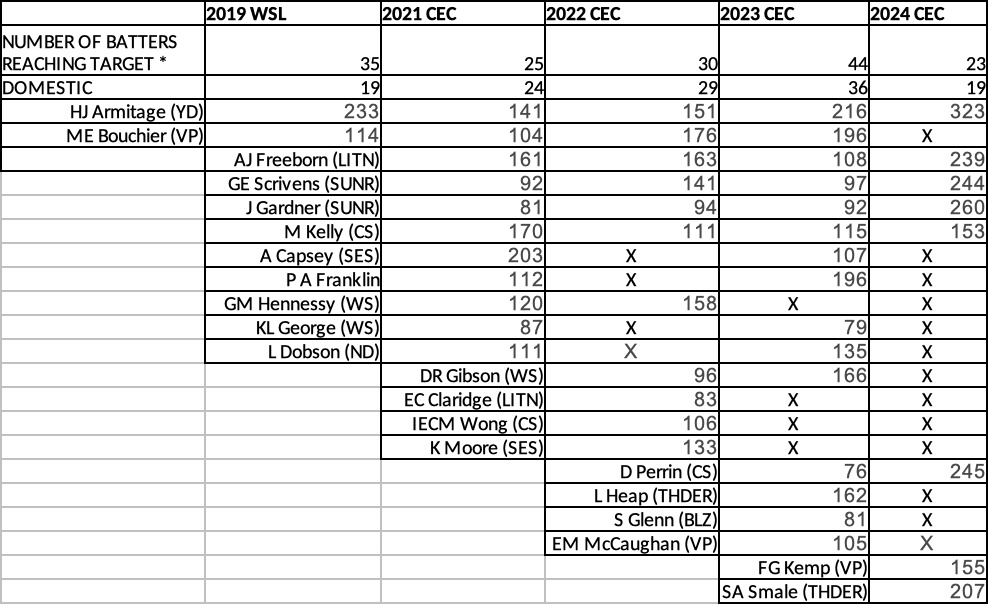
To illustrate this point, consider the highest run scorers in the domestic T20 competitions since 2019 (NB there were no games in 2020).

For each year, the table below shows the total number of batters scoring more than a specified number of runs* and lists all ‘young’ batters (aged under 25) meeting the criterion for the first time (hence ‘emerging batters’) in that year plus the number of runs they scored. The table then tracks their run scoring in subsequent year to distinguish those who have become consistent run scorers and those for whom this was a ‘flash in the pan’.

(* The criterion is 75 runs for 2019-2023 and 150 for 2024 to reflect the higher number of games played.)

Armitage and Bouchier stand out for consistency; one deservedly achieving England honours and one seemingly destined not to. Of the 2020 cohort, Freeborn, Gardner and Kelly have all gone on to the epitome of a cricket professional: reliable and consistent. But all these players are primarily products of their county age group systems and pre-date the professional era. The one ‘new generation’ name is that of Scrivens.

Thereafter, emerging batting talent diminishes in inverse proportion to the increasing professionalisation of the game. From 2020 and 2021 only Gibson probably has the potential to be a genuine (bowling) all-rounder whilst Wong, Glenn and Heap should be more accurately categorised as bowlers who can bat a bit. 

Only in the last 2 years do we see 3 names: Perrin, Smale and Kemp who appear to have the potential to become top class batters; plus of course Alice Capsey.

So after 5 years of academies and considerable investment, we end up with a list of just 5 possible long-term England batters. 

This doesn’t seem like a good return. There are only 2 explanations: (1) The talent doesn’t exist, or (2) the academies and the regions have failed to develop that talent. The first is self-evidently not true – there’s a huge amount of talent on display in every CAG match.

So, what’s going wrong?

Players are selected far too early. Latent and slow-developing talent is squandered. 

With increased prize money on offer, teams (understandably) prioritise winning over player development. And in most teams this means stuffing your batting top order with proven players who can ‘do a job’. The trouble with this approach is that the vast majority of these players have plateaued in terms of skills (as evidenced by their run scoring and strike rates) and consequently the game as a whole isn’t evolving. Younger players either get shoved down the batting order or don’t get picked at all.

What can be done about it? 

The ECB’s plans to address this (Tier 2, etc.) remain vague whilst their ongoing refusal to discuss continuing to run an amateur women’s team in each Tier 1 county will see hundreds of talented girls and young women give up on the sport and huge amounts of talent will go undiscovered.

It’s a simple fact that you get better, faster by playing against people who are better than you. The great former players learnt their game playing “men’s” cricket (Lydia Greenway for instance captained a premier club and scored a century in premier league cricket) but now talented young players are ensconced in the academy set-up from an early age with their workload managed and often banned from playing club cricket. The best batters need to play against the best bowlers possible – which for the foreseeable future means Saturday club cricket. 

The Academy players similarly need to be challenged. One easy way would be for them to enter a mid-week T20 league. (Southern Vipers did this some years ago – and the team went on to win that league.)

Playing for a team in e.g. New Zealand over the winter might be fun, but it’s essentially the same issues outlined above with a different accent. The over-dominance of slow bowling in the women’s game will remain a problem until players learn how to play it better. (An often-barely-spinning ball delivered at 45mph should be going to the boundary, not picking up wickets.) Similarly, going on a 10-day pre-season tour might be good PR but it’s a costly indulgence especially when all the team does is play their domestic rivals in a warmer climate. Instead, why not form a partnership with a school in Sri Lanka and send 5 batters to spend 4 months there – coaching during the day and then getting 2 hours in the nets against the best bowlers every afternoon. (This would also help with life skills and getting coaching qualifications for post-career.)

And finally put some youngsters up the order. If they fail, then the dependable experienced players can come in and restore order. But if they come off, we’ll see higher scores and – hopefully – if this analysis was repeated in a few years far more new names appearing.

ENGLAND v NEW ZEALAND: 4th T20 – Start The Tube

With drinks being taken at the 10-over mark in England’s innings at the Oval this evening, some of the 16,500-strong crowd began to file out of the ground to beat the queues for the tube. It was a sign of two things, both positives for England – first that we are starting to pull-in those more casual fans who are happy to miss the end of the game to avoid the crush getting into Vauxhall Underground; and second that by that stage, the game was very-much done and dusted. And indeed, 9 balls later Nat Sciver-Brunt-Gate (as she will be known for the purposes of this report, having opened a new gate in her name here at the Oval this week) hit the second of two consecutive 4s to get England over the line.

England were good; but the cold, hard truth is that New Zealand were so bad with the bat that the result was a foregone conclusion by the halfway point in their innings, with Sophie Devine having (somewhat optimistically, in retrospect) chosen to bat.

New Zealand got through the powerplay unscathed, but having put a mere 33 runs on the board, with both Suzie Bates and Georgia Plimmer struggling to get the ball off the square. Plimmer was announced on the PA as the “Vitality Powerplayer” by virtue of having hit 17 off 20 balls, and just a single 4; Bates at the end of the powerplay was on 15 off 16, again with only the sole boundary to her name.

Plimmer was dismissed the first ball after the powerplay and yet another Kiwi Kollapse™ ensued, from 33-0 to 42-4. The White Ferns did go the distance, just about, finishing on 103-8; with 10 overs having produced 4 or fewer runs. Sarah Glenn was left literally face-palming after probably the worst legal delivery she has ever bowled resulted in the wicket of Melie Kerr, caught on the pull at midwicket off one that pitched closer to the bowler than the batter; but it was New Zealand who should have been embarrassed by their performance on a pitch that’s middle name was (as England later proved) “Entertainment”.

None of this is to say that England bowled badly – they were efficient and (as Sarah Glenn likes to put it, in what must be her favorite cricketing cliche) kept the stumps in play; but in terms of New Zealand terrible / England good, the ratio mostly fell on the side of New Zealand terrible.

England stepped out and partied in their reply though – it took them just 3 overs to pass New Zealand’s dismal powerplay total of 33, and by the time the field went out, they’d reached 64-1 – that’s 200 territory, which is the mark of a really big innings in this format.

At Canterbury on Thursday, Sophia Dunkley looked a very mixed bag early doors, but got better to finish on 35 off 26. Here she went big from the off, building on the confidence from that Canterbury knock. Ironically, she scored fewer runs here (26) but they were much better runs, at a Strike Rate of 163. England did then lose wickets – 3 of them, of which two (Dunks and Danni Wyatt) were just “We’ve already won this” shots.

England’s one concern may be the way Melie Kerr totally flummoxed Alice Capsey, suggesting that maybe… just maybe… England’s problems playing spin haven’t totally hopped on the tube to Balham, but are still very much with us – I guess we’ll find out in Bangladesh in October!

It was however entirely appropriate that losing those couple of wickets meant that it was Sciver-Brunt-Gate who took the final bow. If Surrey have any sense (and you have to assume they have) they will currently be on the phone daily to her agent to get her to re-sign for the county she grew up representing next season, even if she is unlikely to play many matches. She hasn’t played a single game of regionals for Blaze this year, and almost certainly won’t now, with England heading to a pre-World Cup camp in the Middle East when the RHF Trophy resumes after The Hundred. But nonetheless, she’s “the” name in women’s cricket right now, and even if just for the marketing kudos, getting her aboard would be another feather to add to the 3 Surrey already have on their cap – 4 feathers, anyone?

ENGLAND v NEW ZEALAND: 3rd T20 – Devine’s Glory Day Not Quite Enough

Like the Sugababes smashing Glastonbury, Sophie Devine brought back a glimpse of the glory days, hitting 37 runs off 12 balls in the last 3 overs to give New Zealand something to bowl at; but in the end it was Alice Capsey, still (just) a teenager at the other end of her career who smashed and grabbed her way to 67 – her highest score for England – to get England over the line in the final over.

Devine looked devastated and on the verge of tears at the end, having got so close to a win after what must feel like one of the longest, hardest tours of her storied career.

We’re now 5 years on from Devine’s Purple Patch between 2015 and 2019, when she hit at a Strike Rate of over 120 in T20s for 5 consecutive seasons. The past couple of years, she’s struggled even to break the 100mph barrier; and it looked like more of the same today – coming into the last 3 overs, she was 21 off 30, at a Strike Rate of just 70, with New Zealand 100-6 and looking like posting yet another sub-par total. But a series of spectacular hits from Devine got them to 141, with even Sophie Ecclestone going for 12, and Freya Kemp adding a 13-run over to the 18 she conceded off her 2nd, finishing some way England’s most expensive bowler.

It was not a good day for Kemp with the ball yet again, but to be fair, her moment was to come later.

Having lost Maia Bouchier to a duck off the first ball of the innings, Alice Capsey joined Sophia Dunkley in the middle, hitting her first ball for 2, and her first boundary off the second delivery she faced. Dunkley took longer to settle – there is never a dull moment when she is at the crease, but half the time it is for all the wrong reasons. From the mistimed pulls somehow dissecting the fielders backward of square, to the French cuts trickling past leg stump, Dunks gave us the full range of heart-in-mouth moments, whilst also whacking a few boundaries to keep the scoreboard ticking along. She finished with 35 off 26, which… sounds better than it mostly looked! But that’s Dunks, and as long as others around her can play a less frenetic role, those runs can be crucial, as they proved today – if she’d made (say) “only” 26 off her 26, England’s path to victory would have been that much trickier.

With Dunks falling in the 9th over, and Nat Sciver-Brunt following for another first-baller – the 4th of the day – England needed Capsey and Amy Jones to stick around and stabilise things, and they were able to do that with New Zealand giving them more lives than a herd of cats, thanks to drops in the field. At the half-way point in England’s innings, it was 50/50, pretty much, with WinHer showing England only just having the edge.

England continued chugging along, but as we moved into the death phase, with Capsey playing the anchor role, Amy Jones needed to accelerate, but didn’t quite look like she was going to. Were New Zealand finally about to grab their first win on this tour?

But it was then that New Zealand made the mistake which possibly cost them the match. With Jones looking for a quick single and Capsey hesitant, Jones needed to get back to her ground. Sophie Devine threw it in… Melie Kerr took down the stumps… and the game was lost because of it. It brought Freya Kemp to the middle, who unlike Jones, immediately did look like hitting the allmost 10-an-over England needed, and proceeded to do so. It wasn’t quite as spectacular as Devine had been earlier in the evening; but Kemp’s 16 off 8 was what got England over the line with 4 balls to spare.

It was not a win England particularly deserved, and though Heather Knight, sitting this one out flitting between the balcony and the commentary box, was not really missed with the bat, we did see again why the answer to the captaincy succession does not lie within the current team – there was a lack of leadership out in the middle, which would be making me twitch if I was the man in charge of these things. England have decided to use this series to experiment and play scenarios, but today showed why the one scenario they really need to play is Knight’s retirement – there is obviously no chance of Grace Scrivens playing a part in this series, which means the only option now is to parachute her straight into the captaincy in Ireland. Yes – it sounds just as mad now, as when I first suggested it, but look at today and tell me there is a better option?

ENGLAND v NEW ZEALAND: 2nd T20 – Shore Leave!

England took a 2-0 series lead against New Zealand, winning a rain-shortened match at Hove by 23 runs on DLS.

England made two changes – bringing in Lauren Bell for Linsey Smith, and Dani Gibson for Freya Kemp – presumably with giving Bell and Gibson game-time and the opportunity to show what they can do, rather than dropping either Smith or Kemp. (Smith bowled well at Southampton, while Kemp played a key innings with the bat, and though Kemp didn’t bowl well, England’s management would probably have just been pleased that she got through 4 overs without breaking down.)

New Zealand also made changes, including bringing back Leigh Kasperek for her first game for the White Ferns since an outing against Sri Lanka almost exactly a year ago – reward for a decent home summer that saw her finish as the second-highest wicker-taker in both the Super Smash and the Hallyburton Johnstone Shield.

Heather Knight said at the toss that “you’ve got more time than you think” batting in these shortened games, but England’s batters came out swinging with the wild abandon of a shipful of pirates on shore leave – none more so than Sophie Ecclestone, who for the second time in her career finished her innings with a Strike Rate of 600 by smashing the final ball of the match for 6, having previously done it in an ODI against West Indies in 2019. (I’m pretty sure that she is the only player to have done this, but if anybody knows better, let me know!)

England’s approach of trying to blast the ball up into the night sky and out of the ground largely paid off with the reduced overs. 89 was a decent total, at a run rate which would have netted them 198 in a full 20 overs, though of course because it cost them 6 wickets they would have been bowled out playing like that in a full T20.

On a night where fortune favoured the bold Alice Capsey, who top-scored here against Sri Lanka last summer, did it again making 28 off 16 balls before failing to read a changeup from Kasperek – perhaps an inevitable consequence of the strategy of semi-premeditated shot selection without which she wouldn’t have got the runs she did.

Heather Knight was the only one who really heeded her own advice of not trying to swashbuckle it out to sea, and consequently put in an effective cameo, adding 15 off 8 at the back end.

It was the kind of total that Sophie Devine and Suzie Bates would have had a shot at back in their “Smash Sisters” prime, but neither are quite generating the power they once did, and no one else in the New Zealand lineup is stepping up – Melie Kerr can effectively manufacture runs when she has a bit more time, but she isn’t a power hitter either; and regardless of wickets, New Zealand just weren’t getting the runs on the board when play was curtailed by further rain with 6.4 overs bowled – the White Ferns falling short by 23 runs after DLS had its say.

It’s hard to say much about England’s bowling, given that they only bowled 6.4 overs between them, though Charlie Dean was given Player of the Match after taking 2-3 in the one over she bowled, and given that it was already drizzling again by the time Dean came on, maintaining any degree of control as a finger-spinner was certainly impressive. Lauren Bell also looked fiery in her one over, which was important given that England will be looking to her to continue her turnaround following her 5fer in the final ODI.

England did field a bit better than they had at Southampton, though Nat Sciver dropped another sitter; but again, it is hard to judge anything much on such a short thrash. Let’s hope for better weather and some more meaningful outings in the remaining 3 matches, at Canterbury, The Oval and finishing-up at Lords – the final games England’s 1st XI currently have scheduled prior to the World Cup in October*.

* There are 3 ODIs and 3 T20s in the calendar against Ireland in September,  but England have said they will effectively play a 2nd team in that series.

The CRICKETher Weekly – Episode 224

This week:

  • ⁠Afghanistan women in exile ask for help from ICC – will they get it?
  • England v NZ – Returns to form for Capsey, Bell & Kemp
  • ⁠Would this NZ team beat NZ from 2018?
  • ⁠Why Hollie Armitage signing for Durham is good news for everyone! (Except Yorkshire!)