OPINION: Wisden and Women – The Watershed Moment

I spend a lot of my life in the British Library, reading back editions of Wisden Cricketers Almanack. To get your hands on a copy, you have to go into the “Rare Books” reading room, sit in a special area and – as security – leave your readers card behind the issue desk. It’s the British Library’s equivalent of the Hope Diamond. The system reflects what most cricket fans know, instinctively, to be true: Wisden is special.

Today’s news – that 3 of the 5 Wisden Cricketers of the Year are women: Heather Knight, Nat Sciver and Anya Shrubsole – is also special.

The Almanack, published since 1864, did not feature women’s cricket until 1938; until then, one would have been hard-pushed, reading it, to see any evidence that women were playing the game at all. But they were, and in 1938 the editor Wilfred Brookes decided they warranted inclusion. “I found a good deal of support for the suggestion that some space should be given to women’s cricket,” he wrote.

“Some space” is perhaps an overstatement, implying something more than the reality: one page of the 1000-page volume would carry a women’s cricket report, having to cover – in approximately 500 words – the entire of the global and domestic women’s game in one calendar year.

Occasionally women broke through the barrier: in 1970, the first full page feature on women’s cricket was to be found, featuring leading England all-rounder Enid Bakewell, who in Australia in 1968/9 had become the first cricketer to score 1000 runs and take 100 wickets on tour. But such coverage was rare, to say the least.

Indeed the standing joke was that the women’s cricket page was to be found languishing near the back of the 1000-page volume, right next to the obituaries. Joking about it was the women’s cricket community’s way of shrugging off the fact that their achievements were often given less space than the Eton v Harrow fixture at Lords.

When Roedean School in Brighton submitted their averages for inclusion in the schools section of the 1991 edition, the editor Graeme Wright said they had presented him with “an editorial dilemma”. It was, apparently, shocking to believe that a girls public school might wish to feature alongside their male counterparts. (They were included, reluctantly, in the 1992 Almanack.)

Gradually in recent years more women have featured within the pages of the Almanack, including – in 2009 – the first woman to be featured as a Cricketer of the Year, Claire Taylor. Then editor Scyld Berry wrote that “there is no element of political correctness or publicity-seeking about her selection. The best cricketers in the country should be recognised, irrespective of gender.” Five years later, in 2014, Charlotte Edwards received the same honour. Still, though, a closer look at Almanacks in the decade between 2000 and 2010 reveals that more words were sometimes devoted to “cricketing wives” than any woman worthy of inclusion on her own merit.

It was not until 2015 that a full “women’s cricket” section was introduced, in the same year as the Leading Woman Cricketer in the World was inaugurated as a separate award – both the brainchild of current editor Lawrence Booth. Meg Lanning was the first recipient; Suzie Bates, Ellyse Perry and now Mithali Raj have followed in her footsteps.

Today, in 2018, we have women not just inside the pages of the “Bible of cricket”, but a triumphant Anya Shrubsole adorning the front cover as well.

There are many women in times gone by who would have been worthy Cricketers of the Year: Myrtle Maclagan, who hit the first ever century in an Ashes Test, in January 1935; Rachael Heyhoe-Flint, who in 1973 organised and starred in the first ever cricket World Cup; Cathryn Fitzpatrick, still the fastest bowler to have played the women’s game. To have ignored them has always been Wisden’s loss, not theirs.

Today, though, is a time to look forward, not back. This is not the end of the story for women’s cricketing equality – it never is – but it matters because Wisden matters. It represents – it is read by – the conservative cricketing establishment which ignored the women’s game for far too long. Suddenly, now a woman is on the cover, it becomes simply no longer possible to ignore women’s cricket. That’s worth celebrating.

NEWS: Lancashire Captain Fairclough Retires

Lancashire captain Megan Fairclough has announced her retirement from county cricket in order to pursue a new life with her partner in Milan.

Fairclough, who captained Lancashire to the T20 and County Championship Double last year, played 11 seasons for Lancashire, taking exactly 100 wickets for the county, with best figures of 4-9 versus Durham in 2015.

Fairclough took over the captaincy at a difficult time, following Lancashire’s ignominious relegation from Div 1 after losing all their matches in 2015; but she led them back to promotion again the following year, and then to their double-triumph in 2017.

Talking to the Bolton News, Fairclough said:

“I’m 26 years old, so it’s an early retirement. You never say never. If things change and I come back to the UK or go somewhere else more dominated by cricket, of course I’d look at playing again.”

“I wish the girls and the coaching staff all the best. I will be following from Milan.”

STATS: India v Australia v England Tri-Series – Bowling Rankings

This Tri-Series was a batsman’s paradise if ever there was one. Good pitches meant batsmen were rewarded – and bowlers punished – with an average run-rate of 8.09 runs an over across the whole tournament. As Martin Davies of Women’s Cricket Blog put it after the Aussies posted 209 against England: “Who’d be a bowler?”

In this environment, one bowler stood out above all the others – not only did Megan Schutt take more wickets than anyone else, but she did so at an Economy Rate of 6.28. Now 25 years of age, Schutt is practically middle-aged in cricketing terms, and like South Africa’s Marizanne Kapp seems to have figured out that having a plan… or perhaps more accurately having lots of plans, and sticking to them like superglue… is actually the bowler’s most valuable weapon of all.

Having been dropped in 2014, medium-fast seamer Delissa Kimmince made her come-back for the Southern Stars in the T20 round of the Women’s Ashes, and her performance on this tour to India has validated that recall, with 8 wickets at 7.76.

But will Kimmince be in Australia’s starting XI in the West Indies at the World T20? Well… an interesting point made by Snehal Pradhan on our recent podcast was that the pitches here have been very good and friendly to the quicker bowlers. Seamers dominate this list – unusually for a women’s tournament, especially one held in the sub-continent – but will the pitches be the same in the West Indies? Or will they be slow turners that produce a very different list come November?

Player Matches Wickets Economy
1. Megan Schutt (Australia) 5 9 6.28
2. Delissa Kimmince (Australia) 5 8 7.76
3. Ashleigh Gardner (Australia) 5 6 7.18
4. Jhulan Goswami (India) 4 5 7.90
5. Poonam Yadav (India) 4 4 7.20
6. Ellyse Perry (Australia) 5 4 7.94
7. Deepti Sharma (India) 3 4 8.22
8. Jenny Gunn (England) 4 5 9.42
9. Radha Yadav (India) 2 3 7.85
10. Tash Farrant (England) 4 3 8.08

Bowling Ranking = Wickets / Economy

STATS: India v Australia v England Tri-Series – Batting Rankings

Perhaps unsurprisingly after becoming only the second woman to make two T20 hundreds, England’s new T20 opener Danni Wyatt tops the batting rankings for the T20 Tri-Series, with 213 runs in total. Although over half her runs came in that century innings of 124, she only had one real failure – 6 in the penultimate group game versus Australia – and even then she maintained a Strike Rate of over 150, finishing the tournament with the leading Strike Rate of 182.

It has to be said though that although the numbers (just) favour Wyatt, second-placed Smriti Mandhana was actually the most impressive batsman in the tournament – playing just 4 innings to Wyatt’s 5 due to India not making the final, she too had one failure (3 against Australia) but she passed 50 in each of the other 3 innings she batted, making 67, 76 and 62* at a Strike Rate of 165.

Despite having sat out of one game, Meg Lanning makes the list at No. 3, after her explosive performance in the final, scoring 88* at a Strike Rate of 196 as Australia made their record total of 209. Perhaps the most interesting aspect of that innings is that she did it mostly in 4s – 16 of them, to just the 1 six.

Player Matches Runs Strike Rate
1. Danni Wyatt (England) 5 213 182.05
2. Smriti Mandhana (India) 4 208 165.07
3. Meg Lanning (Australia) 4 175 162.03
4. Elyse Villani (Australia) 5 157 134.18
5. Nat Sciver (England) 5 155 134.78
6. Beth Mooney (Australia) 4 120 136.36
7. Tammy Beaumont (England) 5 120 134.83
8. Ashleigh Gardner (Australia) 5 93 172.22
9. Rachel Haynes (Australia) 5 88 149.15
10. Anuja Patil (India) 4 75 156.25

Batting Ranking = Runs * Strike Rate

NEWS: Australians Take GPS Tracking To The Next Level

In a revolutionary new program, the Southern Stars are set to work with researchers from the Sydney University of Medicine, to pioneer the use of advanced GPS technology to track them both on the field and off.

In recent years Australia, in common with other top teams, have used on-field GPS trackers which are worn via a small harness attached across the shoulders; but this setup was designed for men and is uncomfortable to wear with a sports-bra, so the professors at SUM have come up with an alternative where the tracker is surgically implanted directly into the spine of the player.

Dr April Fulio, Dean of Cyber-Medicine at SUM, speaking at a joint airport press conference following the Southern Stars triumphant return from India, explained:

“It is a quick and relatively painless procedure, which has been used for years to microchip cats and dogs – these gizmos are getting smaller and more functional ever year, and the latest generation trackers are little bigger than a fun-sized Mars bar, making them ideal for surgical use.”

“As well as tracking their mileage on the field, the new tech has advantages off the field as well – if any of them ever gets lost, it will be as simple as taking them to the nearest vet, who will be able scan them in and return them to their family.”

One leading Australian player told CRICKETher: “Everyone already thinks I’m a robot, so I thought, why not!”

Meanwhile, another said: “Hang on… relatively painless…?” before making a quick dash for the nearest emergency exit.

OPINION: Alyssa Healy’s Sporting Gesture Shows The Way For Australian Cricket

Ravi Nair reflects upon a moment from today’s tri-series final between England and Australia, which took place earlier today in Mumbai

About mid-way through England’s innings, as they were attempting to chase down Australia’s mammoth total of 209, Amy Jones hit the ball deep and was called back by Nat Sciver for a second run. She never looked like making it; the ball hit wicketkeeper Alyssa Healy’s gloves and almost simultaneously the stumps were knocked askew. But Healy turned away glumly and shook her head at her colleague, Ellyse Perry.

The umpires were baffled, as they were prepared to give the run-out without even going upstairs, but Healy refused to appeal, saying she had knocked off the bails with her gloves just before the ball hit them and she then knocked the stumps sideways. She didn’t have time to go for the keeper’s back-up, of gathering a stump in her hands and uprooting it.

Jones was halfway to the Pavilion when the umpires called for a television review (perhaps some of the other Australians had instinctively appealed, as most of us spectators did) and, after three long minutes, confirmed what Healy had said. Jones’ innings continued, even though it did not eventually make a difference to the outcome of the match.

Australians apparently like their sporting heroes to play “hard but fair”. After and this action of Healy’s, I’d suggest they would have been better off following the fortunes of their national team in India, as opposed to the one in South Africa.

MATCH REPORT: Australian Practice Makes Perfect in Tri-Series Final

By Ravi Nair in Mumbai

Australia (209-4) comprehensively beat England (152-9) by 57 runs

A phrase apocryphally attributed to Gary Player goes: “The harder I practice, the luckier I get.” An earlier version of the phrase attributes luck to knowledge, instead. Today Australia’s practice and experience came together to show that they deserved all the luck they got, as they comprehensively beat England, despite batting first.

England’s chase eventually fizzled out as they chased Australia’s record T20 score of 209, a total powered by an unbeaten 88 from Meg Lanning, who does not have an average in this tournament, having not been dismissed throughout.

But practice, and perfection, showed up most in the difference between the fielding of the two sides since, once the batters got their hitting hats on, the bowling often seemed irrelevant. Alas for England, their newest players, Bryony Smith and Alice Davidson-Richards, were responsible for most of England’s fielding lapses, giving away boundaries and, on one occasion, letting a catch through the hands that might have made a more substantial difference to the result. Smith, in particular, had a tournament to forget, with both these fielding slips, and her lack of runs, proving a weak point for this young and developing England side.

As per usual, Australia’s Alyssa Healy and Beth Mooney opened positively and took advantage of England’s slightly slipshod fielding. Then Tash Farrant had a huge slice of luck as Mooney was judged out to a delivery that, upon reflection, was clearly missing the leg stump. Later in the over though, the umpire didn’t make the same mistake, recognising the movement she got and rejecting an LBW shout for a delivery of prodigious movement, bowled from outside leg, pitching on middle, and turning so sharply it was missing leg.

Ash Gardner took full advantage of her let-off to join Healy in a stand that helped set up Australia’s monstrous total. Farrant lost her line entirely when put in on only her second over against the two “set” bats (it’s OK to call a batter “set” once she’s faced six deliveries in a T20, right?)

Luckily Gunn, taking pace off the ball, but not guile, induced a top edge that did for Gardner, and then had Healy going far outside leg and cutting onto her own stumps. But that was the last consolation England had, with Lanning and Elyse Villani joining each other at the crease.

Villani clearly has talent, and has worked on it over the last few years, making the most of what she has and turning herself into a bat that Australia can rely on. This is not to say that Lanning doesn’t work hard: it is just that when Lanning plays she seems to define the notion of timing, of using the crease, of easily making the bowlers look impotent. And she does it all with a cold-eyed look that could, you imagine, outstare the sun itself.

She put the English fielders under even more pressure than before, scoring fours apparently at will, down the ground and square of the wicket. Her timing and placement are so good she doesn’t seem to need the “360 degree” tricks of players like Tammy Beaumont. She never needed to sweep, or ramp a delivery; why would you when you can cut, loft and pull the ball for four?

When Villani finally got the opportunity to join her and get her eye in, we saw a slightly more conventional T20 innings, with two reverse swept fours followed by a conventional one to take advantage of the hole made when the fielder moved from fine leg to deep third man. In short, for fans of runs, runs, runs, this was paradise.

Dani Hazell was standing in as England captain for Heather Knight, who has a hamstring twinge. Knight’s form has not been such this series to believe that England missed her runs, but they may have missed her presence in the field: after all, the only match in their tour that Australia have lost is when Lanning didn’t play and Haynes was in charge. No matter what bowling changes Hazell made, Lanning gave us a masterclass in clean, frustratingly good, scoring. Hazell used up, perforce, her “gun” bowlers, Sciver and Gunn, through the middle overs, not because they went for fewer runs, but because they at least had the experience to know when they were up against an irresistible force and treat bowling triumph and disaster just the same.

The match did not involve India, so the free-to-enter crowd in the North Stand was down to a few hundred, if that. But the BCCI had helpfully brought in a number of school age spectators on an outing who took up a substantial amount of the West Stand near the Pavilion, and ensured the game was not played out to lone voices shouting in the wilderness.

Lanning and Villani, between them, showed how to bat first and set a target, to the extent that, even though Villani was out right at the last, and Lanning wanted to push the score along so much she actually forgot herself and hit a six, they still reached a record 209, now the highest score ever in a women’s T20 international.

So England were up against it right from the start. Here is where practice, or experience at least, again showed the difference between the two sides. Danni Wyatt started off, as always, brightly, like an Energizer Bunny on a 9 volt battery. She reminds one of the indomitable Gauls who populate the Asterix comics: nothing can hold her down. Until, of course, the inevitable happened and a lofted drive that should have gone straight through mid-on and to the boundary, was actually clasped by a leaping Lanning. Yes, that woman again, who ensured Wyatt’s adventure was cut off after 34 runs from 17 deliveries.

Even before that England showed that luck was not on their side, any more than experience and, maybe, big-match temperament. In the very first over Wyatt sent back the hapless Bryony Smith, who could only lose her footing disastrously and watch on all fours, as though nailed to the pitch, as she was run out by a delighted Jess Jonassen for a diamond duck. Tammy Beaumont, attempting to be positive, was out to the first ball she faced, nicking off while attempting an expansive drive against Ellyse Perry, who may not have the pace she once had, but can never be taken lightly.

Once Wyatt was out it was all down to Nat Sciver. Or could Amy Jones, perhaps, prove up to the task as well? Jones seems to have modelled herself on Sarah Taylor, standing up to the stumps at every opportunity when keeping and also using drives and flicks along the ground to get her innings going. Unfortunately for her, and England, while this technique, using a closed face of the bat for the most part, is very useful in ODIs, it doesn’t always answer the questions asked by a T20 chase. Eventually, after an innings that showed she has the ability to improvise, and talent to boot, she fell trying to push the rate along in an increasingly desperate chase, metaphorically opening the face of the bat and falling to a top edge to Villani at fine leg as she attempted a paddle sweep.

Even Sciver was not in a position, single-handedly, to somehow make a realistic chase of it for England. Forced to keep running quick singles and twos as the sharp Australian fielding relentlessly cut off the boundaries, she was red in the face and puffing by the time she reached her deserved half century. She was out, immediately after, trying to score in boundaries so she didn’t have to run.

After that it was a regular procession of wickets, with the admirable and excellent Megan Schutt easily having the best of the match figures (3-14), as England’s chase slowly deflated and they wound up 57 runs short, with just one wicket in hand. Schutt, for what it is worth, has not been called upon to bat even once in this Australian campaign, such has been the dominance of their top and middle order bats.

Of Australia’s newer additions Sophie Molineux and Delissa Kimmince have both had some success in wicket-taking, but for the most part they haven’t yet shown that they are up to the standards set by Perry, Schutt and Gardner, among others. For England, Davidson-Richards and Smith will probably want to forget this tournament altogether.

Eventually the ability to keep a cool head and perhaps the luck that comes with practice, ensured a comfortable win for Australia. England shouldn’t feel disgraced, but they know it is going to take a lot more practice before they can get as “lucky” as Australia. In the meantime, three slightly less pressured ODIs against India beckon. For Australia, Lanning can bask in the glory of the Player-of-the-Match award, well deserved, and Schutt in the equally well-deserved Player-of-the-Tournament award. They earned it.

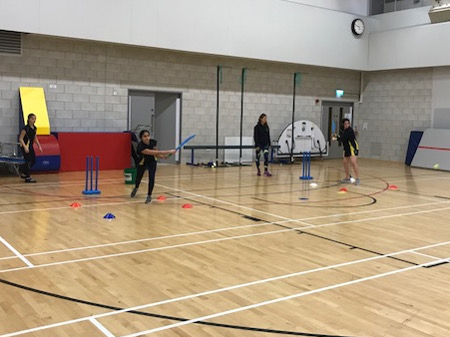
FEATURE: Cricket Taking Off At South Hampstead High School

In the wake of England’s World Cup victory last summer, one of the questions that was asked a lot was: would it encourage more girls to take up cricket?

For one school in London, the answer is an undoubted yes.

South Hampstead High School has recently reintroduced girls’ cricket to its curriculum, after many years of rounders being the main summer sport, and Head of PE Lucy Kench says that the girls are loving it: “We’ve had requests from girls to do more cricket, which is great. The success of the World Cup was a big thing for us.”

Back in the 1930s, South Hampstead High School was a hub of girls’ cricket; England’s Netta Rheinberg learned her cricket there. But somewhere along the way cricket was replaced by rounders – until last year when, following the Department for Education’s decision to remove rounders from the national GCSE curriculum, the decision was made to revert back to cricket.

Why? Lucy explains: “With rounders there’s not a lot of progression. If you play first team rounders at school, where do you then go and play rounders? There’s not very many opportunities.”

South Hampstead is also part of the Girls Day School Trust, a group of 24 leading independent schools, and in GDST schools across the country the feeling is that it is important to provide girls with more sporting options, beyond traditional ‘girls sports’ like hockey and netball. The key aim is to keep as many girls as possible actively engaged in sport in their teenage years and beyond; a range of sporting options is seen as the best way to sustain girls’ interest in sport.

At South Hampstead an indoor cricket club has run across the spring term. This will continue outdoors in the summer term, when Middlesex CCC will provide the girls with coaching. There is also a London GDST Cricket Hub which organises sessions for the girls with ex-professional female cricketers.

Girls Cricket at SHHS

Girls Cricket at South Hampstead High School

Girls from SHHS will also be attending the “MCC Women’s Day” at Lords next month alongside around 4,000 other schoolchildren to watch Middlesex Women play their first ever match on the main ground at Lord’s.

Generally the switch to cricket away from rounders has gone down well, but one issue has been getting teachers on board with the change. “Some people were really against it to begin with,” Lucy explains. “For some teachers who have taught rounders for lots of years, they find it very difficult to adapt the game.”

But GDST teachers have recently benefited from CPD training from Lydia Greenway, who runs nationwide coaching organisation Cricket for Girls and is helping them to understand the best ways to teach cricket to their pupils. “One of the barriers or challenges is getting teachers up to speed with the game of cricket, but also breaking down the barriers that it’s a complicated game, that it’s a technical game,” Lydia says. “And actually empowering them, giving them the confidence, and the skills and drills for them to deliver lessons. They’ve responded really well.”

CRICKETher recently attended a session at South Hampstead and the enthusiasm for cricket displayed by the girls – most of whom had never played cricket before this term – was evident. When asked what they most enjoyed about cricket, answers included: “Being in a team and working together”, and “You work in a team but you keep your own space, it’s nice because it’s not full on tackling and it’s more fun than other sports.”

NEWS: Sophie Ecclestone Wins Cricket Society Award

18 year old Sophie Ecclestone has received this year’s Cricket Society award for Most Promising Young Female Cricketer.

The award, made on the recommendation of Clare Connor, is awarded annually for the young female cricketer who showed the most promise in the preceding 12 months. It has run since 2002, with previous winners including Nat Sciver (2013), Heather Knight (2010) and Katherine Brunt (2004).

While Ecclestone missed last year’s World Cup due to exam commitments, she finished 2017 on a high, helping England draw the women’s Ashes series out in Australia.

She was also leading wicket-taker in Division 1 of the Women’s County Championship, and instrumental in Lancashire “doing the double” last season, winning both the County Championship and the T20 Cup. On the last day of the County Championship she tore through the Warwickshire batting line-up taking 6-12 – the performance that ultimately took them to Championship victory.

The award was presented at yesterday’s Society Lunch and while Sophie unfortunately could not be present to accept it – she is currently in India on England duty – her parents Elaine and Paul were delighted to do so on her behalf.