OPINION: Women’s County Champs v WNCL – The Strange Case of Kara Sutherland

How does the standard of England’s Women’s County Championship compare to Australia’s Women’s National Cricket League? Perhaps one player’s stats tell a story?

New South Wales’ Kara Sutherland had a pretty indifferent season in the WNCL in 2014-15. In 7 matches, the all-rounder took only 3 wickets at 52 and (admittedly batting down the order) scored just 1 run in 4 innings, averaging 0.5 thanks to a couple of not-outs. Looking back at previous years, the story is a similar one: Sutherland is a very good club player, who probably isn’t quite classy enough to play at the highest level of domestic cricket in Australia.

Consequently, it was something of a surprise when Kent – England’s reigning county champions, and home to (among others) England captain Charlotte Edwards and four other contracted England players – signed Sutherland as their “overseas” for the 2015 Women’s County Championship.

But watching Sutherland play for Kent against Berkshire and Ireland in the T20s, however, was something of a revelation – she looked pretty good, bowling at a similar pace to Daisy Gardner, who I rate as probably the best “county” bowler (excluding England and Academy players) around at the moment; and Sutherland’s stats reflect this. So far this season, she has taken 9 wickets at 21. Meanwhile with the bat, she averages 16 – not spectacular… but a lot better than 0.5!

As commentators, we’ve often wondered about the relative standard of the Women’s County Championship compared to the WNCL; and it is usually taken as a “given” that WNCL is the stronger.

But it can be difficult to find hard facts to back-up this hunch; and that is why The Strange Case of Kara Sutherland is so interesting. A player who struggles in WNCL but looks pretty good in the Women’s County Champs? I’d say this was rather strong evidence that domestic cricket in Australia is of a much higher standard than it is here… and that is a big part of why we need the ECB’s new Womens Cricket Super League to succeed in its mission to strengthen our domestic game.

OPINION: What Has Wyatt Got To Do?

When England’s Women’s Ashes ODI squad was announced earlier this week, the omission of Danielle Wyatt was no great surprise to followers of the women’s game. But it does beg the question: just what has TAFKAW* got to do to get selected for England outside of the T20 arena?

Even in T20s, Wyatt has had little opportunity to shine at international level recently. Since the contracts were put in place last year, she has played 6 T20s – three against South Africa last summer, and three versus New Zealand over the winter. But in those games, she has bowled only once, taking 0/5; and batted just twice, scoring 0 and 7. So whilst it is true that she could have made more of her opportunities… when those opportunities are so few and far between, is it really fair to expect her to instantly be able to just ‘turn it on’ at the highest level?

Meanwhile, Wyatt’s form at county level has been superlative – hitting runs all over the place, and averaging over 40, with a highest score of 102 in domestic cricket this season. Even her bowling seems to be getting back on track – we have seen her bowl twice this season and while she wasn’t turning it like Holly Colvin at Billingshurst, not many would be; and she has nevertheless done a job, taking 6 wickets at 29, and bowling very few bad balls.

In contrast, Georgia Elwiss, who was selected, has NOT had a great start to the county season – she averages just 19 with the bat, with a highest score of 34; and has taken only 3 wickets with the ball.

But Elwiss did have one opportunity which Wyatt did not – she was selected for the Academy tour of the UAE, where she made a hatful of runs against Australia’s youngsters – the Shooting Stars.

However, we must then raise the question: is scoring hundreds at county level really so much less valuable than making runs against a very inexperienced Shooting Stars team, in a series of “jumpers for goalposts”** matches on a road in the UAE?

Apparently, the England selectors think so… but I’m not so sure!

————
* The Artist Formerly Known As WAG!
** These games were NOT played under standard international playing conditions, with teams effectively making substitutions and batting on when technically All Out.

MATCH REPORT: Youngsters Shine for Lincolnshire in T20 Triple-Header

Beth Smith reports from Ellesmere College

On Sunday in the latest round of county T20s, the Imps travelled across to Shropshire with their youngest side of the season so far – 5 U15 players making their Ladies’ debut. The first game for Lincolnshire was against Northumberland who they had previously lost to in the 50-over format. Captain Hayley Butts won the toss and put Northumberland in to bat.

With Sarah McDowell playing behind the stumps for the day and the regular opening bowlers not playing, Beth Smith was handed the ball for the first over. Lincs were alert in the field from the start, gaining a run-out with the first ball of the day! The second over went to one of the debutants, Sammy-Jo Boothright (1-21), who combined with another debutant, Charlotte Moore, to pick up her first senior wicket, leaving Northumberland 5-2.

The scoreboard ticked over slowly and there were some chances put down in the field by Lincs, but this altered with a catch at gully by the captain, giving Smith her first wicket of the day. A small partnership formed before quick hands by McDowell removed Sergeant off Smith’s bowling. Two more quick wickets by Smith (4-22) left the batting side 46-6 inside 10 overs.

Rachael Dyer came on and bowled very economically for no wickets (0-6), followed by U15 debutant Olivia Clark (0-5). At the other end opening U15 bowler Megan Quinlan (1-11), also making her debut, took the only other wicket to fall in Northumberland’s innings, combining with U17 Alexia Page-Graves. Northumberland ended at 93-7 so Lincs required 94 for victory.

There was a sense of de-ja-vu as Smith was caught out to only the second ball of the Imps reply. This brought Page-Graves to the middle to join U17 captain Becki Brooker. The duo had built a platform for a partnership before a ball popped, clipping the shoulder of Page-Graves’ (14) bat, giving a simple catch for the fielder at slip. McDowell (4) came to the middle and managed a boundary before being caught in front of the bat bringing Butts to the middle.

Brooker (15) looked to be in good form until she went to play across a ball that kept very low off the pitch, bringing Dyer to join Butts at the crease. The two batted well together getting ever closer to the target, but Butts was then bowled, leaving Dyer to take on the senior role, as four of the U15’s joined her one after the other in the middle. In the end it was Dyer (20*) and Boothright (7*) who saw the Imps over the line, in a game that the Imps felt was much closer than it should have been.

The parallel first game saw the hosts post 99-8 off their 20 overs. Cumbria were 46-8 after 14 overs before the heavens opened, and the rain-affected game meant Shropshire won on run rate. Lunch was taken as the rain continued to fall; this resulted in a 3hr delay before the second games could get started, and saw each match reduced to 10 overs.

In Lincolnshire’s second game, against Shropshire, Butts won the toss and elected to bat. Lincs struggled to set a target of 47-5 from their 10 overs on a pitch that could do anything at any moment, as Brooker found out when bowled first ball. Page-Graves came to join Smith at the crease with the aim to score quickly, with the game only being 10 overs. However, she swung and skied her second ball straight to a fielder leaving Lincs 3-2.

Butts (4), Smith (11) and McDowell (5) were the last three wickets to fall, leaving Dyer and debutant Hermione Baxter-Chinery to push the score as high as they could – Baxter-Chinery showing her pace to get 3 off the last ball.

Shropshire were strong in reply. The Imps managed to take 1 wicket when two of the young guns combined with Baxter-Chinery taking a high catch off Quinlan’s bowling, but Shropshire reached the target within 5 overs.

The game between Northumberland and Cumbria ended with Cumbria reaching their target of 52 in 9.1 overs for the loss of 3 wickets.

Although there was only one result going the Imps way, it is a very good sign of the talent coming through the Lincs set-up, and it will not be the last time these girls get a call-up for the Ladies. It was a very proud moment for this reporter to play alongside 5 of the girls from the junior team she manages, and she could not have been happier with the performances they each put in.

Scorecards for the above matches can be found here.

MATCH REPORT: Kent Storm Ahead in T20 Triple-Header

Two consecutive victories for Kent in Sunday’s round of Twenty20s at Arundel saw them emerge as front-runners in this year’s competition, as the only division 1 team so far unbeaten.

Speaking to CRICKETher after the two wins, Kent opener Tammy Beaumont said that Kent had particularly relished their victory against Sussex, which came in the two sides’ first encounter after the controversial tie at Beckenham earlier this season.

“We’ve put what happened last time behind us, and it was played in a very good spirit, but it’s always nice to come out on top against Sussex.”

“It feels really good.”

Kent’s triumph over Sussex came by just 4 runs as Sussex failed to chase down their target of 114 despite Sarah Taylor’s 48*.

The match had begun in overcast, damp conditions after a half-hour rain delay, and Sussex duly put Kent in to bat after winning the toss. Izi Noakes struck immediately, removing both Tammy Beaumont and Lydia Greenway for 1 run apiece – Beaumont lbw and Greenway bowled.

But a 66-run partnership between Charlotte Edwards and Laura Marsh, aided by some sloppy fielding from Sussex, saw Kent recover to 73-2 after 13 overs.

A spell from Erin Osborne (who finished with 3-14) eventually helped to stem the flow of runs, as Kent ended on 113-7.

It looked an eminently chaseable total, but an excellent opening spell from Tash Farrant (2-13) put Sussex on the back foot, with both Georgia Adams (bowled for 3) and Georgia Elwiss (caught behind for 16) dismissed early.

Sussex struggled throughout the innings to keep up with the rate, hitting no boundaries at all between the 12th and 20th overs, as Kent’s excellent fielding ensured that they were consigned to running singles.

Sarah Taylor was left needing to hit a maximum off the final ball of the match, but managed just one run. Kent were notably careful to avoid premature celebration as Edwards – who had once again elected to bowl the final over – removed the bails at the non-strikers end!

Kent followed this up with a 21-run win over Middlesex, setting an impressive total of 135 thanks to a 62-run partnership from Edwards and Greenway, which Middlesex’s batsmen failed to chase down.

After Tammy Beaumont was stumped off the bowling of Danni Warren in the 3rd over, both Edwards (43) and Greenway (35) looked in good touch. When Edwards was caught by Millie Pope at cover in the 14th over, Greenway and Marsh (30) continued to attack the Middlesex bowlers.

Middlesex were fresh from chasing down 136 against Nottinghamshire in the last round of T20s, and when Farrant’s first over went for 10 (including 7 wides) it looked like they might be able to repeat the feat. But it was not to be. After Sophia Dunkley played onto her own stumps in Kara Sutherland’s opening over, a 3-over spell from Marsh, in which she conceded just 14 runs but removed both Fran Wilson and Anna Nicholls, put a huge dent in Middlesex’s ability to make the total. Despite a fighting 35-run partnership between Beth Morgan (15) and captain Izzy Westbury (30), they eventually fell a long way short of the runs required.

A disappointing day for Middlesex concluded with a second loss to Sussex, in a tight game which eventually saw Holly Colvin (27*) hit the winning runs with 2 overs to spare.

Having won the toss and elected to bat, Middlesex were left 17-3 as ferocious opening spells from Noakes (2-21) and Freya Davies (1-20) ripped through their top order. Wickets continued to fall, but a fluent innings from Wilson (64*) – the highest individual score of the day – saw Middlesex post a competitive total of 118-8.

Once again Sussex suffered from an early set-back in their run-chase, this time thanks to a triple wicket-maiden from Warren, who dismissed Adams (caught at mid-off), Elwiss (lbw) and Schofield (also lbw) to leave them 11-3 after 3 overs.

After Westbury had Taylor stumped for 21 in the 13th over, it was left to Alexia Walker (40) and Colvin to steady the ship, as the two shared a 30-run partnership. There was still time for some last-minute Sussex nerves when Walker was herself stumped in the 17th over, with 12 runs still needed – but Colvin finished with two boundaries to see her team over the line.

The next round of T20s will be played on 2nd August when all teams will be without their England players. For Middlesex, who are without a contracted player in their squad, it should provide an opportunity for a fightback.

England Women’s Ashes Squad

The ECB have announced England’s squad for the Women’s Ashes ODIs, beginning in Taunton on Tuesday 21st July. There are 14 names on the list, and the big news is the recall of Sussex’s Georgia Elwiss. Elwiss was one of only two players to come out of this winter with her reputation enhanced – the other being Middlesex’s Alex Hartley. Both Elwiss and Hartley shone for “The Academy”, England Women’s equivalent of the men’s Lions, the former with the bat and the latter with the ball. It is with the bat that England have struggled more of late, which explains Elwiss’ inclusion in this squad; though Hartley could yet get her shot later, more likely in the T20s than the Test.

Another point of note is the inclusion of Becky Grundy ahead of England’s World Number One Ranked T20 bowler, Dani Hazell. Grundy was set to play a big part in England’s plans last summer, when injury cruelly intervened to rob her of that opportunity, but the selectors clearly rate her, and now she has her chance once again to prove why.

Full ODI Squad:

  • Charlotte Edwards (C)
  • Heather Knight (VC)
  • Katherine Brunt
  • Kate Cross
  • Georgia Elwiss
  • Lydia Greenway
  • Rebecca Grundy
  • Jenny Gunn
  • Amy Jones
  • Laura Marsh
  • Nat Sciver
  • Anya Shrubsole
  • Sarah Taylor
  • Lauren Winfield

ANALYSIS: How Australia’s Top Batsmen Get Out

Australia’s leading batsmen – Jess Cameron, Meg Lanning, Ellyse Perry, Alex Blackwell, Alyssa Healy and Elyse Villani- have collectively been dismissed over 400 times in limited overs internationals*. We run the numbers showing how Anya Shrubsole and the rest of England’s bowling attack will be looking to get them out in this summer’s Women’s Ashes.

Player Caught Bowled LBW Run Out Stumped
Blackwell 38% 17% 15% 23% 7%
Cameron 57% 20% 8% 9% 7%
Healy 54% 17% 10% 13% 6%
Lanning 60% 16% 9% 13% 3%
Perry 52% 14% 5% 23% 7%
Villani 63% 25% 8% 4% 0%
TOTAL 51% 17% 11% 16% 6%

As with England (and as we would expect) the most common mode of dismissal is caught. For individual players the statistically significant figures are highlighted in red.

Jess Cameron and Alyssa Healy (like England’s Heather Knight) have fairly average profiles, and are not particularly susceptible to getting out in one way any more than another.

In contrast, Southern Stars captain Meg Lanning and opener Elyse Villani get caught a lot! (Although Villani hasn’t played that many matches, her % Caught is well beyond any doubts regarding its statistical significance.)

Like England’s Sarah Taylor (who also gets caught more than average) both players like to play their shots; but their style is very different to Taylor’s. Where Taylor tries to go elegantly over the infield, Lanning and Villani are looking to smash it to – and often over – the boundary rope. Tellingly, Taylor’s boundary rate is much lower – 10% of balls faced, while Villani’s and Lanning’s are at 14% and 15% respectively.

The other side of Villani’s game is that she doesn’t get Run Out very often at all – just 4% of her dismissals; probably because… who needs to run when you are hitting it to the rope?

By contrast, Australia’s vice-captain Alex Blackwell is significantly susceptible to being Run Out. Stylistically, she is quite a careful, conservative and unflashy player, at both domestic and international level, so in a way she is the antithesis of Villani, and she just doesn’t play the kind of shots that get Villani caught.

Also, she bats at a similar position in the order to England’s Lydia Greenway, who suffers the same Run Out problem; and so part of the explanation may well be the same too – coming in later on, when the pressure is on to take all the singles that might be on offer, however tight; and more often than not batting with less experienced tail-enders.

Ellyse Perry’s stats look pretty standard at first glance, but hidden behind the numbers shown above is actually something very interesting – compared to her peers, Ellyse Perry doesn’t get out – not very often, anyway! In fact, of all the world’s leading batsmen, she has far and away the highest Not Out % – 40% of her innings ending undefeated.

The underperformance of Australia’s top batsmen was a key reason for their downfall in the 2013 Ashes series in England; it’ll be interesting to see how they fare this time around.

ANALYSIS: Ellyse Perry & Not Outs

Last week we looked at how some of England’s leading batsmen get out. While researching a similar article on Australia’s top order, we noticed something else interesting: Ellyse Perry – the word’s number 12 ranked ODI batsman – doesn’t get out… or not very often anyway! A staggering 40% of her (limited overs) innings end Not Out.

Intrigued, we ran the numbers for the rest of the Top 20 ranked ODI batsmen, plus threw in some other leading names for good measure. Across the group, the Not Out average is 18%. Meg Lanning (admittedly coming in earlier in the order) ends just 9% of her innings Not Out; and even for more comparable players, the numbers max out in the high 20s. Dane van Niekerk, often batting at a similar spot in the order, is 2nd in the list, and her N.O. is 29% – way, way behind Perry.

This raises the question of whether Perry’s cross-format limited overs average of 30 is distorted by this? To an extent it is. If her N.O. was the same as van Niekerk’s (29%) Perry’s average would fall to a somewhat less impressive 25. So if we are using the average as an indication of how many runs Perry might score, it is distorted. But that doesn’t mean to say it isn’t a fair indication of her value to the Southern Stars – after all, you only have one wicket, and giving it away as little as Perry does is clearly a big part of what makes her one of the world’s most extraordinary players.

The Not Out List

Name N.O. %
Perry 40%
van Niekerk 29%
Priest 29%
Raj 28%
Sciver 27%
Greenway 27%
Kapp 26%
Gunn 25%
Knight 20%
Blackwell 19%
du Preez 18%
Cameron 17%
Maroof 16%
Dottin 16%
Kaur 16%
Taylor, SR 15%
Devine 14%
Edwards 14%
Taylor, SJ 13%
McGlashan 12%
Kahn 12%
Lanning 9%
Satterthwaite 9%
Bates 6%
Atapattu 1%

ANALYSIS: How England’s Batsmen Get Out

England’s 4 leading batsmen – Charlotte Edwards, Heather Knight, Sarah Taylor and Lydia Greenway – have collectively been dismissed over 500 times in limited overs internationals*. We take a look at the numbers showing how they got out.

Player Caught Bowled LBW Run Out Stumped
Edwards 49% 19% 19% 9% 5%
Greenway 45% 16% 13% 17% 9%
Knight 47% 20% 12% 16% 6%
Taylor 56% 17% 10% 11% 6%
TOTAL 49% 18% 15% 12% 6%

With the usual caveats about lies, damned lies and statistics, what does this tell us?

Collectively, the most common mode of dismissal is Caught. This is the case throughout all international cricket, men’s and women’s – though the men tend to be caught behind rather more often than the women.

For individual players, the statistically significant numbers (see An Aside on Statistical Significance below) are highlighted in RED.

Sarah Taylor tends to get caught rather more than her peers. She likes to go over the infield, with lofted drives particularly over mid on. It is a tactic which has brought her enormous success, but it isn’t without its risks if she doesn’t actually clear the fielder.

Charlotte Edwards is particularly susceptible to being out Leg Before Wicket; and although the frequency of LBWs has fallen slightly, from 20% earlier in her career to 18% more recently, it remains significant. Is it because she opens the batting? In doing so, she faces the best bowlers at their freshest, swinging it in at pace towards her legs; and if they’ve done their homework, they are probably looking for that decision too! Maybe the England captain also suffers slightly from the man at the other end not having got his eye in yet? (Perhaps that’s the reason for those trade-mark looks of withering disbelief as the ump’s finger is raised!)

Lydia Greenway gets Run Out a lot. Is this because, batting a bit further down the order, England are more likely to be under pressure and chasing every run when she comes to the crease; and so Lydia finds herself taking more risks than her peers? Or perhaps it’s because she finds herself batting more often with all-rounders and tail-enders? Either way, it’s a particular concern this summer given that the fielding of the Aussies is top-notch, and won’t leave much room for confusion between the wickets.

Finally, Heather Knight is… Heather Knight – balanced in dismissals, as she is in life. While it is true that 16% of her dismissals are Run Outs, compared with a group average of just 12%, this is not statistically significant! Why? Well, read on…

An Aside On Statistical Significance

Statistical significance is a complex science, but Heather’s dismissals are actually an interesting case here, helping to explain it in simple terms. As we’ve seen, 16% of her dismissals are Run Out – shown in PURPLE above. This looks like a lot compared with the average of 12%, but actually she has only been Run Out 8 times. Had she been run out just 2 times fewer, her percentage would fall right down to 12% – i.e. the average for the group. So her 16% Run Outs are not considered statistically significant.

——————

* ODI + T20I

MATCH REPORT: MCC Women – 74-Year-Old Enid Bakewell Slices Felsted Middle Order

Andy Lynch reports from Felsted School

Ironically in a regular fixture that has started to so successfully promote girls’ cricket in this part of Essex, it was the bowling performance of England Women’s cricket legend and septuagenarian Enid Bakewell that caught the eye as a strong MCC Women’s side defeated the Felsted School Girls’ team by 40 runs in June.

Felsted

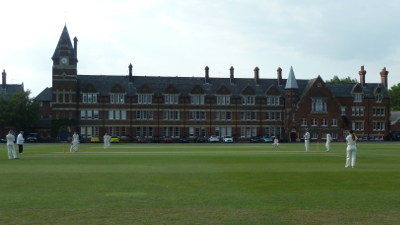
Picturesque Felsted School

In last year’s inaugural match, it was decided to ‘mix and match’ the teams to ensure parity, a policy that worked well despite some early glitches that saw MCC Captain Beth Wild return from winning the toss to realise that she had done so against her own opening batsman. A close finish resulted however, and so it was decided to follow the same policy this year, all conducted in an open and friendly way without the need for lining players against the playground wall (an ordeal which some readers may have endured in their younger days – as did this writer).

Winning the toss, the MCC Women combination XI chose to bat, but suffered an early reverse when Essex Girls’ Nancy Hebron played across the line and was bowled. Some early innings tremors were steadied however by a 3rd wicket partnership of 64 between Georgia Hennessey (Worcestershire) and Lucy Stuchfield (Oxford University). At 71-2 off 11 overs, MCC looked set fair for a sizeable total, but a tidy spell of 3-17 off 5 overs from Dani Lavender put the brakes on somewhat, coupled with the retirement of Hennessy after making a well-compiled 51 off 47 balls. It was left to Beth Wild and New Zealand international Rachel Candy to take the MCC to an impressive, but not unbeatable, 154-8 off their 25 overs, with Alex Straker-Nesbit tidying up the tail to finish with 4-20.

The Felsted combination XI needed a strong start, but the early loss of Berkshire’s Carla Rudd during an impressive spell from the School’s Kieri Samaranayake was a blow. Nevertheless, at 41-2 off 11 overs, a target of a further 114 off 14 overs was tough but still possible.

Enid Bakewell

Enid Bakewell

Then Enid Bakewell got to work. Bowling slow left arm with impressive flight, two wickets followed in her first over as several of the School’s girls found themselves beaten by Enid’s guile. Some hushed conversations were overheard on the boundary’s edge as several returning batsmen expressed surprise at the slowness and loop of the bowling – to which of course could be added ‘straightness’. A third wicket followed with a smart catch by Beth Wild at point, and although there were some late flurries from Felsted’s captain for the day Salliann Briggs, and Beth Absolon of Suffolk, who finished with an impressive unbeaten 44 off 46 balls (including 10 boundaries), MCC eased to a 40 run victory as the School closed on 114-8.

An enjoyable afternoon’s cricket, but no doubt who the star turn of the day was (in my opinion anyway). Pausing to thank the officials, Enid reminded us of her age before making her way to the changing room. Well played indeed – if I’m still scoring after 50+ years in the game (let alone playing) then I’ll be more than happy.

SPECTATOR HINT – for those visiting the School (and it’s a lovely venue, used by Essex Women on occasions) then we can recommend the sausage baguettes in the local tea rooms. I accept that’s not a useful pre-match tip for players however.