THE HUNDRED: Spirit v Originals – Originals A Sum Smaller Than Its Parts

London Spirit beat Manchester Originals by 8 wickets at Lord’s on Friday, leapfrogging Oval Invincibles into third place courtesy of a superior net run rate.

It means that defending champions Southern Brave are now out of the tournament – which will come as a bit of a shock to anyone used to seeing anything Charlotte Edwards touches turning to gold. It also now looks increasingly likely that it will come down to a battle between Oval Invincibles and London Spirit as to who finishes in third place and thus progresses to the Eliminator – making Sunday’s match between the two at The Oval an effective quarter-final. (We can’t wait!)

Spirit were chasing just 113 after another lacklustre effort with the bat by Originals, but had barely made their way out of the starting block by the halfway point, posting 49 for 2 from their first 50 balls compared to the 48 for 3 which Originals had managed. At that point, Georgia Redmayne was 21* off 31, and had hit just two boundaries – one off the first ball, and one off the 45th – a drought-and-a-half when you’ve only got 100 balls to play with.

In fact, when a caught-and-bowled chance popped out of Fi Morris’s hands, you’d have been forgiven for thinking that the drop was actually a deliberate ploy by the fielding side, who were presumably quite happy to continue bowling at the player who looked to be killing the game. “I dug myself into a little bit of a hole at the start. I was wondering if I should retire myself!” Redmayne said afterwards.

But five balls later, Originals opted to take their strategic timeout, and Redmayne had a moment to gather her breath, and listen to her coaches. The message? “Hold my feet, play good shots, find space, don’t panic.”

She went on to hit 45 from the next 28 balls she faced, and Spirit romped home the winners. Has a strategic timeout ever backfired so spectacularly against the fielding side?

It was just one of a number of decisions which Originals captain Sophie Ecclestone didn’t *quite* get right on Friday – another one being the determination to bowl out seamers Kim Garth, Lauren Filer and Alice Monaghan, leaving Fi Morris with 10 balls in the bank, despite the fact that all five Originals wickets had fallen to spin.

Originals have picked up just two wins from six matches in this tournament so far. There are a number of things that aren’t going to plan – Mooney has scored 92 runs in six innings, averaging just 15; Sophie Molineux never even made it onto the plane after being forced out with a rib fracture; they lost Mahika Gaur at the eleventh hour – but maybe Ecclestone’s captaincy is also one factor in the equation?

This is a bowler who recently enjoyed a record-breaking run of 34 consecutive innings for England taking a wicket (34!!!) And yet so far in this year’s Hundred comp, she’s taken just four wickets. She is ranked 27th if you judge her by the CRICKETher Ranking System (wickets divided by economy), or 23rd, if you use Women’s Cricket Blog’s System. That’s an even bigger issue when you consider that Originals have the worst balls-per-wicket ratio of any team in the comp:

If you’re one of those people who thinks that Ecclestone is the answer to England’s Non-Existent Captaincy Succession Plan, you perhaps need to ask yourself: are you happy to risk that dip in form being replicated on the world stage?

Originals have the best T20 bowler in the world in their ranks (Ecclestone), and one of the best T20 batters in the world (Mooney). And yet they now have just a 1% chance of limping through to the knockout stages. It’s probably fair to say that in 2024 they have proved to be one of those franchise teams whose sum is smaller than its component parts.
The CRICKETher Weekly – Episode 228

This week:

  • Hampshire sell off the family silver (and ÂŁ60m debt) to Delhi Capitals
  • ⁠The Hundred: What’s gone wrong for Southern Brave?
  • ⁠Welsh Fire top the table: the queens of pressure run chases
  • ⁠Could Sri Lanka win the World Cup in Bangladesh?

THE HUNDRED: Invincibles v Superchargers – Mistaken Identity

When I walked into the press box before today’s match, the Oval Invincibles media manager mistook me for someone else. I was embarrassed; but perhaps I shouldn’t have been – their socials today suggest he also mistook Oval Invincibles for a cricket team. Now that’s awkward!

Having been put into bat, the Superchargers didn’t get off to the kind of start which suggested they were heading for a huge win. At the halfway point in their innings, they were 62-2, with Phoebe Litchfield and Annabel Sutherland both set, but not exactly motoring. Litchfield remains a little bit of an enigma in short-form cricket – despite the dinks and the sweeps and the ramps, she is far more comfortable playing the kind of booming cover drive with which she opened her account today. She can do the T20 shots all around the ground, but they feel plastic somehow – manufactured rather than her natural game. But having said all that, her natural game is nonetheless so good, that she is able to make T20 work for her regardless, and she was obviously vital today in terms of steadying things after those two early wickets.

Having reached 50 balls with just those two wickets down, Litchfield and Sutherland clearly decided to turn it up a notch, and the acceleration began into a big late middle phase which produced 48 runs at a Strike Rate of 192.

This was probably the key phase of the match, because it turned a middling score into a big one, so although Superchargers slowed down significantly at the death they still ended up on 146, which is right at the top end of a typical total in this competition.

Sutherland finished 63 not out, looking pretty-much as comfortable as it is possible to look in a format that is so relentless; and once again I find myself thinking that what stands Sutherland apart is an incredible work ethic that sees her return to England a better player every summer she comes… and that was even before she got her hands on the ball 45 minutes later!

A very decent total put the pressure on Invincibles batting from the off, and… they cracked big-time, losing a wicket in each of the first 5 sets, to finish the powerplay on 24-5. Lauren Winfield-Hill got a decent ball from Kate Cross; and Kapp was done by an over-optimistic call from Chamari, but everyone else will be wincing when they review the analysis footage, and rightly so.

By the time Amanda-Jade Wellington and Paige Scholfield got together, it was just a question of trying to save some face, and they did what they could, but they obviously weren’t going to go on and win the game from 24-5. And then Sutherland happened for the second time today, taking 4 wickets in 6 balls, with the dastardly tactic of bowling at the stumps – it’ll never catch on!!

The result really opens up the table, with 4 teams on 4 points and one (Superchargers) on 3. It also leaves Southern Brave bottom, which is a new experience for a Charlotte Edwards team; but with there being so little in it, there is still plenty of scope for them to turn things around. The bigger challenge than Edwards’ is on Invincibles coach Jonathan Batty – they were swaggering; now they are staggering. Which way will they go from here?

THE HUNDRED: Spirit v Fire – “If she’s going to lose her shoes but bat like that, who cares?”

Welsh Fire beat London Spirit by wrapping up the fourth highest run-chase in the history of The Hundred, reaching their target of 151 with five balls to spare in what was, largely, a one-woman undertaking:

Battling erratic shoelaces, and at one point a shoe which actually flew off as she hared down the pitch, Hayley Matthews finished on 78 not out from 46 balls – Sarah Bryce’s 21 being the next highest contribution.

More importantly, Matthews was there at the end to propel Fire’s chase over the line, turning an unlikely-looking 50 runs off 25 balls into 26 off 15, 16 off 10, and finally a nice-and-relaxing 10 off the last 9, after just clearing the long-on boundary off the 91st ball – the first of Deepti Sharma’s final set.

“If she’s going to lose her shoes but bat like that, who cares? Maybe I’ll try it!” captain Tammy Beaumont said afterwards.

“I’ll teach her how to!” Matthews joked back.

Matthews did get lucky a couple of times – most notably when she pulled a catch to Eva Gray at deep midwicket on 35*; Gray couldn’t quite hang on and ended up parrying it over the rope. But, largely, it was an intelligent innings under pressure, with exactly the right balance between taking enough risks to keep up with the hefty rate, and then dialling it down when that was no longer necessary:

Matthews knows how to manage run-chases single-handedly under extreme pressure – she’s been doing it for West Indies for about a decade – so for Fire it was a case of cometh the hour, cometh the woman.

London Spirit clearly realised she was the key wicket – hence why Georgia Redmayne refused the easy run-out of Phoebe Franklin off the 90th ball, instead opting to attempt to throw down the stumps at the bowler’s end (it was too wayward to have any effect).

A word, too, for Freya Davies’s efforts with the ball, which ensured that Fire did not feel the absence of Shabnim Ismail through injury too acutely. After a tight opening set in which Meg Lanning managed to score just one run from five deliveries, Beaumont’s decision to bring Davies back to bowl balls 41 to 45 proved inspired:

“She’s such a utility bowler, she can bowl at any phase brilliantly,” Beaumont said. “I felt like we let them get away from us a little bit – I wouldn’t normally bring Freya back as early and I just had that gut feel and I had to do it then. For her to come off then so brilliantly really shifted the game.”

Davies removed Heather Knight and Meg Lanning within the space of three balls, and a total which could have been catastrophic proved within reach… just. No doubt there was a certain amount of karmic satisfaction for Davies, who was not just bowling at her former teammates but against the captain who was responsible for her being dropped from England last summer.

Spirit return to Lord’s on Sunday for their top-of-the-table clash against Oval Invincibles: time to see if they can bounce back from what might be a difficult loss to take.

The CRICKETher Weekly – Episode 227

This week:

  • The privatisation of The Hundred – will the new owners care about gender equality?
  • Is Bangladesh the right place to host a World Cup right now?
  • Deandra Dottin and Cricket West Indies sign a mutual desperation pact
  • More details about Australia’s new T20 Spring Challenge competition

The CRICKETher Weekly – Episode 226

This week:

  • The issues with NZ’s domestic structure & how the ICC could help
  • Why NZC turned down a Test for the White Ferns, & was it the right call?
  • ECB’s plan to sell The Hundred goes belly up…
  • …as do plans for a Super T10 in Scotland

EXCLUSIVE: New Zealand Cricket Refused ECB’s Offer Of A Women’s Test

New Zealand Cricket turned down the chance to play a Test match as part of their recent women’s tour to England, CRICKETher can reveal.

The ECB officially invited NZC to play a Test in March 2022, when tour arrangements were initially being made, but the offer was declined.

Instead, the tour – which concluded at Lord’s on Wednesday – consisted entirely of 50-over and 20-over matches. All eight of the games were won by England.

New Zealand have not played a women’s Test since August 2004, but the recent revival of the format – with England, Australia, India and South Africa now regularly participating in Tests – had sparked hopes that New Zealand might also consider adding multi-day cricket to their schedule.

England played their first Test in India for 18 years in December, while last summer the ECB hosted the first five-day women’s Test since 1992 as part of the multi-format Women’s Ashes series. 

A spokesperson from New Zealand Cricket said: “This decision (to decline) was based on strength and conditioning and preparation rationale, and most importantly, playing as much white ball cricket as possible in the lead-up to the 2024 ICC T20 World Cup.”

CRICKETher also notes that participating in a single Test would have cost New Zealand Cricket over $100,000 in match fees due to the recent equalisation of match fees with the men – a substantial sum which they can presumably ill-afford.

Suzie Bates, who has represented New Zealand since 2006 but never had the opportunity to play a Test, told the BBC this week: “In my long career, there hasn’t been a Test match. I have a little bit of envy when I watch the Ashes, of players that are playing the same sport as you that have those opportunities. You wonder what it would be like.

“With the limited resources that we have currently, they [NZC] see more bang for their buck in the 20-over and 50-over format. It comes down to resources and time and money. They’ve made the decision that Test matches are not the priority right now.

“I’m still hopeful that [a Test] may come in the future – that once the growth of the global women’s game starts to get more traction, the boards will see value in that.”

ENGLAND v NEW ZEALAND: 5th T20 – England End Early Summer On Lucky 13

England won the 5th and final T20 at Lord’s to complete a clean sweep of sorry New Zealand, who have lost all 8 matches played between the sides on this tour. It was England’s 13th win in 14 games this summer, with the only blemish being the rained-off ODI against Pakistan at Taunton.

There was an awful lot of hype around this game, with England players drafted into the marketing efforts at Lord’s, and the BBC going all-out to make a splash with their coverage – the second of the two England women’s matches per season they have the rights to.

With the official England Cricket Twitter feed claiming “last tickets remaining” the expectation was of a near sellout, but in reality the Tavern Stand and the upper tier of the Grandstand were closed and there were big gaps elsewhere, which made for a slightly deflating picture as Fran Jonas ambled in to deliver the first ball of the evening. Slightly over-promising and slightly under-delivering is becoming a bit of a hallmark of English cricket, so it was perhaps appropriate that Danni Wyatt’s one and only shot of the innings was a classic of over-promising and under-delivering – promising to sail into the stands, but delivering a catch to Melie Kerr at deep midwicket.

It was Wyatt’s second duck of the series and her 4th single-figure score of the summer. On the plus side, she did make two big fifties – 87 against Pakistan at Headingley and 76 versus New Zealand at Southampton – in keeping with the general story of her life recently: one match-winning knock per series, and not a lot else. It is definitely enough to keep her in the side, but the big innings somehow make the small ones feel even more frustrating – we know she’s better than them, and her body-language on the way back to the pavillion said that she knows it too, but she’s one of the old dogs of this team now, and new tricks are probably a lot to ask at this point in her career.

For the third time in this five-match series, it meant Capsey coming in very early after one of the openers has bagged a duck. Unlike Wyatt, Capsey took a little bit of time, and was 4 off 8 balls before she hit her first boundary – whacking Lea Tahuhu straight back over the stumps to the (quite short) boundary at the Nursery End. It will go down as a drop, because Tahuhu got a couple of fingers on it, but Capsey hit it so hard that it blasted straight through them. Capsey continued to play within herself, and was the only one of England’s top 6 apart from Wyatt to finish with a Strike Rate under 100, when she was stumped off a decent ball from Eden Carson.

At 66-4 after 10 overs, after Fran Jonas had taken a brilliant caught-and-bowled to send Nat Sciver-Brunt back up the pavillion steps, England weren’t exactly “in strife” but they were on the edge of the blade. The match could have turned either way, and it looked to be going against England with Amy Jones falling to another soft catch, and Freya Kemp getting bowled by an arm ball that was basically a very slow in-swinger from Jonas, which the young Kiwi described in the post-match press conference as her perfect delivery.

But Charlie Dean came to England’s rescue, giving Heather Knight the support she needed to push the scoring rate on in the last few overs. With the help of a big 18th over, Knight taking Carson for 15, Knight and Dean ensured that England accelerated through every phase of the match to get to 155 without having to expose either of the Genuine No. 11s™ sitting nervously in the dugout.

Given New Zealand’s form this tour, it felt like enough and it was enough. But let’s be clear, England did not bowl especially well. Having rested Sarah Glenn, who the written press unanimously agreed was the outstanding player of the series, they went in with 2 front-line seamers – Laurens Bell and Filer – plus Kemp. Bell stuck to her basics of inswingers up top and slower balls at the end, and got a decent return of 3-21. (We are definitely still in the territory of being relieved that she has rediscovered her mojo, so we aren’t going to criticise!)

Filer had a very odd game – she didn’t concede a heap of runs (just 22 from 4 overs) and she caused Suzie Bates all sorts of problems (and eventually took her wicket) but bowling short outside off felt like the wrong plan to anyone not called Suzie Bates, and I just hope she and the coaches realise that, because a Beth Mooney or an Alyssa Healy would have punished her ruthlessly for it.

New Zealand made it to 15 overs only 3 down and 9 runs behind where England had been, but their attempt to push on the final quarter resulted in a clatter of wickets and they ultimately fell 20-odd short, having been unable to quite keep pace with England in any phase.

So ends England’s international summer, barely half way through July, and with the kids (at least those who go to state schools) still having a week more of lessons before their summer holidays start. Jon Lewis, in a typically frank post-match presser, lamented the huge gap between now and the World Cup in Bangladesh, saying that he wanted to be flying out now, with the players where he wants them to be. It is 78 days between today and England’s opening match in Dhaka; but with the ECB having locked themselves into the decision to prioritise domestic cricket in August, we are where we are. (And given the success of The Hundred in terms of crowds, who’s to say it’s not where we want to be?)

One player who will be looking forward to The Hundred probably more than anyone is Bess Heath. Whilst England have switched-up the batting, and chopped and changed the bowling, “BAM” had had little chance to do any BAM-ing at all, having been the one player to remain glued to the bench through the summer. Given that England have explicitly said that they are trying to prep for every scenario, not preparing for the possibility of having to play without wicket keeper Amy Jones – the one player you can’t shuffle your way around losing – is odd.

Asked about Heath in the press conference, Lewis chose his words carefully, but reading between the lines it feels like they aren’t happy with where her keeping is at, though they still see her as the backup to Jones because of her batting. With England’s last wicket-keeping coach having apparently suffered a case of Chuck Cunningham Syndrome there’s a new man on the job – former Sussex glove-butler Nick Wilton. He’ll be working with Heath at Northern Superchargers over the next 6 weeks and hopefully the opportunity to play a regular keeping role in The Hundred with the Popchips will start to bring her glovework on towards where it need to be, should the worst happen with Jones. If not… it isn’t beyond the realms of possibility that the name “Jon Lewis” pops up on Tammy Beaumont’s phone one day in September.

OPINION: Five years on … and where are the emerging batters?

By Andy Frombolton

Underpinning Project Darwin is the ECB’s belief that ownership and accountability is key to the future growth and success of women’s cricket.

But whether a regional or a county-based structure is better will be moot unless the standard of cricket is high enough to attract tv deals and spectators. And with considerable extra funding being put into the women’s game and an ever-increasing cohort of professionals, expectations are quite rightly growing against a rapidly-rising datum.

In many areas the results of increased funding are apparent; there’s an abundance of quality bowlers, both slow and fast; several keepers are making their case for higher honours; and the quality of fielding is so much higher than it was even a few years ago.

But for all the investment in regions and academies, and despite hundreds of talented youngsters passing through the academy system, the same trend is simply not evident in terms of batting.

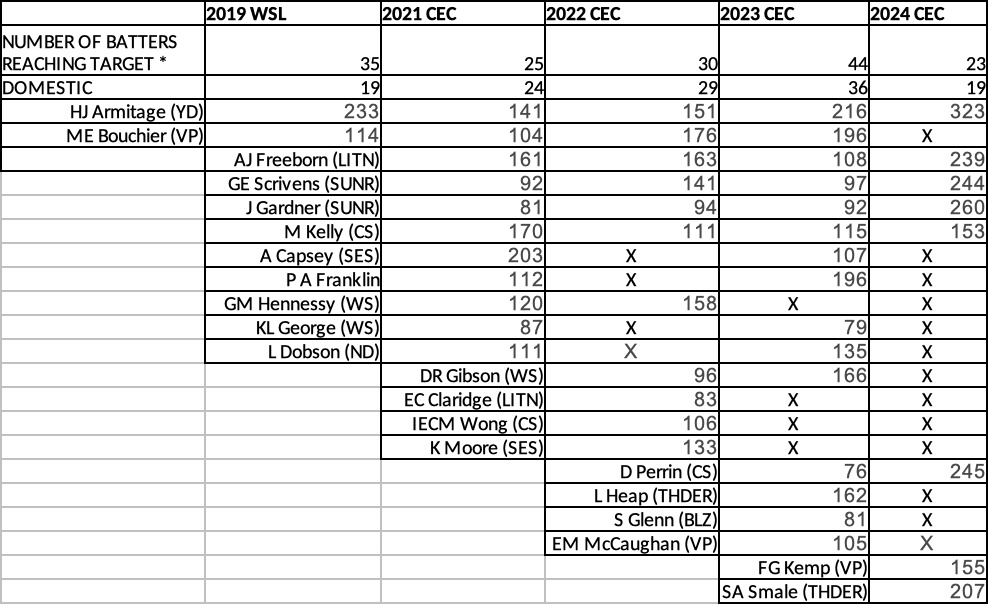
To illustrate this point, consider the highest run scorers in the domestic T20 competitions since 2019 (NB there were no games in 2020).

For each year, the table below shows the total number of batters scoring more than a specified number of runs* and lists all ‘young’ batters (aged under 25) meeting the criterion for the first time (hence ‘emerging batters’) in that year plus the number of runs they scored. The table then tracks their run scoring in subsequent year to distinguish those who have become consistent run scorers and those for whom this was a ‘flash in the pan’.

(* The criterion is 75 runs for 2019-2023 and 150 for 2024 to reflect the higher number of games played.)

Armitage and Bouchier stand out for consistency; one deservedly achieving England honours and one seemingly destined not to. Of the 2020 cohort, Freeborn, Gardner and Kelly have all gone on to the epitome of a cricket professional: reliable and consistent. But all these players are primarily products of their county age group systems and pre-date the professional era. The one ‘new generation’ name is that of Scrivens.

Thereafter, emerging batting talent diminishes in inverse proportion to the increasing professionalisation of the game. From 2020 and 2021 only Gibson probably has the potential to be a genuine (bowling) all-rounder whilst Wong, Glenn and Heap should be more accurately categorised as bowlers who can bat a bit. 

Only in the last 2 years do we see 3 names: Perrin, Smale and Kemp who appear to have the potential to become top class batters; plus of course Alice Capsey.

So after 5 years of academies and considerable investment, we end up with a list of just 5 possible long-term England batters. 

This doesn’t seem like a good return. There are only 2 explanations: (1) The talent doesn’t exist, or (2) the academies and the regions have failed to develop that talent. The first is self-evidently not true – there’s a huge amount of talent on display in every CAG match.

So, what’s going wrong?

Players are selected far too early. Latent and slow-developing talent is squandered. 

With increased prize money on offer, teams (understandably) prioritise winning over player development. And in most teams this means stuffing your batting top order with proven players who can ‘do a job’. The trouble with this approach is that the vast majority of these players have plateaued in terms of skills (as evidenced by their run scoring and strike rates) and consequently the game as a whole isn’t evolving. Younger players either get shoved down the batting order or don’t get picked at all.

What can be done about it? 

The ECB’s plans to address this (Tier 2, etc.) remain vague whilst their ongoing refusal to discuss continuing to run an amateur women’s team in each Tier 1 county will see hundreds of talented girls and young women give up on the sport and huge amounts of talent will go undiscovered.

It’s a simple fact that you get better, faster by playing against people who are better than you. The great former players learnt their game playing “men’s” cricket (Lydia Greenway for instance captained a premier club and scored a century in premier league cricket) but now talented young players are ensconced in the academy set-up from an early age with their workload managed and often banned from playing club cricket. The best batters need to play against the best bowlers possible – which for the foreseeable future means Saturday club cricket. 

The Academy players similarly need to be challenged. One easy way would be for them to enter a mid-week T20 league. (Southern Vipers did this some years ago – and the team went on to win that league.)

Playing for a team in e.g. New Zealand over the winter might be fun, but it’s essentially the same issues outlined above with a different accent. The over-dominance of slow bowling in the women’s game will remain a problem until players learn how to play it better. (An often-barely-spinning ball delivered at 45mph should be going to the boundary, not picking up wickets.) Similarly, going on a 10-day pre-season tour might be good PR but it’s a costly indulgence especially when all the team does is play their domestic rivals in a warmer climate. Instead, why not form a partnership with a school in Sri Lanka and send 5 batters to spend 4 months there – coaching during the day and then getting 2 hours in the nets against the best bowlers every afternoon. (This would also help with life skills and getting coaching qualifications for post-career.)

And finally put some youngsters up the order. If they fail, then the dependable experienced players can come in and restore order. But if they come off, we’ll see higher scores and – hopefully – if this analysis was repeated in a few years far more new names appearing.