This week:
- England smash West Indies
- Injury setbacks for Capsey & Kemp
- Farewell to Mignon du Preez & Carla Rudd
- Have we missed an opportunity for red ball domestic cricket?

This week:
Part 3 of 3 in a series reflecting on WBBL08 by guest writer Andy Frombolton
Who gives a (bat) flip?
Received wisdom is that batting second in T20s constitutes a considerable advantage. However this presumes that teams are good at chasing. And also that team strengths are broadly equivalent .
What’s the WBBL data when teams win the toss?
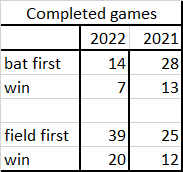
Thus on average teams win half the time whether they bat first or second but behind the headline figures are some big differences by team in terms of strategy and success. For example, in 2022, Renegades won the toss 7x, fielded 7x and lost 5x, whilst Stars won the toss 9x and fielded first every time (3 wins, 3 losses, 3 NR).
If any team displays a strong preference, it’s fairly obvious what the oppositon is going to do when they win the toss. Also, if a team’s whole strategy is built e.g. around chasing, how will they ever develop their ability to post a score?
Most interesting is Sixers’ transformation from the least-successful flippers to the best. In contrast, Scorchers went from winning every game when they won they toss last year to losing two-thirds in 2022!
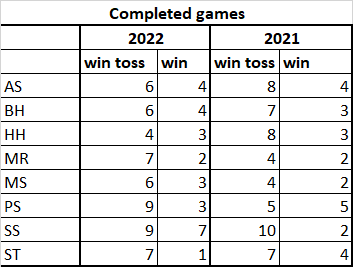
The bat flip doesn’t really make much of a difference – the best teams tend to win whether they bat or bowl first and vice versa.
All-rounders
Professionalism will invariably decrease the viability of someone being an all-rounder since to be a world-class batter or bowler will require specialism for all but the most gifted.
Hence genuine all-rounders will be increasingly rare and conversely desirable in team selections.
How many players make it into the top 25 lists (most runs and most wickets), and who are they? Some of the answers may surprise …

Long term presence Devine had a poor season – a SR of less than 100 (compared to a usual 128+) and just 8 wickets. McGrath just missed out on batting honours (26th) but injury precluded her bowling as much as previous years.
Knight (2020), like Edwards and Root before her as England captains, has tended to underbowl herself. It’ll be interesting to see whether she bowls even less after her hip-surgery which would be a great shame since she’s an (undervalued) all-rounder.
Career resurrections – Perry and Healy
Going into this tournament the T20 careers of both these great players looked like they were in terminal decline when you looked at their WBBL performances. Perry didn’t make the CWG squad but found some form in The Hundred, whereas Healy’s miserable WBBL07 form continued right through until this tournament.
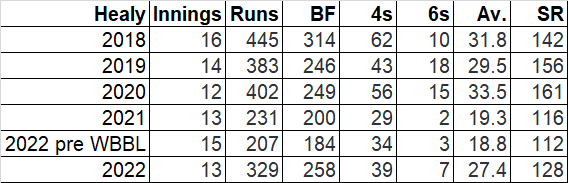

(2022 stats include all T20s for Australia and The Hundred)
Beyond the treat for all cricket fans of seeing these two on the world stage for a bit longer than they might have feared, the broader message is that older players can adapt their games for the modern game.
As discussed in Part 1 Perry, Jonassen and Kapp are great examples of how many older players could be much better deployed in the middle/late overs using their great game experience to pace and judge the innings and with the freedom to play which this new role could bring.
Wicket-keeping standards
In the women’s T20 game, keeping is as much about keeping batters in their crease as taking stumpings but far too few keepers appeared confident in going up to the stumps for the medium pacers. Healy (and previously Sarah Taylor) repeatedly showed how it limits many batters’ options.
Overall though too few of the keepers are athletes – tending to remain fairly static and waiting for a return over the top of the stumps. Keepers need to ‘own’ the area behind them 20 degrees either side of the stumps and whilst comparisons with the men’s game aren’t always relevant in this instance there’s no reason why the best women keeper can’t emulate the standards of the best male keepers who regularly beat fielders not wearing pads to snicks and tickles heading for the boundary.
Heaven help the opposition when Australia finally select the Harris siblings
Their stats say it all.
Is there any other country where Laura Harris wouldn’t be in the national team by now?
Pedestrian powerplays
The average figures were:
In the first innings, 6 of the teams hovered around the average. Sixers were the only team with a materially better average PP (27) and Thunder the only team with a materially worse average PP (20).
In the second innings the stats were slightly more spread out, Hurricanes and Thunder both had materially better average PP (28). Heat had a materially worse average PP (19). But the surprising outlier in all the data was Sixers with an average PP of just 16!
Overall, these figures are far too low. The PP should be the launchpad for the innings but as discussed the batters either don’t have the skills (or feel they can take the risk) to take on the bowlers and take advantage of the fielding restrictions. The answer is simple – either the current batters need to change their mindset or teams need to deploy different openers.
And finally … the ultimate TFC
In the shorter format there will inevitably be squad members who don’t get the opportunity to do much with the bat or ball, but one player’s figures stood out above all others this year. Angelina Genford of the Sixers: 15 matches, 3 innings, 7 balls, 4 runs and 3 separate bowling spells totalling 4-0-36-1.
Part 2 of 3 in a series reflecting on WBBL08 by guest writer Andy Frombolton
Teams posting 140 or less lose 3/4 of their games. Hence any bowling attack which can regularly restrict the opposition to this figure will win the vast majority of games. Chasing down 140 requires a collective SR of just over 110 (well within the capability of even the most pedestrian batting line up) whereas restricting teams to such a low total is much harder.
Hence this article posits that when assembling a team the priority should be securing the best bowling unit.
This is the total opposite of what happens today, with teams competing for the best domestic and international batting talent and generally being far less interested in ‘pure’ bowlers (especially overseas bowlers). The other noticeable theme is how many uncapped players feature in each year’s Top 25 wicket takers list (or conversely how often ‘marquee’ names disappoint).
| YEAR | NUMBER OF FORMER AND CURRENT* INTERNATIONAL PLAYERS IN TOP 25 WICKET TAKERS | |
| 2022 | AUSTRALIAN | 8 |
| OVERSEAS | 4 | |
| 2021 | AUSTRALIAN | 10 |
| OVERSEAS | 3 | |
| 2020 | AUSTRALIAN | 7 |
| OVERSEAS | 7 | |
| 2019 | AUSTRALIAN | 13 |
| OVERSEAS | 3 | |
| 2018 | AUSTRALIAN | 7 |
| OVERSEAS | 5 | |
* as of the relevant season
So, who were this year’s highest wicket takers?

What then constitutes a good bowling unit?
The first point is that, as noted above and unlike batting, international bowlers often don’t deliver the sort of performances expected. The stats are damning – in the past 5 seasons only 4 international bowlers (as opposed to all-rounders) have made it into the table of ‘Top 25 wicket takers’ (Tahuhu 2018, Glenn and Ismail 2020, Ecclestone 2022) (And Ecclestone should be an all-rounder!). So unless a team can secure the services of one of the top 3-4 overseas bowlers in the world the evidence suggests they’d be better off saving their money.
Equally interesting are the Economy Rates (ERs). Shouldn’t the ‘best’ bowlers have better ERs than the other bowlers? In fact, the ERs of the top 20 wicket takers, the next 20, and of all other bowlers are virtually the same and converging. In the past 3 years, the best bowlers are going for slightly more runs, the ‘change’ bowlers are holding steady and the bits’n’pieces bowlers are bowling less but becoming more economical.
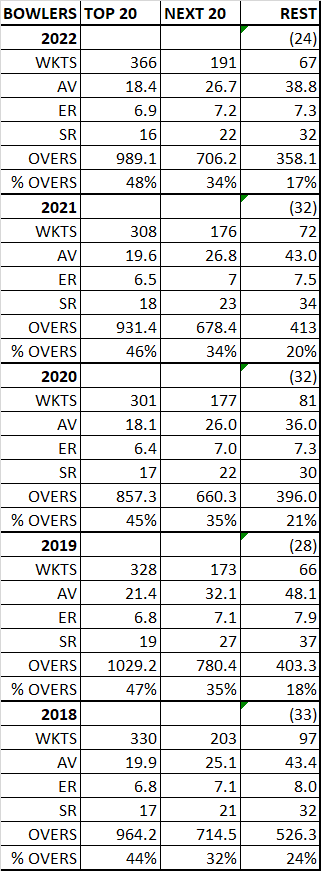
Running counter to the men’s T20 game (where slow bowlers dominate the best ER tables and faster bowlers the best SR tables) the 2 best* (*rationale follows) bowling attacks in this year’s tournament (Adelaide Strikers and Brisbane Heat) employed very different approaches.
Adelaide Strikers: Schutt (fast), Wellington (slow), Barsby (slow), D Brown (fast) and Dottin (fast medium).
Of these, the hitherto-unspectacular Barsby was a revelation and is additionally interesting for being one of the new breed of ambidextrous slow bowlers (her occasional left arm accounting for Alice Capsey in one game).
Brisbane Heat: Jonassen (slow), Hancock (medium), A Kerr (slow) and Sippel (medium).
More important seemingly than the composition of the attack is that bowlers know their role and learn to bowl as a unit, which is what makes Adelaide Strikers truly unique – their 5 main bowlers bowled 92.6% of their overs i.e., the same 5 players bowled their full complement of overs in virtually every game. The closest analogy I can think of is the all-conquering Gloucestershire men’s side of the early 1990s. Similarly Heat had 4 bowlers who delivered 72.1% of their overs. Contrast this to Sixers whose core 3 bowlers always bowled their full allotment (59.4% of overs) but the bulk of the balance was shared between 4 bowlers. Sixers might counter that their approach demonstrated flexibility and greater depth in their bowling attack.
This is another area where performances in the women and men’s game diverge and hence so should tactics. In the men’s game, the best way to slow down the run rate is to get the top batters out (such is the difference in the SR of the top 4 batters compared to the next 4) which means teams need strike bowlers to perform this role (their ER being of less concern), but in women’s cricket (as discussed in the previous article) overall batting SRs are lower and hence dismissing a top batter has less impact (quantum) on a team’s eventual score.
Thus if bowling SR was the key determinant of an opposition’s score then Sixers might have a claim to have the most penetrative bowling unit. Sixers have 5 of the 23 bowlers (≥5 wickets) with a SR<20 with all the other teams having 3 (except Renegades which had 0, which perhaps explains why they conceded the 1st, 2nd and 4th highest scores in this year’s tournament).
But if instead keeping the run rate down is the priority, then a team needs a bowling attack able to do this consistently in all scenarios. Strikers’ top 4 bowlers had a combined ER of 6.4; far better than any other team and only once did a team batting first get on top of them (Stars’ 186, 3rd highest score of this season), otherwise they conceded 4 scores in the range 151-154 and 4 in the range (101-114). And when defending Strikers never got hit for more than 139.
Based on consistency and dependability, Strikers were the best bowling team and thus deserved champions.
The silver bowling award goes to Heat who bowled well in the first innings (only once conceding more than 140) but conceded more than 156 four times bowling second. It was their potential to wilt under pressure (not helped by some poor fielding at key moments) which cost them games.
Sixers also got hit for above par scores five times (three times bowling first and twice bowling second, although they went on to win 4 of these games so could contend this was ultimately irrelevant. The counter argument is that no team, however good their batting line-up, can afford to concede these sort of scores.) Equally telling was the three times they got taken apart in the death overs and only clinched victory each time courtesy of some equally-brutal hitting in their final overs. (Game 1, Heat hit the last 2 overs for 18. Sixers hit 19 off 11 balls; Game 42, Scorchers hit 22 off the last 2 overs, Sixers hit 23 off 12 balls; and Game 49, Heat hit 37 off the last 2 overs (and 47 off the last 3) and Sixers hit 28 (and 41). Hence their honourable bronze position in these bowling awards.
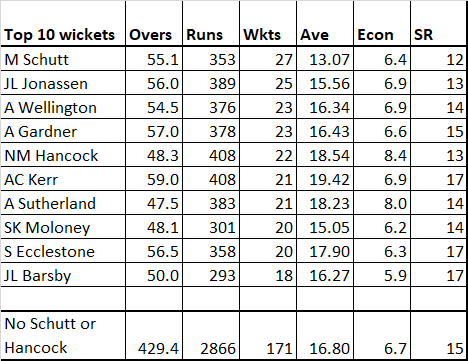
In concluding, what therefore would be the perfect bowling attack look like?
Look again at the list of top wicket takers. The stats say it all. Slow bowlers dominate the wicket-taking tables – 8 of the top 10 (with a collective ER of 6.7 and a SR of 15).
So team selection should start with a fielding set up capable of supporting your bowlers – a superb keeper and a minimum of three fielders who are great in the deep (trading a degree of run scoring ability for fielding prowess if necessary).
You need a fast bowler? Schutt, D Brown, Sippel or Strano. No other fast bowler has appeared in the Top 25 for 2 years in a row so you’re just taking a gamble on any other selection having a good year.
Add 1 all-rounder (more on that subject in the third article)
And finally 3 slow bowlers (or even 4 so you don’t even need to play your fast bowler when conditions don’t suit).
And then pick some batters!
This week:
Part 1 of 3 in a series reflecting on WBBL08 by guest writer Andy Frombolton
The average 1st innings score in this year’s WBBL (in complete games) was 145, up slightly on 2021 (137).
Teams posting 144 or more in the first innings won 22/29 times whilst teams scoring 160 or more won 14/16. But the distribution of above-par 1st innings scores was highly skewed – only 3 teams managed it more than twice: Heat (7 wins from 8); Sixers (6 wins from 7); and, Hurricane (3 wins from 5). In contrast champions Adelade Strikers never posted more than 147 but defended 4 scores in the range 140-147 (twice against the Sixers) and their highest score in 6 successful chases was only 156.
The most obvious conclusion is that it’s bowling units which win games, not batters. Nevertheless batters are the focus of this first article.
There were 24 first innings scores of 150 or more (compared to 17 last season) but more interesting is who’s scoring the bulk of these runs. Intuitively you might imagine it would be the players with international experience – and this certainly used to be the case.
| YEAR | NUMBER OF FORMER AND CURRENT* INTERNATIONAL PLAYERS IN TOP 25 RUN SCORERS (*as of the relevant season) | |
| 2022 | AUSTRALIAN | 7 |
| OVERSEAS | 10 | |
| 2021 | AUSTRALIAN | 8 |
| OVERSEAS | 10 | |
| 2020 | AUSTRALIAN | 8 |
| OVERSEAS | 7 | |
| 2019 | AUSTRALIAN | 10 |
| OVERSEAS | 13 | |
| 2018 | AUSTRALIAN | 11 |
| OVERSEAS | 10 | |
Slowly, uncapped players are being given, and are seizing, their opportunities. Disappointingly however this cohort (extensively coached in power hitting and 360 degree shot making) isn’t having the impact on run rates which might have been expected.
Top 25 run scorers WBBL 2022

(Orange – Australian former and current Internationals. Blue – former and current Overseas Internationals)
With the exception of Laura Harris, the uncapped batters are scoring their runs at about the same rate as the international players they’re incrementally displacing.
| YEAR | TOP 20 RUN SCORERS | 20 NEXT MOST RUNS | REST | |
| 2022 | RUNS | 6511 | 4274 | 3109 |
| % RUNS | 47% | 31% | 22% | |
| SR | 119 | 110 | 102 | |
| 2021 | RUNS | 7301 | 3560 | 2231 |
| % | 56% | 27% | 17% | |
| SR | 116 | 103 | 95 | |
| 2020 | RUNS | 6844 | 3383 | 2070 |
| % | 56% | 28% | 17% | |
| SR | 115 | 101 | 97 | |
| 2019 | RUNS | 8457 | 4063 | 2497 |
| % | 56% | 27% | 17% | |
| SR | 121 | 108 | 101 | |
| 2018 | RUNS | 7805 | 4452 | 2853 |
| % | 52% | 29% | 19% | |
| SR | 124 | 109 | 100 |
Most teams pack their top order with dependable batters who can be relied upon to get their team to the sort of total which will win most games (144 this year, as noted earlier).
But 144 only requires a collective SR of around 112 (assuming 10 extras per innings).
So, if you’re a former international or a fringe player seeking to secure a WBBL or Hundred contract why take risks trying to score more quickly – even against weaker bowling attacks – when a pedestrian 112 will be seen as a good innings? With this attitude team scores aren’t going to grow.
In their defence, the top order could cite some statistics which seemingly justify their cautious approach:
| Bat | Result | % runs (off the bat) scored by batters 1-4 |
| 1st | Win | 75.00% |
| Lose | 53.00% | |
| 2nd | Win | 77.00% |
| Lose | 54.00% |
This seems to suggest that the team won’t win unless the top order scores the bulk of the runs. But a lot of these victories batting second were in pursuit of low scores and hence inflate the average contribution of the top order. Watching teams slowly overhaul below-par scores was a scenario seen far too often this tournament.
More relevant then is to see how the top batters cope when presented with a more challenging target. If you take the average of a team’s 3 highest first innings scores as an indicator of what they’re capable of when they play well (‘batting potential’, ‘BP’) there were only 11 occasions (in full length games) when teams exceeded their BP batting second and only 4 times did this result in a victory.
The conclusion is that most teams simply don’t know how to chase anything above an average score – primarily because their top order is full of established players playing ‘old fashioned’ cricket. Powerplays are squandered and acceleration is too slow; leaving the middle/lower order batters too much to do if the top order fail.
Comparisons to men’s cricket aren’t usually helpful, but sometimes they can serve to shine a light on issues. Looking at 2021 Blast data, the average SR for the top 4 run scorers in each team was 141, 128 for the next 4 and 113 for the rest. This raises two questions: Firstly, why aren’t the best women batters able to achieve SRs more akin to the best men batters (Mandhana and Wyatt dispel any argument that physical size is the primary explanation) and, secondly, why are the tails so long? If batters 6 onwards can barely strike at 100, then it’s little wonder than the top order batters in most teams play so cautiously (knowing that if they fail, their teams have little chance of success).
Let’s look at this year’s (4 over) Powerplays. The average PP (both innings) was 24; equivalent to a SR100 (with only 2 fielders out). That’s not good enough.
Consider 6 hitting. There were 235 6s hit in this year’s competition but just 13 batters accounted for half of them. 46 batters didn’t hit a single 6 (including 4 of the top 25 run scorers) whilst a further 16 hit just 1 (including another 3 of the top 25 runs scorers). This means that 7 of the top 25 most prolific run scorers can’t clear the ropes. Perhaps they don’t take the aerial route? Well, 8 of the 25 (including 5 internationals) score less than 50% of their runs in boundaries – which is the average for the top 85 batters!
Why is this important? Because boundaries win games. In comparison the number of singles has barely any impact. (The same hold true in the men’s game.) The one exception was the Sixer’s (record) 66 singles to beat Hurricanes despite scoring 5 fewer boundaries. Next best (65) helped propel Stars to an truly-underwhelming 114 against the same opposition!
In this year’s WBBL, 42 of the 52 full length games were won by the team which equalled or hit more boundaries than the opposition. (Regarding the other 10 games, in 4 of these the winning team only hit 1 less boundary.)
The players who can hit boundaries are coming in too late, with too much to do.
Kudos then to the handful of players in the top 25 run scorers with a SR>120 and a boundary % greater than 55%.
| PLAYER | RUNS | AV | SR | %4&6 |
| L Harris | 270 | 22.5 | 205 | 84.00% |
| A Gardner | 339 | 28.25 | 151 | 63.00% |
| EA Burns | 295 | 32.77 | 145 | 63.00% |
| DN Wyatt | 263 | 20.23 | 129 | 64.00% |
| A Capsey | 259 | 25.9 | 129 | 58.00% |
| AJ Healy | 330 | 25.38 | 125 | 60.00% |
| BL Mooney | 434 | 43.4 | 121 | 57.00% |
| EA Perry | 408 | 40.8 | 120 | 56.00% |
The stand out names? Harris, Gardner and Perry; because they bat down the order after the top order have chewed up lots of balls (scoring slowly).
Looking outside the top 25 runs scorers provides a vision of a different future. There were 6 other batters with more than 75 runs and a SR above 120:
| PLAYER | SR | Boundary % | Av BF per innings |
| Flintoff | 166 | 60.00% | 10 |
| Brown | 162 | 67.00% | 11 |
| Ecclestone | 159 | 56.00% | 9 |
| Kapp | 143 | 66.00% | 16 |
| Jonassen | 135 | 49.00% | 9 |
| Johnston | 123 | 68.00% | 7 |
How then to hit bigger scores? The starting point has to be to differentiate between scoring rates which are capped by a player’s skill levels and those which derive from the position they bat (top 4 dependency).
The (few) international top order batters who can take advantage of the powerplay must open, but partnered by players with defined roles to take on the bowlers and the limit on out fielders. ‘Success’ has to be to be measured in terms of SR, not average. Imagine the team willing to open with batters like Laura Harris (batting for 4 overs with field restrictions instead of just 2 during the ‘Surge’), Flintoff or Ecclestone with complete freedom from ball 1. Some games it will come off and most it won’t. When it does the team score will surge above the 145 and the team will probably win. In those games a team’s experienced International players will come in later – but with a different role (akin to that which Kapp and Jonassen perform). And when your hard hitters fail, they won’t have wasted many balls and the more traditional players can rebuild and aim for a defendable 140.
This week:
Beth Mooney topped the WBBL batting charts for the second season in succession, after also coming 2nd in 2020, though emphasising the fact that it was a pretty middling year for batters, she did so scoring considerably fewer runs than in either of her past two seasons – “just” 434 from 14 games, compared with 528 from 13 group stage games in 2021 and 524 from 13 games in 2020.
After winning the tournament in 2021, Mooney’s Scorchers failed to qualify for the knockouts this year, showing how quickly things can change between one season and another. The Sixers have shown this from the other perspective, going from last to first in the ladder, with a massive 4 of their batters ranked in the top 6 to put them at the head of the team batting metrics.
| Batting | Balls Per… | Avg Run Rate | ||||||
|---|---|---|---|---|---|---|---|---|
| Wicket | Dot | Single | Two | 4/6 | 1st Ins | 2nd Ins | PP | |
| Sixers | 24 | 3.12 | 2.42 | 16 | 6 | 8.16 | 8.06 | 5.60 |
| Heat | 20 | 3.01 | 2.64 | 14 | 7 | 8.16 | 7.32 | 5.90 |
| Hurricanes | 17 | 2.76 | 2.73 | 12 | 8 | 7.23 | 7.80 | 6.67 |
| Scorchers | 22 | 2.64 | 2.75 | 15 | 7 | 7.26 | 7.10 | 5.54 |
| Stars | 17 | 2.60 | 2.70 | 14 | 8 | 7.34 | 6.77 | 6.67 |
| Strikers | 21 | 2.53 | 2.81 | 17 | 8 | 6.85 | 7.11 | 6.11 |
| Renegades | 16 | 2.46 | 2.69 | 18 | 9 | 5.77 | 6.92 | 6.09 |
| Thunder | 17 | 2.42 | 2.70 | 22 | 9 | 6.22 | 6.63 | 6.23 |
| ©CRICKETher.com/cricsheet.org | ||||||||
Ash Gardner looks to be locked-in for Player of the Tournament, having also finished 2nd in the bowling rankings; Ellyse Perry’s resurgent form has earned her an unexpected place in Australia’s squad for the India T20s, after she sat on the side-lines for the Commonwealth Games; Erin Burns has burned up any suggestion that she is over the hill at age 34; and Alyssa Healy also appears to have rediscovered prime form after a disappointing outing in 2021. Getting all those players singing from the same hymn-sheet after flopping so badly in 2021 is quite the feat… remind me who is coach of the Sydney Sixers again?
The highest ranked overseas player is Mignon du Preez at 4, with 366 runs at a strike rate of 124, helping the Hurricanes achieve their best ladder finish since WBBL02. Alice Capsey was the top English player, coming in 12th thanks in part to that remarkable 80 off 52 balls she hit for the Stars against the Hurricanes – an innings which was notable for not being just a “smash-and-grab” but a perfectly timed slow build which saw her smack 17 runs off the 19th over, and then a 4 off the first ball of the 20th, to win the match virtually single-handed.
| Player | Played | Runs | Strike Rate |
| 1. Beth Mooney (Scorchers) | 14 | 434 | 121 |
| 2. Ash Gardner (Sixers) | 14 | 339 | 153 |
| 3. Ellyse Perry (Sixers) | 14 | 375 | 121 |
| 4. Mignon du Preez (Hurricanes) | 14 | 366 | 124 |
| 5. Erin Burns (Sixers) | 14 | 294 | 147 |
| 6. Alyssa Healy (Sixers) | 14 | 329 | 128 |
| 7. Georgia Redmayne (Heat) | 10 | 333 | 112 |
| 8. Laura Wolvaardt (Strikers) | 14 | 341 | 107 |
| 9. Laura Harris (Heat) | 14 | 193 | 186 |
| 10. Katie Mack (Strikers) | 14 | 317 | 110 |
| 11. Annabel Sutherland (Stars) | 14 | 304 | 114 |
| 12. Alice Capsey (Stars) | 14 | 259 | 129 |
| 13. Suzie Bates (Sixers) | 14 | 308 | 107 |
| 14. Phoebe Litchfield (Thunder) | 14 | 280 | 118 |
| 15. Marizanne Kapp (Scorchers) | 14 | 229 | 143 |
| 16. Grace Harris (Heat) | 12 | 273 | 112 |
| 17. Lizelle Lee (Hurricanes) | 14 | 249 | 119 |
| 18. Heather Graham (Hurricanes) | 12 | 237 | 122 |
| 19. Amelia Kerr (Heat) | 14 | 243 | 117 |
| 20. Deandra Dottin (Strikers) | 14 | 271 | 105 |
| 21. Maddie Penna (Strikers) | 14 | 260 | 107 |
| 22. Hayley Matthews (Renegades) | 14 | 253 | 110 |
| 23. Lauren Winfield-Hill (Stars) | 14 | 254 | 105 |
| 24. Danni Wyatt (Heat) | 11 | 206 | 127 |
| 25. Tahlia McGrath (Strikers) | 12 | 213 | 120 |
| 26. Maddy Green (Scorchers) | 14 | 240 | 105 |
| 27. Georgia Voll (Heat) | 14 | 229 | 110 |
| 28. Courtney Webb (Renegades) | 14 | 252 | 97 |
| 29. Tammy Beaumont (Thunder) | 12 | 194 | 119 |
| 30. Carly Leeson (Renegades) | 14 | 211 | 107 |
Ranking = Runs * Strike Rate
Just weeks after losing her central contract, Lauren Winfield-Hill has been recalled to the England squad for the T20 series versus the West Indies next month.
After an outstanding summer in domestic cricket in 2022, winning The Hundred with Oval Invincibles and leading Northern Diamonds to victory in the RHF Trophy, Winfield-Hill has also had her best ever WBBL season, scoring 254 runs for Melbourne Stars with a best of 74 v Brisbane Heat.
England have named separate squads for the ODI and T20 series, with all of the contracted players except Tash Farrant (who is still in recovery from a stress fracture) named in at least one of the squads. The non-contracted Alice Davidson-Richards is included in the ODI squad only, alongside Tammy Beaumont, Kate Cross and Emma Lamb; while the T20 squad adds Katherine Brunt, Sarah Glenn and Issy Wong as well as Winfield-Hill.
The omission of Brunt from the ODI squad is perhaps the other big surprise, suggesting that having already retired from Tests she may be intending to focus exclusively on short-form cricket going forwards.
Heather Knight (Western Storm)
Tammy Beaumont (Blaze)
Lauren Bell (Southern Vipers)
Alice Capsey (South East Stars)
Kate Cross (Thunder)
Alice Davidson-Richards (South East Stars)
Freya Davies (South East Stars)
Charlie Dean (Southern Vipers)
Sophia Dunkley (South East Stars)
Sophie Ecclestone (Thunder)
Amy Jones (Central Sparks)
Freya Kemp (Southern Vipers)
Emma Lamb (Thunder)
Nat Sciver (Northern Diamonds)
Danni Wyatt (Southern Vipers)
Heather Knight (Western Storm)
Lauren Bell (Southern Vipers)
Katherine Brunt (Northern Diamonds)
Alice Capsey (South East Stars)
Freya Davies (South East Stars)
Charlie Dean (Southern Vipers)
Sophia Dunkley (South East Stars)
Sophie Ecclestone (Thunder)
Sarah Glenn (Central Sparks)
Amy Jones (Central Sparks)
Freya Kemp (Southern Vipers)
Nat Sciver (Northern Diamonds)
Lauren Winfield-Hill (Northern Diamonds)
Issy Wong (Central Sparks)
Danni Wyatt (Southern Vipers)
Megan Schutt produced a come-from-behind win after taking a record 6 wickets in the Strikers’ final match of the group stages versus Thunder, to top this year’s bowling rankings with 23 wickets at an Economy Rate of 6.40 – pipping Ash Gardner (23 wickets at 6.42) by just 2 hundredths of a run.
Schutt led a Striker-Force (!) which topped the overall bowling metrics for this year’s competition, with their five core bowlers (Schutt, Wellington, Barsby, Darcie Brown and Dottin) doing almost all the work, bowling 93% of the Strikers overs between them.
| Bowling | Balls Per… | Avg Run Rate | |||||||
|---|---|---|---|---|---|---|---|---|---|
| Wicket | Dot | Single | Two | 4/6 | Wide | 1st Ins | 2nd Ins | PP | |
| Strikers | 18 | 2.49 | 2.73 | 16 | 8 | 33 | 6.86 | 6.50 | 5.48 |
| Scorchers | 20 | 2.44 | 2.93 | 17 | 8 | 28 | 6.86 | 7.02 | 5.34 |
| Hurricanes | 22 | 2.79 | 2.42 | 20 | 8 | 35 | 6.26 | 7.21 | 6.21 |
| Renegades | 28 | 2.65 | 2.66 | 17 | 7 | 34 | 7.51 | 6.77 | 5.54 |
| Sixers | 18 | 2.65 | 2.82 | 14 | 7 | 36 | 7.68 | 7.20 | 6.87 |
| Thunder | 26 | 2.68 | 2.67 | 17 | 7 | 29 | 7.53 | 6.79 | 5.83 |
| Heat | 18 | 2.91 | 2.57 | 13 | 7 | 32 | 7.29 | 7.69 | 6.82 |
| Stars | 20 | 2.85 | 2.63 | 13 | 8 | 24 | 7.34 | 7.19 | 6.50 |
| ©CRICKETher.com/cricsheet.org | |||||||||
Undoubtedly the most surprising name in the Top 10 is that of Sasha Moloney – the 30-year-old journeyman transferred over to the Stars this season after spending her entire career with Tasmania/ Hobart, and had a golden six weeks in the Melbourne green. Initially bowling at first-change, she was then promoted to opening the bowling in the second half of the competition, finishing with 20 wickets at a better Economy Rate than either of the bowlers above her.
Amanda Jade Wellington came out on top in the battle of the Australian leg-spinners, taking 4 more wickets than Alana King; though King returned a significantly superior Economy Rate, which is likely what was influencing the Australian selectors when they picked the latter in their squad for the up-coming series against India.
Sophie Ecclestone, in her first WBBL season with the Sydney Sixers, was the highest ranked overseas bowler at 8, just ahead of Amelia Kerr at 9. Ecclestone’s success could be considered something of a personal triumph against the received wisdom amongst the Aussie commentariat that she struggles in Australia because her stock delivery is too quick to get any grip and turn on their fast, bouncy pitches – a view which misses the point that turn has never really been what Ecclestone is about anyway, and which we can hopefully put to bed now.
| Player | Played | Wickets | Economy |
| 1. Megan Schutt (Strikers) | 13 | 23 | 6.40 |
| 2. Ash Gardner (Sixers) | 14 | 23 | 6.42 |
| 3. Sasha Moloney (Stars) | 14 | 20 | 6.24 |
| 4. Amanda Jade Wellington (Strikers) | 14 | 21 | 6.62 |
| 5. Molly Strano (Hurricanes) | 14 | 18 | 5.76 |
| 6. Alana King (Scorchers) | 14 | 17 | 5.91 |
| 7. Jess Jonassen (Heat) | 14 | 20 | 7.02 |
| 8. Sophie Ecclestone (Sixers) | 14 | 18 | 6.41 |
| 9. Amelia Kerr (Heat) | 14 | 19 | 6.77 |
| 10. Jemma Barsby (Strikers) | 14 | 16 | 5.86 |
| 11. Nicola Hancock (Heat) | 14 | 22 | 8.38 |
| 12. Annabel Sutherland (Stars) | 14 | 21 | 8.00 |
| 13. Lilly Mills (Scorchers) | 14 | 15 | 6.81 |
| 14. Marizanne Kapp (Scorchers) | 14 | 12 | 5.74 |
| 15. Lauren Cheatle (Sixers) | 14 | 15 | 7.32 |
| 16. Sam Bates (Thunder) | 14 | 12 | 6.02 |
| 17. Darcie Brown (Strikers) | 14 | 13 | 6.59 |
| 18. Maisy Gibson (Hurricanes) | 13 | 12 | 6.30 |
| 19. Kim Garth (Stars) | 14 | 12 | 6.71 |
| 20. Lauren Smith (Thunder) | 13 | 11 | 6.54 |
| 21. Sophie Day (Stars) | 14 | 11 | 6.83 |
| 22. Nicola Carey (Hurricanes) | 14 | 13 | 8.20 |
| 23. Shabnim Ismail (Renegades) | 13 | 11 | 6.95 |
| 24. Maitlan Brown (Sixers) | 8 | 12 | 7.81 |
| 25. Sophie Molineux (Renegades) | 12 | 11 | 7.17 |
| 26. Sarah Coyte (Renegades) | 13 | 10 | 7.20 |
| 27. Kate Peterson (Sixers) | 12 | 10 | 7.29 |
| 28. Piepa Cleary (Scorchers) | 14 | 11 | 8.03 |
| 29. Deandra Dottin (Strikers) | 14 | 10 | 7.56 |
| 30. Alice Capsey (Stars) | 14 | 9 | 6.98 |
Ranking = Wickets / Economy
This week:
 CRICKETher