However, an ECB spokesperson assured CRICKETher that the £20 million investment in women’s and girls’ cricket promised in the new Inspiring Generation strategy is secure, saying: “The ECB remains committed to the transforming women’s and girls’ cricket action plan, despite the repercussions of the COVID-19 pandemic.”
While 6 of the 8 Regional Directors of Women’s Cricket for the CoEs are now in place – including Lisa Pagett for South West & Wales, Adam Carty for South Central, Laura Macleod for West Midlands, Richard Bedbrook for London & South East, and David Thorley for North West – no further staff or coaching appointments are being made until more is known about the shape of the coming season.
The player allocation process for the Centres was due to commence shortly, but is also being placed on hold for the moment. Additionally, it looks likely that the 40 new professional contracts for domestic players (5 per Centre of Excellence) – originally scheduled to begin in June – will now be delayed until the back end of the season, or even postponed until 2021, given that the recipients would be unable to train together for the foreseeable future.
This delay would come as a blow to a number of players, in particular those recently released from England central contracts such as Alex Hartley and Tash Farrant, who might well have been holding off from seeking other employment on the basis of an expected paid full-time future in cricket. While the PCA were able to negotiate with the ECB on behalf of the centrally contracted players, who have agreed a pay cut, the Association only represent existing professional players in England – meaning that female domestic players have no one to speak for their interests.
However, it is important to emphasise that plans for both the Centres and the new domestic contracts are on hold only. While there has been speculation in the media that the ECB’s £20 million investment in the women’s and girls’ game as part of their new strategy, Inspiring Generations, could be at risk due to cost-cutting measures, the ECB have assured CRICKETher that they remain fully committed to this area of investment.
“The Board’s initial two-year investment into this long-term plan remains unaffected and close discussions with our Regional Hosts will continue as the situation becomes clearer,” the ECB spokesperson said.
With the CoE fixtures not scheduled to take place until September, it remains possible that the 50-over regional competition could still go ahead as planned, and a range of scenarios are still being discussed with the Regional Hosts.
“We are currently collaborating closely with our Regional Hosts and modelling a range of alternative scenarios, including a later start to the season and a reduced season,” an ECB spokesperson told CRICKETher. “Although it is not yet on the agenda, a postponement of the first year of elite domestic structure fixtures is also a scenario that may need to come under consideration.”
The Australian government’s decision to ban all its citizens from leaving Australia for the next six months has left the future of the Women’s Hundred hanging in the balance, with many overseas players and coaches now looking unlikely to be able to take part.
Half of the coaches and several of the biggest-name players are currently in Australia, where new restrictions introduced last week essentially ban all overseas travel for a period initially expected to last at least six months, taking us well past the window when The Hundred could feasibly be played, even if it were rescheduled into September.
As discussed on this week’s CRICKETher Vodcast, going ahead with The Hundred without the game’s biggest names, including Ellyse Perry, Meg Lanning and Alyssa Healy, would leave the competition over-reliant on a relatively small pool of domestic players, without the glamour, glitz and firepower that the overseas stars would bring.
Raf & Syd discuss the week’s news, including England Women taking a pay cut, separate TV rights for the women’s game & who will feature in this year’s Wisden Cricketers of the Year?
PS – Thanks to the magic of green screen, we’re back at The G on T20 World Cup Final day… but what on earth is going on in the background?
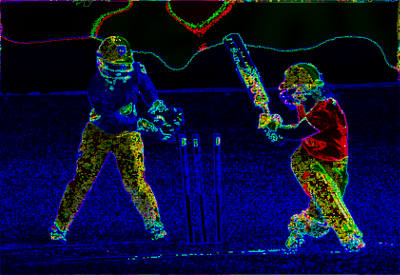
With the cricket season under threat due to the coronavirus, news has emerged of a proposal to play the Women’s Hundred at night, after research carried out in Australia indicated that COVID-19 can’t be transmitted after sunset because the virus is scared of the dark.
Night Cricket (Photo: Don Miles)
Dr April Fulio, Dean of Topical Diseases at the Sydney University of Medicine, told CRICKETher:
“We noticed that viral content on social media is much more active during the day than it is at night, so we extrapolated from that using what scientists call ‘multi-level post-rationalisation’. This allowed us to base our conclusions almost entirely upon the unsubstantiated conjecture that the virus is essentially scared of the dark.”
Suggestions to play the Men’s Hundred behind closed doors, in a so-called ‘sterile environment’, have already been put on the table; but the additional financial constraints on the women’s competition called for a more innovative solution.
Dr Fulio explained:
“The matches would have to be played in total darkness, which rules out using floodlights, but instead we are examining the possibility of playing with a luminous pink Incrediball to assist visibility.”
“Fans will be able to watch the action live-streamed on Instagram, using a “Predator” style filter which simulates military thermal imaging technology, in another innovative first for the women’s game!”
When the ECB first mooted the possibility of abolishing the Women’s County Championship last year, the Eastern Counties provided some of the loudest opposition to the plan – telling CRICKETher that: “Removing county cricket doesn’t make any sense when we are trying to grow the women’s game.”
The competition has been conceived in response to a local demand to retain competitive 50 over Women’s County Cricket in the region, which has seen a resurgence in the last few years.
“With all 4 Counties, the players have a real passion to represent their County and look forward to the County season every year,” Phil Lewis, Women & Girls Development Officer for Huntingdonshire, told CRICKETher. “Not just the playing standard, but the matches we have played in the East have been good hard fought encounters – rarely do you see one-sided games.”
“The standard is getting better and better all the time – players in these sides have now gone through the entire CAG system of their representative counties – 5 or 10 years ago that wasn’t the case. Players in these women’s sides have longstanding rivalries with opposing players right from U11s.”
“I have known the guys at Norfolk and Hertfordshire for years now. We spent a lot of time in each others company during last season and had many a conversation about the impact [of abolishing the County Championship] on the Women’s game, and vowed there and then to do all we could to keep things going.”
The initiative resembles the new London Championship, which will see Surrey, Middlesex, Kent and Essex taking part in a similar 50-over competition, in spite of the ECB’s insistence that all 50-over cricket would as of the 2020 season rest with their 8 new “Centres of Excellence”.
However, an article by George Dobell on Cricinfo suggests that the ECB has “endorsed” the London Championship; by contrast, the East Championship is an entirely independent initiative. “The last word we as counties had received at one of the consultancy events last year was that it was up to individual counties if they did something, but there wouldn’t be any funding for it – which is why we have tried to approach it a little more commercially to help support the tremendous backing from the Counties,” Lewis says.
The Championship is receiving no financial support from the ECB; instead, it is being funded through the support of the representative county boards of Hertfordshire, Norfolk and Buckinghamshire, as well as Huntingdonshire CCC. They have also received backing from some independent sponsors, including Soroptomist International (specifically the Hertfordshire branch), who are providing a Championship Trophy and end of season awards for the teams and players. The trophy is likely to be named after former England player and Chairman of the Women’s Cricket Association 1983-1994 Audrey Collins, who passed away in 2010.
The ECB’s rationale for abolishing the Women’s County Championship last season was that county cricket was providing a “participation experience” for players, which needed to transfer down to local clubs. However, Lewis says that the weakness of club cricket in the East of England means that this is simply not a realistic option for the players he works with.
“Our competition is a clear statement that the removal of competitive county cricket by the ECB in the region is hugely damaging to a great number of women in the area who have very little to fall back on,” he told CRICKETher. “Women’s club cricket is not even remotely close to being an adequate substitute in the area.”
“The standard is very poor, and there are no genuine league options of any kind of standard. A good quality, competitive Women’s league is at least 5 if not 10 years away, depending on the efforts of the local boards.”
The aim, says Lewis, is to utilise the new Championship to help enhance club cricket, rather than act in competition with it.
“The Championship is not there to be a substitute for Women’s Club Cricket and our fixture planning was all about scheduling outside of Women’s Club Sundays – inevitably there may be some clashes now [given the shortened season] but we are here to work with clubs and hopefully help enhance the club competition, not work against it.”
While there is now much uncertainty surrounding the cricket season due to the COVID-19 pandemic, the organisers of the new Championship have agreed a contingency set of fixture dates. As it stands, 50-over fixtures will take place on 16th, 23rd and 30th August, and 13th, 20th and 27th September, with a T20 Cup Festival on 6th September. “There is a great deal of determination to make sure the competition happens,” says Lewis.
What of the future? Currently the Championship may be small-scale, but the hopes for its growth are big. “As a group we hope to bring other long adversaries into the fold to resume battle against, including Suffolk and Lincolnshire – it would also be awesome if we could somehow attract entries from Europe in time as I am sure the Netherlands will be hugely impacted,” says Lewis.
“We absolutely see this competition as a long term thing. No question.”
Raf & Syd look back at the T20 World Cup in Australia.
PS – Can you guess “where” (via the magic of green screen) we are? (Hint: if you don’t recognise it, your local friendly teenager may be able to help!) Post your answer in “Have Your Say” below!
The fixtures for the 2021 World Cup in New Zealand have been announced, with England starting their campaign against Australia at Eden Park, Auckland on Sunday 7th February.
Following a full “round robin” group stages – the same format as 2017 – the semi-finals will take place at Bay Oval, Tauranga and Seddon Park, Hamilton on Wednesday 3rd and Thursday 4th March, with the final at Hagley Oval, Christchurch on Sunday 7th March.
England’s 2021 World Cup Campaign
Sunday, 7 Feb – Australia v England (Eden Park, Auckland)
Wednesday, 10 Feb – England v QUALIFIER (Seddon Park, Hamilton)
Saturday, 13 Feb – QUALIFIER v England (University Oval, Dunedin)
Wednesday, 17 Feb – South Africa v England (Basin Reserve, Wellington)
Sunday, 21 Feb – England v QUALIFIER (Bay Oval, Tauranga)
Wednesday, 24 Feb – England v QUALIFIER (Hagley Oval, Christchurch)
Sunday, 28 Feb – New Zealand v England (Hagley Oval, Christchurch)
Wednesday, 3 March – Semi-Final 1 (1 v 4) (Bay Oval, Tauranga)
Thursday, 4 March – Semi-final 2 (2 v 3) (Seddon Park, Hamilton)
Sunday, 7 March – Final (Hagley Oval, Christchurch)
Six years ago – the last time I was at the MCG – an ODI took place in Melbourne, as part of the Women’s Ashes series. The match was due to get underway at 10am. When I arrived at the ground, I wandered around, trying to find a way in: none of the gates were open. You wouldn’t have known there was a game taking place.
MCG security, I later learned, had decided that they weren’t going to open up the gates to the ground until 9.30am – half an hour before play was due to start. Players’ families were queued up, trying to get in. And the couple of journalists who, like me, were trying to cover the match, were told we would be unable to enter until after the toss had already taken place. It took us a good while to work out who was batting first when we did get inside.
Skip forward six years, and here I am, back at the MCG for another women’s match. Only this time, every gate of this mammoth-sized ground is wide open, beckoning in the tens of thousands of fans who are gradually taking their seats. The place is crawling with photographers, journalists, ardent fans in “Australia” or “India” shirts. The ICC have advised that all fans should be seated by 5pm (an hour before the match is due to start).
It’s really quite the contrast.
—————
29 December 1997, Eden Gardens, Calcutta. Australia are playing New Zealand in a World Cup final. 80,000 people fill the ground: virtually all of them women and girls bussed in by the local Sports Minister. Before yesterday, it was the highest attendance ever at a women’s cricket match. Before yesterday, it was an anomaly.
Harmanpreet Kaur is asked about Eden Gardens 1997 in her press conference the day before the final. “I didn’t even know there was women’s cricket then,” she says. Last night’s match seems unlikely to go under the radar in the same kind of way.
It is not just about yet another Australian World Cup title. The world record for attendance at women’s sport may have remained intact, but this is women’s cricket’s big moment. When 86,000 people at the MCG paused during the 16th over of India’s chase to light up and wave their phones, you could almost hear the lyrics of Katy Perry’s “Firework” echoing through the ground:
“You just gotta ignite the light
And let it shine
Just own the night
Like the Fourth of July
‘Cause baby you’re a firework
Come on show ’em what you’re worth
Make ’em go “Oh, oh, oh!”
As you shoot across the sky-y-y”
—————
During the second ever women’s match at the MCG – a Test in January 1949 between England and Australia – England batsman Molly Hide drove the ball down the ground. It passed through the fence, and disappeared into a drain: the cover was not big enough to stop the passage of the smaller, five-ounce women’s ball.
Fortunately, nowadays, the drains are fully covered: else the sixes slammed over long on by Alyssa Healy (one of them, at 83 metres, clocks in as the biggest six of the tournament) would have significantly lengthened yesterday’s game.
“Women have no power”, they have been saying since time immemorial. “They don’t hit sixes.” 1899: WG Grace declares that cricket is “not a game for women”. 2011: The Sun’s John Etheridge tweets that “Women’s cricket is a joke. The standard is truly appalling”.
The 80,000 people who watched Healy rack up a 30-ball fifty yesterday – the fastest ever hit in an ICC final, men’s or women’s – might beg to differ with Grace and Etheridge.
—————
6 April 2014, Shere Bangla National Stadium, Mirpur, Bangladesh. It’s just a few months after the farce at the MCG, when security didn’t even want to open the gates. England are playing against Australia in the final of the Women’s World Twenty20. It is Meg Lanning’s first tournament as captain; during the group stages she has racked up a record score of 126 against Ireland. Australia walk all over England in the final, winning by 6 wickets.
Six years later here we are on 8 March 2020, at the MCG, in Melbourne, Australia. The result is the same – Australia are triumphant – and the margin of victory is equally huge – 85 runs. The similarity between the two occasions, though, ends there. Beth Mooney’s unbeaten 78 in yesterday’s final took her officially past the record set by Lanning in 2014 for most runs made during a T20 World Cup: all 259 of Mooney’s were broadcast in glorious technicolour; Lanning’s went largely unnoticed.
And in 2014 the official attendance at the final was 4,313. At the G, it’s 86,174. The roar around the ground when the final wicket falls and Australia are world champions once again is unimaginable in its volume.
How do the two occasions compare? Just ask Lanning: “They’re both special in their own ways, but this day today is incredible, and something we could only have dreamed of happening. It was something else. This day is the best of my career so far.”
How about 2020 vs 2018 in the Caribbean – in front of a crowd of 9,000? Here’s Alyssa Healy: “This is soooo much better. To sit here tonight with a medal around our neck at the MCG is going to be very hard to beat.”
—————
23 July 2017: Lord’s Cricket Ground. A full house watches England play India in the World Cup final. India, chasing just 228, collapse to 219 all out. “After the loss of two early wickets, we were cruising with two partnerships that Punam built with Harman and Veda [Krishnamurthy],” captain Mithali Raj says after the match. “But then we lost our way. I think it was the inexperience of playing on such a big stage on such a big occasion.”
2017 may have been big: 2020 is even bigger. 7 of that India team are playing again today. Once again, they are chasing; once again, they fall short. Same old story? Maybe, maybe not. “We enjoyed it,” says Harmanpreet Kaur after the match. “Winning and losing are a part of the game. You cannot convey your day with winning and losing because one team is going to win and one team is going to lose. I think, at the end of the day, it was a great tournament for us. Hopefully, in future, we’ll give our best and try to win for the country.”
Harmanpreet Kaur: the Captain of Hope.
—————
Shafali Verma doesn’t remember the loss in 2017. She is 16 years old: this is her first World Cup final. She has no real conception that this is the biggest match, ever, in the history of the women’s game.
Sometimes players drop catches. Shafali drops a big ‘un: putting down Healy in the very first over of the match. Sometimes players – especially those like Shafali, who live by the sword and die by the sword – get out cheaply: in this instance, she is out third ball, nicking it to Healy behind the stumps. She has been the mainstay of India’s batting all tournament: if anything, it’s surprising she hasn’t failed earlier. Was it nerves? I doubt it. To Shafali Verma, filled with the insouciance of youth, it’s just normal to play in front of a crowd of 80,000 people at the MCG. You might tell her that it isn’t, but since when did a teenager ever listen to anything someone tried to tell them?
My hopes for Shafali’s career are many, but here is one: that she retains that insouciance throughout her career. May 80,000 people never be just associated with a memory of the time she dropped a catch and got out in single figures. May it one day become the everyday occurrence that it seemed like to Shafali on 8 March 2020.
—————
Ever heard the expression: “On the shoulders of giants”? It means we couldn’t have done this without all those who went before. It means that every painful loss – at Lord’s for India in 2017 – and every glorious victory – for Australia in Bangladesh in 2014, or Antigua in 2018, or any of the others – was a precursor to this. It means that Meg Lanning and Harmanpreet Kaur couldn’t be playing in front of packed-out crowd at the MCG if Jill Powell, Betty Wilson, Belinda Clark and Betty Archdale hadn’t played in front of an empty one. It means that every day of international women’s cricket before 8 March 2020 – every day when no one showed up and the players and umpires weren’t paid a cent but they did it anyway – has all been leading up to yesterday.
Australia beat India by 85 runs on International Women’s Day, 2020. And it was all done on the shoulders of giants.
To the countless women who came before us, who played the game we all love with little fanfare or recognition, thank you and happy #IWD2020.
In the 17th over of India’s innings, Richa Ghosh slogged a ball from Nicola Carey out towards Delissa Kimmince, patrolling the boundary at deep midwicket. If the game had been on the line, Kimmince might well have gone for the catch… and the way Australia were catching she would probably have made it too. But she didn’t bother – there was no point – the game was already won, and instead she hung back to take the ball on the bounce as the Indians ran an irrelevant single.
The play summed up the whole of the Indian reply to Australia’s mammoth 184, which was over almost as soon as it had begun, with Shafali Verma edging Megan Schutt to Alyssa Healy for 2 off the third ball. Without the Shafali “kick-start” the Indian innings quickly wilted. Taniya Bhatia retired hurt and Jemimah Rodrigues holed-out for a duck in the following over. While Harmanpreet remained, there was hope I guess, but her departure in the 6th over was not the beginning of the end… it was the end of the end.
From there, India played for survival, knocking out a steady 4 or 5-an-over when they needed 10… which quickly became 11… which quickly became the 25 they needed when Kimmince let that catch go by. Australia’s victory was a mere formality, as the crowd resorted to Mexican Waves to keep themselves entertained.
Proceedings at the MCG had begun a couple of hours previously with Katy Perry belting out the opening ceremony with her anthems to empowerment and inclusivity, Roar and Firework – two songs which could not have been more appropriate for this game on this International Women’s Day.
Boom, boom, boom
Even brighter than the moon, moon, moon
It felt like no one heard the lyrics to Firework as a call to arms more than Alyssa Healy, who smashed five 6s and seven 4s on her way to 75 off 39 balls, opening the innings with Beth Mooney. Mooney ended up scoring more runs (78 off 54) and was later elected Player of the Tournament by the distinguished panel of judges (which included CRICKETher editor Raf Nicholson) but today she was outshone by Healy nonetheless – she gave the Aussie’s the start that the Indians didn’t get from Shafali – boom, boom, boom; even brighter than the moon, moon, Moon…ey!
Could it have been any other way? Healy and Mooney were both dropped early on; but the thing with Australia’s batting line-up is that it is so long that even those two wickets might not have made any difference – those runs could just as easily have been scored by Lanning, Haynes and Gardner. Australia in this tournament have been a juggernaut with the bat, carrying a slightly weaker bowling lineup to yet another Twenty20 World Cup trophy.
Got a couple of bob to spare? Put it on the Aussies to win the next one too.

 CRICKETher