#CWC22: England v West Indies – Uh-oh We’re In Trouble

It was close… but not close enough for England, as they lost their second game in the World Cup to the surging West Indians, leaving them level on zero points from two games, at the bottom of the table with Bangladesh and Pakistan.

How much trouble are England in? Mathematically speaking, not that much: if they win all their remaining games, they still have a c. 99%* chance of qualifying. But that 1% is crucial – as things stand, their destiny is not in their own hands, so that even if they win all their remaining games, they could still find themselves missing out on a spot in the semi-finals.

More significantly, they’ve lost their “insurance policy” – with 3 of the big 5 still left to play (New Zealand, South Africa and India) if they lose again, they really are in a much more precarious situation. They would then very-much be dependent on other results, with only a 57% chance of qualifying even if they finished with 4 wins and 3 losses.

How did we get here? The general consensus against Australia was that England played pretty well – certainly their best ODI performance of the winter… though arguably that isn’t saying much after their Ashes drubbing!

But there were a few warning signs against Australia – they bowled 9 wide deliveries, conceding 21 runs (more than Australia’s margin of victory) in the process and the front-line seamers (Brunt, Shrubsole and Cross) took only 1 wicket, with Nat Sciver chipping in two more.

Against the Windies, the wides got worse – 13 wide deliveries, conceding 23 runs – and again the seam attack struggled to take wickets. After these two matches, the combined figures for the front-line seamers are 1-292.

The runs conceded to wides are a little bit of an occupational hazard of Amy Jones standing up to the stumps, which comes with some big advantages – not just the obvious one of more stumping opportunities, but because it forces the batters to be constantly worrying about being stumped, restricting their shot options coming out of the crease.

Nonetheless, 22 wide deliveries in two games is too many – Australia bowled just two versus England, and that should be the benchmark.

The inability to take wickets though is more worrying, because it has been “A Thing” since at least last summer – remember the last day of the Test v India? Yes, there were dropped catches; but they were mainly tough chances. (Nasser Hussein is very good – he is really leading this commentary team from the front, as he did so often when he captained England – but he was a little harsh on Lauren Winfield-Hill’s first-ball drop of Dottin – she had a long way to move, and only got anywhere near it because she was so sharp.)

Kate Cross can point to a spinner-like Economy Rate of 3.6 from 10 overs in mitigation; but the justification for playing her as well as Brunt, Shrubsole and Sciver – meaning England have a very samey, right-arm, medium paced, seam attack – is that she has been taking wickets in ODIs, not her economy.

Surely something has to change now, especially after Lauren Winfield-Hill failed again? As I’ve said before, LWH one of the BEST people in the game, but she’s not scoring runs in a spot that could be given-over to allowing England more bowling options, which they clearly need because Heather Knight was reduced to bowling herself for 7 overs, while clearly looking physically uncomfortable.

Here’s what I’d do for the next match, from the players available. (Remember, Lauren Bell is not available – she can’t be subbed into the squad unless someone gets COVID.):

  1. Beaumont
  2. Wyatt
  3. Knight
  4. Sciver
  5. Jones
  6. Dunkley
  7. Brunt
  8. Ecclestone
  9. Cross
  10. Dean
  11. Davies

Yes Davies is another right-arm medium, and Farrant’s left-arm would add a bit of Salt’N’Vinegar to the variety pack; but Davies does give you more control, which England also need.

England’s World Cup isn’t over by any means, and the result against Australia shows that they can mix it with the best on their day, but the current bowling line-up is looking stale. It’s probably unfair to single out Anya Shrubsole… but I’m going to do it anyway: she was getting a lot of swing, but it was the same swing every delivery, even the slower balls, and the batters know it’s coming, so it didn’t trouble them.

And now it’s England who are in trouble.

——

* The exact maths employed here assumes no games are rained off (because there are still too many scenarios remaining (about 10.5 billion!) to do the numbers including rain on my little laptop!) but the percentages will be broadly correct.
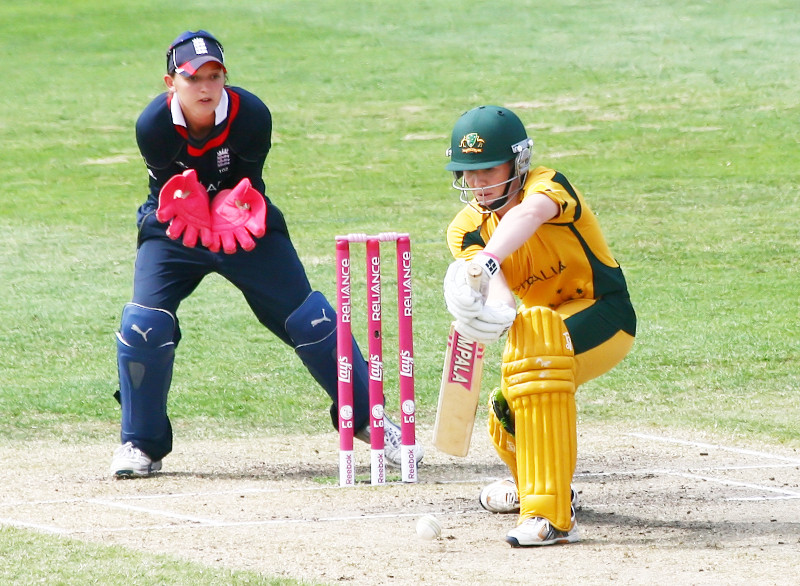
#CWC22: England v Australia – Keep Calm & Carry On

England once again proved they are the best team in the world that aren’t called “Australia”, coming within a wallaby’s whisker of victory after the Southern Stars posted a huge 310-3. England’s 298-8 is the second-highest total ever made chasing in a women’s ODI; and would likely have won them the game against any other team in the world.

In terms of the tournament, this result is far from a disaster – this was a match that England could afford to lose; and the important thing is that they have done so with minimal damage to their Net Run Rate, which could be crucial in 3 weeks time, if semi-final qualification gets squeaky.

Australia aren’t fliers in ODIs at the best of times, but they started particularly slowly. England bowled well, making Healy look scratchy again, while Rachael Haynes dug in like a wintering wombat. Healy’s dismissal brought Meg Lanning to the crease, who joined Haynes in the wombat warren – at the 20-over mark, England had Lanning on 19 off 38 (a Strike Rate of 50) and Haynes on 22 off 47 (SR 47). But the important thing from an Australian perspective was that they were still there, and slowly but surely they began to rebuild towards that big total, and recover those strike rates up towards 100.

Haynes was the one to go big on this occasion, for just her second international century (it feels like she should have more!). But it wasn’t just that she went big – she accelerated too. Haynes wasn’t immune to the ‘Nervous Nineties’ but once she passed the milestone she absolutely smashed the death overs to put Australia just out of reach. Given the eventual margin of victory – 12 runs –  that was basically the difference between the sides.

England got off to pretty-much the worst possible start, with Heather Knight having to de-facto open the batting after Lauren Winfield-Hill was dismissed 3rd ball. Winfield-Hill was preferred to Emma Lamb up-top today – Lamb’s “run” in the side lasting just one match; but it is difficult to see how that can be justified going forwards – Lamb could hardly be doing any worse.

Knight and Tammy Beaumont played positively – as on the final day of the recent Ashes Test – and they obviously believed they could win the game. They got ahead of Australia early on the worm, and stayed there for the best-part of 40 overs.

Even at the very death – needing 16 off 6 – England obviously believed; but in an interesting parallel with yesterday’s match between South Africa and the West Indies, Jess Jonassen, who had been knocked out of the attack earlier after conceding 16 to Knight and Beaumont in 2 overs, played the role of Deandra Dottin (who hadn’t bowled at all in that game, but defended 6 off the final over) and broke up the party by taking the wickets of Brunt and then Ecclestone off the final ball.

Will there be changes for the game against the West Indies on Tuesday? None of England’s bowlers disgraced themselves by any means, and it would feel mighty unfair to drop any of them, but Heather Knight could perhaps have done with having a bit more variety up her sleeve – Ecclestone aside, all her options were right arm medium-fast; and while it is true that Anya Shrubsole is a different kettle of fish to Katherine Brunt, they perhaps aren’t different enough, especially once players like Rachael Haynes have got their eye in. Australia had 7 bowling options to choose from, and made use of them all; England had 5, and no joker to play when they needed a trick.

If you need an extra bowler, the place to find it is Winfield-Hill’s spot in the XI, which means moving Wyatt up to open with Beaumont and bringing in Dean or Farrant. But it feels like very-much the wrong time to be making drastic surgery to the batting line-up, so I’m not sure I’d actually do it; and Heather Knight is generally much more conservative than I am, so I wouldn’t expect it.

And besides, we shouldn’t lose sight of what we said just 8 short paragraphs ago – this was not a catastrophe for England’s chances of winning this World Cup. If anything, it should have given them hope that if they meet Australia again in the semi-final or final, they can match them. And if they play like this for the rest of the tournament, they will make that final – they just need to keep calm and carry on doing pretty-much what they did today.

THE HUNDRED: Where Do Teams Need To Strengthen?

Yesterday’s look at the teams’ remaining budgets and key “free agents” begs the obvious question: where do the different sides need to strengthen?

The tables below map out some of the key metrics, with the colourisation indicating where teams are weak (red) and where they are strong (green). The tables are also ordered by an average of all the different indicators.

Stats aren’t everything, of course – in The Hundred, as with most cricket tournaments, it is also about handling the pressure to win big games, as the Invincibles did so convincingly in the semi-final and final in 2021. But the numbers always tell a tale nonetheless, and it is one the teams should be studying carefully.

The key story that stands out here is that as well as needing a wicket-keeper, the Invincibles desperately need to strengthen their batting – they are 100% a bowling side, topping the bowling table and coming flat-last in the batting table. With no overseas picks remaining, this is going to be tough – for obvious reasons, the other sides have mostly held onto their key local batters. Perhaps they will need to gamble and use the “wildcard” overseas pick? (But that would mean leaving one of Kapp, van Niekerk or Ismail on the bench!) Or is their bowling good enough that they can just rely on blowing everyone else away in key games once again? It is certainly a dilemma for their management to be pondering!

Last year’s group-stage winners, Southern Brave – first in batting, and second in bowling – probably just need to keep doing what they are doing, but get better at winning the big games. The 2021 final was a bitter pill for them, but as their coach Charlotte Edwards says: “There are good days and school days!” so hopefully it was a learning experience their 10 retained players can take into 2022.

Following the retentions announcement, there was some surprise that London Spirit let Tammy Beaumont, Deandra Dottin and Chloe Tryon all go; but the stats bear this out – their batting didn’t really click last season, and they’ve got all 3 overseas picks now to put that right.

A key metric which is not addressed directly by these numbers is fielding, but one possible proxy is the number of twos conceded when bowing. Southern Brave look good on that front, but Manchester Originals really need a gun fielder or two, and letting Mignon du Preez (who is a gun fielder) go unretained was an “interesting” move given that.

Finally, standing back to look more generally at these numbers, we do see clearly that T20 (which The Hundred basically is) is perhaps not the game of superstar batters that we always seem to think it is. It is something that Aussie commentator Chris Brooker (worth following on Twitter) has been saying about the women’s game in particular for some time, and it is one of those where the more you look at the actual numbers, the more it seems to stand out. Oval Invincibles won the trophy with their bowling, despite being the weakest batting side; and although Superchargers had by some distance the outstanding individual batter in the tournament – Jemimah Rodrigues – that wasn’t enough to carry their batting, or for them to reach the knockout stages. Perhaps it is time for a wider re-evaluation of the way we look at the game and select our teams?

Batting Balls Per… Avg Run Rate
Wicket Dot Single Two Four Six 1st Ins 2nd Ins PP
Brave 22 2.88 2.59 15 8 47 8.14 7.42 6.69
Originals 23 2.76 2.68 19 8 57 7.64 7.74 8.07
Phoenix 15 2.92 2.75 13 7 89 7.92 8.13 8.14
Rockets 17 2.72 2.60 23 7 40 8.23 6.98 7.52
Superchargers 18 2.89 2.63 15 6 112 7.51 8.80 6.48
Fire 15 2.88 2.47 16 9 91 6.76 8.10 7.21
Spirit 15 2.72 2.84 16 7 98 6.13 8.11 6.97
Invincibles 18 2.65 2.70 20 8 92 7.34 6.97 6.19
©CRICKETher.com/cricsheet.org
Bowling Balls Per… Avg Run Rate
Wicket Dot Single Two Four Six 1st Ins 2nd Ins PP
Invincibles 15 2.45 2.77 17 8 153 7.03 5.92 5.81
Brave 19 2.65 2.65 23 9 111 6.92 6.98 7.38
Spirit 23 2.60 2.80 22 7 54 7.59 7.03 6.55
Rockets 18 3.04 2.60 16 7 59 7.68 8.25 6.69
Originals 20 2.82 2.77 12 8 51 7.33 8.38 6.07
Phoenix 21 3.12 2.44 14 7 70 7.74 8.00 8.24
Superchargers 22 3.00 2.57 17 7 61 8.39 7.73 8.57
Fire 24 2.97 2.69 17 6 60 8.67 8.21 7.88
©CRICKETher.com/cricsheet.org

THE HUNDRED: Remaining Budgets & Key Free Agents

The 8 Hundred teams this week announced their player retentions for 2022, and there were some big differences. Birmingham Phoenix for example retained almost their entire squad, whereas Trent Rockets let go most of theirs. There are also some substantial variations in remaining budgets – Rockets need to find 10 players, but have (on average) just £15,000 to spend per player. In contrast, Welsh Fire have a whopping £21,000 per player to splash the cash on 7 new faces.

On the overseas front, Oval Invincibles and Northern Superchargers retained all 3 of their overseas players, while Rockets and London Spirit will be looking for a full roster of 3 new overseas stars. (There is also going to be a 4th overseas “wildcard” pick to come for each team, but teams will still only be able to field 3 overseas players.)

Only two England players have not been retained – Lauren Winfield-Hill and Tammy Beaumont. Our guess (and it is only a guess) is that both chose not to remain, and already have other deals informally lined-up. (And 7 days quarantine in New Zealand would have been the perfect opportunity to learn the words to all 3 verses of ‘Land of My Fathers’ – in the original Welsh, of course – we’re just sayin’!!)

Deals may also have effectively been already agreed in the case of a number of the other twenty-odd domestic pros who will be changing colours this summer. Assuming all the overseas spots get filled, there are still 36 spots available for them, and some of the other regional players, up for grabs. Bryony Smith and Sophie Luff look like potential Best Buys, with Fran Wilson and Georgia Adams also likely to be snapped up soon, if not already.

It is also not out of the question that some of the ‘released’ players actually end up remaining with the team that has released them. For example, Invincibles need a wicket keeper, and have no overseas picks left (unless they use their wildcard, which would mean one of Kapp, van Niekerk and Ismail sitting on the bench), meaning there aren’t a lot of options, so they could ultimately turn back to Sarah Bryce, who did the job for them last year. (Though in that particular case, Kira Chathli, who finished last season with the gloves for the South East Stars, could equally well be lined-up for the role too.)

As for the overseas stars, almost everyone who’s anyone will be here for the Commonwealth Games, and there are some attractive salaries remaining. Suzie Bates, Amelia Kerr, Beth Mooney, Shafali Verma, Deandra Dottin – it looks likely to be a case of: take your pick, before someone else does!

Team1 Retained (✈) Open (✈) Budget2
1. Invincibles 9 (3) 6 (0) £12K
2. Brave 10 (2) 5 (1) £11K
3. Phoenix 12 (2) 3 (1) £14K
4. Spirit 8 (0) 7 (3) £18K
5. Originals 9 (1) 6 (2) £14K
6. Superchargers 11 (3) 4 (0) £12K
7. Rockets 5 (0) 10 (3) £15K
8. Fire 8 (1) 7 (2) £21K

1. 2021 Finishing Position
2. Average Budget Remaining / Player (£K)
✈ = Overseas

Key Free Agents

England

  • Tammy Beaumont
  • Lauren Winfield-Hill

Domestic Pros

  • Georgia Adams
  • Sarah Bryce
  • Amy Campbell
  • Aylish Cranstone
  • Kelly Castle
  • Bethan Ellis
  • Jo Gardner
  • Phoebe Graham
  • Jenny Gunn
  • Alex Hartley
  • Lucy Higham
  • Stere Kalis
  • Marie Kelly
  • Sophie Luff
  • Fi Morris
  • Rachael Slater
  • Bryony Smith
  • Fran Wilson
  • Nat Wraith

The CRICKETher Weekly – Episode 101

This week:

  • We assess the big performances for New Zealand v India… and take some positives for India
  • Will the Curse of Raf™ strike again for New Zealand?
  • We look forward to a big summer of internationals in England – including a TEST (woooop) and an ODI at Lord’s

FEELIN’ 2022: England Host South Africa & India Including Taunton Test & Lord’s ODI

England will host South Africa and India this summer, in a packed schedule in which they will play at least 23 days of cricket including the Commonwealth Games.

The international summer will begin with a Test versus South Africa at Taunton from June 27 – June 30; and finish with the 3rd ODI against India at Lord’s on September 24, the day before the Home of Cricket also hosts the RHF Trophy Final.

The South Africa Test – the Proteas first Test against England since 2003, also played at Taunton – will be followed by 3 ODIs, at Northampton, Bristol and Leicester, and 3 T20s at Chelmsford, Worcester and Derby.

Following the Commonwealth Games in early August, India will then return to England in September, although several of the players will presumably have stayed on for The Hundred. India will play 3 T20s at Durham (in England’s first visit to The Riverside since the 2013 Ashes), Derby and Bristol, and 3 ODIs at Hove, Canterbury, and then finally Lord’s.

All games will be shown on Sky Sports in the UK, with 2 of the T20 matches also being shown on the BBC. This is in addition to the Commonwealth Games matches, which will also be available Free To Air, meaning we could see an unprecedented 11 England games broadcast FTA this summer, if England reach the Commonwealth Games final – more games in a single summer than have ever been shown FTA in the UK before.

This, in combination with the return of live cricket to London and the North for the first time in several years, represents a once-in-a-lifetime opportunity to grow the game, and no one is more pleased than us; though shareholders of Premier Inn have allegedly been warned to brace themselves for significant financial losses as Syd books in for 23 all-you-can-eat breakfasts!

England v South Africa

Test

Monday June 27-Thursday June 30 @ Taunton

ODIs

Monday July 11 @ Northampton
Friday July 15 @ Bristol
Monday July 18 @ Leicester

T20s

Thursday July 21 @ Chelmsford
Saturday July 23 @ Worcester
Monday July 25 @ Derby

England v India

T20s

Saturday September 10 @ Durham
Tuesday September 13 @ Derby
Thursday September 15 @ Bristol

ODIs

Sunday September 18 @ Hove
Wednesday September 21 @ Canterbury
Saturday September 24 @ Lord’s

BOOK REVIEW: Fair Game by Alex Blackwell with Megan Maurice

Alex Blackwell’s new book, Fair Game, is not your standard cricket autobiography. Yes, it tells the story of her journey in cricket – from growing up playing in the backyard of her grandparents’ place in Wagga Wagga, to breaking through into the New South Wales team while at university, to her Australian debut in 2003 against England under the great Belinda Clark, to winning multiple World Cups, captaining Australia to glory at the 2010 World Twenty20, and taking home the inaugural WBBL title in 2015/16. It’s also a first-hand insight into the ways in which professionalism transformed the lives of a generation of players overnight. But the most important contribution which this book makes is to lay bare the ways in which cricket has excluded and continues to exclude those who don’t quite fit the mould.

Alex Blackwell batting with Sarah Taylor keeping wicket
Photo courtesy of Don Miles

Blackwell is one such player. An outspoken advocate for increased diversity and equity in cricket, she made history in 2013 as the first international female cricketer ever to publicly come out. Here, it is made clear how much she agonised about that decision – unsurprising when she describes the constant background of casual homophobic remarks which went on, including from Cricket Australia employees and sponsors. “I was not viewed by Cricket Australia to be a good role model for young girls,” she writes. This kind of casualised homophobia did not come as a surprise to me – it is rife within English cricket, too, as my book Ladies and Lords shows – but it is still shocking to read about some of Blackwell’s experiences, and the way in which her experiences in cricket caused deep internal shame about her sexuality, which endured for years.

Relatedly, Blackwell emphasises how CA favoured a particular “image” for female cricketers, which forced gay players permanently into the closet but was equally damaging for non-gay women who did not conform to the favoured “type”. One of the most revealing lines in the book is when Blackwell relays how during her early years playing for Australia, she and her sister Kate toyed with the idea of growing their hair long, in order to market themselves as “the golden twins”. Another damning anecdote relates to the three women chosen by CA in 2013 to receive their first ever “marketing contracts”: Ellyse Perry, Meg Lanning and Holly Ferling – all blonde, attractive and heterosexual. You would have to be blind not to have realised that this was going on – just look at which players were most visible in the marketing of the first WBBL – but Blackwell’s book lays bare the horrendous practice (which, if we’re honest, is still prevalent) of pushing forward players on the basis of their physical attractiveness rather than their cricketing abilities.

Why was Blackwell never chosen to captain Australia on a permanent basis? A convincing public explanation has never been given as to why she was passed over in favour of Lanning in 2014 – a player with no captaincy experience at any level of cricket – nor why Rachael Haynes (then not even an automatic pick in the XI) was handed the reins during the 2017 World Cup, when Lanning was sidelined with a shoulder injury. Blackwell says that she has never been given a reason, other than being told: “Meg had all the attributes they wanted in a captain and I didn’t”. She stops short of saying that those attributes included being heterosexual and taciturn, but it doesn’t take a rocket scientist to connect the dots.

The irony of all this is that CA’s treatment of Blackwell may well have ultimately cost Australia their chance of winning the 2016 and 2017 World Cups. Blackwell’s most damning critique of an individual comes in the chapters which deal with these two tournaments, in which she describes how Australia’s coach Matthew Mott stuck to a limited, basic tactical approach – “bowl at the stumps” – leaving the players without any Plan B in the 2016 WT20 final against Hayley Matthews and Stafanie Taylor, and more famously against Harmanpreet Kaur at Derby in the 2017 semi-final. Blackwell relays how, as vice-captain, she continually tried to raise concerns; but others simply parroted the party line. It’s a brilliant example of why diversity is needed within organisations: somebody needs to tell you the thing you don’t want to hear, or it becomes all about group-think.

Meanwhile, Blackwell’s alternative views about tactics were “shut down” and she was publicly criticised by Mott in meetings, to the extent that she was left in tears. “That tournament was one of the toughest periods of my cricket career,” Blackwell writes. “Throughout every day of it I felt undervalued and insignificant.” It’s rare to read anything critical of Mott, but this is one of the worst examples of player mismanagement I’ve ever come across. Let’s hope things have changed behind the scenes since then.

It’s rare that we get this kind of book in women’s cricket – an honest, wide-ranging critique – and Blackwell should be awarded for her bravery in writing it (credit too to Megan Maurice, who has done a brilliant job of making this book very readable). The timing is perhaps explained by Blackwell’s recent decision to draw a line under her involvement in elite cricket in Australia:

“Maybe I would feel more inclined to keep holding on and continue volunteering in cricket if I was confident that we were setting a high standard and being bold with our ambitions around female representation, inclusion strategies and the environment. Instead I still feel like raising these issues makes a lot of people uncomfortable.”

This is worrying not just as an indictment of the current culture of cricket in Australia. Part of the problem has always been that those IN the game right now don’t feel they can be open about the ways in which things are going wrong – there is a culture of secrecy, whereby those on the inside close ranks.

It’s important that we remember that this isn’t a book about a dark and distant past – as Blackwell writes, “there are still some barriers to inclusion and equal opportunity that remain unconquered”. Her book is a great first step to exposing some of those issues. The next step is for those within CA (and the ECB, and the other boards around the world) to listen, acknowledge, and act as a result – but will they? That would be the best legacy of this brave and revealing book.

Buy the book.

The CRICKETher Weekly – Episode 100

On our 100th episode:

  • Our Ashes post-mortem
  • How can England win the next Ashes Down Under?
  • Was this a better or worse defeat than the 2019 Ashes?
  • England’s World Cup squad: any surprises?

Remember to share your favourite moments from the last 100 episodes with us below!