CE CUP: Stars v Lightning – Freeborn Stars But Stars Shine Through

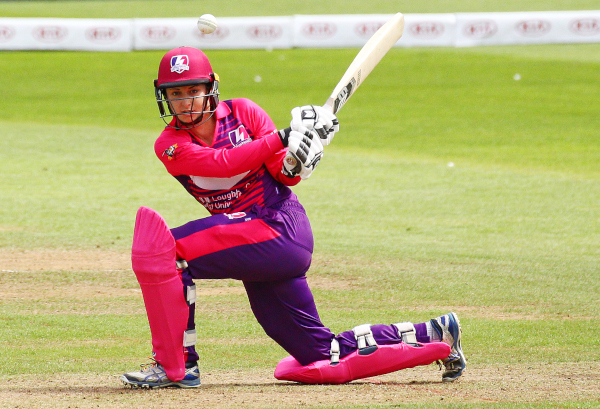
A half-century and four stumpings for keeper-batter Abbey Freeborn proved in-vain as Lightning lost by 28 runs to South East Stars in the Charlotte Edwards T20 Cup at Guildford.

Kirstie Gordon – continuing the long and venerable tradition of Scottish skippers at Loch Loughborough by standing in for Kathryn Bryce – invited Stars to bat after winning the toss, and might soon have been regretting it as Bryony Smith raced to 16 off 12 balls with some thumping strokeplay. Although one thump too many did for Smith, caught at mid on by Grace Ballinger, Alice Capsey continued where Smith had left off with some big hits of her own, as Stars finished the powerplay on 49-1.

Post-powerplay, Capsey settled into more of a running rhythm which took her to to a 28-ball 38 before she was bowled coming down the track to Lucy Higham in the 12th over.

From 80-4, things could easily have drifted for the Stars, but Alice Davidson Richards (41 off 25) and Tash Farrant (35 off 18) had other ideas – taking them to a 175-6 at the close, including two 6s off the first and last balls of the final over by ADR.

Lightning’s reply got off to a tough start, with Beth Harmer caught by Alice Capsey off Tash Farrant for a duck in the first over. This brought Freeborn to the crease, who battered the Stars attack for 61 off 50 balls, but with no one else in the Lightning top-order able to stand up and give her some proper company, the ask quickly began to disappear over the horizon.

Shachi Pai, coming in at 6, had some fun hitting 24 off 18, as did Sophie Munro (17 off 8) but with the required rate already over 13 when Pai entered the fray, the game was already gone, with Lightning finishing 28 runs short on 147-7.

THE HUNDRED FINAL: Everyone Has a Plan Until They Get Punched in the Mouth by Marizanne Kapp

“Everyone has a plan,” the boxer Mike Tyson once said… “until they get punched in the mouth by Marizanne Kapp.”

Well… okay… he might not have said the last little bit, but it doesn’t make it any less apt.

Kapp came out to bowl with rain in the air, and Oval Invincibles defending 121. It felt like a good total in the conditions, but not one that Southern Brave would have been massively worried about chasing. But within 6 balls of their reply, the match was basically over – Kapp hanging the ball outside off stump, and a bit of away movement doing the rest.

Danni Wyatt and Sophia Dunkley – who between them had scored almost half of Brave’s runs off the bat (45%, to be precise) – trudged back to the famous pavilion with ducks to their names. Gaby Lewis followed 4 balls later – also for a quacker – but it was already academic: Brave were on the floor, with Kapp having delivered the sucker punch.

It wasn’t meant to be this way. Brave were by far the best side over the group stages – winning 7 games and losing only once. Invincibles, in contrast, won just 4 matches, lost 3, and had 1 washed out. But that’s the deal with finals – what happened in the group stages doesn’t matter any more – you have to put it all behind you, and handle the pressure of the big day; and that’s what Invincibles did.

It feels strange to say, but Brave actually played better overall than the last time they were here at Lords, when they won a terrible game of cricket against London Spirit. They made a good start with the ball, restricting Invincibles to 27 off the first 30 balls. A late partnership between Kapp and Alice Capsey – 34 off 21 balls – swung the pendulum a little way back the other way, but the bell wasn’t tolling yet – not until Kapp stepped up with the opening spell that doomed them.

Allowing bowlers to send down two consecutive “overs” (as the 5-ball “sets” are still officially called, if you read the playing conditions) was hailed as one of the most exciting innovations of The Hundred, because it meant you could keep a bowler on if they were bowling well; but we haven’t seen it that often, especially with quick opening bowlers, whose bodies aren’t used to delivering 10 consecutive balls.

And it certainly didn’t seem like it was the plan today – Shabnim Ismail looked like she was expecting to deliver the second set of 5. But with Kapp having taken the wicket of Wyatt with her 4th ball, and then beaten Dunkley’s edge with the 5th, the dye was cast – Kapp continued, with a second slip ramping up the pressure on Dunkley, who cracked the very next ball.

Despite that, Brave held out until the 98th ball, although their chances of victory were so slim that the TV feed appeared to stop bothering with the “Win Predictor”. A partnership between Fi Morris and Tara Norris adding 33 off 28 balls – a run rate which would have made for an exciting finish under other circumstances – showed that although conditions weren’t great, batting wasn’t impossible… except when facing Kapp, who fittingly came back on right at the end to deliver the crowning moment, bowling Lauren Bell for 4 – the only runs she scored, in her only visit to the crease, in the whole competition.

As her team-mates celebrated, Kapp took a moment to herself – perhaps to say a brief prayer of thanks – before joining them. She’s won stuff before, of course, including the KSL with the Surrey Stars in 2018; but in front of 17,000 people at the Home of Cricket, this was perhaps the biggest win of all. Certainly none came with her name quite so emphatically stamped upon them as it was today.

THE HUNDRED STATS: Bowling Rankings – Best Wellington Performance Since 1815

The top-ranked bowler in the inaugural edition of The Hundred was Amanda-Jade Wellington, who produced arguably the best performance by a Wellington since The Duke’s famous victory over Napoleon’s XI at Waterloo in 1815. With 13 wickets, Wellington was not quite the leading wicket-taker in the group stages, but her outstanding Economy Rate of well under 6 runs per (traditional, 6-ball) over lifts her above Sammy-Jo Johnson (15 wickets) and Tash Farrant (14). It is remarkable to think that Wellington wasn’t even the Brave’s first choice leg-spinner – they originally selected Amelia Kerr – but on what we’ve seen this summer you’d have to think that if she was English she’d be an automatic pick for the national team, so why she isn’t even in the Australian squad is a mystery even Columbo couldn’t solve.

With none of England’s automatic white-ball bowling picks making the “Top 10”, Tash Farrant and Kirstie Gordon were the leading English bowlers. Anya Shrubsole (11th) and Sophie Ecclestone (19th) did both make the top 20, but neither Katherine Brunt (23rd) nor Sarah Glenn (29th) did. While it is true that you might not want to read too much into a short tournament where a bowler only has 20 balls to make a mark, sometimes you’ve also just got to hand over the microphone and see who can sing, and in that sense Farrant (14 wickets) and Gordon (13) in particular do perhaps continue to make a case for themselves?

The leading English non-internationals were Lauren Bell (9th, with 10 wickets at 6.91) and Alice Capsey (10th, with 8 at 5.24). England have long bided their time on Bell, waiting for her physiological development to catch up with her talent. If she was Australian, she’d have earned her first cap years ago… but also now be on her third potentially career-threatening injury. England’s theory was always that if they waited, they’d have a superb bowler for 10 years, not just 10 months; but it finally looks like it might be time for her to step up to that next level as the wicket-taking “strike” bowler England don’t really have at the moment.

As for Capsey, her fearless performances with bat and ball, in front of these huge crowds, suggest that England have a proper gem on their hands. Although Heather Knight recently tried to pour cold water on the idea of her breaking into the England team any time soon, the calls will only grow – especially if England get smashed about by Australia this winter. My only concern is that England will end up selecting her initially as a bowler, batting her down at 7 or 8, which is not where she needs to be. Her future – and England’s – is for her to be opening the batting; and given that England are not going to change their batting line-up before the Commonwealth Games, I’d rather wait a year than see her introduced in the wrong role.

Player Played Wickets Economy
1. Amanda-Jade Wellington (Brave) 8 13 5.30
2. Sammy-Jo Johnson (Rockets) 8 15 6.89
3. Tash Farrant (Invincibles) 8 14 6.98
4. Deepti Sharma (Spirit) 8 10 5.26
5. Kirstie Gordon (Phoenix) 8 13 7.60
6. Linsey Smith (Superchargers) 7 9 5.54
7. Kate Cross (Originals) 7 12 7.45
8. Hayley Matthews (Fire) 8 11 7.48
9. Lauren Bell (Brave) 8 10 6.91
10. Alice Capsey (Invincibles) 8 7 5.24
11. Anya Shrubsole (Brave) 8 7 5.77
12. Katie Levick (Superchargers) 7 7 6.92
13. Alex Hartley (Originals) 7 8 7.95
14. Dane van Niekerk (Invincibles) 8 6 6.76
15. Heather Graham (Rockets) 8 6 6.84
16. Erin Burns (Phoenix) 8 6 7.05
17. Charlie Dean (Spirit) 8 6 7.09
18. Marizanne Kapp (Invincibles) 3 4 4.80
19. Sophie Ecclestone (Originals) 7 5 6.04
20. Alice Davidson-Richards (Superchargers) 7 7 8.86

Bowling Ranking = Wickets / Economy
Economy recalculated as 6-ball overs

THE HUNDRED STATS: Batting Rankings – Jemimah Goes One Louder

In the final year of the Kia Super League, Jemimah Rodrigues placed 2nd in our KSL Batting Rankings – in the first year of The Hundred, she has gone one louder, topping the table with 249 runs at a Strike Rate of 151. During that 2019 KSL season she started slowly, with scores of 4, 20 and 2, before finding a rich vein of form which included two 50s and a 100. In The Hundred, despite her indifferent recent form for India, she was straight out of the blocks with 92 not out against Welsh Fire, going on to score two further 50s.

Unsurprisingly, with the very best Australians and New Zealanders deciding to pass on The Hundred this year, a cluster of England stars occupy many of the top spots, led by Sophia Dunkley. Since being given a regular spot, and perhaps more importantly a clearly defined role, in the England side, Dunkley looks like a woman who has found a high gear she never knew she had. When I told a group of people at a county match four-or-five years ago that I thought Dunkley would be the next permanent England captain, even her mum looked at me like I was slightly mad. At the beginning of this season, people were still saying the idea was a long call. It doesn’t feel like one now.

The highest ranked non-international is Eve Jones at No. 5. Her success isn’t quite the surprise some seem to think it is – she has 3 County Championship 100s under her belt – and yes, that’s a big number in the old County Championship, mostly played on club pitches with huge boundaries. She also placed 4th in last year’s RHF Batting Rankings. But she has certainly continued to develop her game as one of the older “new” pros, finding the boundary 37 times in the tournament’s group stages – topped only by Jemimah, who did so 42 times.

The other leading non-internationals were Georgia Redmayne, whose performances in The Hundred would have been a factor in her recent call-up to the Australian squad for their series against India… although Cricket Australia were conspicuously careful not to say so in their press release!

And then there is Dani Gibson, who has probably more than anyone else changed the course of her entire life in the last 5 weeks. Previously primarily considered a bowler, whose late teenage years were blighted by serious injury, she has set herself on a new career path as a serious batting allrounder, hitting 108 runs at 180 – the highest Strike Rate of anyone in the top 20. Heather Knight – who usually sticks quite rigidly to established hierarchy – bumped her up the order when Spirit needed quick runs in the final match, and you’d have to say she is now a shoe-in for England’s ‘A’ tour to Australia this winter, which she was probably only on the fringes of selection for a month ago.

Player Played Runs SR
1. Jemimah Rodrigues (Superchargers) 7 249 151
2. Sophia Dunkley (Brave) 8 244 144
3. Nat Sciver (Rockets) 8 220 137
4. Heather Knight (Spirit) 8 214 130
5. Eve Jones (Phoenix) 8 233 119
6. Danni Wyatt (Brave) 8 208 132
7. Lizelle Lee (Originals) 7 215 124
8. Hayley Matthews (Fire) 8 221 119
9. Dane van Niekerk (Invincibles) 8 231 111
10. Shafali Verma (Phoenix) 8 171 143
11. Amy Jones (Phoenix) 8 141 160
12. Smriti Mandhana (Brave) 7 167 134
13. Laura Wolvaardt (Superchargers) 7 181 117
14. Georgia Redmayne (Fire) 8 187 107
15. Dani Gibson (Spirit) 8 108 180
16. Rachel Priest (Rockets) 8 138 137
17. Deandra Dottin (Spirit) 8 146 118
18. Stafanie Taylor (Brave) 8 164 104
19. Emma Lamb (Originals) 7 135 125
20. Erin Burns (Phoenix) 8 133 125

Batting Ranking = Runs * Strike Rate

VIDEO: The CRICKETher Weekly Vodcast – Episode 74

More discussion about The Hundred in this week’s episode:

  • Southern Brave qualifying for the final
  • Smriti Mandhana replaced by Gaby Lewis
  • Raf’s interview with Beth Barrett-Wild (head of the women’s comp)
  • The depth of domestic talent on show
  • Dilemmas for 2022: scheduling alongside the Commonwealth Games, plus will the ECB persist with double headers?

THE HUNDRED: Invincibles v Spirit – Invincibles Close In On The Eliminator™

Oval Invincibles took a big step to qualification for The Eliminator™ with an 8-wicket win over London Spirit in front of a raucous crowd of over 10,000 at The Oval.

Crucially, the 13-ball margin of victory also served to widen the gap in Net Run Rate between them and their closest challengers – Trent Rockets and Northern Superchargers.

In fact, the only way Invincibles can now fail to qualify for The Eliminator™ (it is not really trademarked… but it so ought to be!) is if they lose their final match and both Rockets and Superchargers win theirs, leaving all 3 tied on 9 points.

This would mean that both Superchargers and Rockets would have to overturn Invincibles’ current Net Run Rate advantage. This is certainly possible, but it would need the Invincibles to suffer something of the order of a 30-run defeat to the Brave, with Rockets and Superchargers winning their games (against Originals and Phoenix respectively) by similar margins.

Invincibles v Brave could make for a very interesting final on today’s showing. Brave have been enormous with the bat; but Invincibles won today’s match with a fantastic bowling performance.

Marizanne Kapp, who returned to the side today, is obviously not 100% fit – she looks to be coming in at half pace, and the only ball she bowled today where she shaped-up to come in hard was a total bluff as she bowled Chloe Tryon with a slower ball. But, save an early no ball likely caused by holding back in her run-up, she nonetheless bowled the best bag of 20 balls you’ll likely see in this competition, finishing with figures of 2-12.

Alice Capsey’s 2-15 would have been a Player of the Match (sorry… “Match Hero”) performance on any other day. The ball that bowled Deandra Dottin in particular was a beauty – straightening sharply to take out middle-and-off.

(The fact that neither Capsey nor Kapp were Match Hero – it was Georgia Adams – just goes to show that batters get all the glory and there is no justice for bowlers in this world!)

Spirit weren’t quite as bad as they had been against Brave at Lords earlier in the competition, when they were bowled out for 93, only avoiding total humiliation thanks to a Brave barrel-full of extras. But they were still quite bad. After a slow start, with just 12 runs coming off the first 20 balls, Heather Knight and Tammy Beaumont gave them a platform, taking them to 79 off 60 balls – on course for around 130; but the rest of the batting lineup totally let them down. (If Deepti Sharma wants to be considered as a genuine allrounder at this level in the shorter formats, which she obviously does, she has to do better than 11 off 14 balls.)

Spirit’s 103 was at least 25 under par, and left the Invincibles batters with a pretty easy job to do, to be honest. Of course, it was a job that still needed to be done, but Match Hero Adams, with support from Fran Wilson (who took a while to get going, but delivered in the end) and Kapp with the bat, pulled them home as only she can – mostly in the direction of cow corner!

I was a little disappointed to see Kapp come in ahead of Capsey, but she showed us how its done, and while I don’t always agree with the computer at the ICC that calculates their player rankings, there is a reason Kapp is up there with the likes of Nat Sciver and Ellyse Perry as one of the world’s best allrounders.

The Invincibles know they aren’t there yet – though they could be in The Eliminator™ as soon as Sunday evening if the Originals do them a favour by beating the Rockets. But they are looking increasingly like contenders who can help give this tournament the exciting finish it deserves.

OPINION: Women’s Sport Trust’s £1bn – Where Will It Come From?

The Women’s Sport Trust have recently repeated their claim that “revenue generated by women’s sport in the UK is set to grow [from £350m] to £1bn a year by 2030” via “ticket, broadcast rights and sponsorship sales”.

Women’s sport is undoubtedly an investment opportunity, but we also need to be realistic, and it is difficult to see where £1bn a year is actually going to come from.

The (Men’s Football) Premier League – the most valuable domestic sports competition in the world outside the United States – has revenues of about £5bn per year.

Barclays’ title sponsorship of the Premier League brings in just £13m per season, and total match-day income is of the order of £500m; so tickets and sponsorship sales won’t get us far towards that £1bn figure, even if we can match the Premier League.

Almost all of the Premier League’s £5bn comes from TV, and realistically that’s the only place where most of our £1bn is coming from too.

But where exactly?

The BBC is under enormous budget pressure; while BT Sport’s investors are rumoured to be getting antsy – so those avenues look closed, at least in terms of getting us anywhere near £1bn.

A “new player” is possible, but Netflix are only interested in subscriber acquisition; while Amazon Prime seem to be mainly focused on a long game of destroying the competition. You can imagine Amazon Prime buying men’s cricket, for example, to damage Sky, but it is difficult to imagine them forking out a lot of cash for “women’s-only” deals.

This leaves the aforementioned Sky. Could they squeeze an extra tenner a month out of all their Sky Sports subscribers to get us to £1bn by 2030? Maybe, but Sky are a pretty tightly run ship, and I think we can be fairly confident they know where their sweet spot is – if there was £650m to be found there, it’s a pretty safe bet they’d have already found it, so any increase in subscription prices would almost certainly be accompanied by a drop in the number of subscribers, with no increase in revenue.

It would be fascinating to know in more detail exactly how the Women’s Sport Trust arrived at the £1bn figure. It is a number that has obviously generated headlines and plenty of discussion on social media about how we might spend this windfall, but we need to be realistic.

Women’s sport is going places – it is an opportunity for growth and the success of The Hundred has shown that it is business worth investing in.

But the focus right now needs to be on the core product – the quality of the sport. Ultimately, if we get the product right, the revenue will take care of itself; and while it might not be £1bn a year, it will be real and sustainable.

So let’s stop chasing rainbows; and start chasing balls instead.

THE HUNDRED: Ireland’s Gaby Lewis Replaces Smriti Mandhana For Brave

Ireland opener Gaby Lewis looks set to become the first Irish women to play in The Hundred, as she replaces Smriti Mandhana in the Southern Brave squad for the Brave’s last group match against Oval Invincibles and the final, for which the Brave have already qualified.

Smriti Mandhana will fly home from the UK in order to see her family before India’s tour of Australia; while her Indian teammate Harmanpreet Kaur will also fly home immediately, having sustained an injury to her quad. Manchester Originals have opted not to replace Harmanpreet.

Smriti has been an important, but not critical, part of the Brave’s success in qualifying directly for the final with one round of group matches still to come, having scored 167 runs at an average of 128, making her Brave’s third highest run-scorer after Danni Wyatt (188) and Sophia Dunkley (186).

Her replacement, 20-year-old Gaby Lewis – whose sister, father and grandfather all played for Ireland – is an opening batter with 62 caps, and a highest international score of 71, scored against the Netherlands in 2019.


VIDEO: The CRICKETher Weekly Vodcast – Episode 73

This week we’re once again focusing on #TheHundred :

  • How close are Southern Brave to qualification for the final?
  • Sophia Dunkley & Maia Bouchier’s run-chasing masterclass
  • How have we found watching it on TV?
  • Deandra Dottin & helmets
  • The BBC’s decision to extend their coverage of the women’s comp
  • Why are double headers working so well?